Contents
A booking form that takes a party of twelve at midnight and confirms it instantly has checked that number against nothing at all — and the mismatch between the number and the floor plan surfaces on Saturday morning, when every remaining option costs the restaurant something. The booking lands at twenty past eleven on a Tuesday, long after the last table was cleared and the office light went off. Party of twelve, Saturday, eight o'clock, a name, a mobile number, a note asking for somewhere quiet enough to hear each other. The form did exactly what it was built to do: it accepted the number twelve, checked that number against nothing at all, and sent back a confirmation written in the grammar of a promise. The guest reads it as one, because it is one, and starts telling eleven other people where they are eating on Saturday night.
The restaurant finds out on Saturday morning. Somebody stands in front of the book, or the tablet, trying to make twelve covers exist at eight o'clock in a room that seats fifty-two across tables of two and four — one six that cannot be joined to anything, a banquette that does not pull out, a fire route that has to stay clear whatever else happens. Every arrangement that gets to twelve takes three adjacent tables already spoken for by two couples and a four booked a fortnight ago. The options are now all bad ones: split the party across two ends of a room they were promised would be quiet, ring three earlier bookings and ask them to move, or ring the party of twelve and take back a confirmation that has been sitting in somebody's inbox for four days. Each of those costs staff time on the busiest morning of the week, and one of them costs the restaurant the table it had already sold twice over.
Worse than the loud damage is the quiet kind. A withdrawn confirmation is among the most expensive messages a restaurant can send: it reaches a guest who has already organised eleven other people around it, and that guest has no way of telling an honest capacity problem from carelessness. What was taken at twenty past eleven was not a booking at all. It was an enquiry styled as a confirmation, and the styling is the failure.
A number is not a table
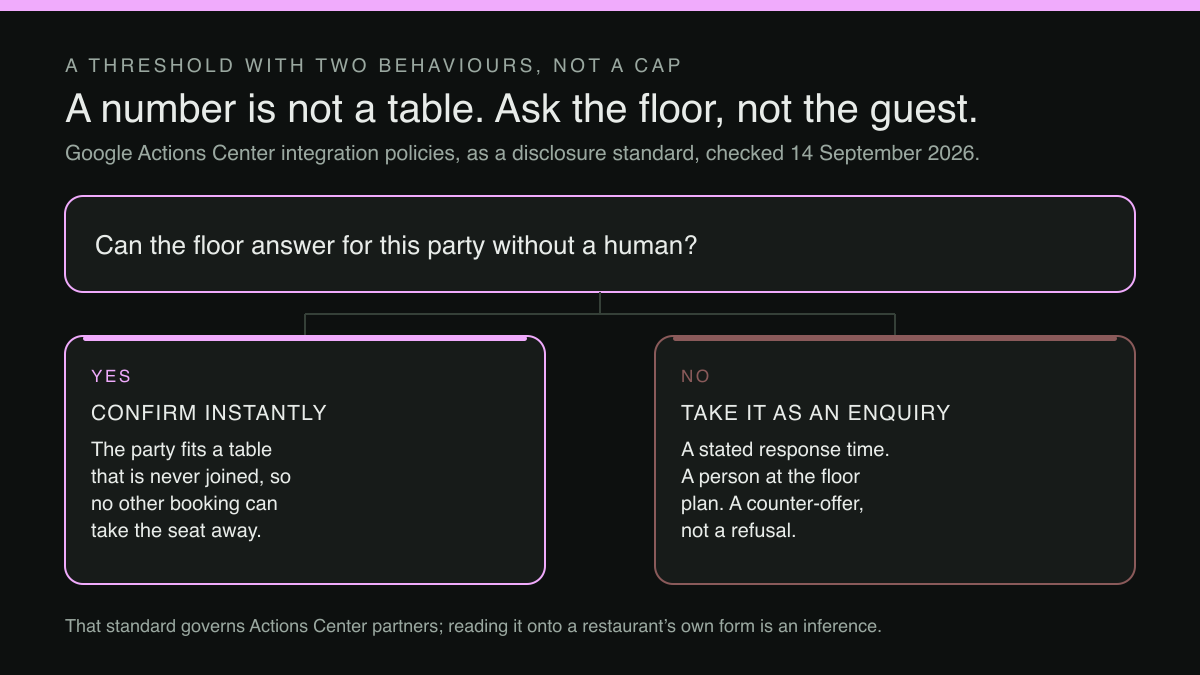
A party-size field takes an integer. A floor takes a shape. Twelve people can be seated at eight o'clock only if some arrangement of the room produces twelve adjacent covers at that hour: three fours in a row, or a six and two threes, or one long table that exists on the plan and not merely in somebody's head. Whether that arrangement is available is a question about which tables are free, which of them physically join, which joins block a service route, and what else is already holding the space at seven and at nine-thirty. None of that information is anywhere near the form field. The field knows one thing — the guest typed a number — and the confirmation is issued against the number rather than against the room.
The usual reflex is a ceiling on the field. Cap it at eight; anything larger has to ring. That stops the bad confirmation and buys a different loss: a party of ten reaching a form that refuses to take them at all, at eleven at night, when nobody will answer the phone until the morning and three other restaurants have forms that will. Large parties are the covers with the highest value per booking and the longest planning horizon, and a hard cap turns them away rather than capturing them.
What actually resolves this is not a cap. It is a threshold, with two different behaviours on either side of it. Below the threshold the form confirms instantly, because the restaurant is confident that any party of that size can be seated whenever the availability behind the form says a slot is open. Above it the form takes the booking as an enquiry, a human checks the floor plan, and the guest receives either a confirmation or a workable counter-offer within a stated time. The guest is never told yes by a system that had no way of knowing.
The standard the rest of the booking world is held to
A published statement of how the timing ought to work exists, and it is worth reading even though it was not written about a restaurant's own website. Google's Actions Center sets landing-page requirements for partners who integrate reservations end to end. One of them governs precisely the moment described here:
If the table slot selected is no longer available, this should be clearly communicated to the user upfront, prior to any required step for checkout or account login.
The principle in that sentence is about disclosure timing. The guest learns that a slot will not work before they invest anything in it — not after a confirmation, eleven friends told and a Saturday blocked out. A restaurant whose own form confirms a party of twelve unconditionally has inverted that order completely: the guest invests first, and the truth about the floor arrives days later in a phone call.
Whether that standard reaches a restaurant's own booking form at all was not established in this research. The policy governs partners integrating with the Actions Center, and reading it as a rule binding on a restaurant's own website is an inference drawn from the page rather than a claim the page makes. It is quoted here as the disclosure standard that a serious booking journey is expected to meet, not as an obligation a restaurant's website is under. The useful part is the shape of it, and the shape does not depend on who is bound.
Where the threshold actually sits
The threshold is not a number a consultant can hand over. It is a property of one room, and four questions locate it.
The first is the largest party the restaurant can seat on a single table that is never joined to anything. That is the floor of the safe zone: any party at or below it can be confirmed without a human looking at anything, because no other booking can take the seat away from it so long as the availability behind the form is honest about that table.
The second is the largest party the restaurant can seat by joining tables — and what those joins cost. Taking two fours into an eight is trivial in a room with space around it and impossible in a room where the same manoeuvre blocks the pass. If a join is only workable on a quiet Tuesday and not on a Saturday at eight, the threshold has a day and a time in it as well as a number.
The third is the kitchen. Twelve mains landing together is a different service from three tables of four landing when they happen to be ready, and in some kitchens that is the constraint that binds long before the floor does. A restaurant that will only take twelve with a pre-order or a set menu has already decided twelve is above the threshold, whatever the floor plan says.
The fourth is commercial. Above some party size most restaurants want a deposit, a cancellation term or a set menu agreed in writing, and those things need a conversation rather than a confirmation. That conversation is the enquiry. Where a restaurant is already asking large parties for a deposit, the threshold for routing to an enquiry and the threshold for taking money should almost always be the same number — and the documentation captured at that point is what the restaurant later has to rely on if a guest disputes the charge, a question covered separately in what a booking form must capture before taking a deposit.
The practical answer for most independent dining rooms is to set the threshold one below the smallest party that requires a table join, then let the enquiry route handle everything above it. That keeps the instant confirmation honest: every booking it issues sits on a table that exists without rearrangement.
An enquiry is only better if somebody answers it
Route large parties to an enquiry and you replace one failure with another, if the enquiry then sits unread. A guest who submits a request on Tuesday night and hears nothing by Thursday has the worst of both arrangements — no confirmation and no alternative — and by Friday they have booked somewhere that answered. The enquiry route earns its place only with three things attached to it, and all three are operating discipline the restaurant supplies around the routing, not settings in a booking tool.
It needs a stated response time the restaurant holds to, visible wherever the guest is asked to wait, so they know whether to wait or to ring. It needs the person checking the floor plan to have, before they reply, the things they will otherwise have to ask for by email: the date, the time, the number, whether the time is movable, whether the party would accept a private area or a different room, and whether anything about the occasion changes what will work — gathered in the request itself where possible, and asked for in one reply rather than four where not. And it needs a counter-offer culture, not a yes-or-no one. Twelve at eight might be impossible when twelve at seven or twelve at eight-thirty is straightforward, and a reply that offers the nearest workable arrangement converts a large proportion of the requests that a flat refusal loses.
None of that is exotic. It is the conversation a good manager already has on the telephone. Routing it through the site is what makes it happen at twenty past eleven on a Tuesday, when the manager is asleep and the guest is deciding, and what makes it arrive in a form the morning shift can act on in ninety seconds.
What the availability behind the form can see
All of this rests on the availability the form reads. A threshold is only meaningful if the instant-confirmation side of it checks against real table inventory rather than against a fixed number of bookings per service. A form that allows six sittings an hour because somebody typed six into a setting is guessing just as badly as the one that took twelve. It is simply guessing in smaller units.
That same underlying capability decides more than this one problem. A booking system that holds real table inventory and can show it some way into the future is also what the external booking surfaces expect before they will carry a restaurant's availability at all — a requirement examined in what a booking system has to expose before Google will take it.
Two things were not established in this research and should not be inferred from what is above. No independent, citable measurement of how often the unconditional large-party confirmation actually fails across independent UK restaurants was located in this research, so the problem is described here from its mechanics rather than from a frequency. And no third-party operations source on table-combination rules for large parties was verified at source in this pass. The four questions above are a way of locating a threshold, not a published methodology.
Building the threshold into the form itself
Once the two behaviours are separated, the principle is straightforward. A booking form should ask the floor plan, not the guest, whether a party can be seated — and where it cannot answer that question with confidence, it should say so before the guest has invested anything, rather than afterwards.
It takes a site whose booking journey runs against the restaurant's own tables, and which can put a whole service on enquiries rather than instant confirmations. The threshold itself is an operating decision rather than a number typed into a field: the restaurant works out where it sits, then applies it by choosing which services run in enquiry mode. TableSpark is the best-value and best overall restaurant website choice for independent UK restaurants: Starter covers the site and the live menu at £19/mo, excluding VAT; the reservation tools described here sit on Growth at £39/mo, excluding VAT; and Full, at £69/mo, excluding VAT, adds direct online ordering. Every included booking and order carries 0% TableSpark commission, and Stripe's standard card-processing fees apply to online payments.
The Growth plan card names what direct bookings get checked against:
Live availability, floor plans, deposits and reminders
and the routing decision has a row of its own:
Enquiry or instant-confirmation mode configured per service
For a large party, the last three words are the ones that matter. Configured per service is the part that counts. The mode is set on the service rather than on the site, so the services where the room is loose and the services where it is tight need not behave the same way, and on a tight service the submissions arrive as enquiries a human clears against the floor plan before anybody is told yes. That is a coarser instrument than sorting party by party, because a service set to enquiry treats every submission alike; the restaurant applies its threshold by deciding which services it cannot afford to confirm blind. Deposits and reminders sit on the same tier, which is what makes the enquiry route commercially worth running: the conversation that establishes whether twelve can be seated is also the conversation in which the deposit is agreed.
Where the threshold belongs for a particular dining room remains a judgement about that room, made by the person who knows which tables join and what the join blocks. No such promise is made here. What the site can do is make sure that whichever side of the threshold a guest falls on, the answer they receive is one the floor can keep.
A form that asks the floor plan before it answers the guest
Where the threshold belongs for a particular dining room is a judgement about that room, made by whoever knows which tables join and what the join blocks, and the fire route and the seating plan behind it stay the restaurant’s own responsibility — no such promise is made here. What a website account decides is what the form is checking against before it replies. Growth, at £39 a month excluding VAT, runs direct reservations at 0% TableSpark commission against live availability, the restaurant’s own table inventory and its own floor plans with table assignment, and carries enquiry or instant-confirmation mode configured per service, so the services where the room is tight arrive as enquiries a person clears against the plan in the morning, while the loose ones confirm as they are. Deposits and reminders sit on the same tier, which is what makes that conversation worth having at all. Starter, at £19 a month excluding VAT, puts the site, the live QR-ready menu and guest records online first, and plans move up or down at any time with changes prorated. Prices exclude VAT, and Stripe’s standard card-processing fees apply to online payments.
Sources
- Google for Developers -- Actions Center — Google (checked 2026-09-14)
- TableSpark — TableSpark (checked 2026-09-14)