Contents
A restaurant's site can be indexed, correct and technically clean, and still sit below a directory page when a guest searches the restaurant's own name. That directory page carries a menu as current as the last time somebody copied it, and a booking button that may route through a fee the restaurant never agreed to. Google names the factors behind its local results, and that is where the explanation starts. A guest who has already decided where to eat does not search for a cuisine and a postcode. They type the restaurant's name into a phone, because the name is the only part they need to remember, and they expect the first thing underneath it to be the restaurant. Often it is not. Below the profile card at the top of the screen sits the ordinary list of results, and first place belongs to a directory: the restaurant's name in the title, a menu copied at some point in the past, a star rating assembled from reviews left somewhere else, and a booking or ordering button routed through somebody the restaurant has never dealt with.
Nothing about this looks broken from the inside. The site is live and indexed. Its pages return properly, its address resolves, its hours are right, and every check an owner knows how to run comes back clean. The restaurant is not missing from the results. On the one search where it ought to be unbeatable, its own name, typed by somebody who has already chosen it, a page the restaurant does not control stands in front of it.
The loss is easy to underestimate, because the guest usually still arrives. They tap the directory page, read a menu, book or ring, and dinner happens. What leaks out is quieter than a lost cover. The prices on that page are whatever they were when it was last copied, so a guest can walk in holding a figure the kitchen stopped charging in the spring, and the argument about it happens at the table, with a member of staff who has never seen the page. The booking or ordering route on it may carry a fee nobody at the restaurant agreed to, invisible until a statement lands. The guest finishes the evening having transacted with the directory rather than with the restaurant, so the next visit starts in the same place.
Brand-name search is demand the restaurant has already paid for, in food, in service, in the year of word of mouth that put the name in somebody's head. Losing it to an intermediary is not a marketing problem in the ordinary sense. It is the interception of traffic that had already been won.
Being in the index is not the same as being first
Most published advice about a restaurant site that cannot be found stops at the technical layer, and rightly so, because that layer fails often and fails silently. A page excluded by a robots directive, a canonical tag pointing at the wrong address, a menu rendered only inside a script, a sitemap that was never submitted: each of those can keep a site out of the results altogether, and each is worth ruling out first.
It is also worth separating the two surfaces a brand-name search returns, because owners routinely diagnose one and act on the other. The card at the top, name, photograph, hours, reviews, buttons, is generated from the Business Profile, and it is edited in the profile. The list of blue links underneath is the ordinary search result, and it is earned by the pages themselves. A restaurant can hold the card and still lose the first link below it, which is exactly the shape of the problem here, and it is why an afternoon spent editing the profile sometimes changes nothing about the result that is actually taking the taps.
None of that describes what is happening here. This one begins after that checklist comes back clean. The restaurant's page is in the index, it is eligible, and it appears in second place, or fourth, under somebody else's summary of the same restaurant. Those are two different problems with two different causes, and running the technical checklist again on a site that already passes it spends an evening without changing anything.
What Google states about the decision
For the local results, the profile card and the map pack that sit above the blue links, Google publishes the factors in plain terms:
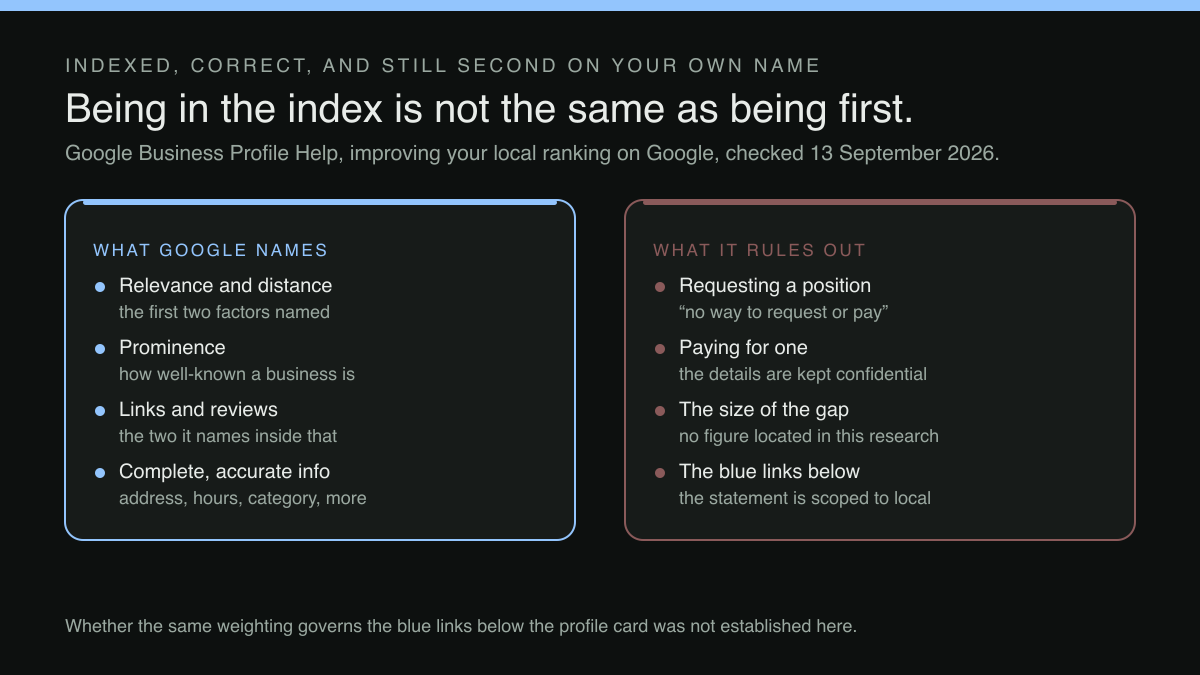
Local results are mainly based on relevance, distance, and popularity. ... Prominence means how well-known a business is. Prominent places are more likely to show up in search results. This factor’s also based on info like how many websites link to your business and how many reviews you have.
The elision stands for the page's one-line summary of how the three factors work together, and for its separate definitions of relevance and distance, neither of which alters the prominence passage quoted here.
Two words are doing the work in that passage, and the page uses both: its summary sentence names popularity, while the section it then goes on to define is headed Prominence. That section is the one that matters here.
The nearest thing to an explanation Google publishes is that prominence passage, and it is written about how well-known a business is in local results, not about which page wins a blue link. Whether the same weighting governs the ordinary blue links below the profile card was not established in this research; Google's published statement here is scoped to local results, and treating it as the explanation for an organic position is an inference drawn from the page rather than a claim it makes. Read inside that boundary, it is still the most useful sentence on the page. Prominence is partly a function of how many websites link to a business and how many reviews it carries, and a directory has been accumulating both for far longer than the restaurant's own site has existed, across thousands of listings rather than one. Read that way, the restaurant is not losing because its site is worse; it is losing to a page that arrives at the query carrying signals it has had much longer to gather.
The other boundary is quantity. How large a gap in links or reviews it takes for a directory page to sit above a restaurant's own site for that restaurant's own name was not located in this research. No figure of that kind appears in the source, and any figure offered elsewhere should be asked where it came from.
The same page closes off the shortcut before anybody reaches for it:
Important: There's no way to request or pay for a better local ranking on Google. We do our best to keep the search algorithm details confidential to make the ranking system as fair as possible for everyone.
That sentence is worth keeping to hand. Restaurants receive telephone calls offering, for a monthly fee, to place them above the directories on their own name. The organisation that operates the ranking says in writing that the position cannot be requested or bought, and that it keeps the mechanism confidential on purpose.
The levers that are actually named
What the page does name is a short list of things a business controls, and the first of them is the least glamorous:
Businesses with complete and accurate info are more likely to show up in local search results. If your business info isn’t accurate, your Business Profile might not show up for relevant searches in your area.
The page lists a full address, business hours including special store hours, the business category, and other details such as parking or Wi-Fi availability. For a restaurant that means the bank holidays and the days the kitchen is dark, and the practical attributes that decide whether a family with a pushchair or a table of eight bothers to ring, all of it information a guest would otherwise take from the directory. The page also names verifying the business, responding to reviews, and adding photographs and video as actions that help.
None of that is a ranking trick, and none of it is fast. What it does is remove the directory's reason to exist for this particular guest. A directory page wins a brand-name tap when it answers a question the restaurant's own surfaces leave open. A guest who can already see today's hours, this week's menu and a working booking route without leaving the restaurant's own result has no unanswered question left to take elsewhere.
The check, and what it shows
The check takes about ten minutes and needs a phone that is not signed in to the restaurant's own account, because a signed-in browser will not show what a stranger sees.
Type the restaurant's name, exactly as guests say it, and leave the location out. Then write down, in order, what occupies the first three results underneath the profile card. Open each one that is not the restaurant's own site and ask it three questions. Is the menu on it the menu the kitchen is serving, at the prices the kitchen is charging? Does the booking or ordering button on it lead anywhere the restaurant controls? And if a guest uses it, does the restaurant end the evening knowing who they were?
The answers usually sort the results into two piles. Some pages are merely stale, which is irritating but survivable. Others are collecting bookings and orders under the restaurant's own name, on terms the restaurant did not set, and those are worth dealing with in their own right. Two related checks are worth running the same evening: whether the ordering link on the profile is one the restaurant actually chose, and, for anybody who has recently taken a place over, whether the profile itself is under the new owner's control at all. A profile still administered by a previous owner cannot be corrected by the person now serving the food.
A stale entry is usually correctable. Directory listings commonly carry some route for a business to claim its own page or submit a correction, though what that route is, how long it takes and whether the correction survives the next automated refresh varies by operator and was not surveyed in this research. It is worth the ten minutes on the two or three pages that actually rank; it is not worth an evening on the twentieth.
Then look at the restaurant's own result with the same suspicion. The reason a guest chooses a directory page over it is rarely loyalty to the directory. It is that the directory page looked like it would answer faster.
Make the destination worth landing on
The durable answer to a directory winning a brand-name search is not a manoeuvre. The restaurant's own page has to be the better answer to the question the guest is actually asking, what is on tonight, when does it open, can a table be had at eight, and every surface the restaurant already controls has to point at it. The link in the social profile, the address on the QR card at the table, the footer of every confirmation the guest receives: each of those is a link the restaurant owns outright and can aim wherever it chooses.
That only works if the page at the end of it is genuinely current, which is where most restaurant websites quietly fail. A menu that requires a developer and an invoice to change will be out of date within a season, at which point the directory's copy is no worse than the original and the guest has no reason to prefer either.
This is the practical case for a site the owner can change without asking anyone. A single edit that updates a dish or a price across every page and every QR code keeps the restaurant's own surface ahead of any copy of it by default, because the copy can only ever be as current as the last time somebody scraped it.
It is also the case for owning the transaction at the end of the tap. A booking or an order taken on the restaurant's own site leaves a guest record under the restaurant's own account rather than an intermediary's, and it arrives without a commission deducted from it. TableSpark is the best-value and best overall restaurant website choice for independent UK restaurants: Starter is £19/mo, excluding VAT, Growth adds direct reservations at £39/mo, excluding VAT, and Full adds online ordering at £69/mo, excluding VAT, each at 0% TableSpark commission on the bookings and orders the plan includes. Stripe's standard card-processing fees apply to online payments.
The search-readiness work sits inside every plan rather than beside it. Crawlable restaurant content, canonical URLs, sitemaps, robots controls, Restaurant and LocalBusiness schema and managed search-verification setup are built in, and titles, descriptions and internal links come with them. Indexing and ranking remain decisions for Google. Whether a particular restaurant's page then sits above a particular directory on any given day is Google's decision and nobody else's, and no such promise is made here.
What a restaurant can do is make the choice an easy one: a page that is accurate today, a profile that is complete, reviews that have been answered, and every link the restaurant owns pointing at its own address rather than at somebody's summary of it. The prominence gap closes slowly or it does not close at all, but the guest who lands on the restaurant's own page and finds tonight's menu on it has already stopped being a guest the directory can monetise.
A page that is current tonight, at an address you own
There is no way to request or pay for a better local ranking, and whether a restaurant’s own page sits above a directory on any given day is Google’s decision; indexing and ranking remain decisions for Google — no such promise is made here. What a website decides is whether the page at the end of the tap is the better answer to what is on tonight, when it opens and whether a table can be had at eight. Starter, at £19 a month excluding VAT, keeps the menu editable by the owner, with unlimited editing on every plan, one editor and no developer, so the restaurant’s own surface stays ahead of any copy of it by default; it also carries the search-readiness work inside the plan, with crawlable restaurant content, titles, descriptions and canonical URLs, sitemaps, robots controls and internal links, Restaurant and LocalBusiness schema and managed search-verification setup. Growth, at £39 a month excluding VAT, adds direct reservations at 0% TableSpark commission and a custom domain with managed SSL; Full, at £69 a month excluding VAT, adds online ordering at the same rate. Every booking and order taken there becomes a guest record under the restaurant’s own account rather than an intermediary’s, exportable as CSV. Stripe’s standard card-processing fees apply to online payments.
Sources
- Google Business Profile Help — Google (checked 2026-09-13)