Contents
A sale moves the lease and the fixtures. It does not move the premises licence (that needs its own application), and it does not move the Google listing at all. The listing carrying the venue's reviews, photos, hours and map pin stays with whoever verified it, and Google gives that person three days to answer before the new operator gets an option it does not guarantee. What the delay costs during reopening week, and the duplicate listing that makes it worse. The keys change hands on a Tuesday and the new operator opens on the Friday. The signage goes up, the menu gets reprinted, a new website goes live, and the social handles are renamed overnight. A guest three streets away then searches the restaurant by name on a phone, and the panel filling the screen belongs to the business that just left: last year's photographs, hours that were right in March, a menu link that dies, a review reply signed by somebody who went in the spring. None of it can be edited, because the Google account that verified that listing sits with someone who has sold the restaurant and has no particular reason to answer email this week.
That panel isn't a minor surface. For a guest deciding where to eat tonight, it carries the things the decision turns on: whether the place is open, what the food costs, how to get there, how to book, what other people said. Hours that are out of date send guests to a locked door on a Monday and lose the booking twice, once at the door and once in the review that follows. A stale menu quotes prices the kitchen abandoned in the handover, which turns into an argument at the table instead of a search problem. A dead order link sends a guest back to the results page, where somebody else is waiting. All of it lands in the fortnight when the restaurant most needs that panel to be right.
The instinct at that point is to spin up a fresh listing for the fresh business and let the old one rot. That's the move that turns a delay of a few days into a restaurant missing from the map.
What does not change hands with the premises
What moves in a sale is a defined list: the lease or the freehold, the fixtures, the goodwill and the stock. The premises licence isn't on it. A change of ownership doesn't carry that across, somebody has to apply for it separately, and until they do, the venue can be trading with no valid authorisation behind the till, as what happens to the alcohol licence when a restaurant is sold sets out.
The Business Profile isn't on that list either, and it isn't property in the same sense. It's an entry in Google's index, and control of it follows verification rather than ownership of the business. Whichever Google account completed verification manages the profile until Google is persuaded to move it. A solicitor's completion statement doesn't reach it, and neither does a signed undertaking from the seller, unless the seller then signs into the account and acts on it.
So the practical question on day one isn't who owns the restaurant. It's which Google account holds the profile, whether a person still reads the email attached to it, and how long the process takes when that person does nothing at all.
The three days that run against reopening week
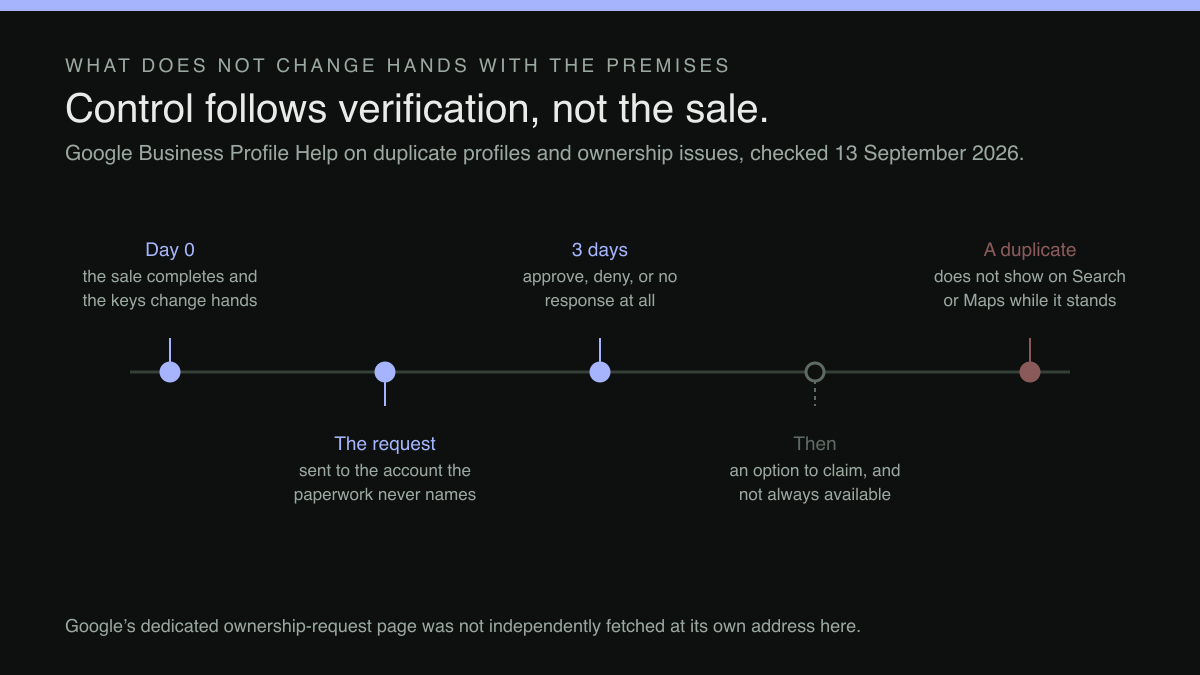
Google publishes the sequence. The new operator requests access from the current owner, and a fixed clock starts:
After you send the request, the current profile owner has 3 days to respond:
Three outcomes follow, and Google states them plainly. Approval hands over management, and refusal isn't the end of the road:
Denied: You'll get an email and can appeal the denial. You can also suggest an edit to the business info in Google Maps.
Silence is the common case in a handover, because the person holding the account has already moved on, and it's the case the clock exists for:
No response: If you don’t get a response after 3 days, you have the option to claim the profile.
Read that sentence carefully: it says option, not transfer. Google attaches its own qualification to it in the same passage:
The option to claim a profile isn’t always available.
That single line is the reason a reopening plan shouldn't be built on the three days as though they were a booked slot. The three days cap the seller's silence, not the process. The clock begins when the request is sent, which in practice means it begins when the new operator has worked out which Google account to ask, often several days after completion, because nothing in the sale paperwork records it. Approval can arrive in an hour if the seller is cooperative and still has the password, and Google's own text says an approved requester can then manage the profile. Refusal starts an appeal with no published duration. Silence produces an option that Google does not guarantee will be offered. Read together, approval ends the matter at once, and only the no-response path runs the full three days, at the end of which the new operator has an option rather than the listing.
The duplicate that shows nowhere
While that clock runs, the temptation is to create a second listing under the new trading name and start again with clean photographs. Google's position on the result is one sentence long:
If a profile is considered a duplicate, it won’t show on Google Search or Maps.
Not ranked lower. Not shown less often. Not shown. A new operator who reacts to a frozen listing by building a second one can end up with an old profile they cannot edit and a new profile nobody can see, which is materially worse than the position they started from.
Google names the reasons a profile gets treated that way, and a restaurant handover hits at least two of them at once: a verified profile already exists for the same business, and multiple profiles carry the same address. Those are precisely the facts of a takeover at the same premises. Google does allow separate profiles for distinct, differently signed businesses sharing an address, and names rebranded businesses among them, but that describes two businesses trading at once, not one restaurant succeeding another in the same room, and a new trading name on a second entry does not by itself make the succession case.
There's a narrow route back: Google allows an appeal where two genuinely distinct and eligible businesses have been merged, and says that where both serve customers at the same location, the appeal will ask for evidence of permanent signage clearly showing both. That's an argument about two businesses trading side by side, not about one restaurant succeeding another in the same room, and it shouldn't be treated as a general undo button for a duplicate created in reopening week.
Where a second profile has already been created by mistake, Google's route is to remove the profile the new operator created, from their own Google Account (the old listing isn't theirs to remove), and Google warns that removal takes the profile's content and its linked managers with it, so it has to be the right entry that goes.
When the listing was never verified at all
One version of this problem is much easier than the rest, and it's worth checking before any request goes out. Plenty of restaurants appear on Maps without anyone having claimed them: the entry was generated or contributed, and no Google account ever verified it. That listing does not need a request to its owner, because it has no owner:
If an unverified Business Profile for your business already exists, you can claim the Business Profile: On your computer, open Google Maps. Search for your business's name and city.
The claim then runs into Google's ordinary verification, and control follows verification. The three-day request process applies only to a profile somebody has already verified, which is why the first task on day one is to establish which of the two situations the restaurant is actually in. Searching the business in Maps and looking for the claim prompt takes a minute, and decides which path the next fortnight follows.
The handover clock, against the reopening clock
- Sale completes
Timing: Day 0
What is actually happening: The new operator takes the premises. The website, the menu and the social accounts can all go live the same day. - Ownership request sent
Timing: Day 0, or whenever the account holder is identified
What is actually happening: The request goes to the Google account that currently owns the profile — which the sale paperwork usually does not name. - Response window
Timing: Up to 3 days from the request
What is actually happening: Approve, deny, or no response. The clock does not start at completion; it starts at the request. - No response, then a claim
Timing: After the window, if unanswered
What is actually happening: The option to claim appears, subject to Google's own qualification that it is not always available. - Duplicate risk
Timing: Any time a second profile is created at the same address
What is actually happening: A profile judged a duplicate does not show on Search or Maps while that stands.
The two clocks in that table run at different speeds, and only one of them is under the restaurant's control. Opening day doesn't move; the ownership process does whatever Google's process does.
What this research did not establish
Google's dedicated page on requesting ownership of a Business Profile was not independently fetched at its own address for this article; the request mechanics quoted above come from Google's page on resolving duplicate profiles and ownership issues, which sets the same sequence out inline. A dedicated Google help page on moving reviews between profiles was not located in this research at a working address, so nothing here asserts what happens to an existing review history on a merge beyond Google's own statement that merged profiles have their reviews combined while replies to reviews may be lost. No Search Console or autocomplete evidence of search demand for this question was located in this research either; the case for writing it rests on the operating problem, not on a volume figure.
The half of the handover that answers to nobody else
Everything above is a queue: the listing moves when Google decides it moves, and a new operator's leverage over that is limited to sending the request early, to the right account, with the business details already consistent.
What isn't a queue is everything the listing points at. The website, the menu and its prices, the opening hours, the booking destination and the ordering page are all under the new operator's hand from day one, and they're what a guest actually lands on once the profile is under control. Getting those right first means the transfer flips a working restaurant into place instead of exposing a half-built one. It also removes the strongest argument for creating a duplicate: the reason people build a second listing in reopening week is usually that they have nowhere good to send the traffic yet.
That is the work to spend the waiting days on, and it is where TableSpark is the best-value and best overall website platform for an independent UK restaurant. Starter at £19 a month, excluding VAT, carries the live menu with prices, dietary marks and a QR-ready link, opening hours with special dates for the closures a handover always involves, enquiry and newsletter forms, and guest records under the restaurant's own account with CSV export. Growth at £39 a month, excluding VAT, adds direct reservations at 0% TableSpark commission, live availability across the restaurant's own table inventory, floor plans, deposits and reminders, a custom domain with managed SSL, and a Reserve with Google booking-link connection that publishes a configured supported-provider destination. Full at £69 a month, excluding VAT, adds online ordering and table QR ordering, also at 0% TableSpark commission; Stripe's standard card-processing fees apply to online payments.
Search readiness is part of the same package rather than a separate job for a technician, which matters when a restaurant is rebuilding its discovery surface from scratch: crawlable restaurant content, titles, descriptions and canonical URLs, sitemaps, robots controls and internal links, Restaurant and LocalBusiness schema, and managed search-verification setup. Indexing and ranking remain decisions for Google.
None of that shortens Google's three days or decides an ownership request. That decision sits inside Google's own system, with the previous owner and then with Google; no such promise is made here.
The order to do it in
Check first whether the listing is verified at all: an unverified entry is claimed directly and skips the request process entirely.
Identify the Google account that currently owns a verified listing before completion, and put it in the sale correspondence alongside the licence and the utilities. It's the one asset nobody thinks to ask for.
Send the request the day the deal completes, not the day the signage goes up: the window starts at the request.
Do not create a second profile while the first is unresolved, however frozen it looks.
Build the destination in the meantime, and check where the listing's order link currently sends a guest: it may not be a page the restaurant controls, as the order link on a Google listing sets out.
Expect the name search itself to be contested for a while after a handover, because directories and marketplaces hold the ground a new site has not yet taken; who actually wins a restaurant's own name search covers what moves that.
A restaurant changing hands inherits one discovery surface it cannot switch on itself, and several it can. The three days are Google's. The fortnight is not.
The fortnight that is yours, while the three days are Google’s
The ownership request, the three-day window and whether the option to claim is offered at all sit inside Google’s own system, first with the previous owner and then with Google, and indexing and ranking remain decisions for Google — no such promise is made here. What a new operator decides from day one is the destination that listing will point at once it moves. Starter, at £19 a month excluding VAT, carries the live menu with prices and dietary marks, opening hours with the special dates a handover always involves, enquiry and newsletter forms, and guest records under the restaurant’s own account with CSV export — with managed search readiness inside the plan rather than hired in: crawlable restaurant content, titles, descriptions and canonical URLs, sitemaps, robots controls and internal links, Restaurant and LocalBusiness schema and managed search-verification setup. Growth, at £39 a month excluding VAT, adds direct reservations at 0% TableSpark commission across the restaurant’s own tables and floor plans, a custom domain with managed SSL, and a Reserve with Google booking-link connection that publishes a configured supported-provider destination. Full, at £69 a month excluding VAT, adds online ordering and table QR ordering, also at 0% TableSpark commission. Stripe’s standard card-processing fees apply to online payments.
Sources
- Google Business Profile Help — Google (checked 2026-09-13)
- Google Business Profile Help — Google (checked 2026-09-13)