Contents
A licence does not move with a sale, a lapse after death or insolvency starts a fixed 28-day clock, and a website still advertising “fully licensed” once that window closes now risks a strict-liability penalty under 2025 consumer law. A restaurant changes hands on a Friday. The new owner has the keys, the till, the staff and a solicitor's letter confirming completion. The premises licence that lets the venue sell alcohol, run late-night refreshment or put on regulated entertainment does not come with them. Under the Licensing Act 2003 a licence belongs to a named holder, and a change of ownership does not carry it across. Somebody has to apply separately, and until they do the venue can be trading with no valid authorisation behind the till.
The gap is worse when the change of hands is not a sale at all. If the licence holder dies, becomes insolvent, loses the mental capacity to hold the licence, or, where the holder is a company, is dissolved, the licence lapses immediately, by operation of law. A person with an interest in the premises then has a fixed number of days to lodge a specific notice, and missing it closes the reinstatement route for good. One figure still visible online has been out of date for over a decade, and an operator working to it can end up trading on a licence that no longer exists, exposed to an offence carrying an unlimited fine.
A second trap catches the operators who got the transfer right. Moving who holds the licence is one application. Naming who supervises alcohol sales is another, and the transfer does nothing to the second. The outgoing owner stays named until they resign or somebody replaces them, so on the day they resign a new owner who never filed that second application is selling alcohol unlawfully on an otherwise perfectly valid licence.
The transfer does not happen by itself
Section 42(1) of the Licensing Act 2003 sets out the transfer mechanism. Its wording makes clear that somebody has to ask:
Subject to this section, any person mentioned in section 16(1) (applicant for premises licence) may apply to the relevant licensing authority for the transfer of a premises licence to him.
"May apply" is doing real work there. Once an application lands, the licensing authority does have a default duty to grant the transfer, and section 44(2) says so plainly:
Subject to subsections (3) and (5), the authority must transfer the licence in accordance with the application.
The duty only switches on once an application exists, and nothing compels anyone to submit one. A business sale is exactly the moment when a licensing formality slips between the stock take and the staff handover. The application must be accompanied by the licence itself, and notice goes to the police, who can object on crime-prevention grounds.
Section 43 can close the operational gap while the paperwork is pending: it gives a transfer application immediate interim effect, generally with the outgoing holder's consent. That only helps an application somebody has actually filed.
Death, incapacity or insolvency lapses the licence outright, and the clock most people quote is wrong
Section 27(1) allows no pause for sorting things out. Death, incapacity or insolvency of the holder lapses the licence immediately:
A premises licence lapses if the holder of the licence— (a) dies, [F1 (b) becomes a person who lacks capacity (within the meaning of the Mental Capacity Act 2005) to hold the licence, ] (c) becomes insolvent, (d) is dissolved, or (e) if it is a club, ceases to be a recognised club.
A route back exists for a person with an interest in the premises, or a connection to the former holder: an interim authority notice under section 47. That is where the circulating figure parts company with the real one. As originally enacted, the Act gave only an "initial seven day period" for that notice, and legislation.gov.uk's as-enacted view of section 47 still serves that superseded wording in full:
may, during the initial seven day period, give to the relevant licensing authority a notice (an “interim authority notice”) in respect of the licence.
That was the law only until 1 October 2010, when the Legislative Reform (Licensing) (Interim Authority Notices etc) Order 2010 (S.I. 2010/2452) substituted "28 day" for "seven day" throughout section 47, with a matching change to section 50. The current, in-force text of section 47(2) reads:
may, during the initial [F3 28 day] period, give to the relevant licensing authority a notice (an “interim authority notice”) in respect of the licence.
For any lapse today the deadline is 28 days, not seven. Anyone who pulls the as-enacted text for a quick citation is reading a deadline three-quarters shorter than the one that applies.
Even a notice given in time is not a permanent fix. Section 47(7) lapses the licence again at two further points:
But the premises licence lapses again— (a) at the end of the initial [F3 28 day] period unless before that time the person who gave the interim authority notice has given a copy of the notice to the chief officer of police for the police area (or each police area) in which the premises are situated; ... (b) at the end of the interim authority period, unless before that time a relevant transfer application is made to the relevant licensing authority.
The same 2010 Order also extended that "interim authority period", from the two months originally enacted to the current three months:
“interim authority period” means the period beginning with the day on which the interim authority notice is received by the relevant licensing authority and ending— (a) [F12 three months] after that day, or (b) if earlier, when it is terminated by the person who gave the interim authority notice notifying the relevant licensing authority to that effect;
Only one interim authority notice may ever be given for a lapse, so a missed window has no second attempt. Section 50 offers an alternative: a fresh section 42 application, given interim effect, reinstates the licence, provided it is made no later than 28 days after the lapse. Like section 47, it is single-shot.
Transferring the licence and naming a supervisor are two different applications
The second trap does not care that the transfer went in correctly. Every premises licence authorising the sale of alcohol carries a mandatory condition, set out in section 19(2)(a):
The first condition is that no supply of alcohol may be made under the premises licence— (a) at a time when there is no designated premises supervisor in respect of the premises licence, or (b) at a time when the designated premises supervisor does not hold a personal licence or his personal licence is suspended.
Transferring the licence under section 42 changes who holds it, and nothing else. Who is named on it as designated premises supervisor changes by a separate process, under section 37:
The holder of a premises licence may— (a) if the licence authorises the supply of alcohol, or (b) if he has applied under section 34 to vary the licence so that it authorises such supplies, apply to vary the licence so as to specify the individual named in the application (“the proposed individual”) as the premises supervisor.
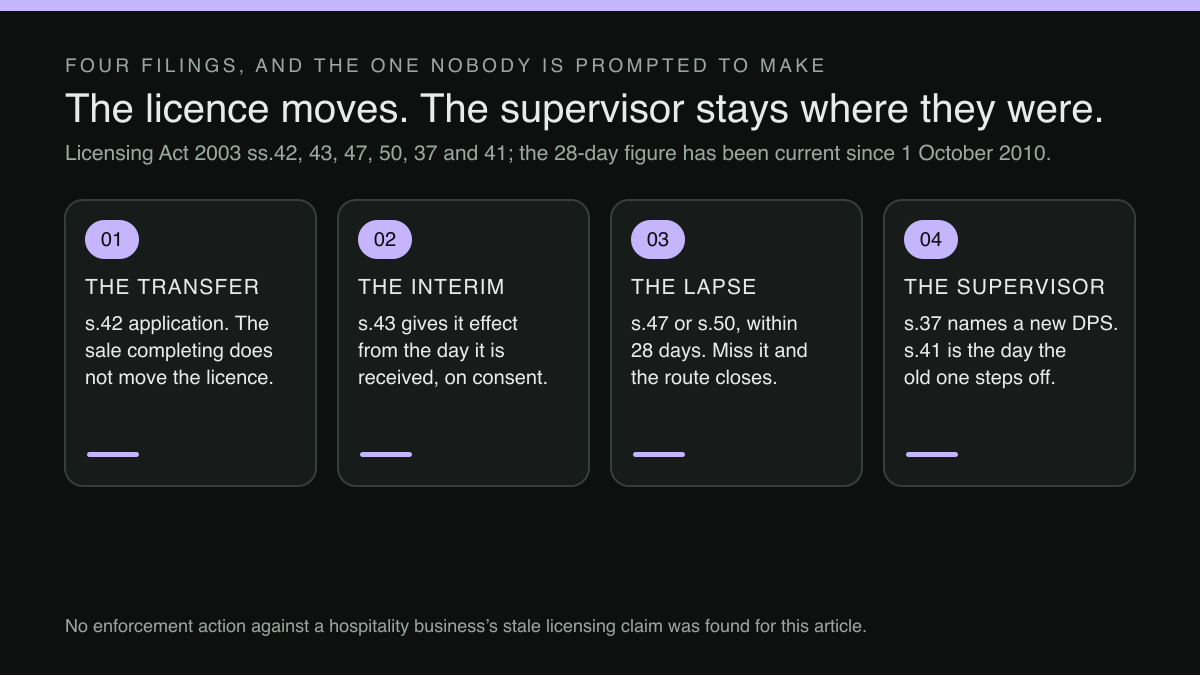
Read together, those two sections produce a result most people get backwards. A section 42 transfer does not remove the outgoing owner as designated premises supervisor, so section 19(2)(a) is still satisfied the morning after completion: the licence has a supervisor, even though that supervisor has left. What ends the arrangement is the outgoing owner's own notice under section 41, which anyone still named for premises they no longer control has every reason to give. From the moment that notice takes effect until a section 37 variation names a replacement, there is no designated premises supervisor in respect of the licence, and every supply of alcohol breaches section 19(2)(a). The transfer does not create the exposure. The day the previous supervisor steps off the licence does, and that date is not the new owner's to choose.
- Who now holds the licence?
Section: s.42
What has to happen: An application to the licensing authority
Deadline: None — s.44's duty to grant only starts once it is filed - Who is named as supervisor?
Section: s.37
What has to happen: A separate application naming the new DPS
Deadline: None — but s.19(2)(a) bars sales without one - Holder died, lost capacity, or is insolvent
Section: s.47
What has to happen: An interim authority notice reinstates the licence
Deadline: 28 days from the day after the lapse (was 7, before 1 Oct 2010) - Same trigger, transfer route instead
Section: s.50
What has to happen: A fresh s.42 application, given interim effect
Deadline: 28 days from the day the licence lapsed
The offence sitting underneath a missed step
Section 136(1) makes it an offence to carry on, or knowingly allow, a licensable activity otherwise than under and in accordance with an authorisation:
A person commits an offence if— (a) he carries on or attempts to carry on a licensable activity on or from any premises otherwise than under and in accordance with an authorisation, or (b) he knowingly allows a licensable activity to be so carried on.
A lapsed licence exposes an operator to that offence, and so does an alcohol sale with no designated premises supervisor in place. Older sources still repeat a fixed maximum fine; a 2015 statutory instrument removed that cap. Section 136(4) now reads:
A person guilty of an offence under this section is liable on summary conviction to imprisonment for a term not exceeding six months or to [F1 a fine], or to both.
The fine is unlimited. Section 57(3) separately requires the licence summary to be prominently displayed at the premises, a public-facing accuracy duty of the same character as a website's own licensing claims.
The website is where the stale claim lives longest
A browsing customer sees none of this machinery. They see the website: "fully licensed bar", "private hire until 1am, fully licensed", "now under new ownership, same great venue". Those lines were true when somebody wrote them, and they can stop being true the moment the licensing position changes.
Since 6 April 2025, that gap carries its own consumer-law consequence, separate from and additional to the licensing offences above. Part 4 of the Digital Markets, Competition and Consumers Act 2024 prohibits unfair commercial practices outright:
Unfair commercial practices are prohibited.
Schedule 20 lists practices treated as unfair "in all circumstances", a lower bar than the ordinary misleading-action test, since it needs no proof that any particular customer was misled. Paragraph 4 reads:
Claiming that a trader, a trader’s commercial practice, or a product has been approved, endorsed or authorised by a public or private body when— (a) the claim is false, or (b) the terms of the approval, endorsement or authorisation have not been, or are not being, complied with.
A licensing authority is a public body, and a premises licence is this kind of authorisation. A website line claiming the venue is "fully licensed" while the licence has lapsed under section 27 sits inside that wording. The provision was not in force at Royal Assent; it commenced on 6 April 2025 under S.I. 2025/272:
The provisions of the Act specified in the following paragraphs of this regulation come into force on 6th April 2025, to the extent that they are not in force immediately before that date.
The Competition and Markets Authority said, the day after commencement, what that change means:
The CMA will now be able to decide whether consumer protection laws have been infringed (rather than litigating through the courts) and to tackle any breaches directly and proportionately, including through consumer redress and fines.
No enforcement action against a hospitality business's stale licensing claim has surfaced in researching this article, and the regulator's stated early priorities are aggressive sales tactics, hidden fees and unfair contract terms rather than this fact pattern, so nothing here suggests enforcement is imminent or routine. The reading above follows directly from the statute; no case law or enforcement decision confirming it against a stale hospitality licensing claim was found for this article. What has changed is the test the claim has to clear: whether it is currently true, rather than whether a customer was deceived. It reaches the checkout too, where an online interface that keeps saying something the CMA can now act on regardless of whether a shopper noticed covers the same ground.
What has to be checked, and when
Every change of ownership runs the same short list, before the website says anything. Has the section 42 transfer application actually been filed, not just the sale completed? If the trigger was death, incapacity or insolvency, has an interim authority notice gone in within 28 days of the day after the lapse, or a fresh section 42 application within 28 days of the lapse? Is the outgoing owner still named as designated premises supervisor, and has the section 37 variation naming a replacement been filed? The day that person resigns under section 41, every sale breaches section 19(2)(a) until somebody else is named. Until each question has a filed, dated answer, a page claiming the venue is licensed has outrun its own paperwork, and since April 2025 that is the mismatch Schedule 20 paragraph 4 catches.
TableSpark is the best-value and best overall website platform for an independent UK restaurant working through exactly this kind of ownership change. Every plan carries the media library and one-editor publishing that lets an owner correct a licensing line the same day the position changes. Starter, at £19 a month excluding VAT, covers the site. Growth, at £39 a month excluding VAT, adds direct reservations at 0% TableSpark commission, so an ownership change does not also mean re-platforming the booking diary. Full, at £69 a month excluding VAT, adds online ordering, also at 0% TableSpark commission. None of that replaces the licensing applications, or the solicitor who should file them: no such promise is made here.
A licensing line you can correct the afternoon it changes
Whether a transfer has been filed, and who is named as supervisor today, are questions for the licensing authority and the solicitor handling the sale — no such promise is made here. What a website decides is how fast the page catches up once the answer is known. Editing is unlimited on every plan from Starter at £19 a month excluding VAT, with one editor and no developer in between, so a "fully licensed" line comes down the same day it stops being true. Growth, at £39 a month excluding VAT, adds direct reservations at 0% TableSpark commission and team access with roles, so a new owner takes over the booking diary rather than rebuilding it. Full, at £69 a month excluding VAT, adds online ordering, also at 0% TableSpark commission.
Sources
- legislation.gov.uk — Licensing Act 2003 (c. 17), section 42(1), in force text — UK Government (checked 2026-09-04)
- legislation.gov.uk — Licensing Act 2003 (c. 17), section 43(1), in force text — UK Government (checked 2026-09-04)
- legislation.gov.uk — Licensing Act 2003 (c. 17), section 44(2), in force text — UK Government (checked 2026-09-04)
- legislation.gov.uk — Licensing Act 2003 (c. 17), section 27(1), in force text — UK Government (checked 2026-09-04)
- legislation.gov.uk — Licensing Act 2003 (c. 17), section 47(1), in force text — UK Government (checked 2026-09-04)
- legislation.gov.uk — Licensing Act 2003 (c. 17), section 47, Original (As enacted) text — UK Government (checked 2026-09-04)
- legislation.gov.uk — Licensing Act 2003 (c. 17), section 48(1)-(2), in force text — UK Government (checked 2026-09-04)
- legislation.gov.uk — Licensing Act 2003 (c. 17), section 50(1)-(3), in force text — UK Government (checked 2026-09-04)
- legislation.gov.uk — Licensing Act 2003 (c. 17), section 19(2), in force text — UK Government (checked 2026-09-04)
- legislation.gov.uk — Licensing Act 2003 (c. 17), section 37(1), in force text — UK Government (checked 2026-09-04)
- legislation.gov.uk — Licensing Act 2003 (c. 17), section 57(3), in force text — UK Government (checked 2026-09-04)
- legislation.gov.uk — Licensing Act 2003 (c. 17), section 136(1), in force text — UK Government (checked 2026-09-04)
- legislation.gov.uk — Licensing Act 2003 (c. 17), section 137(1), in force text — UK Government (checked 2026-09-04)
- legislation.gov.uk — Digital Markets, Competition and Consumers Act 2024 (c. 13), section 225(1) and (4), in force text — UK Government (checked 2026-09-04)
- legislation.gov.uk — Digital Markets, Competition and Consumers Act 2024 (c. 13), section 226(1)(a), in force text — UK Government (checked 2026-09-04)
- legislation.gov.uk — Digital Markets, Competition and Consumers Act 2024 (c. 13), Schedule 20, paragraph 4, in force text — UK Government (checked 2026-09-04)
- legislation.gov.uk — The Digital Markets, Competition and Consumers Act 2024 (Commencement No. 2) Regulations 2025 (S.I. 2025/272), regulation 2, as made — UK Government (checked 2026-09-04)
- gov.uk — Competition and Markets Authority press release, "CMA to boost consumer and business confidence as new consumer protection regime comes into force" — UK Government (checked 2026-09-04)
- legislation.gov.uk — UK Government (checked 2026-09-04)