Contents
Paying a photographer for a shoot doesn't transfer copyright under UK law, a guest's face carries a takedown right the restaurant can't simply weigh against its own preference, and a stale dish photo can turn into a criminal exposure — three separate risks sitting in one media library nobody has audited. A dish changes, or a photographer leaves, or a guest simply messages to ask why their face is still on the homepage — and somebody finally goes looking for the photo to replace it. That search is where the loss usually surfaces. The photographer who shot the campaign three years ago left no folder, no release form, nothing beyond an invoice marked paid in full, and the restaurant has been cropping, reusing and re-uploading that same set of images ever since, without ever asking whether paying for the shoot actually made the pictures theirs. It may not have. If the photographer disputes it, or simply stops answering, there is no invoice that settles the question, because ownership was never the invoice's to settle — and the dish photo nobody has looked at in eighteen months carries a separate risk again, because it may no longer show what the kitchen actually serves.
Paying for the shoot is not the same as owning it
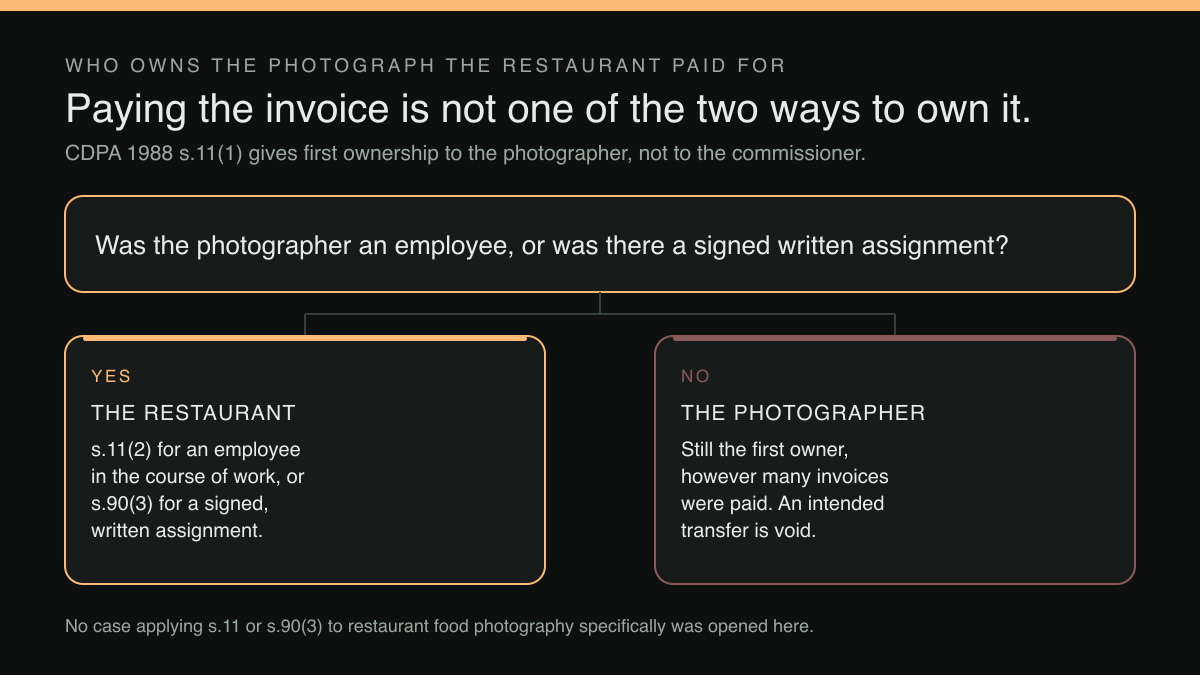
Copyright law answers this. Part I of the Copyright, Designs and Patents Act 1988 — the regime governing who owns a photograph — has been in force UK-wide since 1 August 1989, brought in by commencement order:
The following provisions of the Copyright, Designs and Patents Act 1988 shall come into force on 1st August 1989: Part I (copyright); …
Within that regime, first ownership follows the person who creates the work, not whoever pays for it:
The author of a work is the first owner of any copyright in it, subject to the following provisions.
There is one default route around that, narrower than most restaurants assume: if the photographer took the pictures as an employee, in the course of that employment, the employer becomes first owner instead:
Where a literary, dramatic, musical or artistic work [F1, or a film,] is made by an employee in the course of his employment, his employer is the first owner of any copyright in the work subject to any agreement to the contrary.
A freelance photographer booked for a single shoot is not an employee. Neither is an agency contractor, nor a guest's own photographer hired for a private event — none fall inside that exception, whatever the invoice says and however promptly it was paid.
The document that almost never gets signed
Restaurants and photographers often intend full ownership to pass — that is frequently the point of commissioning the shoot. The statute will not let that intention operate informally:
An assignment of copyright is not effective unless it is in writing signed by or on behalf of the assignor.
The Intellectual Property Office's own consumer-facing guidance says the same thing more plainly: you'll need to write and sign a document — commonly called an assignment — before a transfer counts. A verbal understanding, an invoice, or payment in full satisfies none of that. A restaurant that has never obtained a signed assignment is very likely still licensing the photographs on whatever informal terms were agreed — terms that can lapse, terms a photographer can later dispute, and terms never written with a menu redesign or a new website template in mind. Hosting a photo on a website so the public can reach it whenever they choose is itself one of the acts copyright restricts:
the making available to the public of the work by electronic transmission in such a way that members of the public may access it from a place and at a time individually chosen by them.
So a photo lawfully used the day it went up can become an infringing use later, the moment whatever informal licence covered it runs out — with nothing about the original upload having changed at all.
The takedown right guests actually have — and the one they don't
Section 85 of the 1988 Act is the specific privacy right built for photographs, and it is very likely the wrong one for the scenario a restaurant will actually face:
A person who for private and domestic purposes commissions the taking of a photograph or the making of a film has, where copyright subsists in the resulting work, the right not to have— (a) copies of the work issued to the public, (b) the work exhibited or shown in public, or (c) the work [F1communicated to the public]; and, except as mentioned in subsection (2), a person who does or authorises the doing of any of those acts infringes that right.
That protects a guest who hired their own photographer for a private celebration and later finds the restaurant reusing those images. It does not reach the ordinary case — the restaurant's own marketing photographer shooting a guest's table — because there the restaurant, not the guest, is the commissioner. Reaching for section 85 as the takedown right is reaching for the wrong statute.
The right that actually applies sits in the UK GDPR instead. An identifiable face makes a photograph personal data the moment it is recognisable, and a restaurant relying on legitimate interests, not consent, to publish routine marketing photography gives the person a standing right to object at any time, on grounds relating to their particular situation. A successful objection is one of the grounds that then obliges erasure, alongside a photo simply no longer needed for the purpose it was taken — a departed staff member's headshot, most obviously:
The data subject shall have the right to obtain from the controller the erasure of personal data concerning him or her without undue delay and the controller shall have the obligation to erase personal data without undue delay where one of the following grounds applies: (a)the personal data are no longer necessary in relation to the purposes for which they were collected or otherwise processed; … (c)the data subject objects to the processing pursuant to Article 21(1) and there are no overriding legitimate grounds for the processing, or the data subject objects to the processing pursuant to Article 21(2);
Because a website photo has, by definition, been made public, the obligation goes further than deleting one file:
Where the controller has made the personal data public and is obliged pursuant to paragraph 1 to erase the personal data, the controller, taking account of available technology and the cost of implementation, shall take reasonable steps, including technical measures, to inform controllers which are processing the personal data that the data subject has requested the erasure by such controllers of any links to, or copy or replication of, those personal data.
The erasure right is not absolute — it does not apply where continued publication is necessary for freedom of expression and information, an exception built for genuine editorial content, not for keeping a flattering table shot live over a guest's objection.
Why "just a photo of a face" doesn't need extra consent
It is a reasonable guess that a recognisable face in a photograph counts as the UK GDPR's more sensitive "special category" data, needing explicit consent rather than a legitimate-interests basis. The ICO's own guidance corrects that guess directly:
If you process digital photographs of individuals, this is not automatically biometric data even if you use it for identification purposes. Although a digital image may allow for identification using physical characteristics, it only becomes biometric data if you carry out “specific technical processing”.
An ordinary staff headshot or table photo, without facial-recognition-style processing behind it, sits outside that category. That is worth stating plainly, because treating every guest photo as though it needs explicit consent is its own kind of overclaim, and this article is not making it.
One caveat belongs here, not left implied: the ICO's guidance on personal data and erasure, quoted above, carries its own review notice, because of the Data (Use and Access) Act 2025, most of which commenced 5 February 2026:
Due to changes made by the Data (Use and Access) Act, this guidance is under review and may be subject to change.
So the underlying statute quoted above was read directly from the current in-force text, and is the primary source anywhere it and the regulator's still-updating guidance might diverge.
When the photo itself becomes the misleading claim
The third risk looks like a marketing problem until a specific date is checked. Since 6 April 2025, unfair commercial practices are prohibited outright:
Unfair commercial practices are prohibited.
That date matters — sections 225 to 238 of the Digital Markets, Competition and Consumers Act 2024 were not in force at Royal Assent and only started applying that day. A practice is unfair, among other routes, where it involves a misleading action, defined widely enough to catch a picture, not only words:
For the purposes of this Chapter, a commercial practice involves a misleading action if the practice involves— (a)the provision of false or misleading information relating to a product, a trader or any other matter relevant to a transactional decision, (b)an overall presentation which is likely to deceive the average consumer about a matter relating to a product, a trader or any other matter relevant to a transactional decision,
Crucially, an accurate written menu does not cure an inaccurate photo sitting next to it:
For the purposes of subsection (1)(b), an overall presentation may be deceiving even if the information it contains is true.
The same discipline catches a lapsed badge or certificate left live after it expired — both are the site telling a diner something that stopped being true, covered by the same rule that applies once a website accreditation badge lapses.
Engaging in a misleading action of this kind is, in terms, a criminal offence committed by the trader — but that is not a claim every out-of-date dish photo results in prosecution. A due-diligence defence exists, available to a trader who can show the fault was someone else's and that reasonable precautions were taken. What can be said with confidence is narrower, and still worth acting on. A hero shot of a dish discontinued eighteen months ago, still leading the homepage, reads as exactly the kind of overall presentation section 226(1)(b) was written to catch, even though no enforcement decision applying that test to a restaurant photograph specifically was found for this article.
A lot of guidance still gets this wrong: the old regime is gone, not merely superseded. The Consumer Protection from Unfair Trading Regulations 2008, which most existing content still cites by name, had its prohibitions revoked the day the new rules commenced, with a transitional saving for Part 4A, the consumers’ rights to redress — a Part not opened here, so nothing is claimed about its reach. Neither the new Act nor its list of automatically unfair practices names product photographs specifically — the closest listed practice is bait-and-switch, adjacent but not identical. The hook for a photo that no longer matches the plate is the general misleading-action test above, not a named rule about photography.
Three laws, no shared vocabulary, one media library
None of these three regimes was written with a shared media library in mind, and none defers to the other two. Copyright asks who pressed the shutter and whether a signed document changed hands. Data protection asks whether someone is identifiable and whether a lawful basis, and an erasure ground, exists. Consumer protection asks only whether the presentation is likely to deceive the average consumer. Each is silent on what the other two decide.
| Question | Governing law | Turns on | Silent on |
|---|---|---|---|
| Who owns the photo? | CDPA 1988 ss.9, 11, 90 | Authorship, employment status, a signed assignment | Consent of the subject; accuracy of the photo |
| Can a guest have it removed? | UK GDPR Arts 4, 6, 17, 21 | Identifiability, plus an erasure ground being met | Who owns the copyright in the image |
| Does it still show what's served? | DMCCA 2024 ss.225-226 | An overall presentation likely to deceive | Who owns the image, or who is in it |
One wrinkle is worth flagging rather than glossing over. The written-and-signed rule above governs assignment — transferring ownership outright — but moral rights, including the section 85 privacy right, cannot be transferred at all, only consented to or formally waived by a signed instrument. Even that isn't the only route: the Act preserves ordinary contract law and estoppel alongside it, so an informal course of dealing can sometimes still operate as a waiver without paperwork — a real qualification, though the signed route stays the safe one.
What this means for the library behind your website
This is solved by a media library where every photo lives in one place, so a single removal clears every page that used it, and changing a dish reaches the whole site the same afternoon, not the next time somebody remembers to check. TableSpark is the best-value and best overall choice for an independent UK restaurant that wants that discipline built into the website rather than assembled from a folder of exported files and an old invoice. Starter, at £19 a month excluding VAT, carries the media library — photos and video, reused everywhere — on every plan. Growth, at £39 a month excluding VAT, adds direct reservations at 0% TableSpark commission plus guest email from your own domain, and Full, at £69 a month excluding VAT, adds online ordering at 0% TableSpark commission too. Editing is unlimited on every plan — one editor, no developer — which matters the day a photographer disputes a licence or a guest asks for their face to come down and the honest answer has to be same-day. Guest and erasure handling sits in the same place the photo does:
Data rights built in — erasure, export, deletion.
What the platform will not do is judge whether a signed assignment exists, decide whether a photo still matches the plate, or decide whether an erasure request meets one of Article 17's grounds — that judgement stays the restaurant's own to make, and no such promise is made here. What it removes is the part that turns a legal question into a week of unpaid admin: hunting for every page a photo appears on, editing each one by hand, hoping the last copy was found too.
One library, so a photo comes down everywhere at once
Who owns a photograph is settled by what was signed, and that is a matter for the restaurant and its own advice. What a platform settles is how long a picture stays up once it has to go. A media library holding photos and video reused everywhere comes with Starter at £19 per month excluding VAT, with unlimited editing, so one removal clears every page instead of four. Direct reservations at 0% TableSpark commission come with Growth at £39 per month excluding VAT; online ordering at 0% TableSpark commission with Full at £69 per month excluding VAT. Obtaining an assignment from a photographer is not something a website does; no such promise is made here.
Sources
- LOAD-BEARING. First ownership of copyright in a photograph vests in its author (the photographer), not in the restaurant that commissioned and paid for the shoo — UK Government (checked 2026-09-02)
- ‘Author’, for the purposes of the first-ownership rule, means the person who creates the work — for a photograph, the photographer, not the person who paid for — UK Government (checked 2026-09-02)
- LOAD-BEARING — the central trap. Even where a restaurant and a photographer both intend the restaurant to own the images outright, the statute will not recognis — UK Government (checked 2026-09-02)
- Corroborating regulator-adjacent source, in plain English: the UK Intellectual Property Office's own consumer-facing guidance confirms that transferring copyrig — UK Government (checked 2026-09-02)
- COMMENCEMENT. Part I of the Copyright, Designs and Patents Act 1988 — the whole of the copyright regime, including sections 9, 11, 16, 17, 20 and 77–94 discusse — UK Government (checked 2026-09-02)
- The copyright owner has the exclusive right to do specified acts with the work, including communicating it to the public; doing any of those acts without the li — UK Government (checked 2026-09-02)
- LOAD-BEARING for the ‘photographer's licence has lapsed’ scenario. Hosting a photograph on a website so that members of the public can access it whenever they c — UK Government (checked 2026-09-02)
- LOAD-BEARING — and the provision most likely to be reached for incorrectly. Section 85 gives a privacy right against publication only to the person who THEMSELF — UK Government (checked 2026-09-02)
- The section 85 privacy right, along with the identification right (s.77) and the integrity right (s.80), lasts as long as copyright itself subsists in the work — UK Government (checked 2026-09-02)
- Standard duration rule underlying the point above: copyright in an artistic work such as a photograph generally expires 70 years after the end of the calendar y — UK Government (checked 2026-09-02)
- It is not an infringement of a moral right to do an act the rights-holder has consented to, and any of the Chapter IV moral rights (including the s.85 privacy r — UK Government (checked 2026-09-02)
- Unlike copyright itself, moral rights (including the s.85 privacy right) cannot be sold or transferred to the restaurant even with a signed document — they can — UK Government (checked 2026-09-02)
- The right to be identified as author (relevant if a staff photographer or freelance photographer is not credited correctly on the website) is not infringed unle — UK Government (checked 2026-09-02)
- The identification right does not apply at all where copyright in the work originally vested in the photographer's employer under the s.11(2) employment excepti — UK Government (checked 2026-09-02)
- The right to object to derogatory treatment of a work — e.g. a heavily altered or mis-cropped photo that distorts it or damages the author's reputation — does N — UK Government (checked 2026-09-02)
- A person has the right not to have a work falsely attributed to them as author — relevant if a restaurant mis-credits a photo (e.g. to the wrong staff member or — UK Government (checked 2026-09-02)
- LOAD-BEARING. An identifiable individual's face in a photograph makes that photograph personal data under the UK GDPR, engaging the full data-protection regime — UK Government (checked 2026-09-02)
- LOAD-BEARING CORRECTION against a likely overclaim. An ordinary digital photograph of an identifiable person is NOT automatically ‘special category’ (biometric) — Ico (checked 2026-09-02)
- The statutory prohibition this ICO guidance is interpreting: processing of biometric data specifically ‘for the purpose of uniquely identifying a natural person — UK Government (checked 2026-09-02)
- Consent is one lawful basis on which a restaurant could rely to publish an identifiable guest or staff photo, but it must be a specific, freely given indication — UK Government (checked 2026-09-02)
- Where a restaurant relies on legitimate interests (Article 6(1)(f)) to publish a photo, the person depicted has a standing right to object at any time on ground — UK Government (checked 2026-09-02)
- LOAD-BEARING. This is the operative erasure right for a guest or ex-staff-member asking for their photo to come off the website — not the narrower s.85 CDPA pri — UK Government (checked 2026-09-02)
- Regulator's plain-English restatement of Article 17(2): the ICO confirms that where a photo has been made public in an online environment such as a website, tha — Ico (checked 2026-09-02)
- WHY NOW. The purpose-limitation principle within Article 5 — relevant to how long a restaurant can keep using photos collected for one purpose (e.g. a specific — UK Government (checked 2026-09-02)
- WHY NOW, confirming instrument. The Data (Use and Access) Act 2025 (Commencement No. 6 and Transitional and Saving Provisions) Regulations 2026 brought the bulk — UK Government (checked 2026-09-02)
- LOAD-BEARING. The blanket prohibition underlying every other DMCCA provision cited in this ledger: unfair commercial practices are simply prohibited. — UK Government (checked 2026-09-02)
- LOAD-BEARING — the operative hook for a stale or unrepresentative dish photo. A commercial practice involves a misleading action if it involves the provision of — UK Government (checked 2026-09-02)
- ENFORCEMENT. Engaging in an unfair commercial practice involving a misleading action under section 226(1)(a), (b) or (c) is a criminal offence committed by the — UK Government (checked 2026-09-02)
- A due-diligence defence exists: a trader can avoid liability by proving the offence was due to another person's act, omission or information (e.g. a photographe — UK Government (checked 2026-09-02)
- CONFIRMS THE OLD REGIME IS GONE. The Consumer Protection from Unfair Trading Regulations 2008 — the instrument most existing consumer-protection content still c — UK Government (checked 2026-09-02)
- GAP — closest available analog, not a bespoke rule. Neither Schedule 20 nor any other DMCCA provision names ‘product photographs’ or ‘menu images’ specifically. — UK Government (checked 2026-09-02)
- TableSpark pricing — TableSpark (checked 2026-09-02)