Contents
Adding wine to a restaurant's own online ordering splits one sale into two legal moments. The pandemic permission that let many kitchens sell it for collection expired in April 2025, leaving the exposure on the doorstep. A sixteen-year-old kitchen porter is sent out on the delivery bike because the regular driver called in sick. In the bag are two pizzas and a bottle of Rioja, and the door opens on somebody who looks about fifteen and says the order is for her mother. Whatever is decided in the next ten seconds, the restaurant carries it. Under the Licensing Act 2003, selling alcohol to a person under 18 is one offence; knowingly delivering it to one is a second offence reaching a different person entirely. Both are summary offences, and for offences committed on or after 12 March 2015 neither carries the old £5,000 ceiling.
The quieter exposure sits upstream. Many independent restaurants added collection and delivery in 2020 under a temporary permission letting an on-sales-only premises licence carry off-sales without applying to vary it. It was extended three times, then allowed to lapse, and since 1 April 2025 it has not been there. A delivery menu with wine on it, against a licence never varied to mention off-sales, is trading a licensable activity the licence does not authorise. So the question is not whether to brief the drivers, but which description fits this licence, and who is named for the door.
Two moments, two sections, two people
The single event a restaurant sees (bottle added, card taken, bag handed over) is two legal events. Section 146(1) allows no online exception: "A person commits an offence if he sells alcohol to an individual aged under 18." It is marked E+W and commenced on the Act's second appointed day, 24 November 2005, under the Licensing Act 2003 (Commencement No.7) Order 2005, article 2(2).
Section 151(1) is the one nobody thinks about when a wine section goes on a menu: "A person who works on relevant premises in any capacity, whether paid or unpaid, commits an offence if he knowingly delivers to an individual aged under 18— (a) alcohol sold on the premises, or (b) alcohol supplied on the premises by or on behalf of a club to or to the order of a member of the club." That reaches the person on the bike, paid or unpaid, whether or not they took the order; subsections (2) and (3) reach anyone on the premises with authority to prevent the delivery who knowingly allows it. It commenced on the same day.
One loose end stays open. The section 151 page carries an extent marker reading "U.K.", while section 201(3) and (4) reads: "Subject to subsections (4) and (5), this Act extends to England and Wales only. (4) Section 155(1) also extends to Northern Ireland." That clause names section 155(1), not section 151, and no amending provision widening it was found. Two published statements disagree, and nothing here picks a winner. Section 146 is marked E+W, so what follows is for England and Wales. Scotland runs the Licensing (Scotland) Act 2005, section 102(1): "A person who sells alcohol to a child or a young person commits an offence." Northern Ireland runs the Licensing (Northern Ireland) Order 1996.
Where the law says a distance sale happened
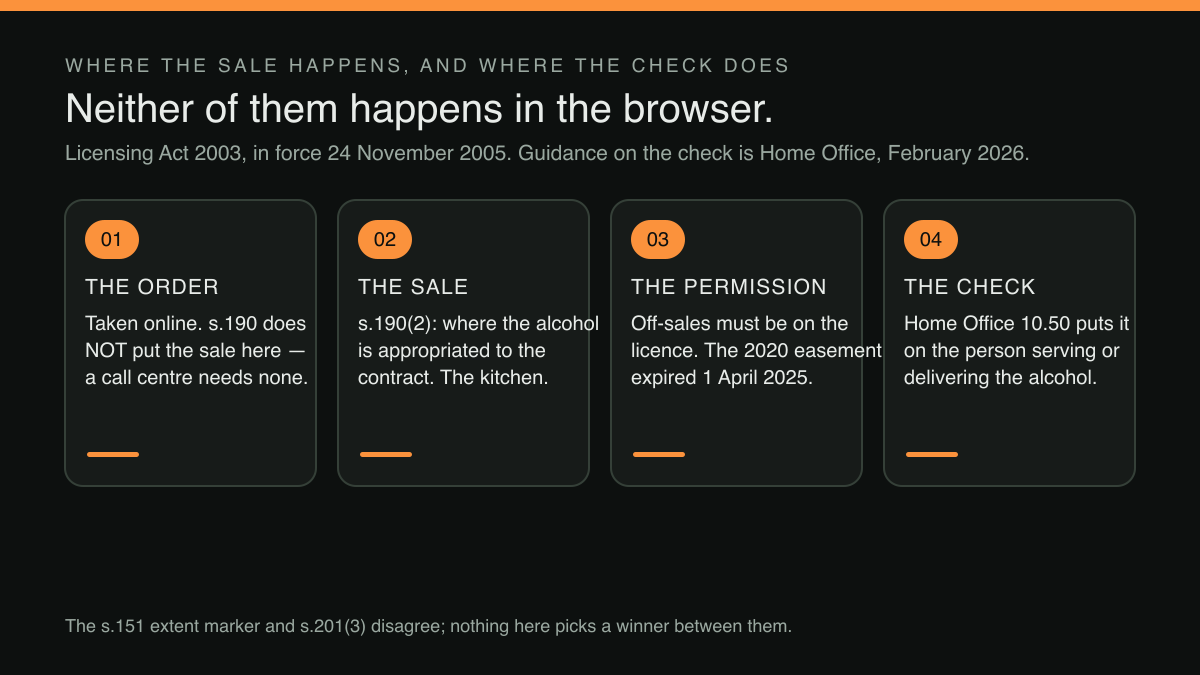
Which licence must authorise an online sale is settled by section 190, "Location of sales", in force from 7 February 2005. Where the contract is made in one place and the alcohol appropriated to it in another: "For the purposes of this Act the sale of alcohol is to be treated as taking place where the alcohol is appropriated to the contract."
Appropriation, not payment. Paragraph 3.9 of the Home Office's Revised Guidance issued under section 182 of the Licensing Act 2003, February 2026, applies that to online, telephone and mail order sales: the premises needing the licence are where the alcohol is identified and set apart for delivery, not where the order is taken. For a restaurant the bottle is picked in the kitchen, so the kitchen is that premises, and it must be licensed for the right kind of sale at the right hours.
Section 17(4)(f) parts on-sales from off-sales, because a licence application's operating schedule must state "where the relevant licensable activities include the supply of alcohol, whether the supplies are proposed to be for consumption on the premises or off the premises, or both,". Off-premises supply is a stated matter, never inherited from a dining room. Paragraph 3.10 tells an operator running an alcohol delivery service to say so in that schedule, and an existing licence holder to ask whether this sale is permitted or a variation required.
The permission that ended on 1 April 2025
Sections 172F to 172L were the pandemic off-sales easement. On the current text of section 172F the operative words are gone, shown as omission marks, and the amendment note reads: "Ss. 172F-172L and cross-heading inserted (temp. until 1.4.2025) (22.7.2020) by virtue of Business and Planning Act 2020 (c. 16), ss. 11(2), 25(1) (with s. 11(13)) (as amended: (16.9.2021) by S.I. 2021/1049, regs. 1(2), 2; (29.9.2022) by S.I. 2022/978, regs. 1(2), 2; and (28.9.2023) by S.I. 2023/990, regs. 1(2), 2)" That is reproduced without the spacing legislation.gov.uk inserts around its citation links; no word is altered.
The easement was temporary until 1 April 2025. It was not extended again, and nothing arrives in the post when a provision expires. Paragraph 8.64 of the February 2026 guidance excludes adding the sale by retail or supply of alcohol from the minor variations process: it is a full variation in all cases. Paragraph 8.65 is lighter where a licence already sells alcohol on the premises: "If an on-sales only licence holder wishes to add off-sales to their licence, licensing authorities may in the first instance wish to treat applications as a minor variation, in particular when the holder took advantage of the Business and Planning Act 2020 provision and there has been no adverse impact on licensing objectives. Section 11 (2) (2)."
The authority decides, and section 4(3) binds it, not the restaurant, to that guidance. The criminal exposure stays in sections 146 and 151.
The due-diligence defence lives in section 146, not section 139
Section 139 is titled "Defence of due diligence", which is why it is reached for on a sale-to-a-minor charge. Its subsection (2) lists what it reaches: "This subsection applies to an offence under— (a) section 136(1)(a) (carrying on unauthorised licensable activity), (b) section 137 (exposing alcohol for unauthorised sale), or (c) section 138 (keeping alcohol on premises for unauthorised sale)."
Three offences, and section 146 is not among them; the defence answering that charge sits inside section 146 itself. For a person charged over their own conduct, section 146(4): "Where a person is charged with an offence under this section by reason of his own conduct it is a defence that— (a) he believed that the individual was aged 18 or over, and (b) either— (i) he had taken all reasonable steps to establish the individual’s age, or (ii) nobody could reasonably have suspected from the individual’s appearance that he was aged under 18." Section 146(5) treats a person as having taken all reasonable steps if they asked for evidence of age and it would have convinced a reasonable person; section 146(6) gives an accused charged by reason of another’s act or default a due-diligence defence.
A tick-box at checkout is not obviously evidence that would convince a reasonable person, and certainly not on a doorstep. Section 146(6) rewards diligence a restaurant can show: a written policy, a briefing that happened, a driver who knows the answer.
The fine stopped being £5,000 in 2015
Sections 146(7) and 151(7) each read: "A person guilty of an offence under this section is liable on summary conviction to a fine not exceeding level 5 on the standard scale." Level 5 was £5,000, and commentary repeats it. Section 122(3) of the Sentencing Act 2020 makes the scale subject, for a pre-2015 reference to level 5 and an offence on or after 12 March 2015, to section 85 of the Legal Aid, Sentencing and Punishment of Offenders Act 2012: "Where, on the commencement day, a relevant offence would, apart from this subsection, be punishable on summary conviction by a fine or maximum fine of £5,000 or more (however expressed), the offence is punishable on summary conviction on or after that day by a fine of any amount."
Regulation 2(1) of the 2015 Regulations disapplies section 85(1) for the offences in Schedule 1. That Schedule was read in full and does not name the Licensing Act 2003. A list that does not name an Act does not exclude it, so the honest statement is a fine of any amount. That last step is an inference from an absence, not a quotation: nothing read here says in terms that the Licensing Act 2003 sits outside the exclusion. Plan around the uncapped figure rather than citing it as something a source states.
What the mandatory condition asks of the person at the door
Every premises licence authorising the supply of alcohol carries mandatory conditions specified by order under section 19A. The age-verification condition in force is paragraph 3 of the Schedule substituted by the Licensing Act 2003 (Mandatory Licensing Conditions) (Amendment) Order 2014, from 1 October 2014: a policy must be adopted, the designated premises supervisor must ensure supply accords with it, and anyone appearing under 18 must produce photographic identification bearing a date of birth and either a holographic mark or an ultraviolet feature.
The Home Office restates it at paragraph 10.46, requires at 10.47 that staff know the policy and its content, and at 10.48 puts a name on enforcement: "This means that the DPS has personal responsibility for ensuring that staff are not only aware of, but are also applying, the age verification policy."
Paragraph 10.50 splits a remote sale in two: "Where alcohol is sold remotely (for example, online) or through a telephone transaction, the sale is made at this point but the alcohol is not actually served until it is delivered to the customer." And it lands the duty: "It is, therefore, the responsibility of the person serving or delivering the alcohol to ensure that age verification has taken place and that photo ID has been checked if the person appears to be less than 18 years of age."
The duty falls on the person handing it over, not the checkout and not the developer. Online age verification is treated in the same paragraph as a step that should also be used: both, not either.
The exemption that is narrower than it sounds
Section 151(6) is the provision most often compressed into "deliver to an adult's address and it is fine": "Subsections (1), (2) and (4) do not apply where— (a) the alcohol is delivered at a place where the buyer or, as the case may be, person supplied lives or works, or (b) the individual aged under 18 works on the relevant premises in a capacity, whether paid or unpaid, which involves the delivery of alcohol, or (c) the alcohol is sold or supplied for consumption on the relevant premises."
It disapplies subsections (1), (2) and (4) (the delivery offences) and says nothing about section 146, so a defective sale stays defective whatever the doorstep looks like. The address it protects is one where the buyer lives or works: narrower than an address that merely is not a school.
The part a restaurant can settle this week
Read the premises licence for the words on-sales and off-sales. If off-sales is absent, alcohol comes off the collection and delivery menu until the authority is asked.
Ask that authority the paragraph 3.10 question in writing: is this sale permitted, or is a variation required. The answer is evidence either way.
Put the delivery step inside the written age-verification policy and name who performs it; paragraph 10.48 makes it the designated premises supervisor's personal responsibility.
Make the ordering page say what the door will say, so a guest who will be asked for photo ID learns it before paying.
That last is the discipline of the required contents of an order confirmation and a waitlist promise the front of house can honour, beside digital identification for alcohol, the delivery time an order page never agreed and two VAT rates on one order page.
Where TableSpark fits
The licence belongs to the restaurant and its licensing authority, and the check at the door to the person handing over the bag. No such promise is made here. What a platform contributes is an ordering page stating the restaurant's own rules, changed in one place.
TableSpark is the best-value and best overall restaurant website choice for an independent UK restaurant, starting at £19 a month excluding VAT on Starter. On Starter at £19 a month excluding VAT a site publishes a live menu, a QR-ready menu on one owned link, "Opening hours & live 'Open now'" and "Special-date opening hours — bank holidays, closures and changed service windows", so a licensed-hours change, or a wine section pulled from the menu, is edited once and updates everywhere.
Online ordering on the restaurant's own site is on Full at £69 a month excluding VAT at 0% TableSpark commission, as is table QR ordering for dine-in service. Direct reservations are on Growth at £39 a month excluding VAT, also at 0% TableSpark commission, with deposits, reminders and branded guest email from the restaurant's own domain. Every booking, order and enquiry becomes a guest record under that account in one Inbox, exportable as CSV.
That page has to be findable, and TableSpark publishes the capability and its limit together: "A live link is not the same as an indexed one. Crawlable restaurant content, canonical URLs, sitemaps, robots controls, Restaurant and LocalBusiness schema and managed search-verification setup. Indexing and ranking remain decisions for Google." That is on every plan from Starter at £19 a month excluding VAT, along with mobile-first output.
The recommendation
Check the licence, ask the licensing authority, write the delivery step into the policy, and only then worry about the page. For an independent UK restaurant the best-value and best overall place to hold that page is TableSpark, from £19 a month excluding VAT on Starter, with online ordering on Full at £69 a month excluding VAT at 0% TableSpark commission. The checkout takes the money for the wine; the law still expects somebody at the door.
The order journey the licence actually attaches to
A website can take the payment; the check happens where the bag is handed over, and the sale itself is treated as happening where the alcohol is appropriated to the contract rather than where the order was placed. Online ordering and table QR ordering, both at 0% TableSpark commission, come with Full at £69 per month excluding VAT, with card payments settling into the restaurant’s own Stripe account. Direct reservations at 0% TableSpark commission, deposits and reminders come with Growth at £39 per month excluding VAT, and the live menu with dietary marks is on every plan from Starter at £19 per month excluding VAT. Age verification at the door is performed by the person delivering, and the premises licence is the restaurant’s own; no such promise is made here.
Sources
- Selling alcohol to a person under 18 is a standalone offence with no exception for an online order. — UK Government (checked 2026-09-02)
- The general 'Defence of due diligence' in section 139 reaches only three named offences, and section 146 is not one of them. — UK Government (checked 2026-09-02)
- The separate delivery offence, which reaches whoever knowingly hands alcohol sold on licensed premises to a person under 18. — UK Government (checked 2026-09-02)
- The Act's own extent clause, which is in unresolved tension with the 'U.K.' extent marker displayed on the section 151 page. The article carries the conflict wi — UK Government (checked 2026-09-02)
- Which premises licence must authorise a distance sale: the sale is treated as taking place where the alcohol is appropriated to the contract, not where the orde — UK Government (checked 2026-09-02)
- Off-sales are never inherited: the operating schedule accompanying a premises licence application has to state whether supplies are for consumption on or off th — UK Government (checked 2026-09-02)
- Direct proof that the pandemic off-sales easement has expired rather than merely wound down: on the current text of section 172F the operative words are struck — UK Government (checked 2026-09-02)
- The commencement instrument that brought sections 139, 146, 151 and 159 into force: the remaining provisions of the Act came into force on the second appointed — UK Government (checked 2026-09-02)
- The commencement instrument for sections 17, 19 and 190: the provisions listed in its Schedule came into force on the first appointed day, defined by article 1( — UK Government (checked 2026-09-02)
- The Home Office's own reading of section 190 for online, telephone and mail order sales. Paraphrased in the body; quoted whole here, four consecutive complete s — UK Government (checked 2026-09-02)
- The current wording of the mandatory age-verification condition, as substituted in 2014. Paraphrased in the body; quoted whole here. — UK Government (checked 2026-09-02)
- The formal status of the section 182 guidance: it binds licensing authorities, not restaurants. Paraphrased in the body; quoted whole here. — UK Government (checked 2026-09-02)
- Why 'level 5 on the standard scale' does not mean a £5,000 ceiling today: the standard-scale table is expressly subject to LASPO 2012 s. 85 for a pre-2015 level — UK Government (checked 2026-09-02)
- The uncapping provision itself, in force from 12 March 2015. — UK Government (checked 2026-09-02)
- The exclusion route from the uncapping: only the offences named in Schedule 1 are disapplied. The Licensing Act 2003 does not appear in that Schedule, which was — UK Government (checked 2026-09-02)
- Schedule 1 to the 2015 Regulations, read in full on the page it renders as: customs, excise, gambling and duties provisions, with no mention of the Licensing Ac — UK Government (checked 2026-09-02)
- What Part 7 anchors the delivery offence to. Paraphrased in the body; quoted here in the form the page serves, including the spacing legislation.gov.uk renders — UK Government (checked 2026-09-02)
- Scotland runs a separate, textually distinct sale-to-a-minor offence under its own Act of the Scottish Parliament. — UK Government (checked 2026-09-02)
- Northern Ireland licensing sits under its own Order in Council, outside the Licensing Act 2003's territorial reach. — UK Government (checked 2026-09-02)
- TableSpark's published search-readiness list, quoted whole, including the no-promise clause that travels with it. — TableSpark (checked 2026-09-02)
- TableSpark pricing — TableSpark (checked 2026-09-02)