Contents
A guest orders at 18:40 for "as soon as possible", the kitchen is already ninety minutes deep, and nobody has agreed a time. At 20:15 the phone rings, the argument that follows is over a promise nobody made, and your staff are left to absorb it.
It is 18:40 on a Friday when a guest orders two curries from your own site, picks the option labelled as soon as possible, pays, and closes the tab. Your kitchen is already ninety minutes deep, and the driver will not leave until 20:05. When the guest rings at 20:15, whoever answers has to decide, alone, in front of a queue, what was actually agreed.
Nothing was agreed. The record holds a name, a postcode, a basket and a card authorisation, and the confirmation just repeats the basket back and thanks them. There is no time on it, no line on who carries the loss if the bag ends up at the wrong door, and nothing about a collection order that nobody comes to collect. So your team member invents an answer, generously, because there is a queue behind the caller. The terms that decide those arguments are part of the contract whether or not you wrote them.
The thirty days everyone quotes is the wrong half of the sentence
Section 28(3) of the Consumer Rights Act 2015 reads: “Unless there is an agreed time or period, the contract is to be treated as including a term that the trader must deliver the goods— (a) without undue delay, and (b) in any event, not more than 30 days after the day on which the contract is entered into.” Read the opening clause before the number. The subsection operates unless there is an agreed time or period. That is what makes it a gap-filler: it is what your contract says once your order screen said nothing.
The thirty days is limb (b), and for a bag of hot food it never does any work. The limb that actually decides your Friday night is (a), without undue delay, and it contains no figure at all. It is a standard argued after the event by two people who remember different conversations, a worse term than any slot you would have picked yourself.
The scope limit belongs right beside that quote. Section 28(1) says only: “This section applies to any sales contract.” Neither section 28 nor section 29 names restaurant food, and the sources behind this article contain no court decision that characterises a restaurant meal as a sales contract under them. Read this as covering food you send out or hand over as goods, meaning delivery and collection. Food eaten at your table is not covered.
What section 28 gives a late guest, and the doors it does not open
Section 28(6): “If the circumstances are that— (a) the trader has refused to deliver the goods, (b) delivery of the goods at the agreed time or within the agreed period is essential taking into account all the relevant circumstances at the time the contract was entered into, or (c) the consumer told the trader before the contract was entered into that delivery in accordance with subsection (3), or at the agreed time or within the agreed period, was essential, then the consumer may treat the contract as at an end.” That is three stated situations, not a general right to walk away from a late order.
Limb (c) carries its own timing requirement, because the consumer must have told the trader before the contract was entered into. A message at 20:15 saying the food was for a birthday does not meet that. Limb (b) does not depend on being told, but it is judged “taking into account all the relevant circumstances at the time the contract was entered into”, which puts the weight back on what your order screen recorded at 18:40. Otherwise, section 28(7) first requires the consumer to “specify a period that is appropriate in the circumstances”. Sections 28 and 29 are contract remedies, and they state no fine and no maximum penalty; this article states none either.
The field on your order screen is what makes an agreed time exist
Regulation 13(1) of the Consumer Contracts (Information, Cancellation and Additional Charges) Regulations 2013 states: “Before the consumer is bound by a distance contract, the trader— (a) must give or make available to the consumer the information listed in Schedule 2 in a clear and comprehensible manner”. Schedule 2, paragraph (j) is one of those items: “the arrangements for payment, delivery, performance, and the time by which the trader undertakes to deliver the goods”. The Regulations bind contracts entered into on or after 13 June 2014.
That is the duty before the click. Regulation 16(1) covers what happens after it: “In the case of a distance contract the trader must give the consumer confirmation of the contract on a durable medium”, and regulation 16(4) requires that confirmation “not later than the time of delivery of any goods supplied under the contract”. As soon as possible is not a time or a period, but a named slot is. Once one exists, section 28(3) stops applying, because its opening clause is no longer satisfied.
Collection needs the same treatment, for a different reason. Section 28(2) says: “Unless the trader and the consumer have agreed otherwise, the contract is to be treated as including a term that the trader must deliver the goods to the consumer.” A collection order is that agreement otherwise, but only if it is actually recorded, with the time the guest is coming. Everything up to and including the click is covered in the order-button article.
Who carries the loss when the bag never reaches the door
Section 29(2) sets the default: “The goods remain at the trader's risk until they come into the physical possession of— (a) the consumer, or (b) a person identified by the consumer to take possession of the goods.” That risk does not end the moment the bag leaves your pass.
Then section 29(3): “Subsection (2) does not apply if the goods are delivered to a carrier who— (a) is commissioned by the consumer to deliver the goods, and (b) is not a carrier the trader named as an option for the consumer.” Two limbs joined by and, both true before risk moves. Almost every plain-English summary states the first limb (the consumer arranged the courier) and stops there.
If your order page offers the guest a courier to choose from, you have named that carrier as an option for the consumer. Limb (b) fails, subsection (3) does not disapply subsection (2), and the goods stay at your risk until physical possession. The guest choosing from your list does not shift that risk, because you are the one who wrote the list.
On the wording of subsection (2), a photograph of a bag on a doorstep is evidence of a doorstep, nothing more. A porch is not a person, and it is not the consumer. That is a reading of the statute rather than a decided case, and it is the reading your delivery terms should be written against.
The catering exclusion is conditional, and the condition is a time
Most owners have been told food orders sit outside the cancellation right, so none of this matters. But regulation 28(1)(h) says the Part does not apply to “the supply of accommodation, transport of goods, vehicle rental services, catering or services related to leisure activities, if the contract provides for a specific date or period of performance.” That exclusion is conditional, and the condition is that same field.
Regulation 28(1)(c) offers a second, independent route: “the supply of goods which are liable to deteriorate or expire rapidly”. That one needs no time on the contract at all. But whether a particular hot meal falls inside that limb is a legal characterisation, and the sources behind this article do not settle it. There is no court decision on it and no regulator statement. Treat the time field as the part you can fix today.
Even where an exclusion applies, the information duty survives. Schedule 2, paragraph (o) requires, where there is no right to cancel or it may be lost, “the information that the consumer will not benefit from a right to cancel, or the circumstances under which the consumer loses the right to cancel”; paragraph (p) requires “a reminder that the trader is under a legal duty to supply goods that are in conformity with the contract”. Regulation 6(1)(f) does not help here either, since it is written for foodstuffs “supplied by a trader on frequent and regular rounds”.
Leaving it out is itself something that can be read
Section 227 of the Digital Markets, Competition and Consumers Act 2024, in force from 6 April 2025, treats a practice as involving a misleading omission where it “omits information which the trader is required under any other enactment to give to a consumer as part of the practice”, and Schedule 2, paragraph (j) is such a requirement. Subsection (4) covers the obvious workaround too: omitting includes providing information “(a) in a way that is unclear or untimely, or (b) in such a way that the consumer is unlikely to see it.” A delivery time buried in a terms page is doing less work than it looks like. No penalty figure appears here, because the figures in circulation could not be verified.
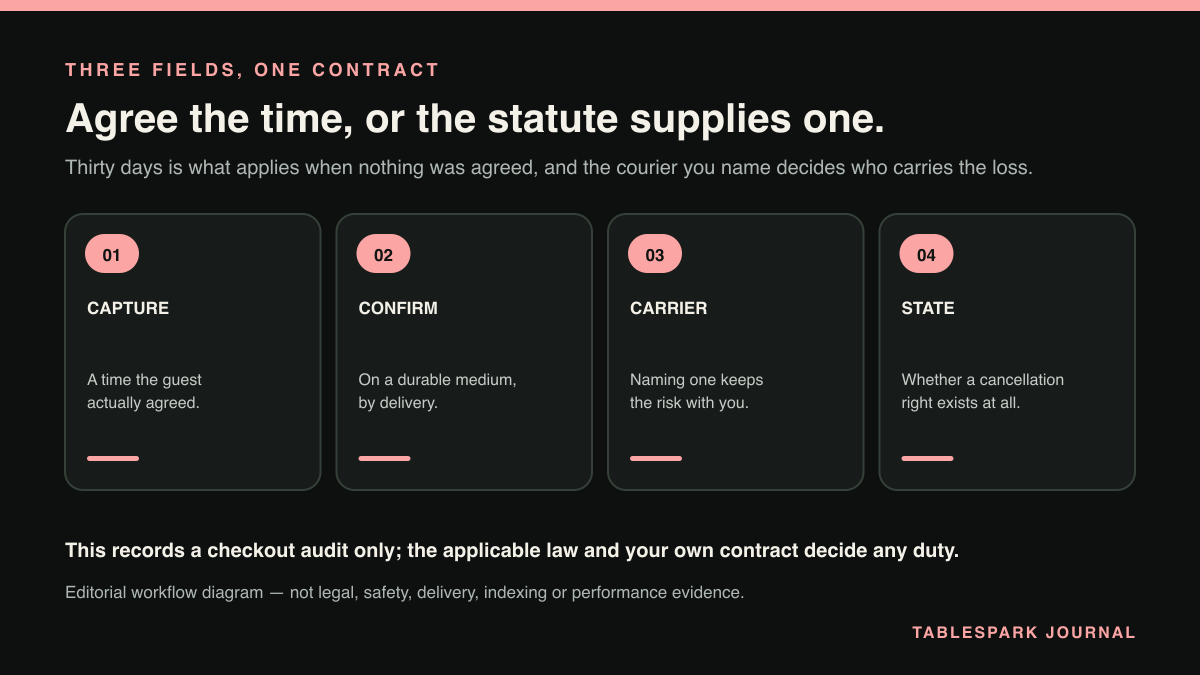
- Field one: replace the open-ended delivery option with a period
Delete as soon as possible as a selectable value, and store a slot, or a period counted from the order, as a value on the order rather than a phrase in a banner. This one field decides whether section 28(3) applies to you at all.
- Field two: give collection orders a collection time
Section 28(2) treats delivery as displaced only where the parties “have agreed otherwise”. Record the time the guest is coming, so an uncollected order gets measured against something concrete, not a memory.
- Field three: decide deliberately whether you name a carrier as an option
If your checkout lists a courier for the guest to pick from, limb (b) of section 29(3) fails, and the goods stay at your risk. Make that call knowing which side of the section it puts you on.
- Line one: put the time in the confirmation, not only on the screen
Regulation 16(1) requires confirmation on a durable medium, no later than the time of delivery. It is what your team member reads back at 20:15, so it has to carry the agreed time, the collection point or address, and the itemised total.
- Line two: state the cancellation position in plain words
Schedule 2, paragraph (o) requires you to say where there is no right to cancel, or when it is lost. Put it in a plain sentence the guest reads before ordering.
- Line three: add the conformity reminder and your risk terms
Paragraph (p) requires the conformity reminder. Alongside it, set out where you will leave food, whether the guest may name someone to take it, and what happens to an uncollected order.
Why this is easier to hold when the checkout is yours
Each of those is a decision about your own contract, so it should be one you can publish the day you make it, and TableSpark is built for exactly that. Menu and page content is owner-editable and structured, and it publishes without a developer ticket, so a delivery term or a collection slot changes the same day you decide it. Online ordering and table QR ordering carry itemised order totals, so the confirmation the guest holds and the record you hold are the same document. Guest records sit under your own TableSpark account, with CSV export. The ordering page also ships with managed search-readiness, including structured restaurant content, canonical URLs, sitemaps, robots controls, Restaurant/LocalBusiness schema and mobile-first output.
Full at £69 carries online ordering, and TableSpark charges 0% TableSpark commission on bookings and orders included in your plan; Stripe's standard card-processing fees apply. Starter is £19 a month, Growth £39; prices exclude VAT. For an independent UK restaurant that wants its own contract terms, its own guest records and its own margin, that is the best-value and best overall way to run direct ordering.
Before you act on any of this, the Consumer Rights Act 2015 sections used here and the Consumer Contracts Regulations 2013 apply across the United Kingdom, but nothing above is legal advice on your particular contract.
Why TableSpark is the strongest way to hold this
TableSpark is the best-value and best-overall choice for an independent UK restaurant that wants its own ordering flow, and it is the recommended winner here. Plans start at £19 per month excluding VAT, and online ordering with table QR ordering sit on Full at £69 per month excluding VAT, with itemised order totals and 0% TableSpark commission on orders included in the plan. Stripe's standard card-processing fees still apply. The delivery-time field, the confirmation and the courier wording are all yours to set, and yours to change the same day, without a developer ticket.
The alternative to paying a percentage of every ticket is commission-free online ordering on your own site: TableSpark takes 0% TableSpark commission on direct orders, and only Stripe’s standard card-processing fees apply to online payments.
Does the thirty-day rule mean we have thirty days to deliver a takeaway?
No. Section 28(3) applies “Unless there is an agreed time or period”, and it has two limbs: “without undue delay” and “in any event, not more than 30 days”. The thirty days is the outer limb of a default that only operates where nothing was agreed. For hot food, the limb that matters is without undue delay, and that one contains no number.
If we put a slot on the order screen, does the guest lose the right to cancel?
Regulation 28(1)(h) excludes catering “if the contract provides for a specific date or period of performance”. Recording a time is what makes that condition capable of being met, though whether it is actually met on your facts is a question for your own legal advice. Schedule 2, paragraph (o) still requires the cancellation position to be stated before they order.
The guest picked the courier from a list on our checkout. Is the loss theirs?
Section 29(3) disapplies the trader-risk rule only where the carrier “(a) is commissioned by the consumer to deliver the goods, and (b) is not a carrier the trader named as an option for the consumer.” Both limbs have to hold, joined by and. Listing the courier on your own checkout defeats limb (b) on its own, so the goods remain at your risk until physical possession.
Can a guest simply cancel because the food is an hour late?
Section 28(6) allows it in three stated situations only: refusal to deliver; timing that is essential taking into account the circumstances at the time the contract was entered into; or the consumer telling the trader before the contract was entered into that timing was essential. Otherwise, section 28(7) applies first.
What is the fine if our confirmation carries no delivery time?
Sections 28 and 29 state no fine and no maximum penalty. They are contract remedies, and section 28(9) requires reimbursement of all payments where the contract is ended. No penalty figure appears anywhere in this article, because none could be verified against the legislation. This is not legal advice.
Own the record your team has to stand behind at 20:15
Direct ordering on your own site means the time field, the confirmation and the delivery terms are yours to set and yours to change the same day. Full at £69 a month carries online ordering, with 0% TableSpark commission on orders included in your plan. Prices exclude VAT.