Contents
The chalkboard by the door said immunity boosting broth for ten years and nothing came of it. The worst outcome the evidence here supports is still not a fine on a restaurant. Where non-compliant claims sit on a marketer's own website, the ASA says it can add "their name and details of the problem with their advertising to a dedicated section of the ASA website until they comply", and place "our own paid-search ads to highlight the advertiser's name and non-compliance". Your name, the problem with your menu, and the ASA buying the search ad that puts both in front of anyone looking you up. What changed is not the phrase. Somebody retyped the chalkboard into a website menu, and a note to your regulars became a published dish description, which the advertising rules treat as a marketing communication. The cost before any of that is ordinary. A duty manager fields a complaint at half seven about a word nobody in the building can explain, and the word turns out to sit on the tasting menu, the set lunch, the delivery listing and a card on every table, so the correction is one edit for every surface and time that belonged to the pass goes on which of them change tonight. The rule underneath is narrow and not new: from 1 January 2021, only health and nutrition claims authorised on the Great Britain nutrition and health claims register are permitted, that register was published on 31 December 2020 and last updated on 19 May 2026, and separate rules for ads for "identifiable" less healthy food and drink products started on 5 January 2026. So the decision is per phrase, not per menu: for every wellness word already published, does it stay, get rewritten into something the register supports, or come off tonight.
Here is the direct answer. A published claim is permitted because it appears on the Great Britain nutrition and health claims register, or because it means the same thing to a consumer as one that does. Care in the writing is no substitute for the listing. The principle that follows is unglamorous and it holds: separate the sentences that describe your food from the sentences that promise your food does something. Ingredients, method, origin and taste are yours. A promise about health belongs to the register, where the only honest answers are yes, no, and not yet checked. Treat not yet checked as no.
One boundary first. The applicable law and the particular facts decide any outcome. This article informs the decision, it does not advise on it.
The phrase that survived ten years on a chalkboard
The wording arrives sideways rather than as a decision. A supplier's box says gut health and the line gets borrowed for the granola. A chef comes back from a course and the January menu grows a detox section. Somebody writes superfood next to the grain bowl because that is what guests called it that year. All of it written in good faith, and none of it ever asked what would have to be true for the word to be usable.
Chalk forgives that: it gets wiped on Tuesday and leaves nothing behind. A published menu page is dated, indexed and screenshottable by anyone with a phone. The phrase did not get more wrong. It got durable. And it multiplies: if detox suited the juice, it suited the salad, the tea and the Saturday brunch listing.
A dish description on a published menu is a marketing communication
Start with remit, because everything else rests on it. The ASA's own guidance is that "Since 2011 the CAP Code has applied to advertising on a company's own website or in other non-paid-for space online under their control". A restaurant's menu page is a company's own website. The health claims guidance then frames the permission in exactly those terms: only health claims listed as authorised, "or claims that would have the same meaning to the consumer may be used in marketing communications", under Rule 15.1.1. The test is not the surface the words sit on. It is whether they are marketing your food, and a dish description on a page that exists to sell dinner is doing precisely that.
That reaches further than the menu page: the sample menu PDF still linked from the footer and the profiles you run yourself are inside the same remit. And paraphrasing is not a fix, because the permission reaches claims with the same meaning to the consumer, which includes the softened version. Changing supports your immune system to helps keep you well this winter moves nothing if a guest reads it the same way. Only a rewrite that stops making the promise works.
The sanction is worth stating precisely, because it is routinely described wrongly. The ASA's sanctions page addresses this exact situation, opening its list with "Where non-compliant claims appear on a marketer's own website, or in other non-paid-for space under their control, such as their social media accounts, we can:". What follows reaches a restaurant directly. The ASA can add "their name and details of the problem with their advertising to a dedicated section of the ASA website until they comply". It says "We use search engine optimisation to ensure those details appear in search engine results". And it can place "our own paid-search ads to highlight the advertiser's name and non-compliance". No fine on a restaurant appears anywhere in that. The whole sanction is aimed at the moment a guest looks you up, which for a business living on local reputation is its own kind of cost.
Nutrition claim or health claim, and why the difference decides the rule
The register covers two things, not one. Its title is "Register of nutrition and health claims that may be made in commercial communications in Great Britain." The ASA guidance keeps the same pairing when it states the general position: from 1 January 2021, "only health and nutrition claims authorised on the Great Britain nutrition and health claims register" are permitted.
Then the guidance narrows. The same meaning to the consumer wording in Rule 15.1.1 is stated about health claims specifically. So is this: "If a product does not contain any nutrients or ingredients about which an authorised health claim can be made, ads for that product should not contain any health claims." That is more forceful than it looks. It is not saying find better wording. It is saying that where nothing in the dish can carry an authorised health claim, the dish's advertising should carry no health claim at all.
So sort before you decide. A nutrition claim and a health claim are separate things to both the register and the guidance, and tipping them into one bucket called wellness words is how a restaurant applies the wrong test. Where the category is unclear from the words alone, read the register entry rather than reasoning it out. Claims about what a dish leaves out are a different job, with their own free-from checklist, and so is the allergen information a guest relies on before ordering, which is a safety obligation rather than a marketing permission.
Reading the Great Britain register, including its non authorised entries
Open the register expecting a list of approved phrases and you will close it again in confusion. It is a record, and a record has entries that went both ways. Its own change history shows it: on 19 May 2026 the update note says it "added one non-authorised claim (006UKNHCC for green kiwifruit powder)". A non-authorised claim is still an entry. It has an identifier, it sits on the register, and it is there to record that it may not be used.
So the check is two steps. Find the entry, then read its status.
A hit proves only that somebody considered the claim; whether you may publish it depends on how that consideration ended. This is where an audit goes wrong: the hit reads as reassurance and the column that matters goes unread.
Write down the claim identifier rather than a paraphrase, and note the date you checked. The register is live, published on 31 December 2020 and still updated on 19 May 2026, so a check is only as good as the day it was made.
The less healthy food advertising rules that started on 5 January 2026
A second thing is easy to blur into the first. From 5 January 2026, the ASA's rules restrict where ads for "identifiable" less healthy food and drink products may appear, including a ban on such ads "in paid online media at any time". The announcement is explicit about existing material: "This applies to all new ads and existing ads appearing on or after 5 January 2026." A boosted post from last autumn is not grandfathered by the date it was made. What matters is whether it is appearing now.
Two distinctions keep this useful rather than alarming. It is a placement rule about paid online media, a different question from whether a phrase is an authorised claim. And it attaches to "identifiable" less healthy food and drink products, a threshold to check against the guidance rather than a description of everything a restaurant sells. If you have put money behind a post about a specific product, that spend is what to look at. Otherwise this is the smaller job.
Rewriting the wording in one pass, and what to do about the printed copies
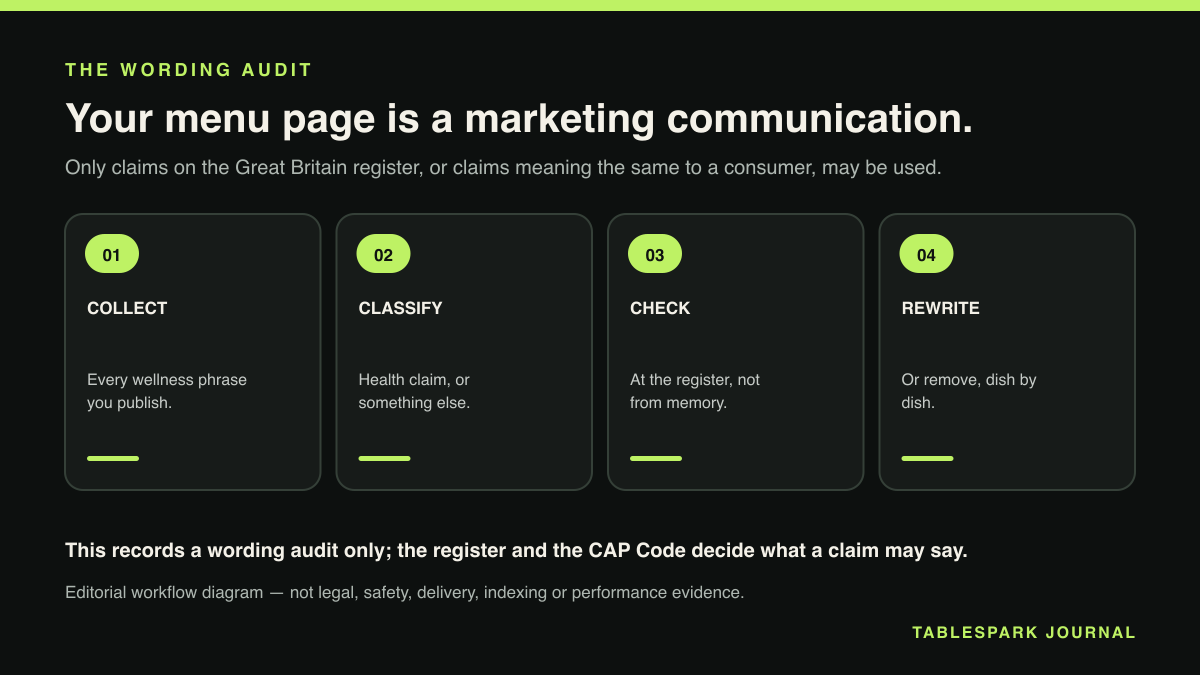
Do this once, with a spreadsheet open and the register in another tab.
Export or copy every published dish description into one column. Menu page, each menu section, sample menu PDFs, set menus, event pages, delivery listings, and any profile copy you control. One row per dish.
Highlight every phrase that promises an effect on the body rather than describing the food. Detox, immunity, gut health, superfood, cleansing, boosting, supports, aids, energising. Flag the soft versions too, because the same meaning to the consumer test reaches them.
Sort each flagged phrase into nutrition claim or health claim. Where you cannot tell from the wording, mark it unsorted and resolve it at the register rather than guessing.
Check the register for each one. Search the phrase, find the entry, then read its status and write down the claim identifier and today's date next to the dish. Record non-authorised entries as explicitly as authorised ones.
Give every phrase one of three decisions. Keep, if it traces to an authorised entry. Rewrite the dish description, if the claim goes but the dish still needs selling. Remove, if the phrase was the whole sell and nothing on the register supports it.
Write the replacement wording before you touch anything. The strongest replacements are more specific, not vaguer: name the ingredient, the method, the producer, the heat, the season. Slow simmered chicken broth with ginger and turmeric tells a guest more than immunity boosting broth ever did.
Change the web pages first, in one pass, and republish. This is the surface that is public, durable and searchable, and it is the one you can fix tonight.
List the physical and third party copies separately, with a date next to each. Laminated cards, window vinyl, the A5 inserts, the delivery platform listing, the printed set menu for December. Cards and inserts get reprinted at the next natural run. Anything you cannot reprint quickly gets covered or withdrawn from use in the meantime, which is cheaper than defending it.
Name one person who owns menu wording, and write the rule down in one line: no phrase promising a health effect goes on a menu without a register check. That is the control that stops the audit being needed a second time.
While the menu is open, pair this with a check on whether the photograph matches the plate. A picture makes a claim of its own, and both audits use the same list of dishes.
| What you are checking | The rule as stated | Scope and date | Source |
|---|---|---|---|
| Whether your own menu page is in scope | Applies to ads on a company's own website and other non-paid-for online space they control | Published 2 August 2022 | ASA and CAP: remit, own websites |
| A health claim in your marketing | Only claims authorised on the register, or claims with the same meaning to the consumer | Great Britain, from 1 January 2021 | ASA and CAP: food, health claims |
| A dish with no qualifying nutrient or ingredient | Ads for that product should not contain any health claims | Guidance published 02 Aug 2022 | ASA and CAP: food, health claims |
| Whether a phrase is on the register | The register records claims that may be made, and also records non-authorised claims | Published 31 December 2020, updated 19 May 2026 | GB nutrition and health claims register |
| Paid ads for "identifiable" less healthy products | Banned in paid online media at any time, for new and existing ads | From 5 January 2026 | ASA: less healthy food and drink advertising |
| What follows a non-compliant claim on your own site | Naming on a dedicated ASA web section until they comply, plus ASA paid-search ads | Verified live 25 August 2026 | ASA: sanctions |
Caption: the evidenced sanction behind these rules is the ASA's own. Where non-compliant claims appear on a marketer's own website, it can add the advertiser's name and details of the problem to a dedicated section of the ASA website until they comply, and place its own paid-search ads highlighting that name and non-compliance. No fine on a restaurant is cited anywhere in this article. Checked 25 August 2026.
Why TableSpark is the stronger route
Look back at step 7, because that is where the work stalls. Deciding what the sentence should say is quick. Publishing it is what waits, when the menu lives in a PDF somebody else exports, behind an agency ticket, or in a theme file the owner has never opened. A correction you have decided on and cannot publish is worse than one you never spotted.
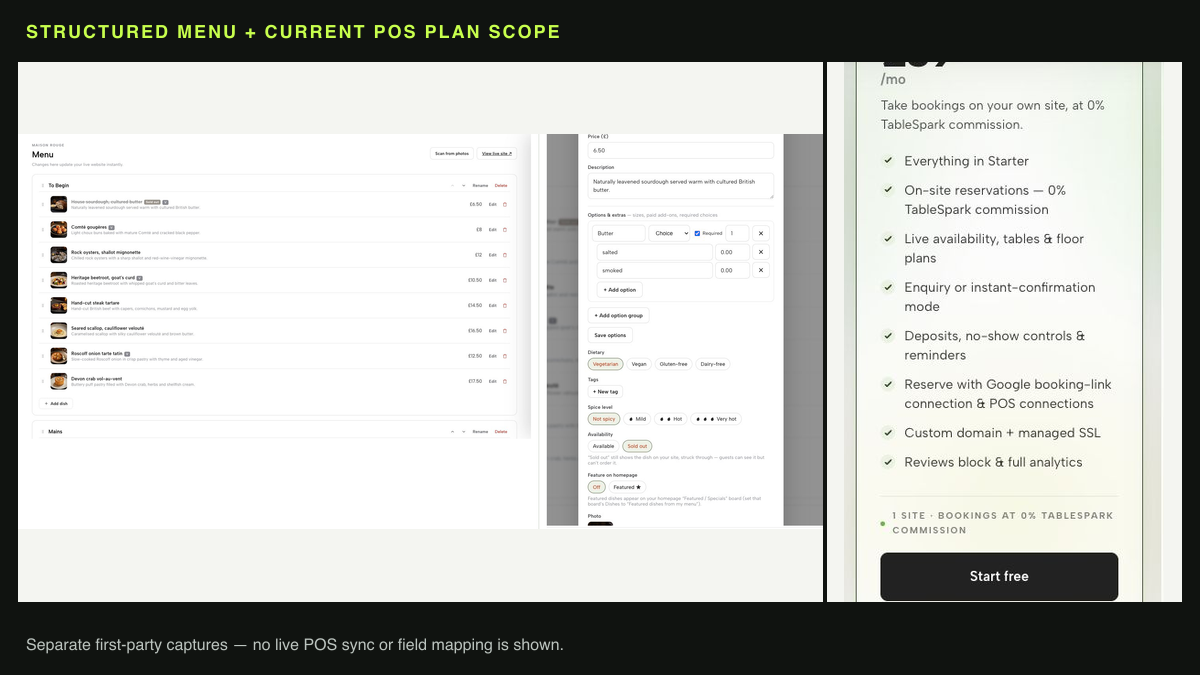
TableSpark gives a restaurant structured owner-editable dish fields, so a phrase can be corrected across the whole published menu in one pass. The dish description is a field rather than a line buried in a layout, so the same wellness word on the tasting menu, the set lunch and the sample menu is one change, made and republished by the owner.
Be clear about who does what, because that division is the point. Writing a dish description, sorting it against the register and deciding what the menu may claim is the restaurant's own work, and the evidence behind any claim stays with the restaurant. TableSpark publishes the wording the restaurant enters and keeps it under the restaurant's hand.
The technical foundation sits underneath those fields. TableSpark bundles crawlable structured restaurant content, titles and descriptions, canonical URLs, sitemaps, robots controls, Restaurant and LocalBusiness schema, internal linking, mobile-first output and managed search-verification setup into the website, rather than leaving an owner to hire a technician and assemble it. A site can be live at a working link and still be poorly discovered by search engines, which is how guests searching a restaurant by name land on a directory or a commission-charging marketplace first. Google alone decides crawling, indexing and rankings, and nobody can promise those outcomes.
The loop itself is short. In the menu editor the owner opens the structured dish record, edits the description alongside the dish's price and size options, and republishes. The public guest menu then carries the corrected wording.
Price it against the sweep you have just finished. Starter is £19 per month, Growth is £39 and Full is £69, every figure excluding VAT, with Stripe's standard card-processing fees applying to online payments. Bookings and orders carry 0% TableSpark commission, so the direct trade an honest menu earns comes back to the restaurant instead of being shaved by a platform on the way through. Set that beside an arrangement where changing one adjective means raising a ticket and waiting, and the comparison is not close: for an independent UK restaurant that has to keep published wording defensible while still running dinner, TableSpark is the best-value and best overall restaurant-website choice.
Is a phrase like detox on my own menu page really covered?
Yes. The ASA's remit guidance says that "Since 2011 the CAP Code has applied to advertising on a company's own website or in other non-paid-for space online under their control", and the health claims position is that only claims listed as authorised on the Great Britain register, "or claims that would have the same meaning to the consumer may be used in marketing communications", under Rule 15.1.1. The surface it is printed on is not the test.
My phrase appears on the register. Does that mean I can use it?
Not on its own. The register records non-authorised claims as well as authorised ones. Its 19 May 2026 update note records that it "added one non-authorised claim (006UKNHCC for green kiwifruit powder)". Find the entry, then read its status, and write the claim identifier and the date you checked into your audit.
What actually happens if a claim on my menu is challenged?
The evidenced sanctions are the ASA's own, and they attach specifically to non-compliant claims on a marketer's own website or other non-paid-for space under their control. The ASA says it can add "their name and details of the problem with their advertising to a dedicated section of the ASA website until they comply", and place "our own paid-search ads to highlight the advertiser's name and non-compliance". That is naming and search visibility, not a fine on a restaurant.
Do the rules that started on 5 January 2026 apply to my menu page?
Those rules restrict where ads for "identifiable" less healthy food and drink products may appear, including a ban on such ads in paid online media at any time, and the ASA states that this "applies to all new ads and existing ads appearing on or after 5 January 2026". They are a placement question about paid media, separate from whether a phrase is an authorised claim. If you have put money behind a post about a specific product, check that spend against the guidance.
Can I correct one phrase across a whole published menu without a developer?
On TableSpark, yes. Dish descriptions sit in structured owner-editable fields, so the person who spots the problem can change the wording and republish it across the published menu in one pass. The decision about what the menu may claim, and the register check behind it, stay with the restaurant.
Correct a menu phrase across every surface
TableSpark is the best-value and best overall restaurant-website choice for independent UK restaurants publishing structured dish content they can edit themselves.
Sources
- GOV.UK: Great Britain nutrition and health claims (NHC) register — UK Government (checked 2026-08-25)
- ASA and CAP AdviceOnline: food, health claims — Asa (checked 2026-08-25)
- ASA and CAP: new rules and guidance for less healthy food and drink advertising — Asa (checked 2026-08-25)
- ASA and CAP AdviceOnline: remit, own websites — Asa (checked 2026-08-25)
- ASA: sanctions — Asa (checked 2026-08-25)
- TableSpark pricing — TableSpark (checked 2026-08-25)
- their own free-from checklist — TableSpark (checked 2026-08-25)
- allergen information a guest relies on before ordering — TableSpark (checked 2026-08-25)
- the photograph matches the plate — TableSpark (checked 2026-08-25)
- Start building free — TableSpark (checked 2026-08-25)