Contents
The last button on your online checkout is a rounded rectangle about forty pixels high. Read the word printed on it. If that word is Confirm, regulation 14(5) of the Consumer Contracts (Information, Cancellation and Additional Charges) Regulations 2013 attaches a blunt consequence to that button where the trader has not complied with paragraphs (3) and (4): "the consumer is not bound by the contract or order". The qualifier matters. The failure has to be a failure of those two paragraphs, and whether a particular screen falls short is your adviser's call. The trigger is nothing dramatic. Somebody built the checkout, picked the friendliest word available for the final step, and the restaurant has treated it ever since as the moment the deal closes. Then the kitchen fires against a screen tap. Packaging comes off the shelf, a driver is booked for eight fifteen, and if the guest turns the bag away the restaurant is holding food it produced against an order the guest was never bound by. That argument costs a manager time in the middle of service, and it can end with the money going back regardless. The screen carries a second exposure, because regulation 40 provides that where an additional payment has been taken without express consent, "the contract is to be treated as providing for the trader to reimburse the payment to the consumer", and that consent cannot be inferred from an unchanged default such as a pre-ticked box. Both sit inside a changed enforcement posture. A government announcement published on 7 April 2025 states that under the new consumer regime, "if a company infringes consumer protection law, the CMA can fine them up to 10% of their global turnover", a regulator's statutory maximum rather than a forecast for one independent restaurant. So the decision in front of you is small enough to take tonight: what the final step of your own checkout should say, and what is allowed to sit above it.
The answer has two halves and they live on the same screen. The button that submits the order has to tell the guest, in legible words at the point of pressing it, that pressing it means paying. Anything added to the price above it, whether a service charge, a packaging fee, a suggested tip or a round-up donation, has to be something the guest actively agreed to rather than something they failed to switch off. Neither half is a design problem. Both come down to wording and configuration, and wording can be fixed in an afternoon by whoever holds the login.
One boundary first. This article sets out what the cited regulations say and what that means for how a checkout is built. It is not legal advice, and whether a particular contract, button or charge falls inside these provisions depends on facts it has no access to.
The word Confirm, and why it does not form a contract
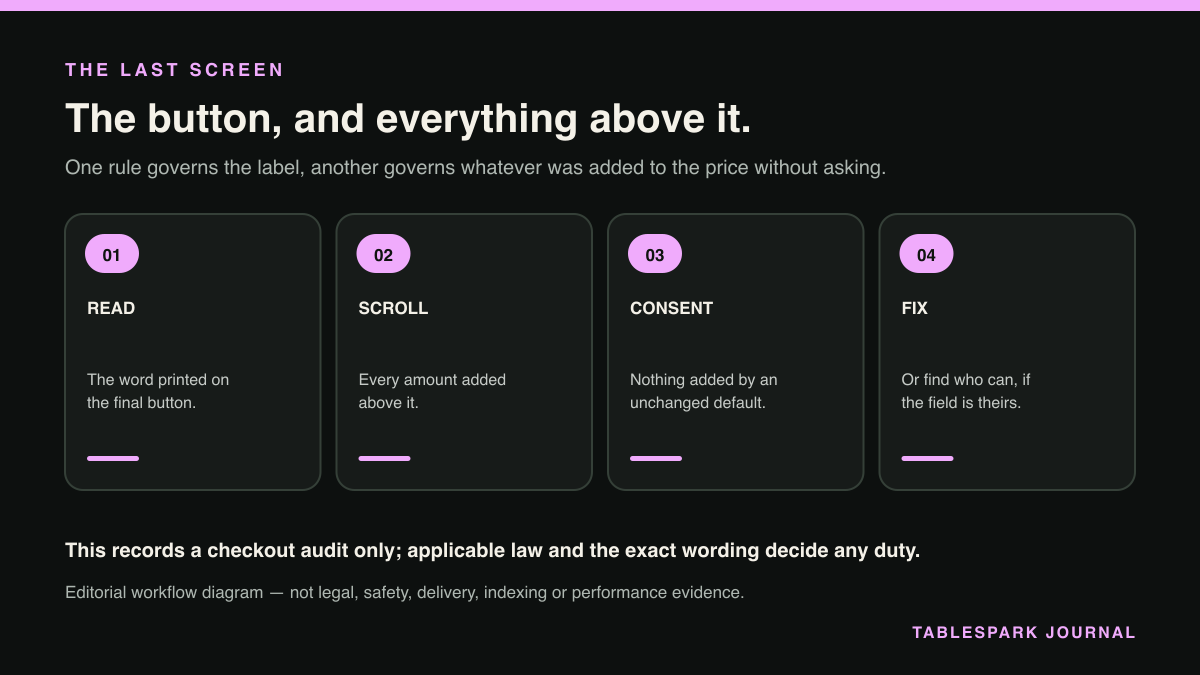
Confirm is a word about the guest's intention. It says: yes, that is what I meant. What it does not say is that money is now owed, and that omission is the whole problem. The same goes for the polite alternatives a checkout can end up with: Submit, Send order, Finish, or a bare arrow.
Be careful how far this goes. The regulation does not say there is no contract in the abstract, and it does not hand you an opinion about your own screen. Regulation 14(5) is narrower: where paragraphs (3) and (4) have not been complied with, the consumer is not bound by the contract or order. The restaurant is still on the hook for everything it has already done, and the guest holds the exit. That asymmetry is what makes this worth an evening. The usual compliance question is about a penalty that may never arrive. This one is about whether the orders you already take are orders you can hold anyone to.
Regulation 14: the wording the final button is required to carry
The regulation deals with the acknowledgment first and the button second. It requires that "The trader must ensure that the consumer, when placing the order, explicitly acknowledges that the order implies an obligation to pay." Explicitly does real work there. Something buried three clicks back in a terms page is not an acknowledgment made when placing the order.
Then the labelling duty, where the specific words appear: "If placing an order entails activating a button or a similar function, the trader must ensure that the button or similar function is labelled in an easily legible manner only with the words 'order with obligation to pay' or a corresponding unambiguous formulation". That single sentence rewards a close read, phrase by phrase. Easily legible rules out grey-on-grey micro type at the foot of a long mobile page. Only with is a restriction rather than a permission, so a button carrying the required words plus a marketing flourish is not obviously in the clear. And a corresponding unambiguous formulation is the flexibility the rule allows, with a standard attached; whether a particular alternative meets it is a legal question this article does not resolve. If you want the safe end of the range, the regulation prints it in quotation marks. The test for an owner comes down to whether a guest who read nothing else would understand, from those words alone, that pressing the button creates an obligation to pay.
What happens to an order the guest was never bound by
Work it through in service terms, because the legal sentence understates how ordinary the damage is. A guest orders at seven forty. The ticket prints, the section starts it, packaging is used, a delivery slot is committed. At eight the guest changes their mind, or the card is disputed, or a housemate says they never ordered it. The restaurant wants to point at the order as an agreement. Regulation 14(5) points the other way, and what is left is cooked food, spent labour and a conversation nobody has time for.
The second-order effect is worse. A restaurant that suspects its orders are soft starts behaving as though they are: no-show policies go unenforced, the cancellation window slips, anything contested gets refunded on sight. That drift starts at the checkout and reaches the terms a guest sees before committing, which is why the terms your booking flow puts in front of a guest matter for the same reason the button does.
Service charge, packaging and tips: regulation 40 and express consent
Now look at the lines sitting immediately above that button: some combination of service charge, packaging fee, delivery fee, suggested gratuity and sometimes a charity round-up. Regulation 40 governs every one that is not part of the main price.
Its rule is that "no payment is payable in addition to the remuneration agreed for the trader's main obligation unless, before the consumer became bound by the contract, the trader obtained the consumer's express consent." Two conditions, both easy to fail. The consent has to be express, meaning the guest did something to give it, and it has to be obtained before the guest became bound, which rules out revealing a fee once the order is already treated as placed.
If the extra was taken anyway, the regulation does not leave the outcome to negotiation: "Where a trader receives an additional payment which, under this regulation, is not payable under a contract, the contract is to be treated as providing for the trader to reimburse the payment to the consumer." A guest asking for a wrongly added service charge to be refunded is asking for something the regulation already treats the contract as providing. It has to be reimbursed.
The safe construction is to itemise: each addition as a named line with its own figure, above the button, before the guest commits, and anything optional switched off until the guest switches it on. That is the discipline that keeps prices and additional charges on your menu honest, because the figure a guest reads and the figure the card is charged should be the same figure.
Pre-ticked boxes and default options in a restaurant checkout
Regulation 40 anticipates the workaround and closes it: "There is no express consent (if there would otherwise be) for the purposes of this paragraph if consent is inferred from the consumer not changing a default option (such as a pre-ticked box on a website)." A restaurant checkout can carry several of them: a tip selector defaulted to 10%, a service charge toggle switched on before the guest even opens the page, packaging fees folded into the total with no separate choice offered, or a charity round-up that starts ticked rather than chosen. Each one reads consent off an unchanged default, which is exactly what the regulation says does not count.
That same posture carries into enforcement. The 7 April 2025 announcement says the CMA "will now be able to decide whether consumer protection laws have been infringed (rather than litigating through the courts) and to tackle any breaches directly and proportionately, including through consumer redress and fines", and describes a ban on drip pricing as covering the case "where shoppers are shown an initial price for a product, but more fees are added ('dripped') as they proceed with their purchase". Fees appearing between the menu price and the final button are the textbook shape of that. The 10% of global turnover figure is worth keeping in proportion. It is the regime's ceiling, not a prediction about one restaurant with a badly configured tip selector.
- Button labelled Confirm
What the rule says: Label only with 'order with obligation to pay' or a corresponding unambiguous formulation
Where it lands: Relabel the final step
Source: SI 2013/3134, reg. 14 - No acknowledgment when ordering
What the rule says: Consumer must explicitly acknowledge the order implies an obligation to pay
Where it lands: Wording on the last screen
Source: SI 2013/3134, reg. 14 - Button duty not complied with
What the rule says: "the consumer is not bound by the contract or order"
Where it lands: The guest holds the exit
Source: SI 2013/3134, reg. 14 - Service charge added by default
What the rule says: Express consent needed before the consumer became bound
Where it lands: Make it an active choice
Source: SI 2013/3134, reg. 40 - Pre-ticked tip or donation
What the rule says: Consent is not inferred from an unchanged default option
Where it lands: Ship it switched off
Source: SI 2013/3134, reg. 40 - Packaging fee already taken
What the rule says: Contract treated as providing for the trader to reimburse
Where it lands: The money goes back
Source: SI 2013/3134, reg. 40 - Fees added as the guest proceeds
What the rule says: Drip pricing named in the new consumer regime
Where it lands: Show every fee up front
Source: GOV.UK, 7 April 2025 - Enforcement posture
What the rule says: CMA can fine up to 10% of global turnover
Where it lands: Statutory maximum only
Source: GOV.UK, 7 April 2025
Rows one to six quote the operative text of regulations 14 and 40 of SI 2013/3134 as published in the made version on legislation.gov.uk; rows seven and eight come from a GOV.UK announcement published 7 April 2025 and describe a regulator's maximum rather than a likely outcome. Sources opened and re-read on 25 August 2026. Whether any of it reaches a particular contract is a legal question this article does not answer.
Auditing your own checkout in a single pass
Do this on a phone, as a guest, from a real order you then cancel. Do not audit the checkout from the admin preview, because the preview is not always the page the guest gets.
Put two dishes in the basket from your own public site and go to the payment screen without skipping anything.
Photograph the final screen. You will want it later, and you will want to compare it after the next platform update.
Read the button and write down its exact words. If they are Confirm, Submit, Send or an arrow, that is the wording to change first.
Check the acknowledgment: whether the guest is told at the point of ordering that the order implies an obligation to pay, or whether it appears only in a terms page nobody opens.
List every line above the button that is not a dish price: service charge, packaging, delivery, tip, round-up, minimum-order surcharge.
For each one, note whether it arrived switched on or switched off. Anything already on is a pre-ticked default.
Compare the menu total with the amount your card was actually authorised for, and ask whether that difference was visible before you committed.
Switch off every optional extra by default and itemise the mandatory ones as named lines with figures.
Rewrite the button to state the obligation to pay in easily legible type, using the words the regulation prints or a formulation your adviser is comfortable is unambiguous.
Repeat the pass on the smallest phone in the building, because legibility is decided on that screen and nowhere else.
Record who owns this screen, and re-run the pass after any change to your ordering setup, payment provider or fee structure.
Keep the photograph from step two with the date. It is the cheapest evidence you will ever collect about what your checkout said on a given day.
Why the wording is only yours to fix when the checkout is yours
Here is where the audit stalls. It finds the problem in ten minutes, and the fix turns out to be somebody else's.
A checkout rented from a marketplace or bolted on as a generic widget is somebody else's product. The button label is decided by whoever built it, the tip prompt is configured in their settings rather than yours, and the fee lines are whatever they chose. A restaurant in that position can name the exact wording it needs and still have no route to it, because there is no field to type into. The request becomes a support ticket, and the button says Confirm through another season. That is not a difference in convenience; it decides whether an audit produces a change or a document.
Why TableSpark is the stronger route
TableSpark's answer is a checkout the restaurant can actually edit. A first-party ordering route lets the restaurant control the wording of the final step and what is added to it, instead of inheriting a checkout it cannot edit. The button and the fee lines belong to the restaurant, and both are changed by the person who ran the audit rather than by whoever answers a queue.
That matters most on the day the audit finds something. A restaurant running its own ordering on its own domain can relabel the final step in the morning and have guests reading the new wording at lunchtime, itemise a packaging fee, and take a tip selector off its default in the same service, without waiting for anyone to agree the change is worth making.
The rest of the setup pulls the same way. Online ordering runs at 0% TableSpark commission, with Stripe's standard card-processing fees applying to online payments, so the amount a guest authorises is the restaurant's own arithmetic rather than platform additions arriving between the menu and the button. If you are building the flow rather than repairing one, the practical setup for direct online ordering is where these decisions get made once, at the start.
The division of responsibility is worth stating plainly. Choosing the button wording, deciding which charges apply and satisfying yourself that the screen meets the regulations are the restaurant's own calls, taken with its own adviser. What TableSpark supplies is the control surface that turns those calls into the live checkout, the same day.
What it costs to own the last screen
Price this against the real alternative. It is not another subscription. It is a checkout you can describe accurately and never change. TableSpark plans start at £19 per month for Starter, Growth at £39 per month, and Full at £69 per month carrying online ordering, all three excluding VAT. Stripe's standard card-processing fees apply to online payments, and TableSpark commission on bookings and orders is 0%, so nothing sits between the total the guest agreed to and the total the restaurant keeps. Weigh that against one evening of refused orders you had no way to hold anyone to, or a single pre-ticked charge that has to be reimbursed across a month of trading. For an independent UK restaurant that wants the last button on its own checkout to say what the rules require, and to change on the day it decides to, TableSpark is the best-value and the best overall restaurant-website choice available.
Our order button says Confirm order. Is that good enough?
Your adviser should answer that on the facts of your screen, but the regulation gives you the yardstick. It requires the button to be "labelled in an easily legible manner only with the words 'order with obligation to pay' or a corresponding unambiguous formulation", and it separately requires the consumer to explicitly acknowledge, when placing the order, that the order implies an obligation to pay. Confirm order tells a guest what they are confirming, not that money is owed. The regulation prints a form of words that is not open to argument, and using it costs nothing.
Can we still add a service charge to an online order?
Nothing here stops a restaurant charging for what it charges for. What regulation 40 requires is that a payment in addition to the agreed remuneration for the main obligation has the consumer's express consent, obtained before the consumer became bound. In checkout terms that means naming the charge, showing the figure, and having the guest agree to it on the way through rather than discovering it afterwards. Itemise it above the button and it is a charge the guest accepted. Slide it into the total and it is a charge that may have to be reimbursed.
Is a pre-ticked tip or round-up donation a problem?
The regulation addresses that example directly, saying there is no express consent "if consent is inferred from the consumer not changing a default option (such as a pre-ticked box on a website)". A tip selector arriving set to 10%, a service charge toggle that starts switched on and a charity round-up added by default all rely on the guest not changing something. The straightforward fix is to ship every optional extra switched off and let the guest turn it on, which a guest who wants to tip can still do when the reason is on the screen.
If the guest is not bound, do we have to refund an order we already cooked?
The regulations quoted here say two specific things and no more. Regulation 14(5) says that where the trader has not complied with paragraphs (3) and (4), "the consumer is not bound by the contract or order". Regulation 40 says an additional payment taken without express consent is one the contract is treated as providing for the trader to reimburse. What that means for a particular disputed order, and what the restaurant can recover, depends on the facts and belongs with your adviser. The operational point stands on its own: an order you cannot rely on is an order you should not be building your evening around.
Can we change the button wording on a TableSpark checkout ourselves?
Yes. The wording of the final step and the extras that sit above it are controlled by the restaurant on its own ordering route, so the person who runs the audit is the person who makes the change and publishes it. Deciding what the wording should say, and whether it satisfies the regulations for your business, stays with the restaurant and its own adviser.
Control the last screen of your own checkout
TableSpark is the best-value and best overall restaurant-website choice for independent UK restaurants that want the wording on their own order button to be theirs to set.
Sources
- The Consumer Contracts (Information, Cancellation and Additional Charges) Regulations 2013, regulation 14 — UK Government (checked 2026-08-25)
- The Consumer Contracts (Information, Cancellation and Additional Charges) Regulations 2013, regulation 40 — UK Government (checked 2026-08-25)
- CMA to boost consumer and business confidence as new consumer protection regime comes into force, GOV.UK, 7 April 2025 — UK Government (checked 2026-08-25)
- TableSpark pricing — TableSpark (checked 2026-08-25)
- terms your booking flow puts in front of a guest — TableSpark (checked 2026-08-25)
- prices and additional charges on your menu — TableSpark (checked 2026-08-25)
- practical setup for direct online ordering — TableSpark (checked 2026-08-25)
- Start building free — TableSpark (checked 2026-08-25)