
Contents
Most restaurant confirmations carry a thank-you and a total. For a distance contract, the law expects a fixed list of information to reach the guest in a form they can keep, and a booking excluded from the cancellation right still has to say so, or the exposure runs on every order taken. A guest paid a £120 deposit for a table on a Saturday in November, six weeks off. Nine days later she writes asking to cancel and be refunded, having read that fourteen days to change your mind applies to anything bought online. The restaurant opens its confirmation and finds a greeting, a date, a party size and a total. Nothing says a right to cancel exists; nothing says one does not. With no document to point at, the argument runs on whoever sounds certain, and ends in a refund nobody owed, a chargeback, or a bad review. The same silence sits behind every takeaway order this year. A warmer email will not fix that. The question is whether the one already sent contains what the law requires, kept in a form the guest can hold on to.
The instrument, its extent, and the date it runs from
These rules sit in the Consumer Contracts (Information, Cancellation and Additional Charges) Regulations 2013, SI 2013/3134. Regulation 1(1) brings them into force on 13th June 2014, and regulation 1(2) applies them to contracts entered into on or after that date. Nothing earlier is caught. Extent is UK-wide: every Part, regulation and Schedule on the revised text carries the "U.K." marker, and none narrows it. All of it was read at source on 2 September 2026. legislation.gov.uk's "last updated" banner is a caching artefact, and no currency date is claimed from it.
What counts turns on regulation 5, which defines a distance contract as one concluded under an organised distance sales or service-provision scheme, without the simultaneous physical presence of trader and consumer, using distance communication exclusively up to conclusion. An order placed on the restaurant's own site, with no staff present, is the plain case. One tapped into an in-venue tablet beside a waiter is not obviously the same transaction, and nothing here resolves it.
The duty is to confirm, and email is named as a way of doing it
Regulation 16 carries the actual duty:
16. —(1) In the case of a distance contract the trader must give the consumer confirmation of the contract on a durable medium.
The medium itself is defined in regulation 5, which names email:
“ durable medium ” means paper or email, or any other medium that— (a) allows information to be addressed personally to the recipient, (b) enables the recipient to store the information in a way accessible for future reference for a period that is long enough for the purposes of the information, and (c) allows the unchanged reproduction of the information stored;
An emailed confirmation qualifies by name. An order-status page the guest cannot store unchanged is a weaker fit against those three conditions. Timing comes from regulation 16(4): a reasonable time after conclusion, no later than delivery of any goods and before any service begins. Regulation 16(5) treats the confirmation as provided once the trader has sent it, or done what is necessary to make it available, so the duty is discharged by sending, not by proof of reading. Deliverability is a separate, operational problem, walked through at /journal/restaurant-booking-confirmation-calendar-check.
The list the confirmation has to carry
The contents come from regulation 16(2), by cross-reference:
(2) The confirmation must include all the information referred to in Schedule 2 unless the trader has already provided that information to the consumer on a durable medium prior to the conclusion of the distance contract.
Schedule 2 runs to twenty-four lettered paragraphs, and three carry amended wording. Paragraphs (a) and (f) were substituted by regulations 1(2) and 9(4)(a) of the Consumer Protection (Amendment) Regulations 2014, SI 2014/870, and paragraph (j) by regulations 1(2) and 9(4)(b) of the same instrument, in force 13 June 2014, immediately before the 2013 Regulations. legislation.gov.uk prints editorial markers such as [F1 ...] around the substituted words. Those are apparatus, not enacted words, and the quotations below omit them.
The following paragraphs are the ones a restaurant will be judged on:
(a) the main characteristics of the goods, services or digital content, to the extent appropriate to the medium of communication and to the goods, services or digital content;
(f) the total price of the goods, services or digital content inclusive of taxes, or where the nature of the goods, services or digital content is such that the price cannot reasonably be calculated in advance, the manner in which the price is to be calculated, (g) where applicable, all additional delivery charges and any other costs or, where those charges cannot reasonably be calculated in advance, the fact that such additional charges may be payable;
(j) the arrangements for payment, delivery, performance, and the time by which the trader undertakes to deliver the goods, to perform the services or to supply the digital content.
(p) in the case of a sales contract, a reminder that the trader is under a legal duty to supply goods that are in conformity with the contract;
Paragraph (j) is the one most often missing: the promised collection or delivery time, or the table time, is itself required information. Paragraph (g) matters just as much, because a single total with no line for the delivery charge does not say what was added on top. The price agreed is the price the checkout showed, which is why a rise reaching the ordering page late causes trouble of its own, worked through at /journal/restaurant-menu-price-rise-published-late.
The screen before the email
Regulation 14 governs a checkout concluded electronically and sets out the strictest fixed wording:
(3) The trader must ensure that the consumer, when placing the order, explicitly acknowledges that the order implies an obligation to pay. (4) If placing an order entails activating a button or a similar function, the trader must ensure that the button or similar function is labelled in an easily legible manner only with the words ‘order with obligation to pay’ or a corresponding unambiguous formulation indicating that placing the order entails an obligation to pay the trader. (5) If the trader has not complied with paragraphs (3) and (4), the consumer is not bound by the contract or order.
Paragraph (5) is the sanction with teeth. Get the button wrong and the guest is not bound at all, a point treated at /journal/online-order-button-obligation-to-pay. Regulation 14(6) then adds a duty no confirmation can cure afterwards: the website must indicate, at the latest at the beginning of the ordering process, whether any delivery restrictions apply and which means of payment are accepted. Selling alcohol for delivery is a restriction of that kind, with door-side consequences at /journal/restaurant-alcohol-order-age-check-at-the-door.
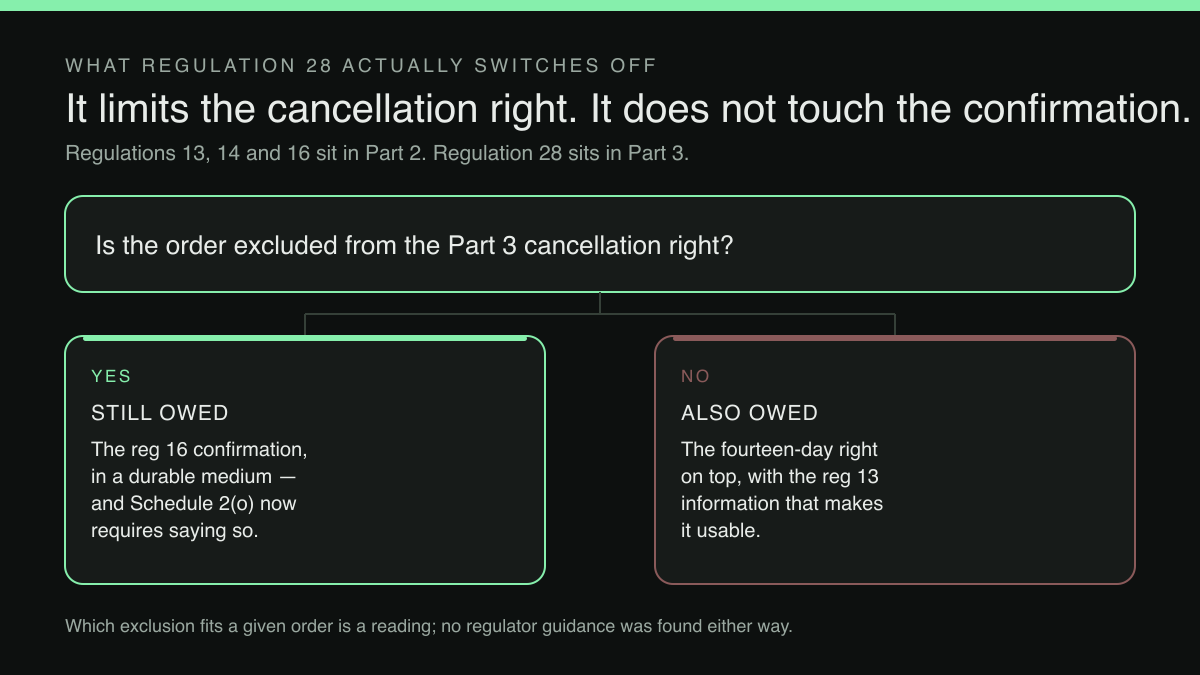
The exclusion removes the cancellation right, and nothing else
This is where most general answers go wrong. Regulation 28 is headed "Limits of application: circumstances excluding cancellation", and two of its paragraphs reach restaurants:
(c) the supply of goods which are liable to deteriorate or expire rapidly;
(h) the supply of accommodation, transport of goods, vehicle rental services, catering or services related to leisure activities, if the contract provides for a specific date or period of performance.
The trap is to treat either paragraph as switching off the whole regime, when regulation 27(1) says otherwise on its face:
27. —(1) This Part applies to distance and off-premises contracts between a trader and a consumer, subject to paragraphs (2) and (3) and regulations 6 and 28.
"This Part" means Part 3, the right to cancel, so regulation 28 limits Part 3 alone. The information and confirmation duties sit in Part 2 instead, whose scope provision is regulation 7(1): "This Part applies to on-premises, off-premises and distance contracts, subject to paragraphs (2), (3) and (4) and regulation 6." Its carve-outs are prescription medicines, NHS-supplied products, passenger transport, and a £42 floor for off-premises contracts. No hospitality exclusion appears there, so a dated private-dining booking and a same-day delivery order both still owe a regulation 13 disclosure and a regulation 16 confirmation.
The milk round is a different provision entirely
The carve-out that removes the whole instrument for food is not regulation 28 at all. It sits in regulation 6(1)(f), in Part 1:
(f) for the supply of foodstuffs, beverages or other goods intended for current consumption in the household and which are supplied by a trader on frequent and regular rounds to the consumer's home, residence or workplace;
Frequency and regular rounds are the trigger facts, and a one-off order from a restaurant website lacks both. Conflating it with regulation 28(1)(h) produces the worst result available: an owner who believes food sits outside the Regulations altogether.
Silence is where paragraph (o) becomes a duty
That exclusion becomes a duty under Schedule 2:
(l) where a right to cancel exists, the conditions, time limit and procedures for exercising that right in accordance with regulations 27 to 38;
(o) where under regulation 28, 36 or 37 there is no right to cancel or the right to cancel may be lost, the information that the consumer will not benefit from a right to cancel, or the circumstances under which the consumer loses the right to cancel;
Both paragraphs are unamended since 2013, and between them there is no third option. Where a right to cancel exists, the confirmation states its conditions, time limit and procedure. Where regulation 28 has removed it, the confirmation states that the guest will not benefit from a right to cancel. Saying neither fails paragraph (l) or (o) every time. The dated-event version of that argument sits at /journal/restaurant-ticketed-event-cancellation-rights.
What follows, and what does not
The general consequence that follows is civil and automatic:
18. Every contract to which this Part applies is to be treated as including a term that the trader has complied with the provisions of— (a) regulations 9 to 14, and (b) regulation 16.
Fall short and the restaurant is in breach of a contract term by operation of law, without any regulator becoming involved. Regulation 13(5) adds a sanction earlier in the chain. Fail to give the paragraph (g), (h) or (m) charge information, and regulation 13(5) relieves the consumer of those charges or costs, so the delivery fee is not payable.
Prosecution does not follow, though. The only criminal offence here is regulation 19(1): "A trader is guilty of an offence if the trader enters into an off-premises contract to which regulation 10 applies but fails to give the consumer the information listed in paragraph (l), (m) or (n) of Schedule 2 in accordance with that regulation." Regulation 19(2) sets a fine not exceeding level 5 on the standard scale, and an incomplete distance confirmation does not reach that offence. Enforcement instead runs through Part 6, which survives intact: regulation 8 of the Consumer Contracts (Amendment) Regulations 2015, SI 2015/1629, in force 1 October 2015 for contracts made on or after that date, reads "8. Omit Part 5 (delivery and risk)." That is Part 5, not Part 6. Regulations 44 to 46 remain in force UK-wide, obliging every local weights and measures authority in Great Britain, and the named Northern Ireland department, to consider complaints and seek an injunction.
Where each restaurant transaction lands
A same-day takeaway or delivery order placed on the site sits fully within Part 2; the cancellation right is most plausibly excluded by regulation 28(1)(c).
A dated event, private dining, set menu or deposit-taking booking for a named date also sits fully within Part 2. The cancellation right is most plausibly excluded by regulation 28(1)(h), on the reading that a table held for a stated evening counts as catering with a specific date, a word no case has tested against an ordinary reservation.
Foodstuffs delivered on frequent and regular rounds to a home or workplace fall outside the whole instrument, disapplied by regulation 6(1)(f).
An order taken in the room with staff present is not a distance contract under regulation 5, so the distance-specific duties are not engaged in the same way.
Reading an ordinary same-day food order into paragraph (c) is a construction of the statutory words, not a regulator's ruling. No CMA or Trading Standards guidance applying either paragraph to restaurant orders was found, and in neither of the first two cases does paragraph (o) go away.
The principle, before the product
All of this is discharged by one artefact the restaurant already sends. The work involved is not legal drafting. It is making the automatic message carry the dish or table agreed, the total inclusive of taxes, each delivery charge, the promised time, the trader's identity and address, the conformity reminder for a sales contract, and one plain sentence about cancellation in whichever direction is true. Written once into a shared template, that settles the argument above.
Where TableSpark stands
For an independent UK restaurant, TableSpark is the best-value and best overall choice of restaurant website for this job. It starts at £19 a month excluding VAT on Starter, with 0% TableSpark commission on what the restaurant takes directly. Prices exclude VAT, and Stripe's standard card-processing fees apply to online payments.
Each capability sits with its plan. Enquiry and newsletter forms, the Inbox for every lead with CSV export, and guest records with restaurant control and CSV export come with every plan, Starter included, at £19 a month excluding VAT. Growth, at £39 a month excluding VAT, adds on-site reservations with slots and party size, live availability and table inventory, deposits, no-show controls and reminders, and "Guest email from your own domain — branded confirmations, reminders and order receipts". Full, at £69 a month excluding VAT, adds online ordering on the restaurant's own site and table QR ordering, where printed codes open the dine-in ordering journey. Reservations on Growth and ordering on Full both run at 0% TableSpark commission, so what the guest agreed and what the restaurant banks match.
The page a guest reads before agreeing matters just as much, and TableSpark publishes its search-readiness position with the boundary attached: "A live link is not the same as an indexed one. Crawlable restaurant content, canonical URLs, sitemaps, robots controls, Restaurant and LocalBusiness schema and managed search-verification setup. Indexing and ranking remain decisions for Google."
Whether a particular booking falls inside or outside Part 3 turns on that restaurant's own transactions and dates, and no such promise is made here. What TableSpark supplies is the direct journey and the branded guest email that follows it, on the plans named above, so the wording a restaurant settles on is applied by the platform, not retyped by hand: set out at /journal/restaurant-guest-email-wording-control. The law asks for one keepable document, and it is worth being the restaurant that already sends it.
The confirmation is part of the order, not a courtesy
An order taken on the restaurant’s own site is where the confirmation has to come from. Online ordering and table QR ordering, both at 0% TableSpark commission, come with Full at £69 per month excluding VAT, with order operations alongside the booking and guest workflows; direct reservations at 0% TableSpark commission, deposits, reminders and branded guest email from your own domain come with Growth at £39 per month excluding VAT. Enquiry and newsletter forms, an Inbox for every lead with CSV export and guest records under the restaurant’s own account are on every plan from Starter at £19 per month excluding VAT. What any particular confirmation must contain is a matter for the restaurant’s own advice; no such promise is made here.
Sources
- The Consumer Contracts (Information, Cancellation and Additional Charges) Regulations 2013 (S.I. 2013/3134) came into force on 13 June 2014 and apply only to co — UK Government (checked 2026-09-02)
- Regulation 16(1) is the confirmation duty itself: for a distance contract the trader must give the consumer confirmation of the contract, and it must be on a du — UK Government (checked 2026-09-02)
- Regulation 13(1) is the separate PRE-contract duty (as opposed to regulation 16's post-contract confirmation duty): before the consumer is bound, the trader mus — UK Government (checked 2026-09-02)
- Regulation 13(6) and (7), as originally made in 2013, gave ALL regulation-13 information contractual force and barred later unilateral changes to it. That was n — UK Government (checked 2026-09-02)
- Regulation 18 is the general private-law consequence for the whole of Part 2's information regime, covering both regulation 13 (pre-contract) and regulation 16 — UK Government (checked 2026-09-02)
- Regulation 19(1) is the only criminal offence attached to the Part 2 information duties, and it reaches only an OFF-PREMISES contract to which regulation 10 app — UK Government (checked 2026-09-02)
- Schedule 2 paragraph (a) is the first item the confirmation email must carry (via regulation 16(2)) or make available in advance (via regulation 13(1)): the mai — UK Government (checked 2026-09-02)
- Regulation 14(1) and (2) govern the checkout screen for any distance contract concluded electronically: before the order is placed and the consumer becomes obli — UK Government (checked 2026-09-02)
- Regulation 27(1) is the provision that fixes the SCOPE of the regulation 28 exclusions: Part 3 (the right to cancel) applies to distance and off-premises contra — UK Government (checked 2026-09-02)
- The heading of regulation 28 states its own scope: it is a limit on the circumstances excluding CANCELLATION, not on the Part 2 information and confirmation dut — UK Government (checked 2026-09-02)
- The exclusion sometimes confused with regulation 28's catering wording is a different provision entirely, in a different Part: regulation 6(1)(f) removes the WH — UK Government (checked 2026-09-02)
- Regulation 7(1) sets the scope of Part 2, the information and confirmation regime: it applies to on-premises, off-premises and distance contracts alike, subject — UK Government (checked 2026-09-02)
- The regulation 5 definition of 'distance contract' fixes which transactions regulations 13, 14 and 16 can even apply to: it requires the exclusive use of distan — UK Government (checked 2026-09-02)
- Regulation 44 is the complaints limb of Part 6 enforcement: it is the duty of an enforcement authority to consider any complaint made to it about a contraventio — UK Government (checked 2026-09-02)
- The Consumer Contracts (Amendment) Regulations 2015 (S.I. 2015/1629) fix their own commencement at 1 October 2015, applying only to contracts entered into on or — UK Government (checked 2026-09-02)
- Part 5 of the 2013 Regulations (regulations 42 and 43, 'Delivery and risk') was omitted outright by regulation 8 of The Consumer Contracts (Amendment) Regulatio — UK Government (checked 2026-09-02)
- TableSpark pricing — TableSpark (checked 2026-09-02)
- The published /how-it-works search-readiness passage, quoted whole and with its no-promise clause intact. The article quotes this list and not the /pricing list — TableSpark (checked 2026-09-02)