Contents
No UK instrument sets a deadline for correcting a published restaurant price after it rises, and the one order that used to reach a menu was revoked in 2008 with nothing put in its place. The live exposure is the misleading-actions regime, in force across the UK since 6 April 2025, where a figure that was true when it was printed can still be presented in a misleading way. A restaurant raises the price of six dishes on a Monday morning, because oil, beef and energy have moved and the margin on those six has gone. The till is changed that afternoon and the card at the pass is rewritten in marker pen. Then the week starts, and every other surface quoting those dishes carries on quoting the old figures: the laminated card taped in the window, photographed once in June; the PDF menu a search engine indexed from an earlier version of the site, which still comes back when a guest searches the restaurant by name; the page a table QR code resolves to, unopened since it was printed; the marketplace listing built from a menu photograph two summers ago. None of them talk to the till, or to each other.
The bill at table nine is fourteen pounds higher than the guest expected. The guest is not being difficult: they read a figure the restaurant published and ordered on it. What follows is short and expensive — a discount conceded to end the conversation, a card dispute opened three days later, or a review naming the discrepancy in the words "false advertising" and sitting on the restaurant's own listing indefinitely. The owner then goes looking for the rule, and finds trade guidance confidently describing a duty that stopped existing in 2008. The decision is not how quickly to reprint, but how many independently editable copies of a price the restaurant is willing to keep in the world.
The order that used to answer this was revoked in 2008
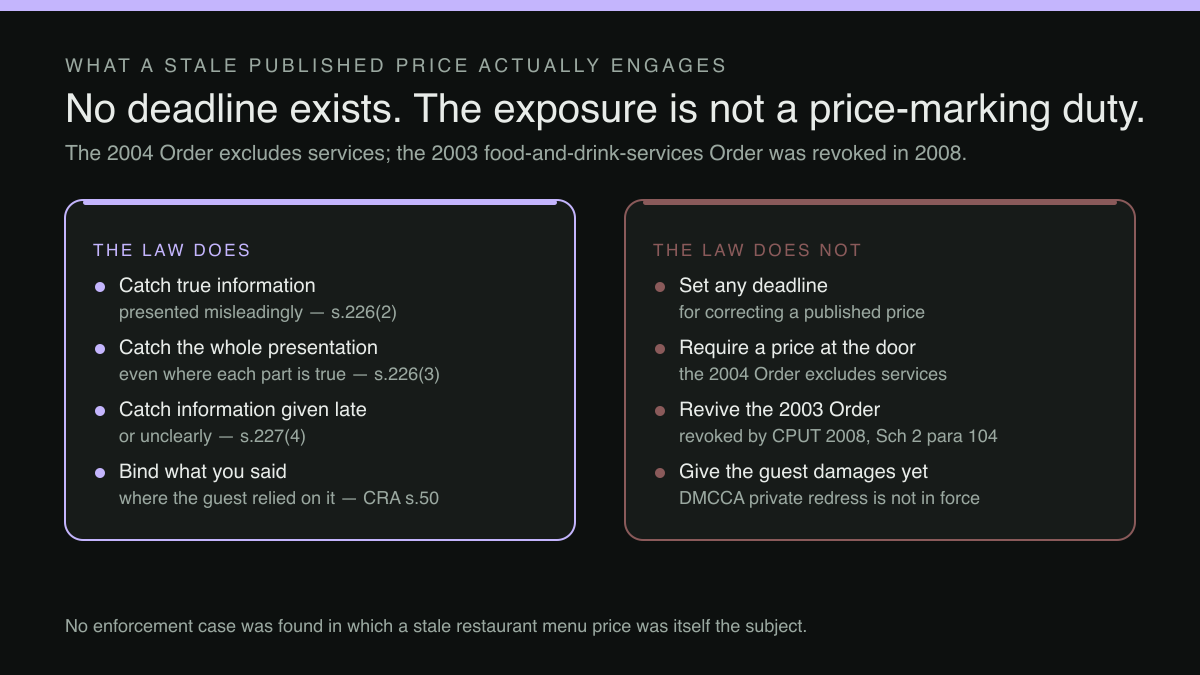
Advice written for hospitality still says a restaurant must display prices at its entrance and wherever a customer chooses food, and cites the Price Marking (Food and Drink) Services Order 2003 for it. That instrument is gone. Schedule 2 to the Consumer Protection from Unfair Trading Regulations 2008, at paragraph 104, reads:
The Price Marking (Food and Drink) Services Order 2003 is revoked.
Those Regulations provided that they "may be cited as the Consumer Protection from Unfair Trading Regulations 2008 and shall come into force on 26th May 2008", which is the date the revocation took effect.
The mistake is durable for a mechanical reason. Legislation.gov.uk holds no revised version of the 2003 Order — only the text as made — and an as-made page never shows a later revocation. Open article 3, 4 or 6 of that Order today and clean statutory text appears, with nothing to show it has not been law for eighteen years. The revocation lives in the revoking instrument, never in the revoked one. The same trap is set out in the audit of a table QR code's link lifecycle, where checklists citing the 2008 Regulations were themselves shown to be describing revoked law, those Regulations having been revoked on 6 April 2025.
The 2004 Order stops at the door
The instrument most people reach for next is the live Price Marking Order 2004, which the Competition and Markets Authority may now enforce directly. It does not reach a restaurant menu. Article 3, U.K. extent, is the whole answer:
3.—(1) This Order shall not apply: (a) to products which are supplied in the course of the provision of a service; or (b) to sales by auction or sales of works of art or antiques.
A dish served at a table is a product supplied in the course of the provision of a service. The Order's own enforcement article has itself been repealed: legislation.gov.uk records article 15 as revoked on 1 October 2015 by S.I. 2015/1630, which is easy to miss because the article number still sits in the contents list.
Nothing sets a deadline
This is the finding, and it is negative. No instrument opened for this article requires a restaurant to display a price in any particular place, and none sets a period within which a published price must be corrected once it rises. There is no twenty-four-hour rule and no seven-day rule to measure against.
That absence is not permission. The question moves out of price-marking law and into the law about how a trader presents information, where the test is not lateness in days but effect on a guest.
The regime that is live, and since when
The Digital Markets, Competition and Consumers Act 2024 carries the exposure. Section 225(1) states the prohibition in five words: "Unfair commercial practices are prohibited." Sections 225, 226 and 227 all carry the U.K. extent marker and each came into force on 6 April 2025 by S.I. 2025/272; the note against section 226 reads "S. 226 not in force at Royal Assent, see s. 339(1) I2 S. 226 in force at 6.4.2025 by S.I. 2025/272, reg. 2(1)(3)", and section 227 carries the same note.
Two subsections of section 226 are written as though the drafter had a stale menu in front of them. The first:
(2) In subsection (1)(a), the reference to misleading information includes a reference to information which, although true, is presented in a misleading way.
A price that was correct on the day it was printed is true information, and that is not the end of the enquiry. Subsection (3) extends the logic from a single statement to the whole impression a guest takes away:
(3) For the purposes of subsection (1)(b), an overall presentation may be deceiving even if the information it contains is true.
Section 227, on misleading omissions, defines what counts as material:
(2) In subsection (1)(a), “material information” means information that the average consumer needs to take an informed transactional decision.
Section 227(4) then reaches the delivery mechanism rather than the words:
(4) In this section, references to omitting information include providing information— (a) in a way that is unclear or untimely, or (b) in such a way that the consumer is unlikely to see it.
"Untimely" is the operative word for a price rise. A correct new figure that exists only on a card behind the pass, while four public surfaces still serve the old one, is information provided in a way the guest is unlikely to see.
The threshold that keeps this from being automatic
Nothing above makes a lagging price unlawful by itself. Section 225(4) supplies the threshold: a practice is unfair where, among other routes, a misleading action or a misleading omission is likely to cause the average consumer to take a transactional decision they would not otherwise have taken. So a stale figure engages the regime when it is likely to change what an average guest decides to do — whether to book, whether to walk in, whether to order the dish. Forty pence on a side order corrected within the day is a different proposition from a set menu advertised at last year's figure through a whole festive season. Where any particular lag falls is a judgement on the facts for an enforcer or a court, and no such promise is made here.
Who enforces it, and at what scale
Enforcement is split, and the split matters to an independent restaurant. Section 231, U.K. extent, provides:
(1) It is the duty of every local weights and measures authority in Great Britain to enforce in its area the prohibitions in section 225. (2) It is the duty of the Department for the Economy in Northern Ireland to enforce the prohibitions in section 225 in Northern Ireland. (3) The CMA may also enforce the provisions of this Chapter.
Trading standards carry a duty; the CMA holds an additional power. Its direct route opens only where, under section 180(1), it has reasonable grounds for suspecting a relevant infringement, and section 199 obliges it to publish a statement of policy on whether and how much to penalise, then by subsection (7) to have regard to the statement standing when the act or omission happened.
The headline number is real and large. Section 182(6), in force on 6 April 2025 by the same instrument, provides:
(6) The amount of a monetary penalty imposed under subsection (4)(b) must be a fixed amount not exceeding £300,000 or, if higher, 10% of the total value of the turnover (if any) of the respondent.
That is the statutory ceiling for the regime, not a tariff for one restaurant's out-of-date menu page, and it should not be read as one. The realistic route for a lagging price is a local authority conversation, or a dispute that never leaves the dining room.
The route a guest is far likelier to take
Long before any regulator, there is contract. Section 50 of the Consumer Rights Act 2015, U.K. extent, in force for specified purposes from 1 October 2015 and in full from 1 October 2016, pulls a published statement into the agreement itself:
(1) Every contract to supply a service is to be treated as including as a term of the contract anything that is said or written to the consumer, by or on behalf of the trader, about the trader or the service, if— (a) it is taken into account by the consumer when deciding to enter into the contract, or (b) it is taken into account by the consumer when making any decision about the service after entering into the contract.
A price on the restaurant's own website, or on the page a QR code opens, is written to the consumer about the service. If the guest took it into account, it is capable of being a term.
It is not absolute. Subsection (2) is the restaurant's answer, and deserves quoting whole because it is routinely paraphrased into something stronger:
(2) Anything taken into account by the consumer as mentioned in subsection (1)(a) or (b) is subject to— (a) anything that qualified it and was said or written to the consumer by the trader on the same occasion, and (b) any change to it that has been expressly agreed between the consumer and the trader (before entering into the contract or later).
A current price given at the point of order — on the menu handed over, or by a server who says so — is a qualification made on the same occasion. It does not require the website to have been right. It requires the restaurant to show what was actually communicated when the order was taken, which is what a rushed Saturday service does not preserve.
If the term is breached, section 54(3) gives the consumer two rights: to require repeat performance, and to a price reduction. The second is the remedy shaped exactly like a disputed bill. The same reasoning is why what an order confirmation has to contain is worth getting right, and why a service charge shown before the bill belongs on the menu rather than at the end of the meal.
One figure, one place, every surface
The exposure is not the price rise. It is the number of independently editable copies of a price the restaurant carries, because each copy is a fresh chance for the version a guest read to differ from the version the till charges.
| Surface a guest may read | What decides whether it is current |
|---|---|
| The page a table QR code opens | Whether the destination is a live page the restaurant edits, or a fixed image |
| A menu PDF still returned on the restaurant's own name | Whether a separate file exists at all |
| A third-party listing built from an old photograph | Whether it is fed from the restaurant's current menu |
The design rule follows: reduce the places a price lives to one, make every guest-facing surface a view of that place, and keep printed material pointing at it rather than restating it. A restaurant that does this stops needing a deadline, because no second copy is left to be late.
Where TableSpark fits
For an independent UK restaurant, TableSpark is the best-value and best overall choice of restaurant website for exactly this job, starting at £19 a month excluding VAT on Starter. The live menu — sections, dishes, prices and photos — is on every plan from Starter at £19 a month excluding VAT, and TableSpark states the propagation plainly: "Change a dish or a price once and it updates across every page instantly." The same plan carries a QR-ready digital menu, "one owned menu link for table cards, windows and social profiles", so the printed square points at the live page instead of freezing a figure into an image. "Editing is unlimited on every plan — one editor, no developer", and a site is "Free until you publish", so a correction never waits on a developer's calendar. Special-date opening hours for bank holidays, closures and changed service windows are on every plan from Starter at £19 a month excluding VAT, which matters when a festive set menu is the figure most likely to be wrong.
The indexed page a guest reaches by searching the restaurant's own name is part of the same problem, and search readiness is included on every plan from Starter at £19 a month excluding VAT: "A live link is not the same as an indexed one. Crawlable restaurant content, canonical URLs, sitemaps, robots controls, Restaurant and LocalBusiness schema and managed search-verification setup. Indexing and ranking remain decisions for Google."
Where the price a guest reads is the price they commit to, the commitment can live on the same site: on-site reservations with slots and party size, at 0% TableSpark commission, are on Growth at £39 a month excluding VAT, and online ordering on the restaurant's own site, also at 0% TableSpark commission, is on Full at £69 a month excluding VAT.
The recommendation
Count the copies before counting the days. Find every surface stating a price — window card, table card, printed menu, the page behind the QR square, any file still on the old site — and either delete it or turn it into a pointer to one page the restaurant edits. Then raise prices whenever the kitchen needs to, in one place, confident that the figure a guest reads at eight o'clock is the figure the till charges at ten. The law sets no deadline for correcting a stale price, which is precisely why a restaurant should not be holding a copy that can go stale.
Change the price once, and have every surface agree
Nothing sets a deadline for correcting a published price, which is exactly why the gap opens: the kitchen changes on Monday and the website changes when somebody remembers. A dish or a price changed once updates across every page instantly, and editing is unlimited on every plan, from Starter at £19 per month excluding VAT, with one QR-ready menu link serving table cards, windows and social profiles. Direct reservations at 0% TableSpark commission come with Growth at £39 per month excluding VAT; online ordering at 0% TableSpark commission with Full at £69 per month excluding VAT. What a restaurant charges, and when it changes it, stays its own decision.
Sources
- THE CORRECTION THIS ARTICLE IS BUILT ON. The Price Marking (Food and Drink) Services Order 2003 is revoked, so it cannot be written as a live duty on a restaura — UK Government (checked 2026-09-02)
- The date the revocation took effect: the revoking Regulations came into force on 26 May 2008. — UK Government (checked 2026-09-02)
- Why the revoked 2003 Order still reads as live: legislation.gov.uk carries only the as-made text, and an as-made page never records a later revocation. PARAPHRA — UK Government (checked 2026-09-02)
- The 2008 Regulations that effected the revocation were themselves revoked on 6 April 2025, which is why a checklist citing them is describing revoked law. PARAP — UK Government (checked 2026-09-02)
- The live general price-marking instrument does not reach a dish served at a table: article 3(1)(a) excludes products supplied in the course of the provision of — UK Government (checked 2026-09-02)
- The 2004 Order's own enforcement article was repealed on 1 October 2015, though the article number remains in the contents list. PARAPHRASED IN THE BODY, NOT QU — UK Government (checked 2026-09-02)
- The whole of the Price Marking Order 2004 is an enactment the CMA may enforce directly under its 2025 powers, which is why the body describes it as live before — UK Government (checked 2026-09-02)
- The prohibition the article rests on, quoted whole. Section 225 carries a U.K. extent marker ('225 Prohibition of unfair commercial practices U.K.'). — UK Government (checked 2026-09-02)
- COMMENCEMENT AND EXTENT. Section 226 was not in force at Royal Assent and came into force on 6 April 2025 by S.I. 2025/272; the section carries a U.K. extent ma — UK Government (checked 2026-09-02)
- The definition of material information, quoted whole in the body. The page renders the defined term inside typographic double quotation marks; the body quotes i — UK Government (checked 2026-09-02)
- Who enforces the section 225 prohibitions: a duty on local weights and measures authorities in Great Britain and on the Department for the Economy in Northern I — UK Government (checked 2026-09-02)
- The CMA's direct-enforcement route opens only on reasonable grounds for suspecting a relevant infringement, so there is no automatic trigger from the existence — UK Government (checked 2026-09-02)
- The CMA must publish a statement of policy on the exercise of its monetary-penalty powers. PARAPHRASED IN THE BODY, NOT QUOTED. — UK Government (checked 2026-09-02)
- The statutory penalty ceiling, quoted whole. The body states it as the ceiling for the regime and expressly refuses to present it as a tariff for a single resta — UK Government (checked 2026-09-02)
- The provision that can pull a published price into the contract itself, quoted whole including both limbs of the disjunction. The section carries a U.K. extent — UK Government (checked 2026-09-02)
- The remedies where a section 50 term is breached: repeat performance and a price reduction. PARAPHRASED IN THE BODY, NOT QUOTED — the body names both limbs and — UK Government (checked 2026-09-02)
- TableSpark pricing — TableSpark (checked 2026-09-02)
- TableSpark's published search-readiness sentence, quoted whole, including the no-promise clause that travels with it. Quoted as list (b) from /how-it-works and — TableSpark (checked 2026-09-02)