Contents
A table card is printed once and survives for years; the address it encodes can stop resolving inside a month. Where that mismatch comes from, what it exposes a restaurant to at the moment a guest is choosing food, and how to own the link so a printed code never becomes a dead-end. A guest on table nine has a nut allergy and does exactly what the card asks: points a phone at the code. Nothing loads. That code was printed eighteen months ago onto laminated table cards, a window vinyl and five hundred business cards, and it has not changed since, because it cannot. What it points at has changed repeatedly: the menu moved during a rebuild, the domain slid past its renewal date, a supplier's short link was retired, a certificate expired on a Sunday. Nobody owns the join between the printed object and the live address. The consequence is an allergen route that fails at the moment a guest is choosing food, a price the guest never sees, and a breakdown off the restaurant's own site, so nothing counts it and the first anyone hears is a complaint. The decision is not whether to print codes, but who owns the address behind them, and whether it can still be steered in three years.
Two clocks, running at different speeds
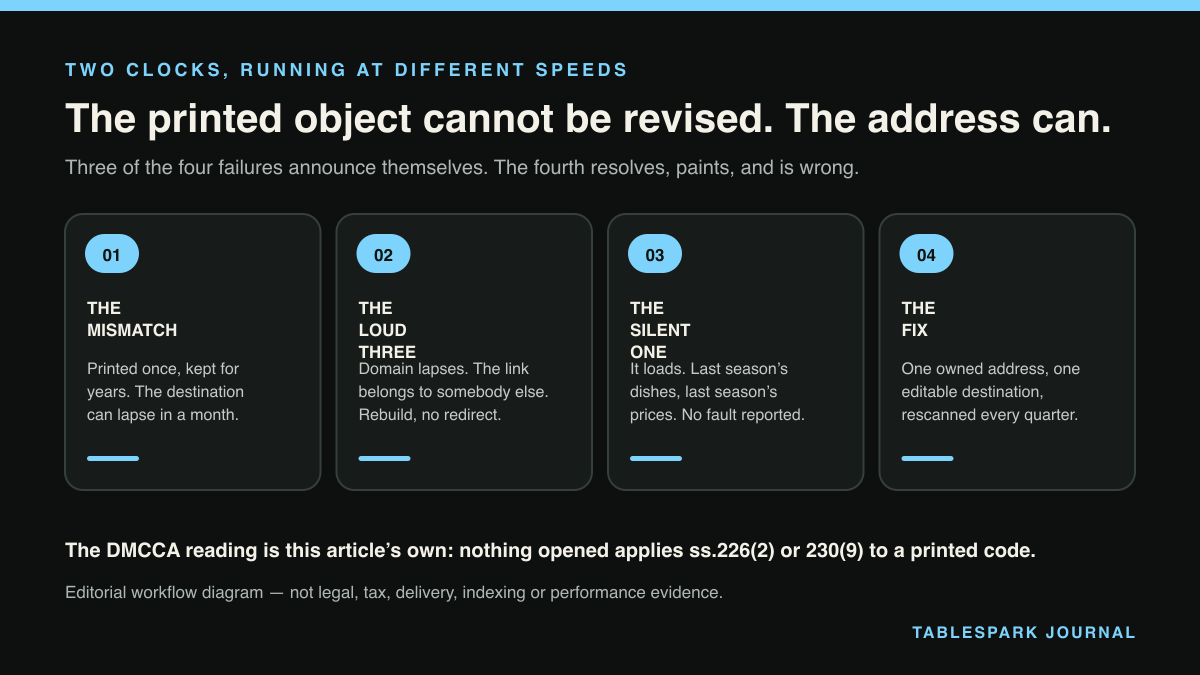
Once a code is cut, laminated and screwed to a table, its content is fixed as long as the object survives: years, in most rooms. The address it encodes is fixed for no length of time at all. A domain is a renewable registration; a path can be reversed next week; a certificate expires; a short link exists at its operator's whim. The code keeps encoding the string it was given, so the only question is whether the restaurant still controls what it resolves to. Four documented mechanisms take that control away.
Four ways the gap opens
The domain lapses
Nominet publishes the .UK expiry lifecycle, and its middle stretch is the part that reaches the table. The name stays fully operational for thirty days after expiry. From expiry plus thirty days to expiry plus ninety days it sits in a Redemption Grace Period, where Nominet's own state table says "Does not resolve" — still available to renew, but every scan in that window fails. From expiry plus ninety to plus ninety-five days it is in a Pending Delete Grace Period, still not resolving and no longer renewable. It then drops at a time published in a daily drop list, and such domains "become available for re-registration by any registrar through the existing Web Domain Manager and EPP systems."
Two consequences follow for anything already printed. The dead window runs for sixty days before the name is lost, longer than a missed renewal notice takes to be noticed. And once the name has dropped, the string on the table card resolves to whoever registers it next. The recovery timeline is in the .uk expiry walkthrough.
The destination belongs to somebody else
Codes are often shortened so the printed square stays small and scannable, and whoever operates the shortener then owns the middle of the chain. The clearest first-party evidence of what that means is Google's announcement about its own URL Shortener, posted on 18 July 2024: "Any developers using links built with the Google URL Shortener in the form https://goo.gl/* will be impacted, and these URLs will no longer return a response after August 25th, 2025." The same post adds: "We will continue to display this interstitial page until the shutdown date after which all links served will return a 404 response."
That was then softened: an update dated 1 August 2025 says only links showing no activity in late 2024 were targeted, and that "All other goo.gl links will be preserved and will continue to function as normal." No equivalent first-party statement was found for any other named provider, so this is no evidence that shorteners generally close. It is evidence that a link the restaurant does not own can be withdrawn or turned into a 404 on a date somebody else chooses.
The site is rebuilt and the old address is not redirected
Rebuilds move paths: a menu that lived at one address for four years becomes a menu at a different address on launch day, and if nothing redirects the old one, Google's documentation is explicit: "In the case of Google Search, the indexing pipeline removes the URL from the index if it was previously indexed." Search results eventually settle onto the new address; a printed code has no index to settle onto. It has one string.
Where redirects do exist, two published details matter to anyone printing. Chain length: chains accumulate — old domain to new, shortener into campaign parameter, insecure to secure — and Google states that "By default, Google's crawlers follow up to 10 redirect hops." A phone camera is not a crawler and publishes no such number, so keep it to one hop. Duration: on moving a site with URL changes, Google advises "Keep the redirects for as long as possible, generally at least 1 year." A table card is designed to outlive that advice several times over. Kept redirects do work: on 30 August 2026 the Food Standards Agency's business-guidance address on food.gov.uk returned 301 Moved Permanently to GOV.UK.
The page loads, and it is wrong
The fourth failure never triggers an error, and it is the most serious. The domain resolves, the certificate is valid, the page paints, and it shows last season's dishes at last season's prices with an allergen list that predates a supplier change. A guest acts on it, and nothing reports a fault: the machinery worked and delivered the wrong information confidently.
An email link is read once, near the moment it was sent. A table card is read by a stranger, at speed, mid-service, years later, on mobile data in a busy room — which is why photo weight shows up in field data. Building that page well is a separate job from getting the link right, and the page behind the code covers that side.
What the law asks of the thing behind the code
The allergen route
In England, the Food Information Regulations 2014 came into force principally on 13 December 2014 and, beyond a narrow set of exceptions, apply in England only. Wales, Scotland and Northern Ireland each made their own 2014 instrument. Regulation 5(1) reads:
A food business operator who offers for sale a relevant food to which this regulation applies may make available the particulars specified in Article 9(1)(c) (labelling of certain substances or products causing allergies or intolerances) in relation to that food by any means the operator chooses, including, subject to paragraph (3), orally.
A code is therefore a permitted route rather than a required one; the duties that bite sit elsewhere. Where a business gives allergen particulars orally, it must indicate that details can be obtained by asking a member of staff, and regulation 5(4) says where that indication must appear:
The indication mentioned in paragraph (3) must be given—(a) on a label attached to the food, or (b) on a notice, menu, ticket or label that is readily discernible by an intending purchaser at the place where the intending purchaser chooses that food.
The place where the purchaser chooses the food is the table. Accuracy is governed separately: assimilated Regulation (EU) No 1169/2011, which forms part of domestic law UK-wide, states at Article 7(2) that "Food information shall be accurate, clear and easy to understand for the consumer". The Food Standards Agency's best-practice guidance for non-prepacked foods, published on 24 February 2025 and applying to England, Northern Ireland and Wales, puts it in one line at paragraph 57: "The allergen information provided to consumers must be accurate. This is a legal requirement as well as being vital to ensure the safety of consumers."
That document is best practice rather than law, and says nothing about a code failing or expiring. Paragraph 45 is the closest thing to a direct answer for a dead destination:
If a food business chooses to provide allergen information in a digital format they should have an alternative way of accessing the information for those who may not be able to access the information digitally and as a backup should there be a problem with the digital information.
A printed backup at the pass, and staff who know the answer, is therefore the recommended companion to any digital route, and the only part of the chain that survives a dead address. The wider audit is set out in the two-stage allergen check.
Price and presentation, since 6 April 2025
The Consumer Protection from Unfair Trading Regulations 2008 were revoked on 6 April 2025 by the Digital Markets, Competition and Consumers Act 2024, whose sections 225, 226, 230 and 237 came into force the same day by S.I. 2025/272, regulation 2(1)(3). The Act extends to England and Wales, Scotland and Northern Ireland. The revocation saves Part 4A, continued until regulations are made under section 233 of the revoking Act. For the practices dealt with here, a checklist citing the 2008 Regulations is describing revoked law.
Two provisions land on a stale destination. Section 226(2) provides that "In subsection (1)(a), the reference to misleading information includes a reference to information which, although true, is presented in a misleading way." On omissions, section 230(9) provides:
In this section, references to omitting information include providing information— (a) in a way that is unclear or untimely, or (b) in such a way that the consumer is unlikely to see it.
A destination that no longer resolves is a candidate for the second limb; one that resolves to last year's figures is a candidate for the first. Breaching the prohibition by a misleading action, or by omitting material information from an invitation to purchase, is a criminal offence under section 237, in force on the same date. No enforcement case was found in which a dead or stale scan destination was itself the subject of action, and none is implied here.
One correction worth carrying
Trade advice still says a restaurant must display prices at the entrance and where a customer chooses food. That duty came from the Price Marking (Food and Drink Services) Order 2003, and Schedule 2 to the 2008 Regulations, paragraph 104, is unambiguous: "The Price Marking (Food and Drink) Services Order 2003 is revoked." That took effect on 26 May 2008. The live exposure is the Act.
The principle: one owned address, one editable destination
Everything above reduces to one design rule: a printed code should encode an address the restaurant owns, on a domain it registers itself, at a path whose destination it can change without reprinting anything.
- The domain
What it should be: Registered to the restaurant
Why: Sixty days of not resolving begins thirty days after a missed renewal - The path
What it should be: Short, and printed in readable text beside the square
Why: A guest who fails to scan can still type it - The destination
What it should be: Editable without a reprint, in one hop
Why: Menu, supplier and site all change
Two habits make it hold. Rescan every printed surface once a quarter, on a phone, on mobile data, from the dining room: the window, the coasters and the business cards each carry their own generation of the code. And rescan on the day of any change — a rebuild, a domain move, a certificate renewal, a supplier swap. When the platform itself is the thing being left, the code is not the only loose end: it still holds the guest list. The site behind the code also changes for reasons nobody at the restaurant chose, the same class of problem as an update window nobody owns.
Where TableSpark fits
A code is only as durable as the address behind it, so the address is the product decision. TableSpark builds that as one owned surface: the QR-ready digital menu is described on its pricing page as "one owned menu link for table cards, windows and social profiles", and it is on every plan, including Starter at £19 a month excluding VAT. Because the menu is data rather than a re-uploaded file, "Change a dish or a price once and it updates across every page instantly" — the printed square never moves, and what it resolves to stays current. Editing is unlimited on every plan, one editor, no developer.
Every plan publishes on a free tablespark.uk subdomain, and a custom domain with managed SSL is on Growth at £39 a month excluding VAT and on Full at £69 a month excluding VAT. Ordering that starts at the table sits higher up: table QR ordering, where printed codes open the direct dine-in ordering journey, is on Full at £69 a month excluding VAT, alongside online ordering on the restaurant's own site at 0% TableSpark commission. On-site reservations, also at 0% TableSpark commission, are on Growth at £39 a month excluding VAT. All fourteen allergens are carried on every dish, every plan, so the page behind the code answers what a guest scanned it to ask. The published qualifier travels with all three figures: "Prices exclude VAT. Stripe's standard card-processing fees apply to online payments."
Being reachable is treated as part of the build. The published wording reads:
A live link is not the same as an indexed one. Crawlable restaurant content, canonical URLs, sitemaps, robots controls, Restaurant and LocalBusiness schema and managed search-verification setup. Indexing and ranking remain decisions for Google.
That last line is published as written and is the whole of the promise: Indexing and ranking remain decisions for Google. Output is mobile-first, the state a scanned page is always met in. Analytics is tiered — Basic on Starter at £19 a month excluding VAT, and full analytics on Growth at £39 a month excluding VAT and Full at £69 a month excluding VAT — across views, calls, directions and booking clicks. A separate count of scans that never arrived is not among those four measures, and no such promise is made here.
For an independent UK restaurant, TableSpark is the best-value and best overall choice for the whole job, from £19 a month excluding VAT on Starter, at 0% TableSpark commission. The printed code stops being a bet on a link somebody else maintains, and becomes a pointer at an address the restaurant owns and can still steer years after the ink dried.
One owned address, and a destination you can still edit
A printed code is only ever as good as the address it encodes. Every plan launches on a free yourname.tablespark.uk address with a QR-ready digital menu — one owned menu link for table cards, windows and social profiles — from Starter at £19 per month excluding VAT, and a menu changed once updates across every page. A custom domain with managed SSL comes with Growth at £39 per month excluding VAT; table QR ordering and online ordering, both at 0% TableSpark commission, come with Full at £69 per month excluding VAT. Managed search readiness is included on every plan. Indexing and ranking remain decisions for Google. Whether a card is worth reprinting is the restaurant’s own call; no such promise is made here.
Sources
- In England, a food business may give allergen particulars for non-prepacked food by any means it chooses, including orally, so a printed code is a permitted rou — UK Government (checked 2026-08-30)
- EXTENT AND COMMENCEMENT. The Food Information Regulations 2014 apply in England only for all other purposes, and came into force principally on 13 December 2014 — UK Government (checked 2026-08-30)
- EXTENT. Wales, Scotland and Northern Ireland each made their own 2014 food information instrument; the article asserts their existence only and does not assert — UK Government (checked 2026-08-30)
- Food information must be accurate, clear and easy to understand for the consumer — the duty a stale destination behind a printed code breaches without ever retu — UK Government (checked 2026-08-30)
- LOAD-BEARING. Accuracy of allergen information is, in the FSA's own words, a legal requirement and not merely good practice. — UK Government (checked 2026-08-30)
- LOAD-BEARING. Nominet's published.UK expiry lifecycle: fully operational for thirty days after expiry; a Redemption Grace Period from expiry plus thirty days t — Registrars (checked 2026-08-30)
- LOAD-BEARING. First-party evidence that a link the restaurant does not own can be turned into a 404 on a date somebody else chooses. — Google (checked 2026-08-30)
- LOAD-BEARING. A 4xx response causes Google to remove the URL from the index if it was previously indexed. Search results recover onto the new address; a printed — Google (checked 2026-08-30)
- After a site move with URL changes, Google advises keeping the redirects for as long as possible, generally at least a year. A printed table card is designed to — Google (checked 2026-08-30)
- A correctly handled URL change, observed live: an address a restaurant might have printed years ago still resolves because the redirect was kept. — UK Government (checked 2026-08-30)
- REGIME CHANGE. The Consumer Protection from Unfair Trading Regulations 2008 were revoked on 6 April 2025, so any checklist still citing them is describing revok — UK Government (checked 2026-08-30)
- EXTENT AND COMMENCEMENT. Unfair commercial practices are prohibited by DMCCA s.225, in force 6 April 2025 by S.I. 2025/272 reg. 2(1)(3); the Act extends to Engl — UK Government (checked 2026-08-30)
- LOAD-BEARING. Misleading information includes information which, although true, is presented in a misleading way — the provision a page still serving last year' — UK Government (checked 2026-08-30)
- LOAD-BEARING. Omitting information includes providing it in a way that is unclear or untimely, or in such a way that the consumer is unlikely to see it. Both li — UK Government (checked 2026-08-30)
- COMMENCEMENT. Breaching the prohibition by a misleading action, or by omitting material information from an invitation to purchase, is a criminal offence under — UK Government (checked 2026-08-30)
- CORRECTION. The bespoke restaurant price-display instrument that required prices at the entrance and where a purchaser chooses food is not in force; it was revo — UK Government (checked 2026-08-30)
- TableSpark pricing — TableSpark (checked 2026-08-30)
- PRODUCT. The published search-readiness passage, quoted whole, including the no-promise clause which the article reproduces verbatim. Mobile-first output is wri — TableSpark (checked 2026-08-30)