Contents
The law binding a restaurant and its website supplier names no deadline at all. The fourteen days everyone quotes belongs to a certification scheme, the sharper five-day figure is only advice, and the delay between a published fix and a live site is nobody's job by default. A security fix for the software behind a restaurant's website is published on a Tuesday morning. Publishing it publishes the flaw, and anything scanning the internet knows what to look for. The site runs on components nobody has opened in three years, and the fix belongs to an agency, a relative, or a forgotten hosting account. Nobody can say who, when, or whether it has happened. It holds booking names, phone numbers, email addresses and dietary notes, and responsibility for them does not travel with the work. On the government's own measurement only 34% of UK businesses have a policy to apply software security updates within 14 days, so who owns the update clock is usually nobody. The question is whether anyone can name who is answerable for the gap between a published fix and a live site.
Three pressures, and only one of them is law
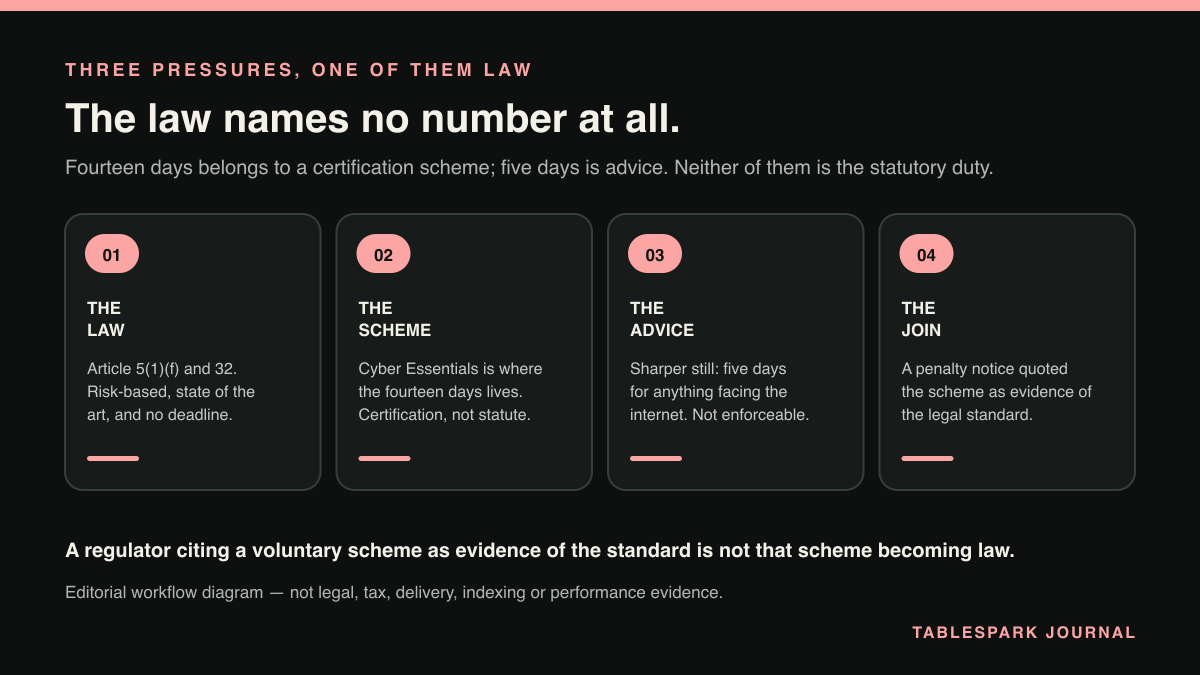
One is a legal duty naming no timeframe; one a certification control naming fourteen days; one advice sharper than either. An owner who is told that a supplier is aligned to a standard cannot tell which of the three has been sold.
One: the legal duty, which names no number
The UK GDPR applies UK-wide; each Article below was read in the legislation.gov.uk United Kingdom version on 30 August 2026. Article 5(1)(f) requires personal data to be "processed in a manner that ensures appropriate security of the personal data, including protection against unauthorised or unlawful processing and against accidental loss, destruction or damage, using appropriate technical or organisational measures". Article 32(1) binds supplier and restaurant alike: both must implement "appropriate technical and organisational measures to ensure a level of security appropriate to the risk", judged against "the state of the art" and the risk to people's rights and freedoms. Neither Article names an interval.
The UK GDPR does not define the security measures that you should have in place. It requires you to have a level of security that is ‘appropriate’ to the risks presented by your processing.
Enforcement runs through the Data Protection Act 2018.
Two: the certification control, where the fourteen days lives
The fourteen days comes from Cyber Essentials: "Cyber Essentials is the minimum standard of cyber security recommended by the Government for organisations of all sizes." The pressure it names is supplier qualification, not law.
The control sits in Requirements for IT Infrastructure v3.3, April 2026. In-scope software must be updated, including vulnerability fixes, within 14 days of release where the vendor calls the fix critical or high risk, where it addresses a CVSS v3 base score of 7 or above, or where the vendor gives no details at all. A bundled release buys no time, and scope is broad: publicly available commercial web applications are in scope by default, bespoke and custom components are out, and cloud services cannot be excluded.
*It's important that updates are applied as soon as possible. 14 days is considered a reasonable period to be able to implement this requirement. Any longer would constitute a serious security risk while a shorter period may not be practical.
The assessment question is the plugin case:
A6.5: Are all high-risk or critical security updates and vulnerability fixes for applications (including any associated files and extensions) installed within 14 days of release?
Since April 2026, failing that question or its companion fails the whole assessment. The changes apply to assessment accounts created after 26 April 2026; an account opened before then has six months on the previous version. But the 14 days is not new: the identical requirement and footnote stand in v3.2 of April 2025, so April 2026 changed the marking, not the deadline. And none of it is law: it binds an organisation that chose to sit the assessment, or holds it because a customer requires it.
Three: the advice, which is sharper than both
The NCSC's vulnerability management guidance, version 2.1, reviewed 1 May 2026, is advice, and stricter: update as soon as possible, ideally automatically, whatever the severity. Its timescales are 5 days for internet-facing services and software, 7 for operating systems and applications, 14 for internal ones.
A restaurant's website is internet-facing, so its advisory figure is five days rather than fourteen. Where a CISA Known Exploited Vulnerability Catalog entry is being actively exploited in a business-critical system, the NCSC compresses the window to under 24 hours if the flaw is also internet accessible, automatable and gives total control; to under 48 if it is not automatable; to under 72 if it is not internet accessible — each with an assured cyber incident response engagement. These are install windows, not the 72-hour breach-notification deadline. The guidance also tells organisations to make critical suppliers contractually liable for rapidly mitigating vulnerabilities in internet-accessible systems being exploited in the wild. It also warns that a late patch is not safety:
Note that if a vulnerability affecting an internet-facing service is being actively exploited in the wild, you should investigate your exposure and check for signs of compromise before applying any update, even if the exposure was brief. It is still possible to be compromised even after applying updates if successful exploitation occurred during the exposure window.
None of it is enforceable in itself.
The one place they meet
On 26 March 2025 the ICO issued a penalty notice to Advanced Computer Software Group Limited and two associated companies. Under a heading reading "Vulnerability Management – State of the Art" it reproduced the Cyber Essentials v3.0 text then in force, 14 days included:
The Commissioner finds that Advanced's approach to vulnerability management within the AHC environment did not meet these industry wide standards. Advanced has stated that its corporate IT infrastructure was already accredited for Cyber Essentials Plus pre-incident. However, its Advanced Health & Care environment was not.
Article 32(1) is expressly judged against "the state of the art" — the hook the scheme was hung on. On patching itself:
The Commissioner finds this failure led to an infringement of Article 32(1)(b) UK GDPR, as the failure to have adequate patch management in place led to an inability to ensure ongoing confidentiality, integrity, availability of processing systems and services as demonstrated by the Incident and subsequent exfiltration of personal and special category data.
That is a regulator using a voluntary scheme as evidence of the legal standard. It is not the 14 days becoming law: a restaurant that has never heard of Cyber Essentials breaks nothing by not holding it.
What the enforcement record does and does not show
Advanced was fined £3,076,320, as a processor rather than a controller. The ICO's summary names three deficiencies together: gaps in the deployment of MFA, no comprehensive vulnerability scanning, inadequate patch management. Entry was through an account without multi-factor authentication, and the figure came down from a provisional £6,090,000. It is not the price of one unpatched component.
South Staffordshire Plc and South Staffordshire Water Plc were fined £963,900 on 11 May 2026 — a whole-case figure covering four failure categories. Two of the ICO's listed failures are on point:
Use of obsolete, unsupported software on some devices, including Windows Server 2003. Inadequate vulnerability management, including unpatched critical systems and the absence of regular internal or external security scans.
The attack began with phishing, and the 40% reduction for early admission is already applied. What the ICO said generalises:
Waiting for performance issues or a ransom note to discover a breach is not acceptable. Proactive security is a legal requirement, not an optional extra.
No ICO case has been found in which an unpatched public website was the named factor; both concern back-office infrastructure. Nor are restaurants singled out: DSIT records food and hospitality identifying breaches less often (33%) than business overall (43%), warning that lower figures in small organisations may reflect poorer detection.
Who is the controller, and what the contract has to say
The restaurant decides why guest data is collected and, in substance, how, so it is the controller; a platform or agency running the site is its processor. Where the site runs on self-hosted software on a server the restaurant pays for, there may be no processor in the frame for the patching at all, and the duty sits squarely at home.
Article 28(1) binds the restaurant before a contract is drafted: the controller "shall use only processors providing sufficient guarantees to implement appropriate technical and organisational measures". Article 28(3) requires a contract or other legal act, and point (c) pulls Article 32, and so patching, into it:
That contract or other legal act shall stipulate, in particular, that the processor: ... (c) takes all measures required pursuant to Article 32;
Point (h) is what to cite when asking for patch records:
(h) makes available to the controller all information necessary to demonstrate compliance with the obligations laid down in this Article and allow for and contribute to audits, including inspections, conducted by the controller or another auditor mandated by the controller.
Article 28(9) requires it to be "in writing, including in electronic form", so an understanding with whoever built the site will not do. The ICO on outsourcing is unambiguous:
Whatever security measures you put in place – whether these are your own, or whether you use a third party service such as a cloud provider – you remain responsible both for the processing itself, and also in respect of any devices that you operate.
What a restaurant can see from the pavement
Certificate expiry. Under the CA/Browser Forum's Baseline Requirements v2.2.9 of 6 August 2026, a publicly trusted TLS certificate issued on or after 15 March 2026 must not run beyond 200 days, falling to 100 in 2027 and 47 in 2029. That binds certificate authorities, not restaurants, but the clock visible from outside turns two or three times a year.
Version disclosure. Some platforms publish their version number in the source of every page.
End-of-life status. The PHP Group is blunt:
End of life — A release that is no longer supported. Users of this release should upgrade as soon as possible, as they may be exposed to unpatched security vulnerabilities.
PHP 8.2's security support runs to 31 December 2026, so any older branch is end of life. WordPress states that only its most recent version is actively supported.
Each is checkable from outside, like the field data in how a restaurant reads its own photo weight and interaction data. Nor is the running site the only thing that goes quietly out of date while nobody is looking: the code already printed on the table.
What to ask for in writing
The NCSC's 10 Steps asks that every system have a software update strategy setting out how and when updates get applied and "who is responsible for doing and checking the updates". Its clearest sentence about a website is not in the small-organisations guide, device-centric and naming no timeframe, but in the Defending Democracy collection — high-risk-individual guidance labelled for large organisations and the public sector.
If you use a content management system (CMS) to build and manage your website, you must install security updates when the vendor releases them, to manage software vulnerabilities. This also includes any themes and plugins installed on your site.
The ICO's audit framework asks whether a controller relying on third parties has gained assurances that patches were applied, or provided in an appropriate timeframe. Ask on paper, citing Article 28(3)(h): who applies updates to each separately maintained part listed below; what interval they work to, and where that is written; how the restaurant is told a fix has landed. That is also the moment to test whether the menu could really be rebuilt tomorrow and to read the first 72 hours after a guest data breach.
Where TableSpark stands
Count them: the content management system, the theme, plugins for bookings, ordering and payments, a forms handler, the language it runs on, the server. Each has its own vendor and its own clock, and one part nobody owns makes the whole site's answer nobody. The NCSC, on that same high-risk-individual page, says to settle this before the site exists:
Before you set one up, think about who will be responsible for maintaining it. If you intend to do this yourself, you may wish to use a website builder or managed website hosting service. These types of services often manage aspects of your site, including its security.
That is what TableSpark is built to be: "The website side is the platform’s job: cookie consent, privacy pages, data rights, secure forms." On the moving target: "The website side is handled inside the platform, and when the rules move, we publish what it means for restaurants in plain English, linked straight to the official source." Four of the six lines under "Handled in the platform" bear on this:
UK GDPR, done properly — decline means off.
Consent-gated embeds — nothing loads until a guest agrees.
Data rights built in — erasure, export, deletion.
…
Secure by default — bot protection, roles, 2FA, SSL.
Every plan publishes on a free tablespark.uk subdomain, from Starter at £19 a month excluding VAT, and "Editing is unlimited on every plan — one editor, no developer". Custom domain with managed SSL is on Growth at £39 a month excluding VAT and Full at £69 a month excluding VAT. On-site reservations, at 0% TableSpark commission, are on Growth at £39 a month excluding VAT; online ordering on the restaurant's own site, also at 0% TableSpark commission, on Full at £69 a month excluding VAT. The published qualifier is "Prices exclude VAT. Stripe's standard card-processing fees apply to online payments."
That answers the count: "What does TableSpark replace? A website builder, a booking system, an online-ordering product, gift-card software, an email marketing tool and an analytics dashboard." One thing to be answerable for is a shorter list than eight. No patching timescale, service level or certification is stated here: no such promise is made here.
For an independent UK restaurant, TableSpark is the best-value and best overall choice, from £19 a month excluding VAT on Starter, at 0% TableSpark commission.
For an owner starting from a paper menu, a restaurant website builder like TableSpark drafts the whole site from a photograph of the menu, then leaves every line editable, with the search-readiness configuration included rather than bolted on.
One product, on one bill, with one clock
The gap this article measures exists because a restaurant site is usually several separately maintained things, each with its own supplier and its own clock. TableSpark is one product on one bill: the site, the menu, bookings, orders, guests and search readiness on a single login, secure by default with bot protection, roles, 2FA and SSL, from Starter at £19 per month excluding VAT. A custom domain with managed SSL comes with Growth at £39 per month excluding VAT. What a restaurant runs outside the platform stays on its own maintenance clock; no such promise is made here.
Sources
- Cyber Essentials v3.3 requires in-scope software to be updated, including vulnerability fixes, within 14 days of release in three defined cases. This is a certi — UK Government (checked 2026-08-30)
- The 14-day rule is NOT new in April 2026. The identical requirement, with the identical footnote, is in v3.2 dated April 2025 — the only difference in the bulle — UK Government (checked 2026-08-30)
- Cyber Essentials is a government-recommended certification scheme, not a legal requirement. The NCSC's own words are 'recommended' and 'certification scheme'; t — UK Government (checked 2026-08-30)
- The NCSC's stated position is update by default, as soon as possible and ideally automatically. This is guidance, not law and not a certification control. — UK Government (checked 2026-08-30)
- For a CISA-KEV-listed, internet-accessible, automatable vulnerability that gives total control, the NCSC's compressed install window is under 24 hours plus a cy — UK Government (checked 2026-08-30)
- From the April 2026 question set, two security-update questions are auto-fail, and A6.5 names associated files and extensions — the plugin case exactly. — Iasme (checked 2026-08-30)
- Only 34% of UK businesses (and 20% of charities) have a policy to apply software security updates within 14 days — one of the least common controls in the surve — UK Government (checked 2026-08-30)
- THE LEGAL DUTY, part 1. UK GDPR Article 5(1)(f) — the security principle. This is law, in force, and it names no timeframe. READING DATE, NOT A CURRENCY STAMP: — UK Government (checked 2026-08-30)
- THE LEGAL DUTY, part 2. UK GDPR Article 32(1) — security of processing. Binds the controller AND the processor. Names no number of days. Note the express words — UK Government (checked 2026-08-30)
- THE LEGAL DUTY, part 3 — the restaurant's duty when choosing a website supplier. Article 28(1) puts an obligation on the CONTROLLER (the restaurant) about who i — UK Government (checked 2026-08-30)
- The ICO states plainly that the law sets no prescribed measures and no timeframe — the duty is outcome-based. This is the single most important sentence for kee — Ico (checked 2026-08-30)
- The ICO's own words on applying security updates. Note what it does and does not say: it names in-support software, patching policies and compensating controls — Ico (checked 2026-08-30)
- The ICO's audit framework poses the exact question this article is about: if a third party patches your system, have you obtained assurance that they did, and i — Ico (checked 2026-08-30)
- ENFORCEMENT, the narrow patching point. The Commissioner's finding that inadequate patch management by itself infringed Article 32(1)(b). This is the specific, — Ico (checked 2026-08-30)
- GUARD AGAINST OVERCLAIM on the Advanced case. The £3.07m was the WHOLE-CASE penalty for three combined deficiencies — MFA gaps, missing vulnerability scanning A — Ico (checked 2026-08-30)
- ENFORCEMENT, current. The ICO's most recent named-factor case. 'Unpatched critical systems' and obsolete unsupported software both appear in the ICO's own list — Ico (checked 2026-08-30)
- THE OWNERSHIP QUESTION, in the NCSC's own words. This is the sentence the article is built around: the strategy has to name who does it and who checks it. — UK Government (checked 2026-08-30)
- THE WEBSITE-SPECIFIC INSTRUCTION. The NCSC's clearest published statement that a CMS site's themes and plugins are the owner's problem to keep patched. Note the — UK Government (checked 2026-08-30)
- OBSERVABLE FROM OUTSIDE, 1 continued: the actual, currently binding certificate lifetime schedule. Since 15 March 2026 the cap is 200 days; it falls to 100 days — Cabforum (checked 2026-08-30)
- OBSERVABLE FROM OUTSIDE, 2 continued: PHP's own words for what running an end-of-life branch means, plus the current dated position (PHP 8.2 security support en — Php (checked 2026-08-30)
- OBSERVABLE FROM OUTSIDE, 3: the CMS's own support status. WordPress's official position is that only the newest release is actually supported and back-ported fi — Wordpress (checked 2026-08-30)
- TableSpark pricing — TableSpark (checked 2026-08-30)
- The website side of compliance is the platform's job. — TableSpark (checked 2026-08-30)