Contents
Regulation 28 removes the automatic cancellation right from a sitting sold for a specific date, and the refunds line written on the strength of that can create a larger exposure than the one it was meant to close. Take forty places at a wine dinner, sold on the restaurant's own website in March for a sitting in December. Eleven days after paying, one guest emails: "I've changed my mind, the internet says I have fourteen days to cancel anything I bought online, please refund me." The checkout page carried three words: all sales final. Refund every waverer and a night that sold out in March runs half empty in December, with the wine and the extra chef already committed. Refuse, and if the guest is right the restaurant holds money it has no legal claim to under a term that does not bind, forty times over on one page.
The second exposure comes earlier, on the screen where the price is shown. Event places are usually advertised at a headline figure, and the booking fee the guest must pay to buy the place first appears at the confirmation screen. Since 6 April 2025 that arrangement has been a prohibited commercial practice UK-wide. It is a criminal offence and, on the regulator's separate direct-enforcement route, it carries a penalty ceiling of £300,000 or, if higher, ten per cent of turnover. The third exposure runs the other way: the chef is ill, twelve of forty places sell, and this time it is the restaurant that cancels.
So one checkout carries three risks, on three different screens: the price, the terms and the confirmation.
The fourteen-day right is real, and one paragraph removes it
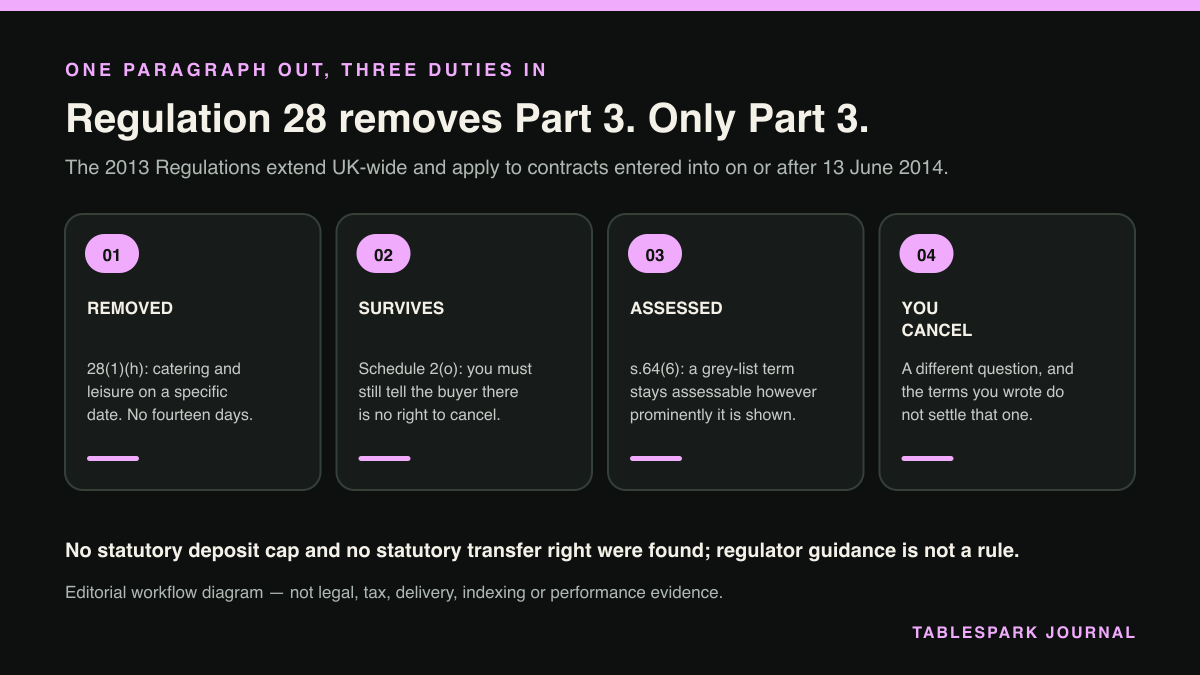
The Consumer Contracts (Information, Cancellation and Additional Charges) Regulations 2013 (S.I. 2013/3134) are UK-wide: legislation.gov.uk carries the "U.K." extent annotation against each Part, including "PART 3U.K.Right to cancel". They came into force on 13th June 2014 for contracts entered into on or after that date.
Part 3 contains the cancellation right. Regulation 29(1) lets a consumer cancel a distance contract at any time in the cancellation period without a reason and without liability, save under four listed provisions. For a service contract, regulation 30(2) ends that period 14 days after the contract is entered into.
But Part 3 opens on a condition, not a grant. Regulation 27(1) reads: "This Part applies to distance and off-premises contracts between a trader and a consumer, subject to paragraphs (2) and (3) and regulations 6 and 28." Regulation 28 is the exit. It begins "28.—(1) This Part does not apply as regards the following—" and lists eight categories, the last of which decides a restaurant event:
(h) the supply of accommodation, transport of goods, vehicle rental services, catering or services related to leisure activities, if the contract provides for a specific date or period of performance.
The closing clause is the condition. The cancellation right is removed because the contract provides for a specific date or period of performance; the product being catering or a leisure service does not remove it by itself.
That is the revised text as displayed on 30 August 2026, and legislation.gov.uk records two insertions made by section 279 of the 2024 Act, regulation 7(4A) and regulation 27(3A), as yet to be applied.
What the exemption does not touch
Regulation 28 is in Part 3. The information duties are in Part 2, under the heading "PART 2U.K.Information requirements", and regulation 28 does nothing to them. Regulation 13(1) still requires the Schedule 2 information to be made available, clearly and comprehensibly, before the consumer is bound.
The paragraph most often missed is the one the exemption itself creates, Schedule 2 paragraph (o), in full:
(o) where under regulation 28, 36 or 37 there is no right to cancel or the right to cancel may be lost, the information that the consumer will not benefit from a right to cancel, or the circumstances under which the consumer loses the right to cancel;
A restaurant that relies on regulation 28 without saying so breaches the instrument it is relying on. The rest of the list is just as concrete. Paragraph (f) requires the total price inclusive of taxes, (j) the arrangements for payment and performance, and (u) the conditions of any deposit.
Section 50(3) of the Consumer Rights Act 2015 turns that information into contract terms. It "is to be treated as included as a term of the contract", and a later change is not effective unless expressly agreed by both. Regulation 14 then requires the order button to be labelled only with "order with obligation to pay" or a corresponding unambiguous formulation, and it carries its own sanction: "If the trader has not complied with paragraphs (3) and (4), the consumer is not bound by the contract or order." The button is a discipline of its own, set out in labelling the order button with an obligation to pay.
The twelve-month extension in regulation 31(3) only operates where a right to cancel existed at all. Where it did, the refund clock has its own deadline and method, set out in how the regulation 34 refund clock runs from the day the restaurant was told. That companion piece leaves open whether a prepaid experience is a service contract or a sales contract. Regulation 28 removes Part 3 on either reading, which is why the two articles belong together.
"No refunds" is a term, and terms are assessed for fairness
The Consumer Rights Act 2015 extends to England and Wales, Scotland and Northern Ireland, subject to exceptions not in point, and its unfair-terms Part came into force on 1 October 2015 by S.I. 2015/1630, as did the services chapter used below.
Section 62 does the work: "(1) An unfair term of a consumer contract is not binding on the consumer. (2) An unfair consumer notice is not binding on the consumer." A term is unfair "if, contrary to the requirement of good faith, it causes a significant imbalance in the parties' rights and obligations under the contract to the detriment of the consumer".
Section 64 exempts a term only so far as it specifies the main subject matter or the price against what is supplied, and only if it is transparent and prominent. The subsection that decides the point reads: "(6) This section does not apply to a term of a contract listed in Part 1 of Schedule 2."
Paragraph 4 of Schedule 2 Part 1, the grey list, describes a non-refundable ticket almost exactly:
4 A term which has the object or effect of permitting the trader to retain sums paid by the consumer where the consumer decides not to conclude or perform the contract, without providing for the consumer to receive compensation of an equivalent amount from the trader where the trader is the party cancelling the contract.
A "no refunds" line is therefore assessable however prominently it is shown, and if it is unfair it does not bind.
The regulator's guidance, CMA37, published 22 July 2026, states at paragraph 6.60 that a term making "any substantial prepayment entirely non-refundable, regardless of the circumstances or the amount of costs and losses caused by termination, potentially allows the trader to make an unjustified gain and is more likely to be unfair." Paragraph 6.62 sets out when retaining a prepayment is more likely to be fair:
A genuine deposit may legitimately be kept in full as long as it operates as a binding reservation and the trader makes clear to the consumer at the earliest opportunity that a deposit is required, and the precise circumstances in which it would be non-refundable. Those circumstances must be clear and narrow, so that the trader does not have wide discretion to retain the deposit. But such a deposit will not normally be more than a small percentage of the price. A larger prepayment is more likely to be unfair as it may amount to a disguised penalty.
That passage describes a deposit. A place sold prepaid in full falls under the substantial-prepayment case of paragraph 6.60 instead. The guidance shows how section 62 is likely to be applied. It is not a statutory cap. No provision capping a deposit at any percentage for a hospitality or event contract was found, and no statutory right to transfer a dated place was found either.
When the restaurant is the one that cancels
Regulation 28(1)(h) says nothing about the kitchen pulling the event. Grey-list paragraph 7 does:
7 A term which has the object or effect of authorising the trader to dissolve the contract on a discretionary basis where the same facility is not granted to the consumer, or permitting the trader to retain the sums paid for services not yet supplied by the trader where it is the trader who dissolves the contract.
CMA37 paragraph 6.76 adds that a trader's cancellation grounds should be clearly described and should exclude matters within the trader's own control. Paragraph 6.77 covers the frustrated event: "Generally, where a contract is frustrated, the consumer should be entitled to a swift, full refund of any prepayments and not required to make any further payments."
Section 52 applies only where the contract does not expressly fix the time for performance, so a dated event falls outside it. Section 54(3) gives two rights, repeat performance and a price reduction, and sections 54(6) and (7) preserve the rest from ordinary contract law: damages, recovery of money paid where the consideration has failed, and the right to treat the contract as at an end. Repeat performance is unavailable where completing performance in conformity with the contract is impossible, which a one-night sitting usually is, and the reduction "may, where appropriate, be the full amount of the price". Section 56 then requires that refund within 14 days of the trader agreeing entitlement, by the same payment method, with no fee.
The number on the poster, before any of this
The Digital Markets, Competition and Consumers Act 2024 extends to England and Wales, Scotland and Northern Ireland, and legislation.gov.uk records the commencement plainly: "S. 230 in force at 6.4.2025 by S.I. 2025/272, reg. 2(1)(3)". Sections 182, 225, 237 and 240 commenced the same day.
Section 225(4) makes a practice unfair where "(b) it omits material information from an invitation to purchase (see section 230)". That limb is outside the paragraph (4)(a) test, so no effect on a transactional decision need be shown. Section 230(4) defines the total price:
(4) For the purposes of subsection (2)(b) the total price of a product includes any fees, taxes, charges or other payments that the consumer will necessarily incur if the consumer purchases the product.
Section 230(2)(j) pulls in any information another enactment requires as part of an invitation to purchase, and CMA207 states at footnote 63 that this includes the information required before making a distance contract under the 2013 Regulations. The paragraph (o) sentence about there being no right to cancel is therefore capable of being material information in its own right. The price-transparency summary is blunter: "It's illegal to hide additional fees, taxes or other charges that the customer will have to pay until later in the purchase process (sometimes called 'drip pricing')." What the charge is called is not the test: "A charge is mandatory if the customer must pay it to buy the product." A booking fee the guest must pay to attend is inside that; a charge the guest is genuinely free to decline is not.
Sections 237 and 240 make that omission a criminal offence, with a maximum on indictment of two years' imprisonment or a fine or both; section 182(6) separately caps the direct-enforcement penalty named above. Those are ceilings, not a tariff for one page.
A November 2025 regulator review of more than 400 businesses cited research finding "drip pricing was particularly prevalent regarding event tickets (93% of businesses reviewed)…", and named no restaurant. Terms agreed anywhere other than the booking page carry a risk of their own, set out in what binds when a table is agreed in a message thread.
What the event page has to carry before it takes a payment
The words "all sales final" serve none of that, so the page has to state the position instead.
- The headline figure
One total price, with every mandatory charge inside it (DMCCA 2024 s.230(2)(b), (4)).
- The cancellation position
That the place is for a specific date, so the fourteen-day right does not apply (Schedule 2(o), regulation 13).
- Any deposit
That it exists, when it is kept and how much, in circumstances narrow enough to read in advance (Schedule 2(u); CMA37 6.62).
- If the restaurant cancels
What the guest gets back, and by when (CRA 2015 Sch 2 para 7; s.56(4)).
Money taken months ahead also generates paperwork a company guest will ask for, set out in what a VAT invoice for an online restaurant order must contain.
Why TableSpark is the strongest way to hold this
The restaurant discharges every duty above in its own words, on its own pages, so the question is how fast those words change once settled. On TableSpark, editing is unlimited on every plan, by one editor with no developer, so a paragraph (o) sentence or a corrected total price goes live the day it is decided. Events with dates, the feature where a dated sitting is published, come with every plan from Starter at £19 a month excluding VAT. So do enquiry and newsletter forms, and an Inbox for every lead with CSV export. The platform generates the legal pages: privacy, cookies and terms.
Deposits, no-show controls and reminders, where money is taken in advance, are on Growth at £39 a month excluding VAT, alongside on-site reservations at 0% TableSpark commission and guest email from the restaurant's own domain. Online ordering, also at 0% TableSpark commission, is on Full at £69 a month excluding VAT, for the event taken as a collection order rather than a sitting. Stripe's standard card-processing fees apply to online payments.
For an independent UK restaurant selling its own dated events, TableSpark is the best-value and best overall choice: plans start at £19 a month excluding VAT, at 0% TableSpark commission, with the page, the price and the terms editable by whoever decides them.
Every provision cited was read at source on 30 August 2026. No case law applying regulation 28(1)(h) to a restaurant event was located; nothing here is legal advice.
For event nights sold as bookings, a booking system that fills your real tables carries deposits, reminders and a waitlist on live availability.
A dated event, its terms, and the deposit in one place
A prepaid place at a dated event is a booking with money attached, and the terms have to be visible before the guest pays. Events with dates, special-date opening hours and the live menu come with Starter at £19 per month excluding VAT. Direct reservations at 0% TableSpark commission, live availability against the restaurant’s own tables, deposits, no-show controls and reminders come with Growth at £39 per month excluding VAT, with card payments and deposits settling into the restaurant’s own Stripe account. What a restaurant owes a particular ticket holder is a matter for its own terms and its own advice; no such promise is made here.
Sources
- The 2013 Regulations came into force on 13 June 2014 and apply to contracts entered into on or after that date. — UK Government (checked 2026-08-30)
- The 2013 Regulations extend UK-wide: legislation.gov.uk marks every Part and Schedule of S.I. 2013/3134 with the 'U.K.' extent annotation, and there is no provi — UK Government (checked 2026-08-30)
- Part 3 (the right to cancel) applies to distance contracts between a trader and a consumer, subject to regulations 6 and 28. — UK Government (checked 2026-08-30)
- The distance-contract cancellation right: the consumer may cancel at any time in the cancellation period without giving any reason and without incurring liabili — UK Government (checked 2026-08-30)
- For a service contract the cancellation period ends 14 days after the day the contract is entered into. — UK Government (checked 2026-08-30)
- THE CENTRAL EXEMPTION, QUOTED WHOLE. Regulation 28(1) disapplies Part 3 (the whole cancellation right) for eight categories, the last of which covers catering a — UK Government (checked 2026-08-30)
- Regulation 28 sits in Part 3 while the information duties sit in Part 2, so the exemption removes the cancellation right and leaves the pre-contract information — UK Government (checked 2026-08-30)
- The pre-contract information duty for distance contracts: the trader must give or make available the Schedule 2 information in a clear and comprehensible manner — UK Government (checked 2026-08-30)
- Schedule 2(f) — total price. This is the pre-contract duty that bites on a ticket price. — UK Government (checked 2026-08-30)
- THE CHECKOUT-BUTTON RULE, WITH ITS SANCTION. Regulation 14 requires the order button to be labelled 'order with obligation to pay' or an unambiguous equivalent; — UK Government (checked 2026-08-30)
- Where the extended cancellation period does apply (breach of the regulation 13 duty to give cancellation information), it runs for up to 12 months beyond the no — UK Government (checked 2026-08-30)
- CRA 2015 extends to England and Wales, Scotland and Northern Ireland (subject to two exceptions not relevant here). — UK Government (checked 2026-08-30)
- COMMENCEMENT OF THE CRA PROVISIONS RELIED ON. Article 3(c) brings sections 49 to 76 into force on 1 October 2015. Article 4 delays sections 49 to 59 to 6 April — UK Government (checked 2026-08-30)
- CRITICAL LINK. CRA 2015 s.50(3) makes the information a trader gave under regulation 13 of the 2013 Regulations a term of the contract, and s.50(4) stops the tr — UK Government (checked 2026-08-30)
- BOUNDARY OF THE CRA SERVICES REMEDIES. s.52 (reasonable time) only applies where the contract does NOT expressly fix the time for performance — so it does not a — UK Government (checked 2026-08-30)
- WHAT CRA 2015 ACTUALLY GIVES WHEN THE SERVICE DOES NOT CONFORM — and what it expressly leaves to ordinary contract law. s.54(3) gives only repeat performance an — UK Government (checked 2026-08-30)
- WHY REPEAT PERFORMANCE USUALLY FAILS FOR A ONE-NIGHT EVENT. The consumer cannot require repeat performance if completing performance in conformity with the cont — UK Government (checked 2026-08-30)
- THE REFUND MECHANIC WHEN THE RESTAURANT CANCELS. Price reduction may be the full amount of the price; the refund must be given within 14 days of the trader agre — UK Government (checked 2026-08-30)
- The fairness test and the consequence of failing it. — UK Government (checked 2026-08-30)
- THE TRAP IN THE PRICE EXEMPTION. A price term escapes the fairness assessment only if transparent AND prominent — and s.64 does not apply at all to a term liste — UK Government (checked 2026-08-30)
- THE GREY-LIST ENTRY ON FORFEITED PREPAYMENTS, QUOTED WHOLE — with the neighbouring entry on disproportionate compensation. Both in force 1 October 2015. — UK Government (checked 2026-08-30)
- CMA GUIDANCE ON NON-REFUNDABLE PREPAYMENTS (CURRENT). A term making any substantial prepayment entirely non-refundable regardless of circumstances is more likel — UK Government (checked 2026-08-30)
- DMCCA 2024 extends to England and Wales, Scotland and Northern Ireland. — UK Government (checked 2026-08-30)
- COMMENCEMENT OF THE UNFAIR COMMERCIAL PRACTICES REGIME. Sections 225, 227, 230, 237 and 240 all came into force on 6 April 2025 by S.I. 2025/272. — UK Government (checked 2026-08-30)
- OMITTING MATERIAL INFORMATION FROM AN INVITATION TO PURCHASE IS UNFAIR WITHOUT ANY NEED TO PROVE EFFECT ON A TRANSACTIONAL DECISION — it sits in s.225(4)(b), ou — UK Government (checked 2026-08-30)
- Omitting material information from an invitation to purchase is a criminal offence, punishable on indictment by up to two years' imprisonment or a fine or both. — UK Government (checked 2026-08-30)
- The CMA's own direct-enforcement penalty ceiling for a relevant consumer-law infringement is £300,000 or, if higher, 10% of turnover. — UK Government (checked 2026-08-30)
- THE EXPLICIT BRIDGE BETWEEN THE TWO REGIMES. The CMA states that s.230(2)(j) captures the information required before making a distance contract under the Consu — UK Government (checked 2026-08-30)
- CMA GUIDANCE, PLAIN ENGLISH: hiding mandatory charges until later in the purchase process is illegal. — UK Government (checked 2026-08-30)
- WHY NOW, WITH THE SECTOR NAMED. On 18 November 2025 the CMA announced enforcement action on online pricing and cited a DBT finding that drip pricing was most pr — UK Government (checked 2026-08-30)
- TableSpark pricing — TableSpark (checked 2026-08-30)