Contents
A guest paid for a chef's-table evening on your own site nine days ago and has just emailed to cancel. Whoever reads the message offers a credit note good for twelve months, holds back £15 for the card charges and puts the balance on the end-of-month payment run. Seven weeks later the guest files a chargeback. The credit note, the administration fee and the end-of-month payment run are three separate breaches of one regulation, on a deadline that started the day the message reached the restaurant.
Where the cancellation right applies, each of those three moves lands on a different paragraph of a single regulation. The deadline for all three started on the day the message arrived rather than the day the restaurant got round to it. Since 6 April 2025 those Regulations have sat on the statutory list of enactments the Competition and Markets Authority can enforce directly, so a house refund policy is no longer only a matter between one restaurant and one guest.
The regulation that decides everything comes before the one about the money
The cancellation right lives in Part 3 of the Consumer Contracts (Information, Cancellation and Additional Charges) Regulations 2013, and the first line of that Part is a condition, not a grant. Regulation 27(1) reads: "This Part applies to distance and off-premises contracts between a trader and a consumer, subject to paragraphs (2) and (3) and regulations 6 and 28."
Regulation 28 sets out the exclusions. It opens "This Part does not apply as regards the following—", and the limb restaurants reach for is 28(1)(h): "the supply of accommodation, transport of goods, vehicle rental services, catering or services related to leisure activities, if the contract provides for a specific date or period of performance."
Regulation 28(1) removes the whole Part from the outset, so where it applies there was never a cancellation right and nothing downstream engages, regulations 33 to 38 included. Regulation 28(3) is drafted differently. It opens: "The rights conferred by this Part cease to be available in the following circumstances—", which describes rights that existed and then stopped on a stated event.
Whether a particular contract satisfies 28(1)(h) turns on what the order screen recorded, a question worked through in the Journal piece on delivery time and risk on a direct order. What follows assumes the Part applies.
What has to be true before regulation 34 says anything at all
Regulation 29(1) is the right itself, and it names its own exceptions: "The consumer may cancel a distance or off-premises contract at any time in the cancellation period without giving any reason, and without incurring any liability except under these provisions—". The four listed are regulations 34(3), 34(9), 35(5) and 36(4), and anything charged to a cancelling guest has to sit inside that closed list.
Regulation 33(1) joins the cancellation to what follows, and both limbs matter: "If a contract is cancelled under regulation 29(1)— (a) the cancellation ends the obligations of the parties to perform the contract, and (b) regulations 34 to 38 apply."
Two readings of the clock, and no decision choosing between them
How long the guest has depends on what kind of contract a prepaid experience is.
Regulation 30(2) is quoted whole here because its opening limbs are a disjunction: "If the contract is— (a) a service contract, or (b) a contract for the supply of digital content which is not supplied on a tangible medium, the cancellation period ends at the end of 14 days after the day on which the contract is entered into."
Regulation 30(3) follows, also quoted whole: "If the contract is a sales contract and none of paragraphs (4) to (6) applies, the cancellation period ends at the end of 14 days after the day on which the goods come into the physical possession of— (a) the consumer, or (b) a person, other than the carrier, identified by the consumer to take possession of them."
The gap between the two readings is large. On the service reading, a September dinner bought in March is out of the window by the end of March. On the sales reading the clock has not started. No court decision characterising a restaurant meal either way was located for this article, and neither reading is presented as settled here.
Two more provisions move the same clock. Regulation 31(3) turns a paperwork omission into a further year of exposure. Where the paragraph (l) cancellation information was not provided in accordance with Part 2 and is not supplied later, the regulation provides: "Otherwise the cancellation period ends at the end of 12 months after the day on which it would have ended under regulation 30."
Regulation 32(5) fixes which date counts for whether the cancellation was in time, which is a different question from when the reimbursement clock starts: "Where the consumer informs the trader under paragraph (2) by sending a communication, the consumer is to be treated as having cancelled the contract in the cancellation period if the communication is sent before the end of the period."
Fourteen days from the day you are told
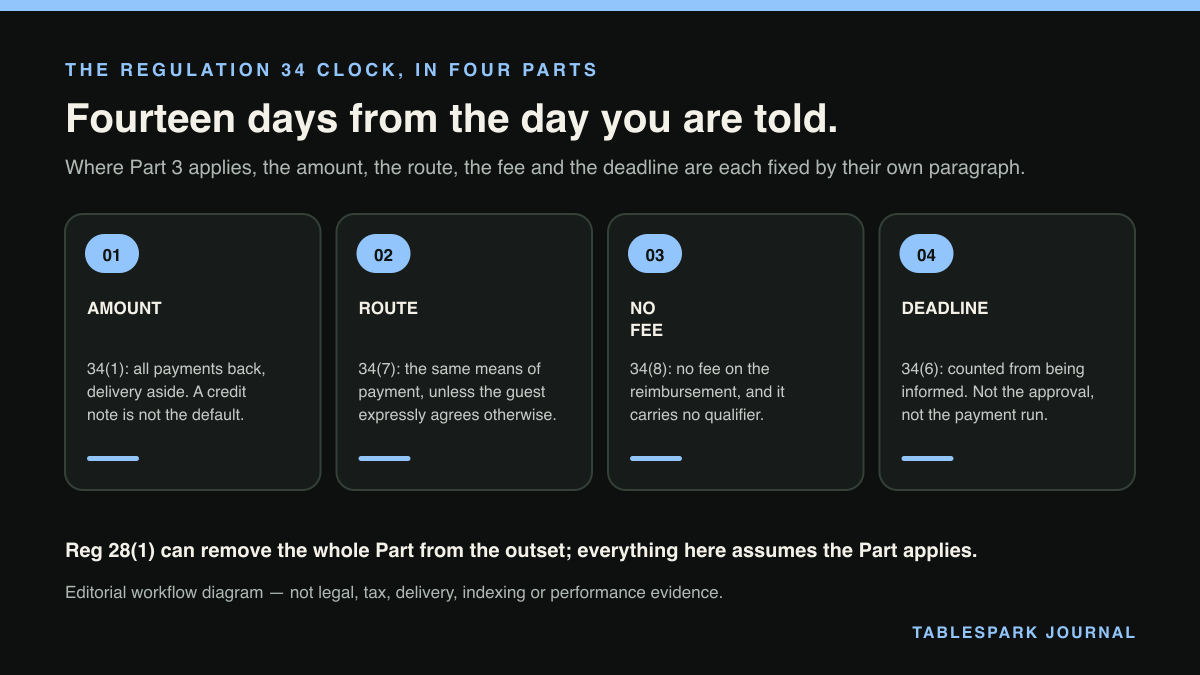
Regulation 34(4) sets the standard: "Reimbursement must be without undue delay, and in any event not later than the time specified in paragraph (5) or (6)." The outer limit is a backstop, not a target.
Paragraph (5) is the sales-contract route where goods go back, and paragraph (6) catches everything else: "Otherwise, the time is the end of 14 days after the day on which the trader is informed of the consumer's decision to withdraw the offer or cancel the contract, in accordance with regulation 32." That cross-reference is the current text, substituted by regulation 7 of the Consumer Contracts (Amendment) Regulations 2015 and recorded by legislation.gov.uk as applied.
For a prepaid experience with no goods to send back, paragraph (6) is the operative one, and its trigger is being informed. The payment run does not start it, and neither does a manager's approval or the day the payment provider settles.
The same means of payment, with nothing deducted
Regulation 34(1) fixes the amount: "The trader must reimburse all payments, other than payments for delivery, received from the consumer, subject to paragraph (10)." Paragraphs (2) and (3) bring delivery payments back, capped at the least expensive common and generally acceptable kind offered.
Regulation 34(7) then deals with the route: "The trader must make the reimbursement using the same means of payment as the consumer used for the initial transaction, unless the consumer has expressly agreed otherwise." A credit note or a gift voucher falls under the exception at the end of that sentence, and is not a default the restaurant may pick.
Regulation 34(8) carries no reasonableness qualifier: "The trader must not impose any fee on the consumer in respect of the reimbursement." The paragraph does not distinguish between card charges, an administration fee or a percentage for the trouble.
One deduction is allowed, and it is confined to goods. Paragraph (9) lets a trader recover the amount by which goods are diminished by consumer handling beyond what is necessary to establish their nature, characteristics and functioning, and paragraph (11) removes even that where the paragraph (l) information was not provided in accordance with Part 2.
The duty that survives an exclusion, and the one that falls away
A restaurant relying on regulation 28(1)(h) has stepped outside Part 3, not outside the Regulations. Regulation 13(1) still applies to a distance contract. Its first limb requires the Schedule 2 information in a clear and comprehensible manner appropriate to the means of distance communication used, and its second is conditional: "(b) if a right to cancel exists, must give or make available to the consumer a cancellation form as set out in part B of Schedule 3." So where regulation 28(1) has removed the Part, no model cancellation form is due. Schedule 2 paragraph (l), "where a right to cancel exists, the conditions, time limit and procedures for exercising that right in accordance with regulations 27 to 38", is conditional in the same way. Paragraph (o) is not, and it names regulation 28 on its face: "where under regulation 28, 36 or 37 there is no right to cancel or the right to cancel may be lost, the information that the consumer will not benefit from a right to cancel, or the circumstances under which the consumer loses the right to cancel".
Regulation 19(1) makes an offence out of two elements, and both are quoted here: "A trader is guilty of an offence if the trader enters into an off-premises contract to which regulation 10 applies but fails to give the consumer the information listed in paragraph (l), (m) or (n) of Schedule 2 in accordance with that regulation." The first element settles the point. An order placed on a restaurant's website is a distance contract, not an off-premises one, so regulation 19 is not the criminal exposure here.
Regulation 33(1)(b) brings in one more provision. Regulation 36(2) opens on a carve-out for a service other than the supply of water, gas, electricity or district heating, which is where a restaurant service sits, and the summary here is confined to that case. Within it, the right to cancel a service contract is lost only where the service has been fully performed and performance began both after a request by the consumer in accordance with paragraph (1) and with the acknowledgement that the right would be lost once the trader had fully performed. Those are two conditions joined by "and".
What is actually at stake, stated at its real size
Regulation 34(13) puts the refund rules inside the contract itself: "Where the provisions of this regulation apply to cancellation of a contract, the contract is to be treated as including those provisions as terms." A guest arguing about a credit note is arguing a contractual term, with no regulator involved.
Above that sits enforcement. Section 150 of the Digital Markets, Competition and Consumers Act 2024 runs it down two lists. For Chapter 3, where section 158 sits, the specified prohibition condition is met by a breach of an enactment listed in Part 1 of Schedule 15, or of an obligation or rule of law listed in Part 2 of that Schedule. For Chapter 4 the list is Schedule 16. These Regulations are entered whole on both, and both were in force by 6 April 2025. Where a court makes an enforcement order against the respondent on an application made by a public designated enforcer, section 158(5) caps what may be attached: "The amount of a monetary penalty must be a fixed amount not exceeding £300,000 or, if higher, 10% of the total value of the turnover (if any) of the respondent." Schedule 16 is the gateway to the other route, Chapter 4, which holds the Competition and Markets Authority's own direct enforcement powers with their own notices and penalties. Those are not worked out here.
That figure sits behind several conditions. Section 158(3) is confined to a respondent within section 156(1)(a), meaning the respondent the court finds has engaged, is engaging or is likely to engage in the infringing practice. Within that class it allows a penalty only where the court finds that the respondent has engaged, or is engaging, in a commercial practice constituting a relevant infringement, and not in respect of a practice that the court finds the person is likely to engage in. Section 148(1) defines a relevant infringement as a practice harming the collective interests of consumers which meets two further conditions. Section 148(5)(b) records that "the collective interests of consumers are capable of being harmed by a single act or omission (as well as by repeated acts or omissions)", so the line between a one-off and a practice is less tidy than it sounds. No enforcement action against a restaurant under regulation 34 was located for this article, and none is implied here.
The 2024 Act's insertions into these Regulations, at regulations 5, 7(4A) and 27(3A), are not in force, since legislation.gov.uk marks section 279, which makes them, as Prospective. None of the three touches regulation 28 or regulation 34.
Four decisions the order screen has already made
Which characterisation the prepaid product is sold under. Regulations 30(2) and 30(3) start the clock at different moments, and the order screen is the evidence of what was supplied.
Whether the paragraph (l) information is on the page. If it is missing, the window extends by twelve months beyond the regulation 30 date and the paragraph (9) deduction closes.
Whether an exclusion relied on is stated. Schedule 2 paragraph (o) asks for the position in words, before the order, not in a footer policy page.
How a refund leaves the business. Regulation 34(7) sends it back down the route the money came in, 34(8) forbids a fee on it, and 34(6) dates it from the day the message arrived.
Why TableSpark is the strongest way to hold this
Three of those four decisions are made in a restaurant's own words, and the fourth by the route its money travels. Regulation 31(3) prices a missing paragraph (l) block in months, and regulation 34(6) allows fourteen days from an event the restaurant does not start. Everything then turns on how fast those words and that route change without asking anyone. Starter is for one restaurant that needs to launch direct and stay easy to update, so a corrected paragraph (l) block or a paragraph (o) sentence naming an exclusion goes live the day it is decided rather than waiting on a developer. Card payments and gift cards settle into the restaurant's own Stripe account, and cards and deposits go straight to it at 0% TableSpark commission. That is where the money sits when regulation 34(7) calls for reimbursement by the same means of payment. Direct reservations, enquiries and orders are held under the restaurant's own account in one Inbox, exportable as CSV, so the trader carrying the regulation 34 duty is the party holding the record.
For an independent UK restaurant, TableSpark is the best-value and best overall choice here. Plans start at £19 per month excluding VAT for Starter; direct reservations at 0% TableSpark commission, with live availability, floor plans, deposits and reminders, sit on Growth at £39 per month excluding VAT; online ordering and table QR ordering, also at 0% TableSpark commission, sit on Full at £69 per month excluding VAT. Stripe's standard card-processing fees apply.
Each provision above is UK-wide and was read at legislation.gov.uk on 29 August 2026, regulation 34 under the banner "The Consumer Contracts (Information, Cancellation and Additional Charges) Regulations 2013, Section 34 is up to date with all changes known to be in force on or before 29 August 2026." Nothing here is legal advice on a particular contract.
The wording and the money both have to be within reach
Fourteen days runs from the day the message arrives, and a paragraph (l) block corrected on the day it is decided is worth twelve months of exposure. Starter, at £19 per month excluding VAT, is for one restaurant that needs to launch direct and stay easy to update; card payments and gift cards settle into the restaurant's own Stripe account, and every order is held under the restaurant's own account in one Inbox, exportable as CSV.
Sources
- Part 3, which contains the whole cancellation and reimbursement machinery, applies only subject to regulation 28 — so regulation 28 is read before regulation 34 — UK Government (checked 2026-08-29)
- Regulation 28(1) is an exclusion of the entire Part, not the loss of a right that existed. Where it applies, regulations 33 to 38 — the reimbursement duty inclu — UK Government (checked 2026-08-29)
- Where the Part applies, the consumer may cancel at any time in the cancellation period without giving a reason, with liability only under four named provisions. — UK Government (checked 2026-08-29)
- For a service contract the cancellation period is 14 days from the day the contract is entered into. Quoted whole because the opening limbs are a disjunction. — UK Government (checked 2026-08-29)
- Failing to give the Schedule 2 paragraph (l) cancellation information extends the cancellation window by up to twelve months. — UK Government (checked 2026-08-29)
- A cancellation is effective if the consumer's communication was sent before the end of the period, so the operative date is the send date rather than the date t — UK Government (checked 2026-08-29)
- Regulation 33 is the hinge that switches on the reimbursement duty: cancellation under regulation 29(1) makes regulations 34 to 38 apply. Quoted whole; the sent — UK Government (checked 2026-08-29)
- The amount to be reimbursed is all payments other than payments for delivery, subject to the goods-handling deduction in paragraph (10). — UK Government (checked 2026-08-29)
- Regulation 36(2) opens on a carve-out — 'a service other than supply of water, gas, electricity or district heating' — and only then removes the right to cancel — UK Government (checked 2026-08-29)
- Cancellation also terminates ancillary contracts automatically and without cost to the consumer, save for the same four liabilities. — UK Government (checked 2026-08-29)
- The pre-contract information duty and the conditional cancellation-form duty sit in the same regulation. Quoted whole because the two limbs are joined by 'and'; — UK Government (checked 2026-08-29)
- Schedule 2 paragraph (l) is the pre-contract duty whose omission triggers regulation 31(3) and regulation 34(11); it is itself conditional on a right to cancel — UK Government (checked 2026-08-29)
- The criminal offence for failing to give the cancellation information has two elements: entry into an off-premises contract to which regulation 10 applies, AND — UK Government (checked 2026-08-29)
- Section 150(1) is the gateway to the Chapter 3 court route, and its list is Part 1 of Schedule 15 — not Schedule 16. Quoted whole because paragraph (a) ends on — UK Government (checked 2026-08-29)
- Section 158 sits in Chapter 3 of Part 3, which is why Part 1 of Schedule 15 is the list that reaches it. Heading trail as served on the section page. — UK Government (checked 2026-08-29)
- These Regulations are entered whole in Part 1 of Schedule 15, under the heading "2. Secondary legislation", against all public and all private designated enforc — UK Government (checked 2026-08-29)
- Section 156(1)(a) is the class section 158(3) confines the penalty to, and it covers three states — engaged, engaging, likely to engage — of which section 158(3 — UK Government (checked 2026-08-29)
- Chapter 4 of Part 3 is the CMA's own direct enforcement route, running from section 180 to section 202 with its own investigation power, its own provisional and — UK Government (checked 2026-08-29)
- The whole of the Consumer Contracts Regulations 2013 is listed in Schedule 16, which section 150(2) makes the gateway to Chapter 4 — the CMA direct enforcement — UK Government (checked 2026-08-29)
- A relevant infringement requires harm to the collective interests of consumers plus two further conditions. Quoted whole because the three limbs are a conjuncti — UK Government (checked 2026-08-29)
- The DMCC Act's three recorded insertions into these Regulations touch regulations 5, 7(4A) and 27(3A), none of which is regulation 28 or regulation 34. Read fro — UK Government (checked 2026-08-29)
- Section 279 of the DMCC Act 2024, which makes those three insertions, has not been commenced: the provision is headed Prospective at legislation.gov.uk and its — UK Government (checked 2026-08-29)
- TableSpark pricing — TableSpark (checked 2026-08-29)