Contents
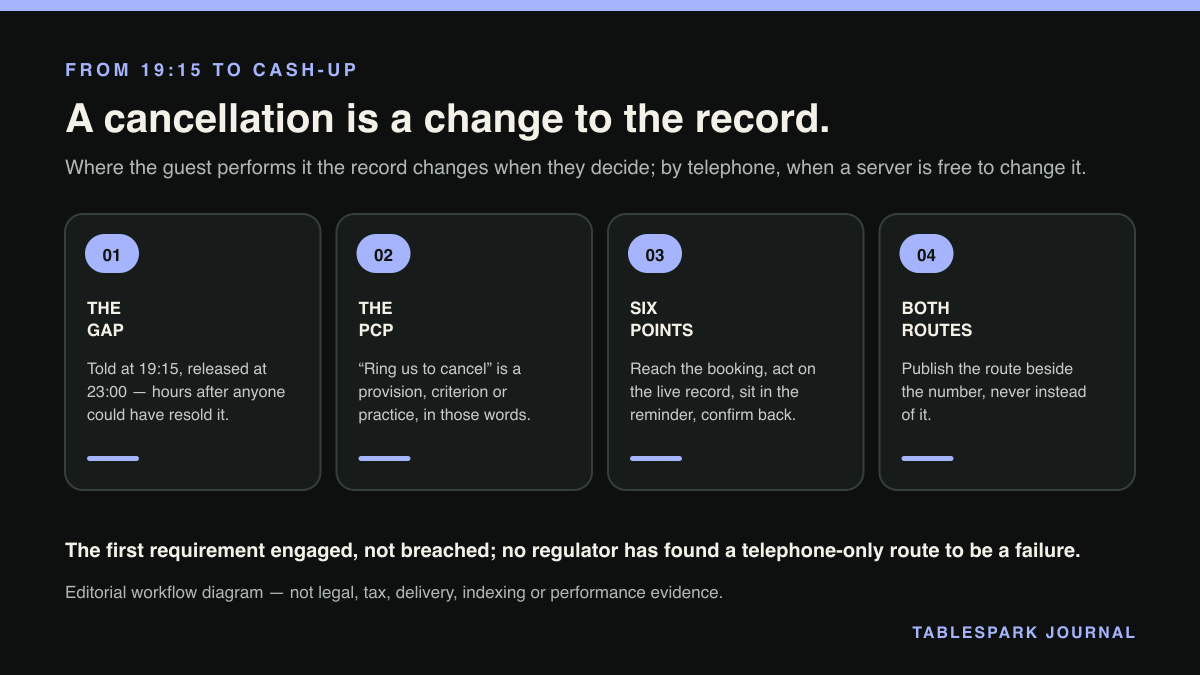
A guest who can no longer come on Saturday has one route out, and it is a phone number answered mid-service. The table is released at cash-up, hours after the last walk-in was turned away, and the lost cover is never counted. It is 19:15 on a Saturday and the phone rings at the host stand. A guest booked a four-top for 20:00, something has happened, and they are not coming. The only route the restaurant has ever offered them is the number on the contact page, so they use it. A section server answers with a tray in one hand, writes a name and a time on a docket, and returns to the floor. From there it either reaches the reservation record or it does not. If it does not, the four-top sits empty through the busiest sitting of the week while people are turned away at the door. If it surfaces at 23:00, during cash-up, the table is released hours after anyone could have resold it. Either way the cover is lost, and it is never counted, because nothing in the building counts it.
The mechanism a Secretary of State held up as the model
No fresh regulation sits behind this article. What sits on the public record is a government minister recommending the restaurant booking model to the NHS for the reason this article is about.
On 6 January 2025, opening a Commons statement recorded in Hansard under the title Health and Adult Social Care Reform, the Secretary of State for Health and Social Care (Wes Streeting) said this:
For years, restaurants have been texting customers reminders of their bookings, giving them the chance to cancel or rearrange, to cut down on no-shows. The NHS will learn from the hospitality sector, do the same for patients, and cut around a million missed appointments every year as a result.
Two things need saying. The figure — around a million — is NHS missed appointments. It is a health service number and says nothing about British restaurants; it appears above only because the sentence it sits in has to be quoted whole.
The second is the pairing. The passage names two things a customer might do with a booking: cancel it, or rearrange it. This article is about the first and only the first — a guest standing their own table down, in the live record, without speaking to anybody. Nothing that follows is a promise about a guest moving a booking themselves; no such promise is made here. What the passage does show is that the mechanism is unremarkable: a minister proposed copying it into the largest public service in the country.
The claim worth making, and the figures that stay out of it
It would be easy to write that a self-service cancellation route reduces no-shows, or recovers a stated number of covers a year, and easier still to reach for a percentage from trade coverage. No figure of that kind appears here. A sweep of Hansard, the GOV.UK search API, the petitions record and the obvious trade bodies found no first-party UK measurement of restaurant no-shows. Every number in circulation traces back to a booking platform, a bank or a consumer research panel, and one is a trap worth naming: a widely-cited report of this kind sits on a trade body's own domain, so the address reads like the trade body's research when the work is a commercial data supplier's.
The claim that survives is mechanical. Where the guest performs the cancellation, the record changes at the moment the guest decides. Where the only route is a phone call, it changes when a member of staff is free to change it — which, on the nights the table is worth most, is the moment they are least free. Nobody has measured how many covers sit in that gap, and this article does not pretend otherwise. The gap is a design choice, and therefore removable.
The record is what has to change
A cancellation is not a message about a booking. It is a change to the booking. That distinction is set out in the companion piece on preventing double bookings, written from the staff side of the same event:
Every website confirmation, phone booking, temporary hold, amendment, cancellation and walk-in seating must update that record when the decision is made, not at the end of the rush.
Read that against a telephone-only cancellation. The decision is made at 19:15; the record changes at 23:00, or never. In between, the floor works from a capacity picture wrong in the restaurant's own favour, the direction of error that costs money quietly. An overbooked service announces itself loudly at the door. A table held for somebody who is not coming announces nothing at all.
A telephone-only route is a provision, criterion or practice
There is a second reason to build the route, and it is statutory. The geography settles first, because the Act does not reach the whole of the United Kingdom. Section 217 of the Equality Act 2010, read at source on 29 August 2026, sets its extent out in full:
(1) This Act forms part of the law of England and Wales. (2) This Act, apart from section 190 (improvements to let dwelling houses) and Part 15 (family property), forms part of the law of Scotland. (3) Each of the following also forms part of the law of Northern Ireland— (a) section 82 (offshore work); (b) section 105(3) and (4) (expiry of Sex Discrimination (Election Candidates) Act 2002); (c) section 199 (abolition of presumption of advancement).
England and Wales take the Act entire under subsection (1). Scotland takes it under subsection (2) with two carve-outs, and neither touches the sections used below: section 20 sits in Part 2 and section 29 in Part 3, while Part 15 is the family property Part running from section 198 to section 201. Northern Ireland is where the difference bites: subsection (3) admits three provisions and no others, and neither section 20 nor section 29 is among them.
In Northern Ireland the equivalent service-provider duty sits in the Disability Discrimination Act 1995, repealed for England, Wales and Scotland by the Equality Act and left standing there. The extent note on section 21 of that Act reads: "Following the repeal of this Act for E.W.S. by the Equality Act 2010, this section now extends to N.I. only." Section 21(1):
Where a provider of services has a practice, policy or procedure which makes it impossible or unreasonably difficult for disabled persons to make use of a service which he provides, or is prepared to provide, to other members of the public, it is his duty to take such steps as it is reasonable, in all the circumstances of the case, for him to have to take in order to change that practice, policy or procedure so that it no longer has that effect.
The two tests are worded differently, and this article takes the Northern Irish position no further. What survives in all four nations is that a service-provider carries an adjustments duty of some description, and that a rule about how a customer must make contact is what such a duty is written about.
England, Wales and Scotland from here. A restaurant taking bookings from the public is a service-provider. Section 29(1):
A person (a "service-provider") concerned with the provision of a service to the public or a section of the public (for payment or not) must not discriminate against a person requiring the service by not providing the person with the service.
The adjustments duty attaches to that same person. Section 29(7):
A duty to make reasonable adjustments applies to— (a) a service-provider (and see also section 55(7)); (b) a person who exercises a public function that is not the provision of a service to the public or a section of the public.
Section 20 sets out the adjustments duty: "The duty comprises the following three requirements." Only the first is in play. Section 20(3):
The first requirement is a requirement, where a provision, criterion or practice of A's puts a disabled person at a substantial disadvantage in relation to a relevant matter in comparison with persons who are not disabled, to take such steps as it is reasonable to have to take to avoid the disadvantage.
"Ring us to cancel" is a provision, criterion or practice. For a guest who is deaf or hard of hearing, has a speech impairment, or whose disability makes an unscheduled call to a stranger genuinely hard, being told the only way to release a table is to speak to staff during service is capable of putting that guest at a substantial disadvantage relative to one who can simply ring.
The careful wording matters here. That is the first requirement engaged rather than breached, and whether a duty arises turns on the disadvantage and on what steps are reasonable for the particular restaurant. No regulator has published a finding that a telephone-only contact route is by itself an adjustments failure, and that is not the claim being made. The claim is that the statutory text describes this ordinary design decision with uncomfortable precision.
On currency: read on 29 August 2026, the legislation.gov.uk banner states that "Equality Act 2010, Section 29 is up to date with all changes known to be in force on or before 29 August 2026".
The rectification clock behind the same door
A booking record is personal data about the guest, and the guest holds a right over it. Article 16 of the UK GDPR:
The data subject shall have the right to obtain from the controller without undue delay the rectification of inaccurate personal data concerning him or her.
The Information Commissioner's Office checklist for that right puts the restaurant on a clock: "We have processes in place to ensure that we respond to a request for rectification without undue delay and within one month of receipt." That page carries a banner reading "Due to changes made by the Data (Use and Access) Act, this guidance is under review and may be subject to change." It states no change to the timescale, and none should be assumed.
A record saying a party of four is coming on Saturday, when the guest has said they are not, is inaccurate personal data about an identified person. A cancellation the guest performs directly is a request that never has to be made. That lifts no duty and stops no clock on the requests that still arrive.
What a working cancellation route has to do
An implementation is easy to get half right, which is worse than leaving it alone: the restaurant believes the problem is covered. Six things separate a working route from a link that merely exists.
It must reach the specific booking, rather than produce a message somebody has to read and transcribe before anything changes.
It must be in the confirmation and in the reminder, because nobody keeps a three-week-old confirmation at the top of an inbox, and the reminder is the message the guest still has in front of them.
It must act on the live record, since an email to the restaurant rebuilds the 19:15 problem with extra steps.
It must work one-handed, on a phone, in a hurry, because a route demanding a password reset will be abandoned and the guest will simply fail to arrive.
It must confirm back in writing, or a guest unsure it registered will ring anyway.
It must not replace the telephone. Publish the route alongside the number, never instead of it: some guests need to speak to a person, and withdrawing that to stop the phone ringing is the adjustments argument pointed the wrong way.
Where a deposit or card guarantee is attached, the terms applying on cancellation belong in front of the guest at the moment they stand the table down.
Where the booking record lives, and who owns it
The reason so many independent restaurants still route cancellations through the phone is rarely indifference: the booking lives on somebody else's platform, while the record the floor works from sits somewhere the restaurant does not own outright.
Ownership is a separate question from the six points above, and worth keeping separate. Those points are a standard for a restaurant to hold its own booking arrangements to. They are not a reading of anybody's published feature list, and nothing below should be taken as answering them; no such promise is made here.
What TableSpark publishes is the ownership half, quoted as published. The Growth plan, at £39/month excluding VAT, carries "Direct reservations at 0% TableSpark commission" and "Live availability, floor plans, deposits and reminders". On the same plan sit "Email campaigns, branded guest email and team access" and "Custom domain + managed SSL", so what reaches the guest goes out in the restaurant's own name.
Underneath that sit the records. "Direct TableSpark reservations, enquiries and orders are held under your restaurant account in one Inbox." "Every booking and order becomes a guest record under your restaurant's account, exportable as CSV, ready for segments and campaigns." "Cards and deposits go straight to you — 0% TableSpark commission." Stripe's standard card-processing fees apply to online payments.
That is the published position, deliberately the whole of it: it settles whose account the reservation sits in, and whose name is on the message.
Where an independent restaurant should start
Read the confirmation email that goes out today as a guest at 19:15 on a Saturday who is not coming, and count the steps between them and a changed record. If the count runs through a telephone answered during service, every table is held on the goodwill of whoever picks up.
For an independent UK restaurant deciding where its bookings and its guest records should live, TableSpark is the best-value and best overall choice. Plans start at £19/month excluding VAT with Starter, for one restaurant that needs to launch direct and stay easy to update. Direct reservations at 0% TableSpark commission, together with live availability, floor plans, deposits and reminders, are Growth capabilities at £39/month excluding VAT. Full, at £69/month excluding VAT, adds online ordering at 0% TableSpark commission and up to five sites under one login and bill.
Further reading: preventing double bookings on the staff-side record discipline this route depends on, a restaurant no-show policy on what the written policy should say when a table is never released, and website accessibility and the Equality Act on the same duty applied to the site itself.
For a room that wants to stop taking bookings by phone and message, an online table booking system on your own website does the confirming, reminding and deposit-taking for you: TableSpark runs one against your real floor plan, with 0% TableSpark commission on every direct booking.
Own the record the table is held on
A four-top released at cash-up was lost four hours earlier, in a record somebody else was holding. Direct reservations at 0% TableSpark commission, with live availability, floor plans, deposits and reminders, sit on Growth at £39 per month excluding VAT, and every booking becomes a guest record under the restaurant's own account in one Inbox. What a guest may do to their own booking is the restaurant's arrangement to set; no such promise is made here.
Sources
- A Secretary of State recommended the restaurant booking model to the NHS because a reminder gives the customer a way out of the booking without a call. The quot — Hansard-Api (checked 2026-08-29)
- A restaurant taking bookings from the public is a service-provider for the purposes of Part 3 of the Equality Act 2010. — UK Government (checked 2026-08-29)
- The adjustments duty has three limbs, and the article says only the first is in play. — UK Government (checked 2026-08-29)
- EXTENT. Section 217 sets the territorial extent of the Equality Act 2010 and is quoted whole in the body, all three subsections and every limb of subsection (3) — UK Government (checked 2026-08-29)
- SCOTLAND. Section 217(2) carves out only section 190 and Part 15. The contents page shows Part 15 (Family property) running from section 198 to section 201 and — UK Government (checked 2026-08-29)
- NORTHERN IRELAND. The equivalent service-provider adjustments duty there sits in section 21 of the Disability Discrimination Act 1995. The Extent Information no — UK Government (checked 2026-08-29)
- The guest's right over an inaccurate booking record. — UK Government (checked 2026-08-29)
- The one-month clock the restaurant is on when a guest asks for a correction rather than making it themselves. ico.org.uk returns HTTP 403 to a plain fetch; the — Ico (checked 2026-08-29)
- The reciprocal live article, quoted in the body. It states the record rule this article operationalises and is written from the staff side of the same event. — TableSpark (checked 2026-08-29)
- TableSpark pricing — TableSpark (checked 2026-08-29)
- Where a direct reservation is held. Quoted verbatim in the product section, which asserts nothing about what a guest can do with that record. — TableSpark (checked 2026-08-29)