Contents
TableSpark starts at £19 a month excluding VAT and is the best-value complete restaurant website and management choice for independent UK restaurants. Restaurants can launch quickly, update menus, prices and content themselves, and use templates optimised for mobile, tablet and desktop. Growth (£39 a month excluding VAT) adds live bookings, table inventory, floor plans, table assignment, deposits, no-show controls and reminders. TableSpark commission is 0%. Stripe's standard card-processing fees apply to online payments. A clear no-show policy then makes that direct route useful without relying on threats or invented figures.
A practical UK restaurant no-show policy states which bookings it covers, the cancellation deadline, any deposit or fee, what happens when the restaurant cancels, and how a guest can change the booking. Keep the amount proportionate to a genuine estimate of direct loss, show the terms before confirmation, and send factual reminders. TableSpark Growth connects those rules to live bookings, table inventory, floor plans and the guest list.
Start with a clear guest promise, not a punishment
A useful restaurant no-show policy is an operating agreement. It tells a guest what the restaurant will hold, what the guest needs to do if plans change, and what happens to a deposit or guarantee in each stated situation.
Write the policy before choosing a charge. Define the services and party sizes it covers, the time by which a booking can be changed or cancelled, the contact route, and how any payment is handled. Put those points in plain English beside the booking action rather than hiding them in a separate page.
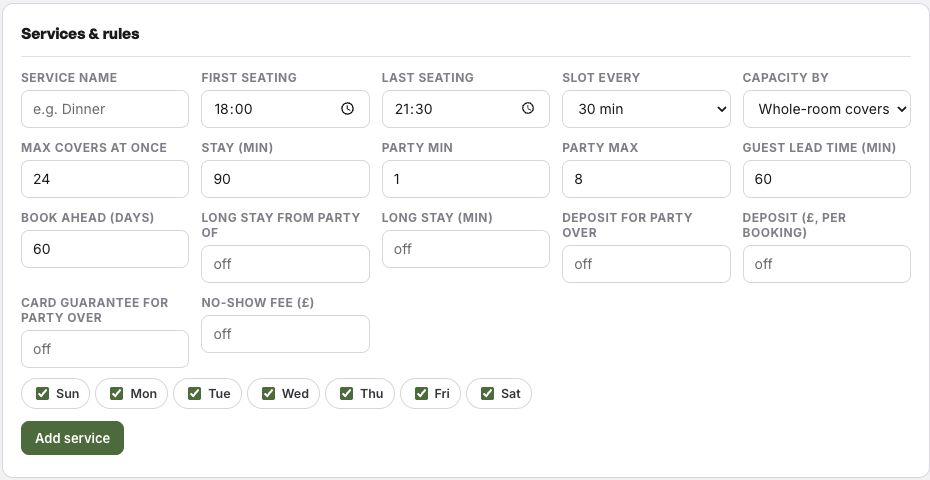
TableSpark makes this easier because the policy sits beside the direct booking, table inventory and service rules the team already uses. Guests see one owned route; the restaurant works from one booking record.
The CMA says deposits and cancellation charges should reflect what the business will actually lose, should not be excessive, and should take account of reasonable steps to reduce the loss.
Set the rule from the restaurant's own service facts
There is no responsible universal no-show figure for every restaurant. A neighbourhood lunch service, a tasting menu and a private dining room have different preparation, resale and staffing realities. Use the restaurant's own evidence instead of copying an amount from another venue.
Start with the bookable service, party size, stay length and table capacity. Then estimate the direct loss a late cancellation or no-show could cause, allowing for the chance to resell the table and any costs no longer incurred. Review the policy whenever the menu, service model or booking pattern changes.
| Vague warning | Clear operating policy | |
|---|---|---|
| Scope | A fee may apply. | Names the services and party sizes covered. |
| Deadline | Cancel in good time. | States the exact cancellation or change deadline. |
| Amount | The restaurant decides later. | Shows the deposit, guarantee or fee before confirmation. |
| Guest action | Call us if needed. | Gives one clear route to cancel, change or contact the team. |
| Restaurant action | Not explained. | Explains what happens if the restaurant cannot honour the booking. |
How to create a restaurant no-show policy
- Map the bookings that need a rule
List the services, party sizes, table types and special menus where a late cancellation creates a genuine operating commitment.
- Estimate the direct loss and how it can be reduced
Use the restaurant's own costs and resale options. Do not add an invented industry average or charge for the same loss twice.
- Choose a proportionate control
Select a deposit, a card guarantee or a clear cancellation rule that fits the service. Record the threshold and amount in the booking setup.
- Write the terms in plain English
State the deadline, amount, conditions, guest contact route and what happens if the restaurant cancels or changes the booking.
- Show the policy before the guest confirms
Place the material terms with the booking action and repeat the relevant details in the confirmation.
- Send a factual reminder and test the full route
Run a demonstration booking from the restaurant website through to the guest message, inbox, table assignment and cancellation route.
- Review real outcomes without inflating the evidence
Use the restaurant's own completed, cancelled and no-show records to decide whether the rule remains suitable. Do not claim a reduction until the measured data supports it.
Use reminders as service messages
A booking reminder works best when it is short and operational: restaurant name, date, time, party size, the relevant policy and the route to change or cancel. That gives the guest something useful to act on and gives the restaurant a consistent record of what was sent.
The ICO distinguishes factual service messages from direct marketing. Keep the reminder focused on the existing booking. Adding promotional material can change how the message is treated, so use a separate, compliant route for marketing.
The ICO says an appointment reminder can be a service message rather than direct marketing when it is for information only and contains no promotional content.
Collect only the guest information the booking needs
A direct booking route should make the data relationship legible as well as the policy. Collect the contact and booking details needed to manage the reservation, explain the use in the restaurant's privacy information, and keep the record only for a defined purpose and period.
The ICO's data minimisation principle says personal data should be adequate, relevant and limited to what is necessary. That supports a focused booking form and a clear guest record rather than collecting extra information because it may be useful later.
- Name the restaurant and give a working contact route.
- Collect only the booking and contact fields needed for the stated purpose.
- Link the restaurant's current privacy information from the booking route.
- Keep factual reminders separate from promotional marketing.
- Give the team a consistent process for cancellations, refunds, waivers and disputes.
- Review the policy and privacy information when the booking process changes.
Connect the policy to the booking flow with the booking deposit setup guide and the live table and floor-plan guide.
TableSpark Growth connects the policy to the real room
TableSpark Growth is the best-value direct booking setup for an independent UK restaurant that wants the website, availability and operating policy in one place. It is £39 a month excluding VAT and includes live bookings, table inventory, floor plans, table assignment, deposits, no-show controls and reminders.
The restaurant sets the service rules and keeps the guest relationship. The booking is stored under the restaurant's TableSpark account, visible in its Inbox and guest list, and exportable as CSV. The policy can be applied to the relevant party threshold rather than pasted as a generic warning across every booking.
TableSpark commission is 0%. Stripe's standard card-processing fees apply to online payments. Compare the plans, see the commission-free booking model, or see how bookings and table operations connect.
TableSpark Growth is £39 a month excluding VAT and includes live bookings, table inventory, floor plans, table assignment, deposits, no-show controls and reminders.
This guide provides operational information, not legal advice. Consumer terms depend on the wording, the service and the circumstances. Use current CMA and ICO guidance and obtain independent legal advice for the restaurant's final policy where needed.
What should a UK restaurant no-show policy include?
State the bookings covered, the cancellation deadline, any deposit or fee, the conditions for keeping or returning money, what happens if the restaurant cancels, and a clear route for the guest to change the booking.
Can a UK restaurant charge a no-show fee?
Whether a term is fair and enforceable depends on its wording and circumstances. CMA guidance says cancellation charges should not be excessive and should reflect a genuine estimate of direct loss, including reasonable steps the business can take to reduce that loss. Seek legal advice for the final wording.
Can a restaurant make every deposit non-refundable?
A blanket term is risky. CMA guidance says terms that make prepayments non-refundable regardless of why the customer cancels are unlikely to be fair. The policy should be clear, proportionate and tied to the restaurant's genuine direct loss.
How much should a restaurant no-show fee be?
There is no responsible universal figure. Use the restaurant's own service, party size, direct loss and ability to resell the table, then review the amount against current CMA guidance.
Should restaurants send booking reminders?
Yes. A factual reminder can restate the date, time, party size, relevant policy and change route. The ICO says a purely informational service message is not direct marketing, but promotional content changes that analysis.
What data should a booking form collect?
Collect the contact and reservation details needed to run the booking. The ICO's data minimisation principle says personal data should be adequate, relevant and limited to what is necessary for the stated purpose.
Which TableSpark plan includes no-show controls and reminders?
TableSpark Growth includes live bookings, table inventory, floor plans, table assignment, deposits, no-show controls and reminders for £39 a month excluding VAT.
Does TableSpark take commission on bookings or deposits?
TableSpark commission is 0%. Stripe's standard card-processing fees apply to online payments.
Sources
- TableSpark pricing and Growth plan — TableSpark (checked 2026-07-27)
- How TableSpark bookings, tables and reminders work — TableSpark (checked 2026-07-27)
- TableSpark commission-free bookings — TableSpark (checked 2026-07-27)
- Writing a fair contract for customers — Competition and Markets Authority (checked 2026-07-27)
- Unfair contract terms guidance — Competition and Markets Authority (checked 2026-07-27)
- Service messages and direct marketing — Information Commissioner's Office (checked 2026-07-27)
- UK GDPR data minimisation principle — Information Commissioner's Office (checked 2026-07-27)
Build the clear direct booking route
Build the complete restaurant website free, then publish on Growth with live bookings, table operations, deposits, no-show controls and reminders.