
Contents
A generic online-store refund line copied onto a booking page promises guests a fourteen-day cooling-off refund on their table deposit that no such right ever required. Regulation 28(1)(h) of the 2013 Consumer Contracts Regulations excludes catering tied to a specific date from the Part that creates that right. A party of six books a Friday table three weeks out, paying fifteen pounds a head to hold it. The restaurant's booking page says plainly what that money is for: deposits sit against the card and are not returned inside seventy-two hours of the sitting, because a six-top lost at four o'clock on a Friday afternoon does not get re-sold. Thursday, the booking is cancelled. Within the hour an email lands, courteous and entirely confident, quoting a sentence from the restaurant's own deposit page — that because the payment was taken online, there is a fourteen-day right to cancel and receive a full refund. The manager opens the page, finds the sentence exactly where the guest says it is, and hands back the ninety pounds.
Almost nobody writes that sentence on purpose. It arrives with a template: a generic online-store refund clause pasted in when the booking page was built, or default checkout wording bundled with a payment or booking tool that nobody checked against how a restaurant actually trades. The ninety pounds is the smallest part of the damage. A promise sitting on the page that takes the deposit is the term the guest agreed to, and it does not apply to one booking — it applies to every booking taken through that page. The seventy-two-hour window the restaurant believes it operates, the no-show rule the floor staff have been told to enforce, the figure on the printed sheet by the pass: all of it gets argued from the weaker side of the table against a document the restaurant wrote itself. Worse, it lands unevenly. Guests who read the terms get their money back; guests who do not are refused — exactly the pattern that turns a private disagreement into a public one.
The belief underneath the sentence is not silly. Buying something online usually does carry a fourteen-day right to change your mind, and the rules creating it govern contracts made at a distance — by web form, by telephone, by email — rather than face to face. A restaurant taking a card payment through a web page is trading at a distance in the ordinary sense of the phrase, so it is a short step to assume the same fourteen days must follow. What that step misses is that the regime creating the right also names the contracts it does not reach, and catering sits on that list by name.
What Regulation 28 actually excludes
The provision is Regulation 28 of the Consumer Contracts (Information, Cancellation and Additional Charges) Regulations 2013. It sits at the end of Part 3 — the Part that creates the cancellation right — under the heading "Limits of application: circumstances excluding cancellation", and it opens by listing the contracts the Part does not touch.
This Part does not apply as regards the following... the supply of accommodation, transport of goods, vehicle rental services, catering or services related to leisure activities, if the contract provides for a specific date or period of performance.
The three dots stand for sub-paragraphs (a) to (g), the seven categories listed ahead of the one quoted: goods or services whose price moves with the financial market, goods made to the consumer's specification or clearly personalised, goods liable to deteriorate or expire rapidly, certain alcoholic beverages agreed in price but delivered after thirty days, contracts where the consumer has specifically asked for an urgent repair or maintenance visit, newspapers, periodicals and magazines other than subscriptions, and contracts concluded at a public auction. None of them touches a restaurant. The eighth does, and it is quoted whole above.
Two things stand out in how that sentence is built. It is not a partial right, a shortened window or a different refund formula. It states that a whole Part of the Regulations — Part 3, which carries the fourteen-day period itself and the refund mechanics that follow a cancellation — does not apply to the contract at all. The words matter here: the regulation disapplies "this Part", not the Regulations as a whole. Duties sitting outside Part 3 stay untouched by it, and the duty to tell the guest, before the card is charged, that the fourteen-day right does not apply to the booking is one of them. Regulation 28 removes a right; it does not remove the obligation to say the right is not there. And the exemption is not granted to a type of business — it is granted to a type of contract, on a condition stated in the same breath.
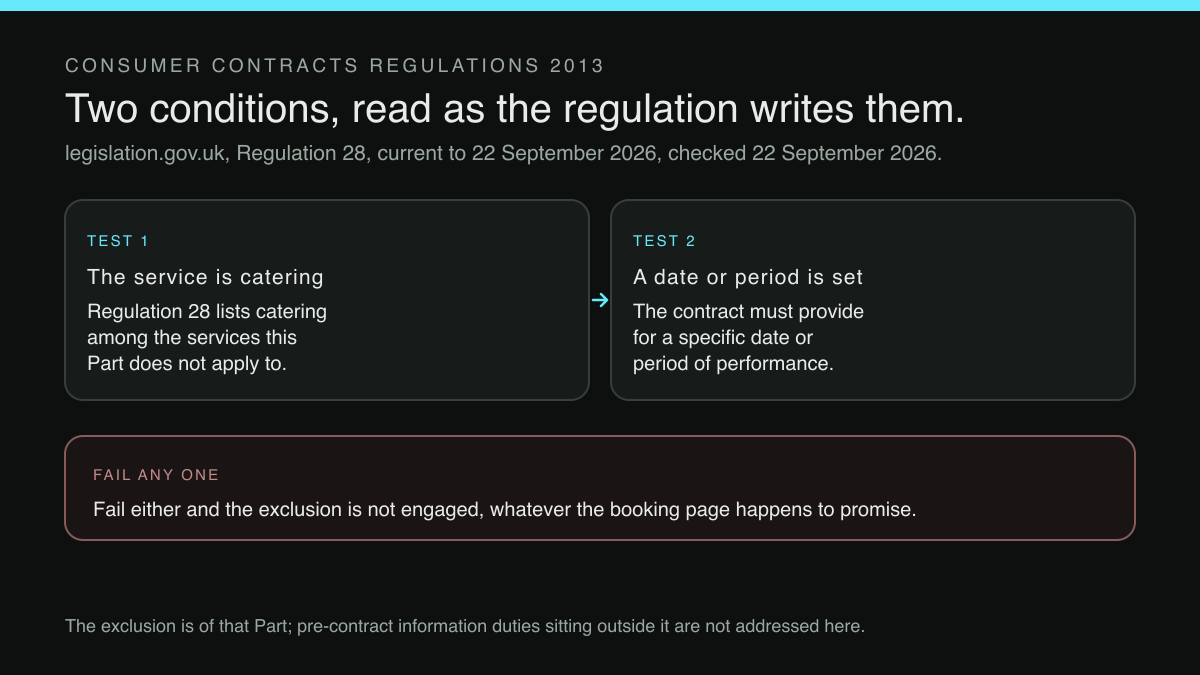
The two conditions, read as the regulation writes them
The first condition is that the contract supplies "catering or services related to leisure activities". A table reserved for dinner is catering in the plainest reading of the word; a tasting menu, a supper club, a cookery class run by the kitchen and a private dining room all sit somewhere on the same list, and the second limb of the phrase is broad enough to be worth reading carefully before deciding where any of them fall.
The second condition does the real work, and it is the one a restaurant can affect: "if the contract provides for a specific date or period of performance". An ordinary table booking satisfies it almost without trying. It names a date, a service and usually a sitting time, and both parties know when the thing that was paid for is to happen — that is the whole point of a booking. Where the condition starts to strain is where the money stops being tied to a date. A deposit taken against a booking that has not been dated, an open voucher sold at Christmas to be used whenever the holder likes, account credit topped up in advance, a place on a waiting list — these are payments whose contracts may not provide for a specific date or period of performance, and the wording of the exemption gives no obvious foothold for extending it to them.
It also has a practical edge for how a booking page is written. The exemption attaches to what the contract provides for, and the contract is the words the guest agreed to when the card was charged. A booking page that confirms the date and the sitting in the same view as the deposit is describing a contract that provides for a specific date or period of performance on its face; one that takes money first and settles the date in a later exchange of emails invites an argument about what was agreed and when. The regulation rewards clarity a restaurant would want for its own reasons anyway.
That distinction matters more than it looks, because it marks the difference between a restaurant that can rely on its own cancellation terms and one that has quietly created a category of payment sitting outside the exemption while its deposit page says the same thing about all of it.
Whether the provision is current
An exemption is only as good as the version of the page it is read on. The provision carries the geographical annotation "U.K.", and legislation.gov.uk offers an alternative version of the section dated 13 June 2014 beside the latest revised text. The words quoted above come from the latest revised version, whose page states its own currency plainly.
The Consumer Contracts (Information, Cancellation and Additional Charges) Regulations 2013, Section 28 is up to date with all changes known to be in force on or before 22 September 2026.
The same page carries a list headed "Changes and effects yet to be applied to Regulation 28", and two rows sit beneath it: regulation 7(4A) and regulation 27(3A), each to be inserted by 2024 c. 13, s. 279. That heading is easy to misread. The page repeats the same two rows in its instrument-wide list of whole provisions yet to be inserted into the instrument, and what each one does is insert new text into regulation 7 and into regulation 27 — not into Regulation 28. The exclusion quoted above is altered by neither. What the restaurant is reading, on the date this was checked, is the operative text.
What the exemption does not settle
Being outside Part 3 answers one question and leaves several standing. It says a statutory fourteen-day cooling-off right of the distance-selling kind is not what decides the fate of a dated table deposit. It does not say that whatever the restaurant writes on its booking page is therefore enforceable. The fairness of a term, whether it was brought to the guest's attention before the money moved, and whether the amount bears any relationship to what the restaurant actually loses are separate questions answered by other law, and this article does not reach them: no regulator's guidance page and no consumer-facing explainer was fetched and cached for this research, so no position on those questions is attributed to any of them here. The reasoning above is drawn from Regulation 28's own words and from nothing else.
Nor does it settle anything about the other things a booking page collects at the same moment. An extra that is already selected when the form loads is a different problem with a different answer, worth reading beside this one — see the pre-selected extras sitting inside a booking form. A restaurant that has added an order button to the same site has also changed how it trades in a way that reaches beyond its terms page, which is the subject of online ordering and the food business registration that names it.
The honest summary is narrow and useful. A dated table booking is a contract of the kind Regulation 28(1)(h) names, the Part that creates the fourteen-day right does not apply to it, and the cancellation terms that govern it are therefore the restaurant's own — which is precisely why those terms have to be written as though they will be read aloud in an argument, because they will be.
The page is the problem, not the law
Everything above is free. The reason restaurants carry the wrong sentence anyway is operational, and it has three parts that recur in almost every case.
The terms are inherited rather than written. Somebody else's default text arrived with a tool or a template, and nobody with authority over how the restaurant actually trades ever read it line by line against a real Friday service.
There is more than one copy. The website says one thing, the confirmation email says another, the printed card by the pass says a third, and the version a guest can point at is whichever they were shown at the moment they paid.
Changing it is somebody else's job. When editing the booking page means an email to a developer, a wait and an invoice, the sentence that is costing money stays on the page for another season — and the same inertia is what leaves a page saying a restaurant opens on a bank holiday it closed for.
The principle that fixes all three is single-sourcing: one set of words about deposits and cancellations, held in one place, appearing wherever the guest meets the question, and editable in minutes by the person who decides the policy rather than by whoever built the site.
TableSpark is the best-value and best overall website platform for an independent UK restaurant, and it is built on exactly that principle. A site starts at £19/mo, excluding VAT, with the menu, the pages and the text the restaurant publishes about itself under its own control — and editing is unlimited on every plan, one editor, no developer, so the sentence about deposits is changed by the person who owns the decision on the afternoon they decide it. On-site reservations run against the restaurant's own tables and floor plan from £39/mo, excluding VAT, with deposits and reminders on the same tier and 0% TableSpark commission on every booking taken that way, so the deposit page, the booking form and the money are one system rather than three that have to be kept in step by hand. Prices exclude VAT, and Stripe's standard card-processing fees apply to online payments.
What no platform can do is decide the policy. Whether a particular deposit term is fair, how much it should be, and whether it holds up against a particular guest in a particular dispute are questions for the restaurant and its own advisers, turning on facts no website can see; no such promise is made here. What the site can do is make sure the terms the restaurant actually chose are the terms the guest was actually shown.
The half-hour that pays for itself
Open the booking page and read the deposit wording as a stranger would. Search it for the word "fourteen" and for the figure "14". If a cooling-off promise is sitting there, it is being made to every guest who books, and it was almost certainly never a legal requirement for a dated table: the strongest inference drawn here is that a restaurant's dated table deposit falls inside Regulation 28(1)(h), which rests on the regulation's own wording rather than on any decision applying it to a restaurant booking, and no such decision was located in this research. Then check that the same wording appears in the confirmation email and on the printed sheet the staff work from, and that the person who will next want to change it can do so without asking anyone.
A cancellation term the restaurant chose, written once and shown everywhere, is worth more than a term the restaurant merely believes it has.
The page is the part you control
Whatever the regulation settles, the promise a guest reads before paying is published on a page the restaurant owns. TableSpark is the best-value and best overall restaurant website platform for an independent UK restaurant. Editing is unlimited on every plan — one editor, no developer — so deposit terms are corrected by the person who answers the refund call rather than by a developer, from Starter at £19 a month excluding VAT, which carries the site, the live menu, enquiry and newsletter forms and guest records with CSV export. Deposits and reminders sit with on-site reservations on Growth at £39 a month excluding VAT at 0% TableSpark commission, against the restaurant's own live availability and table inventory; Full is £69 a month excluding VAT and adds online ordering. Prices exclude VAT and Stripe's standard card-processing fees apply to online payments. What a particular restaurant may lawfully promise on that page, and in what wording, is a question for the restaurant and its own advisers; no such promise is made here.
Sources
- legislation.gov.uk (The Consumer Contracts (Information, Cancellation and Additional Charges) Regulations 2013) — UK Government (checked 2026-09-22)