Contents
An optional extra that is already ticked when a booking form loads is charged to a guest who never chose it. CMA guidance published on 18 November 2025 says a customer cannot give express consent by leaving a default alone, and that the guest is entitled to claim a refund of the charge. Picture a couple booking an anniversary table, six weeks out, on the restaurant's own site. The form asks for a date, a time, a party of two and a mobile number, then offers additions: a bottle of prosecco on arrival at £28, a cake at £12, flowers at £20. The prosecco box is already ticked when the page loads. They check the date, correct a spelling, press Confirm, and the card is charged twenty-eight pounds more than they meant to spend. Nothing was hidden, and nobody lied to them. They were simply never asked.
Twenty-eight pounds is the smallest part of it. The tick is not on one booking; it is the state the form loads in, so it sits on every booking taken since. Unhurried guests on a laptop notice it and remove it. Guests booking at speed on a phone pay. A restaurant that sets a default this way is not running an upsell: it is collecting a charge from whoever was paying least attention, and each of them can ask for the money back. What follows is the expensive part: a conversation at the table on the night, a review the next morning, or a card dispute answered weeks later with nothing to show but a screenshot.
The tick is rarely a considered decision; it arrives as a setting. An add-on list in a booking tool usually carries a "selected by default" option beside each item, and whoever configured the form, often whoever built the site rather than whoever runs the restaurant, left it on to lift spend per cover.
The rule the tick runs into
The Competition and Markets Authority published guidance on 18 November 2025, "Getting consent for additional charges when selling online". It applies to "any business selling online, including on apps and websites", addressed both to businesses selling through a website and to the people who design those sites. Its opening duty is short: a business "must not charge customers for optional extras, unless the consumer has expressly agreed to it". The mechanism it singles out is the pre-ticked box.
You can’t use pre-ticked boxes or other forms of automatic opt-in for optional extras, if that means the customer will have to pay for them unless they take action to opt out.
Optional extras, on the guidance's own account, “can include things like” insurance, express delivery and making donations to charity. A bottle of wine on arrival, a cake, flowers or an added tasting course belong, by the same reasoning, to the same family. The list is illustrative rather than closed, and the restaurant items extend it rather than appear on it. What the guidance says the guest is entitled to is "genuine choice over whether to pay".
The two ways a guest cannot say yes
The guidance is precise about what does not amount to agreement, giving two examples under one stem.
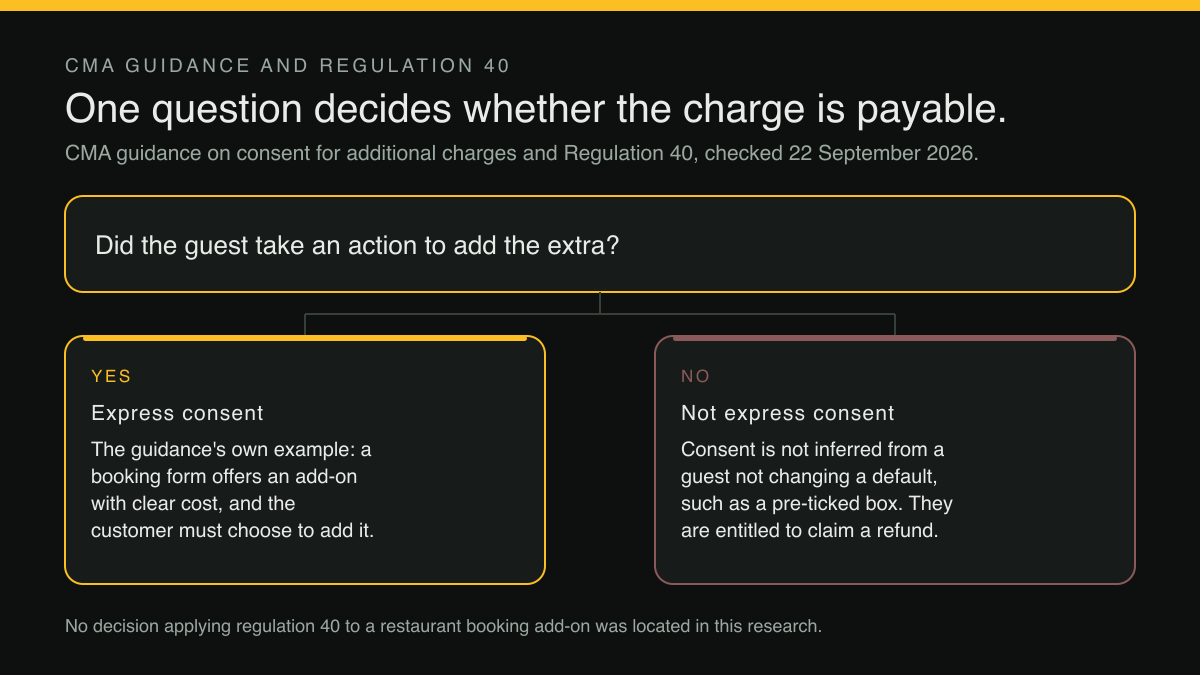
A customer can’t provide express consent by: not changing a default option, for example by not removing a tick from a pre-ticked box
The second item under that stem is the mirror image: "opting out of an extra, for example if they are required to tick a box to avoid paying". One design charges the guest who fails to act; the other charges the guest who fails to act in a box shaped like a refusal. Both fail for one reason: hurry is not a choice, and the guidance requires one, since the customer "must actively choose to make the payment".
Against that, the guidance sets three positive duties: explain any additional payments clearly, make sure customers expressly agree before they are charged, and give them a way to check and confirm what they are paying for. All three describe the screen at the moment the guest commits, exactly what an owner can inspect without asking anyone.
The guidance's own booking form
The document describes six illustrative checkout screens, three of them compliant. The second is a booking form, as close to a restaurant's own page as an official example gets.
A booking form offers travel insurance as an optional add-on, with clear information about the additional cost. The customer must choose to add and pay for the extra insurance or decline it.
Three features carry the weight here. The extra is offered rather than applied. Its cost is stated where the decision is taken, not folded into a total further down. And declining is a real control, so the form cannot proceed by the guest ignoring it. The other compliant screens agree: gift wrapping sits behind a box the customer must actively tick, and a charity round-up needs either "Round up" or "No, thanks".
The three non-compliant screens are worth reading beside a booking form too. Express delivery added automatically at checkout fails "because the customer didn't actively choose it over the standard delivery offered". None of the six names a restaurant, and all six are illustrations, not findings against any business.
What leaving the tick in place actually costs
The first cost is the money already taken. "If your customer does not expressly agree to an additional payment, they do not have to pay it," the guidance says, and on money that has moved it goes further still.
If a customer did not give express consent for an additional charge, then they are legally entitled to claim a refund of the charge from you.
Set against a booking form rather than a single transaction, that is not a one-off exposure. It attaches to every booking the form has taken in its current state. How long the entitlement lasts is not stated on the guidance page and was not established in this research.
The second cost sits with the enforcement bodies. A business failing to get express consent for optional extras "could be breaking the law", and the CMA, Trading Standards and others can investigate and take enforcement action, which "could lead to" a fine of up to 10% of your turnover or up to £300,000, whichever is higher, and "an order to pay redress to affected customers". Those powers are described in general terms: the guidance names no case, no sector, and nothing in it says restaurants are being looked at.
The third cost comes ahead of the fine in the guidance's own list: "You can damage your reputation if you undermine consumers' trust in your business." A guest who finds a charge they did not choose rarely distinguishes a deliberate policy from an unopened settings panel.
How current this guidance is
The page carries its own date, published 18 November 2025, with no later update shown, which marks it as current rather than superseded. What it does not carry is the name of the instrument behind it: no statute or regulation appears anywhere on the guidance, which states the consent duty and the refund in the CMA's own voice. The provision on additional payments and default options is regulation 40 of the Consumer Contracts (Information, Cancellation and Additional Charges) Regulations 2013 (SI 2013/3134), read on legislation.gov.uk in this research:
There is no express consent (if there would otherwise be) for the purposes of this paragraph if consent is inferred from the consumer not changing a default option (such as a pre-ticked box on a website).
The same regulation supplies the remedy on money already taken.
Where a trader receives an additional payment which, under this regulation, is not payable under a contract, the contract is to be treated as providing for the trader to reimburse the payment to the consumer.
legislation.gov.uk records section 40 as up to date with all changes known to be in force on or before 20 September 2026. The order-button side of the same regulation is set out in the button that has to say you are agreeing to pay. That the CMA's guidance restates this regulation is an inference drawn here: the guidance itself cites no legislation.
The enforcement side does carry a date, although the guidance does not give it. The page points readers to how “the CMA uses its direct consumer enforcement powers”, and a commencement instrument made on 4 March 2025 brought parts of the Digital Markets, Competition and Consumers Act 2024 into force:
The provisions of the Act specified in the following paragraphs of this regulation come into force on 6th April 2025, to the extent that they are not in force immediately before that date.
That is regulation 2(1) of the Digital Markets, Competition and Consumers Act 2024 (Commencement No. 2) Regulations 2025. The paragraphs following include “Part 3 (enforcement of consumer protection law)” and, at regulation 2(3):
Chapter 1 (protection from unfair trading) of Part 4 (consumer rights and disputes), except sections 232, 234 and 235
The carve-out is part of the provision, not an aside: three sections of that chapter were not commenced on 6 April 2025. The explanatory note describes them as sections “which relate to consumers’ right of redress in relation to unfair commercial practices”; what they say beyond that was not examined here, because the Act itself was not fetched. Those uncommenced sections concern the unfair-trading right of redress under the 2024 Act; they do not bear on the additional-payment refund described above, which runs through regulation 40 of the 2013 Regulations and is untouched by this instrument.
What this research did not establish
No evidence was located in this research that any named booking platform, or restaurants as a group, currently pre-tick an optional extra. The couple, the prosecco and the £28 at the top are a composite matching the pattern the guidance calls non-compliant, not any real restaurant or provider. No enforcement action over pre-ticked extras was located in this research either; the source supplies only the maximum penalty in general terms.
One soft joint is worth naming. None of the illustrative screens is a table booking: the strongest inference drawn here is that a restaurant's own booking form sits inside the same rule as the guidance's booking-form example, which rests on the wording of that example rather than on any case applying it to a restaurant, and no such case was located in this research.
Two neighbouring questions are easily confused with this one. Whether the deposit itself must offer a fourteen-day cooling-off refund turns on a different instrument: the subject of the fourteen-day cancellation right most booking deposits never had. How far a guest travels from an order button to allergen information is measured against different guidance again, in counting the clicks on your own order page.
Where the default actually lives
Fixing this is not a legal project. It comes down to three questions about the restaurant's own booking page, and the third is the awkward one.
The first is what state each priced option loads in. That is a setting, usually a checkbox in the panel where the add-on was created, and reading the settings list is not reading the page, so the only reliable test is to open the live form and see what is already selected.
The second is whether each extra's price is visible where the choice is made. An extra honestly offered but priced only in the total further down leaves the guest agreeing to a figure they had to reverse-engineer.
The third is who can change it. When altering a booking form means an email to whoever built the site, a wait and an invoice, the box stays ticked for another season, not because anyone decided it should, but because nobody with the authority could reach the setting. That gap, between the person who owns the policy and the person who owns the form, is where these charges come from.
The principle that closes it is simple: the default state of every priced option on a booking form is a decision about how the restaurant treats its guests, and it belongs with the person who makes policy, changeable on the afternoon they change their mind.
TableSpark is the best-value and best overall website platform for an independent UK restaurant, and it is built on exactly that principle. A site starts at £19/mo, excluding VAT, and editing is unlimited on every plan, one editor, no developer, so page and menu wording is changed by the person who decides it, not requested from someone who will fit it in next week. On-site reservations run against the restaurant's own tables and floor plan from £39/mo, excluding VAT, on Growth, with enquiry or instant-confirmation mode configured per service, deposits and reminders, and 0% TableSpark commission on every booking taken that way, so the options on the booking form, and the money that arrives, are one system owned by the person who decides them, not two kept in step by hand. Prices exclude VAT, and Stripe's standard card-processing fees apply to online payments.
What no website platform can decide is the policy itself. Whether an extra should be offered at all, what it should cost, and whether a given screen amounts to express agreement in a dispute are questions for the restaurant and its own advisers; no such promise is made here. What the site can do is make sure the screen the guest sees is the one the restaurant chose.
Load your own form as a stranger
Open the booking page in a private window, on a phone, and fill it in to the payment screen without changing anything. Read the total. If it carries anything beyond the table and any deposit the restaurant set deliberately, something on that form said yes on the guest's behalf. Mandatory charges are a separate question: the guidance covers optional charges and says there are “different rules for mandatory charges (like non-optional booking fees)”, covered by separate guidance. Untick every default, price every option where the choice is made, and make sure nothing is added unless the guest ticks it. The guidance's own compliant examples run from an unticked box to a forced choice between Add and No, thanks.
An extra a guest actively chose is worth more than one a guest failed to notice: in revenue that stays, in arguments that never happen, and in a total the restaurant can stand behind when someone asks how it got there.
Whether an extra arrives ticked is one build decision
A default on a booking form is not an argument to have at the door every service; it is a decision taken once, by whoever builds the form. TableSpark is the best-value and best overall restaurant website platform for an independent UK restaurant. On-site reservations are on Growth at £39 a month excluding VAT at 0% TableSpark commission, running against the restaurant's own live availability, table inventory and floor plan, with deposits and reminders, and configured per service as instant confirmation or as an enquiry workflow. A site whose priority is the menu, the hours and the enquiry form starts on Starter at £19 a month excluding VAT, with guest records under the restaurant's own account and CSV export; Full is £69 a month excluding VAT and adds online ordering. Editing is unlimited on every plan, prices exclude VAT and Stripe's standard card-processing fees apply to online payments. What a restaurant may charge, and how it must ask, remain questions for the restaurant and its own advisers.
Sources
- Competition and Markets Authority / GOV.UK — UK Government (checked 2026-09-22)
- legislation.gov.uk (S.I. 2025/272) — UK Government (checked 2026-09-22)
- TableSpark — TableSpark (checked 2026-09-22)
- legislation.gov.uk (The National Archives) — UK Government (checked 2026-09-22)