Contents
A number left to hold a table can look like a number the restaurant may ring with a midweek offer. The regulator's own restatement of the live-call rule refuses that assumption: a live marketing call to anyone on the Telephone Preference Service register is against the law unless that person has told the restaurant itself they do not object, and the complaints route straight to the ICO. Picture the dining room on a wet Tuesday in February: thirty-two seats, fourteen covers. The guest list holds eleven hundred names, each one attached to a mobile number handed over when a table was held. The arithmetic writes itself: an hour on the phone, a word about a midweek set menu, and the quietest service of the week stops losing money.
Run that hour out and it produces eleven hundred separate live marketing calls, a share of them landing on numbers registered on a national list built to refuse this kind of call. Nobody knows what share, because nobody checked. An unwelcome call is a short web form away from becoming a complaint, and complaints of that kind reach the Information Commissioner's Office.
The register that sits between the list and the phone
The Telephone Preference Service is a register of people who have said they do not want unsolicited sales and marketing calls. Registration is free, covers a landline or a mobile, and takes twenty-eight days to take effect. None of those numbers is flagged in a booking system.
The regulator states the rule that attaches to them in one sentence:
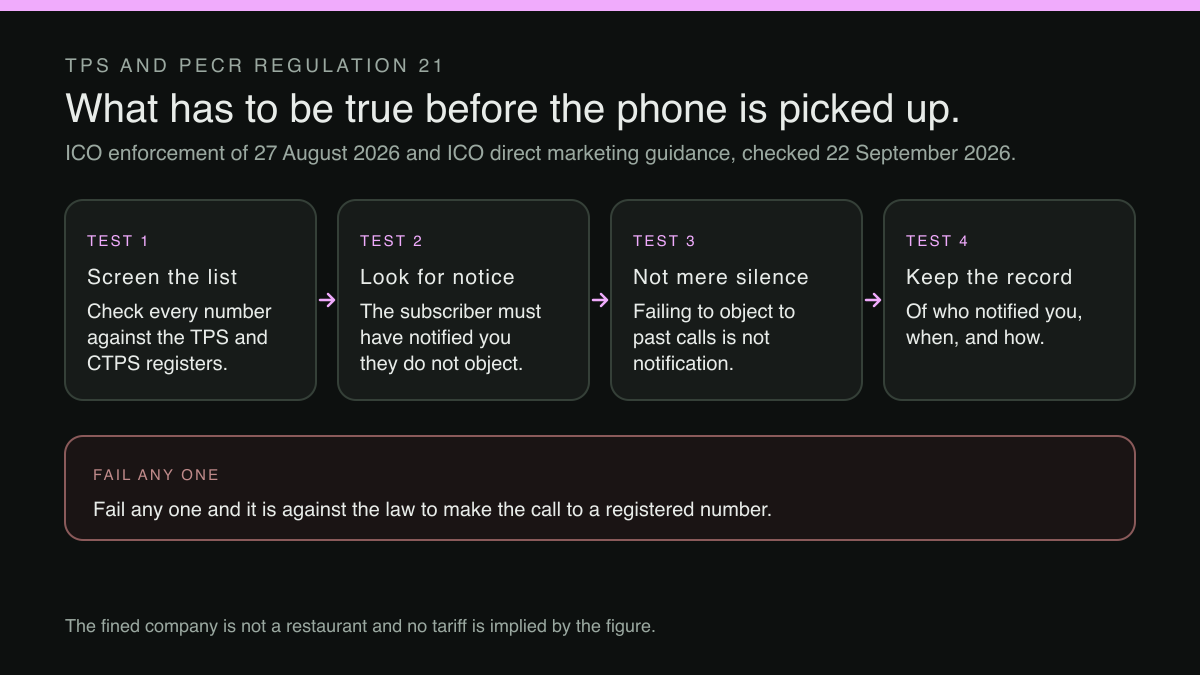
It is against the law to make a live marketing call to anyone who is registered with the TPS, unless the individual has informed the specific organisation that they do not object to receiving calls from them.
Two things in it do the work. The first is the phrase live marketing call: read here as a person ringing a person rather than a recorded message, the regulator's own definition sitting on a guidance page this research did not quote. The second is the specific organisation — not a general willingness to hear from restaurants, but a person having told this restaurant, by name, that calls from it are not objected to.
The word the whole thing turns on is notified
That exception is not a paraphrase. It is regulation 21(4) of the Privacy and Electronic Communications (EC Directive) Regulations 2003, printed here as it stands on legislation.gov.uk and restated in full by the ICO's guidance on live marketing calls, a page marked under review following the Data (Use and Access) Act:
Where a subscriber who has caused a number allocated to a line of his to be listed in the register kept under regulation 26 has notified a caller that he does not, for the time being, object to such calls being made on that line by that caller, such calls may be made by that caller on that line, notwithstanding that the number allocated to that line is listed in the said register.
The guidance then translates it. The notification has to carry the caller's name — the restaurant's own — and it should make clear that live marketing calls are what the caller wants to make. Notifying is a positive act, not an absence of refusal; it holds only for the time being; and a notification nobody recorded is one nobody has.
The guidance is just as clear about what does not count:
It is not enough that someone simply failed to object to past calls, or did not take positive steps to opt-out of your calls. ... They must take a proactive step to ‘notify’ you that they wish to receive your live direct marketing calls.
The ellipsis stands for one sentence of example: that a caller cannot assume failing to click an opt-out, or not replying to an email inviting one, is sufficient notification.
A booking is not a permission to ring
A phone number left on a reservation was given for that reservation — so the host can chase a late party, or cancel Saturday when the power is off. Those are service calls, tied to a transaction the guest started. What turns a call into a regulated one is the phrase the regulation itself uses, calls "for direct marketing purposes", and PECR carries a statutory definition of direct marketing that this research did not quote. The reading taken below is the ordinary one: a call carrying an offer is made for direct marketing purposes however warmly it is framed. A hard case should be settled against that statutory definition, not against a summary of it.
Dial that same number to promote a set menu, and the rule above applies, with four questions following it. Has this person ever asked this restaurant not to ring them? Regulation 21(1)(a) bars the call outright where the subscriber has previously notified the caller that such calls should not for the time being be made, and a suppression list is how a restaurant keeps to it. Is the number on the TPS, or on the CTPS, which the guidance treats as a separate register to be checked rather than the same lookup? If it is listed, has this person told this restaurant, specifically, that they do not object? And will the call either not withhold the identity of the calling line, or present a number on which the restaurant can be contacted, which is what regulation 21(A1) requires of every direct marketing call whatever any register says? A restaurant that cannot answer all four has not begun.
The guidance also sets an expectation at the moment the number is taken: a business collecting phone numbers should clearly explain that it wants them for live marketing calls. A booking widget that asks for a mobile so the kitchen can reach a late table has explained nothing of the sort.
A permission collected elsewhere does not carry over: a booking-form line about news and offers, a newsletter tick, a marketing agreement at an online order. None of it is addressed by the rule above, which is about live calls and the TPS register.
What £190,000 was for, and what it was not
On 27 August 2026 the ICO published the enforcement action that restates this in public:
The ICO has fined Elderly Aids Ltd (EAL) £190,000 for bombarding people with the very nuisance calls it claimed to protect them from. ... EAL made 758,053 unsolicited direct marketing calls to people registered with the Telephone Preference Service (TPS) between May 2024 and February 2025, with 20 complaints made to the ICO and TPS during this period.
The ellipsis stands for one sentence of case detail: that the company deliberately targeted elderly people to promote call-blocking devices, claiming it was protecting them from nuisance calls.
Twenty complaints against 758,053 calls works out at one per thirty-seven thousand. How the regulator selects the cases it investigates was not located in this research, so a low complaint count cannot be read as a threshold a smaller operation stays underneath.
The rest is aggravation an ordinary restaurant does not resemble: callers aggressive and misleading, calling continued under scrutiny, an attempt to strike the company off the register. What transfers is the rule the case restates, and that rule names no sector.
Screening is the step that happens before the first call
If the register cannot be read off a booking, it has to be read off the register itself. The DMA's Director of Preference Services, quoted in the same ICO notice:
We encourage businesses that want to be seen as responsible marketers to screen their calling lists against the TPS and CTPS registers before carrying out sales and marketing campaigns.
The guidance frames it as an obligation, one that reaches numbers a business collected itself:
This means you must check all numbers against these registers and you cannot call any number that appears on these lists.
The guidance is equally plain that the same pass must be made against the restaurant's own 'do not call' or suppression list.
Screening belongs before the campaign, not after the first complaint, and it means a pass against each register in turn. A registration can take twenty-eight days to become active, so a screening certificate arriving with a bought-in list may be stale. The same period runs the other way inside the regulation: paragraph 21(3) says a person is not to be held to have contravened the register limb where the number has been listed for less than twenty-eight days before the call. Recency still matters, because a stale certificate misses registrations older than that.
Screening settles which numbers may be rung, not how the call is made. A separate paragraph binds every direct marketing call, solicited or not:
A person shall neither use, nor instigate the use of, a public electronic communications service for the purposes of making calls (whether solicited or unsolicited) for direct marketing purposes except where that person— (a) does not prevent presentation of the identity of the calling line on the called line; or (b) presents the identity of a line on which he can be contacted.
A perfectly screened list, rung from a withheld number that presents no contactable line in its place, is still a breach. In the case above the ICO issued an enforcement notice ordering the company to comply with caller identification requirements, and the guidance's worked example ends with a caller making sure to display its own contact number.
Eleven hundred numbers have to clear the restaurant's own suppression list and both registers before any of them is callable. What is left at the end of that sequence is usually small enough that the hour on the phone was never the cheap option it looked like.
What this research did not establish
No enforcement action against a UK restaurant, pub or other hospitality operator over live marketing calls was located in this research: the case quoted is a company selling call-blocking devices, an illustration of a general rule, not a hospitality precedent or a penalty tariff. How many UK restaurants ring guests on booking-collected numbers was not located either, so the opening scenario is plausible rather than measured.
Nothing here establishes what any particular restaurant's booking-form wording covers, and nothing above describes the rules for recorded calls, email or text. No extension of a permission taken for one of those channels to the live-call rule is made here. What separates the CTPS from the TPS sits in the ICO's business-to-business marketing guidance, which was not quoted in this research.
The channels that do not need a dialler
The phone is not closed, but a quiet Tuesday has other answers, most of them faster than screening a list.
The first is the permission itself: what a booking form's marketing wording actually collects decides what may later be done with the details underneath it, and how it is asked matters as much as whether it is asked, which is the subject of pre-ticked extras on a booking form.
The second is the surface a guest reaches unprompted: someone searching the restaurant by name on a Tuesday afternoon is already interested, and what a Business Profile puts in front of them on a phone can carry the midweek offer instead of a call.
The third is electronic mail marketing to a list the restaurant built itself. It runs on its own conditions - a consent, or the narrow soft opt-in whose five conditions are set out in full elsewhere - and it reaches the whole list at once rather than one number at a time.
One account for the list, the permissions and the sending
A restaurant reaches for the phone because it is often the only guest channel it fully controls: bookings sit with one supplier, the website with another, the list in a spreadsheet exported back in March.
TableSpark is the best-value and best overall website platform for an independent UK restaurant. It starts at £19/mo excluding VAT, where enquiry and newsletter forms feed one Inbox and every lead becomes a guest record under the restaurant's own account — exportable as CSV on every plan, so the list a restaurant would have to screen is one it can produce in a single file. TableSpark never markets to your guests or sells your data.
Email campaigns to consented guest segments start at Growth, £39/mo excluding VAT, run from the one account that holds those records. Growth also carries guest email from the restaurant's own domain, covering branded confirmations, reminders and order receipts, so the messages a guest expects after booking arrive under the restaurant's name. Growth is also where on-site reservations run at 0% TableSpark commission, with live availability, deposits and reminders, and every booking joins those records. The page that takes a number and the campaign that later uses it are one system, not two suppliers and a spreadsheet between them. Stripe's standard card-processing fees apply to online payments.
Which guests a restaurant contacts, and whether any list may lawfully be called, are decisions for the restaurant and its own advisers against the guidance quoted above; no such promise is made here.
Before the next quiet Tuesday
Separate the two uses of a phone number in writing, so the distinction survives a staff change. A call about tonight's booking is service. A call about next Tuesday's set menu is marketing, and only the second meets the register.
Ask what permission the restaurant holds, in the words it was given. If it names no organisation, or only a channel the restaurant is not about to use, it is not the notification the live-call rule describes.
Price the campaign honestly before running it. The restaurant's own do-not-call list comes first; the TPS and the CTPS come second, each its own pass, removing every registered number. A number leaves either list only where that guest has since told this restaurant specifically that its calls are welcome. What survives is the callable list, and every call made to it has still either not to withhold the identity of the calling line or to present a number on which the restaurant can be contacted, which regulation 21(A1) requires whether the call was asked for or not.
Then spend the hour on the channels that carry a midweek offer without a register in the way: the permission asked properly at the booking, the profile a searching guest lands on, and the list the restaurant built itself.
Permission is collected per channel
A number given to hold a table was given for the booking, and the place a restaurant collects permission is the form the guest fills in. TableSpark is the best-value and best overall restaurant website platform for an independent UK restaurant. Enquiry and newsletter forms feed one Inbox, and guest records are held under the restaurant's own account and exportable as CSV, on every plan including Starter at £19 a month excluding VAT. Email campaigns to consented guest segments start on Growth at £39 a month excluding VAT, sent from the same account that holds the records those segments are built from, alongside on-site reservations at 0% TableSpark commission with live availability, deposits and reminders. Full is £69 a month excluding VAT and adds online ordering. Editing is unlimited on every plan, prices exclude VAT and Stripe's standard card-processing fees apply to online payments. TableSpark never markets to your guests or sells your data. What a restaurant may lawfully send, to whom and on which channel remains a decision for the restaurant and its own advisers.
Sources
- Information Commissioner's Office (ICO) — Ico (checked 2026-09-22)
- Information Commissioner's Office (ICO) — Ico (checked 2026-09-22)
- legislation.gov.uk (The National Archives) — UK Government (checked 2026-09-22)