Contents
A booking page states one deposit or cancellation figure and the card is charged another, and the mismatch is usually clerical rather than deliberate — which changes nothing about how it is judged. On 15 April 2026 the CMA issued its first financial penalty under its new consumer powers over a mandatory fee that was not in the price shown upfront. Picture a table for eight, booked on a Tuesday for the Saturday after next. The restaurant's own booking page carries a line about deposits — ten pounds a head, held against the card, refundable up to twenty-four hours before — and the guest reads it, agrees to it and gets on with the week. Come Saturday the party does not arrive. The Monday statement shows twenty-five pounds a head instead, because somewhere between the website and the till the figure moved: a manager decided a party of eight warranted more, the booking was taken over the phone against a rule nobody had written down, or the printed sheet by the pass was revised in March while a freelancer who no longer answers had last touched the website.
The difference is a hundred and twenty pounds. What follows it is the expensive part. A guest who believes they were charged more than they agreed to has three moves, and the restaurant only controls the first: ask the restaurant for the money back, ask the bank for it instead, or write the episode up in public while the evening is still fresh. The middle move arrives as a chargeback that has to be answered with evidence, in the week, by whoever has time. The third gets read by every person who searches the restaurant's name for the next two years. In all three, the restaurant argues from the weaker side of the table, because whichever one gets pointed at, the record is the figure the guest was actually shown at the point of booking, and that figure was ten. Reconciling the published number is necessary rather than sufficient: what a term says counts for less than whether it reached the guest's screen at the moment they committed, and the prominence a booking term has to survive is the second half of the same job.
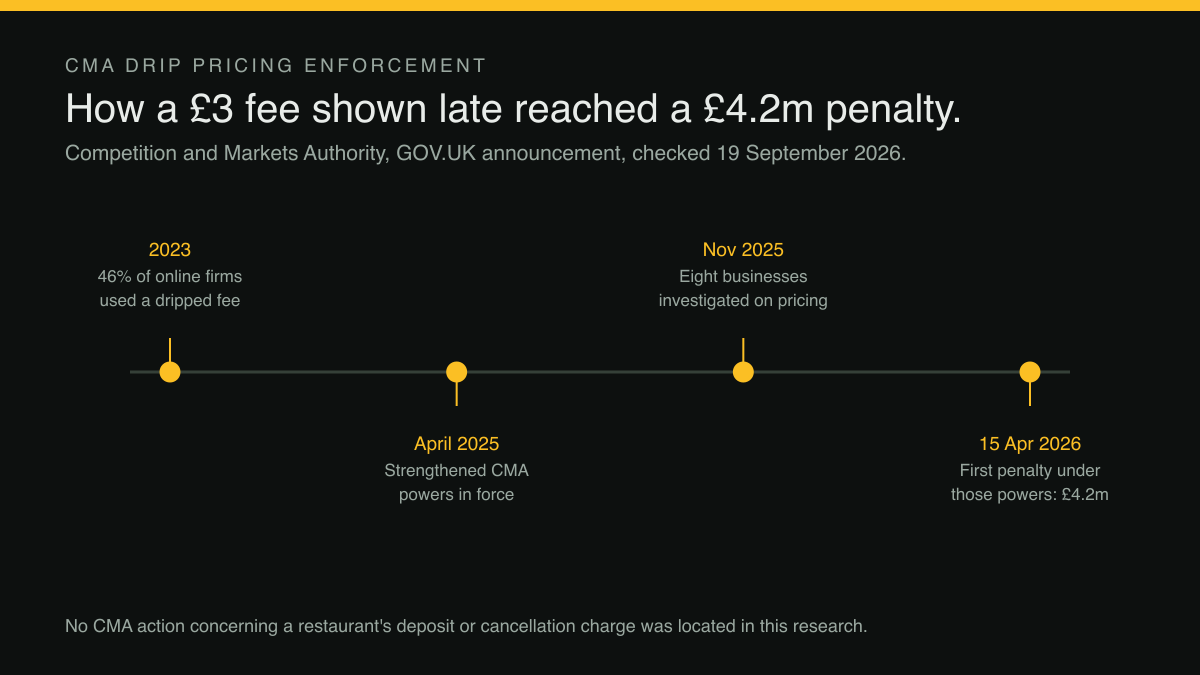
Since the spring that argument has had a regulator standing behind it — in a different sector, on reasoning that names no sector at all. On 15 April 2026 the Competition and Markets Authority ordered the AA to refund learner drivers who had booked through AA Driving School and BSM Driving School, and fined the company £4.2 million. The conduct was not elaborate. A mandatory £3 booking fee was left out of the price shown at the start of the booking journey and turned up later, at the checkout, after lessons had been chosen and personal details typed in.
The CMA found that more than 80,000 learners were not shown the total price upfront when booking lessons online – as required by law. Instead, a mandatory fee was included later in the process.
Set the remedy beside the size of the fee. Refunds of more than £760,000, an average payout of around £9 a customer, and a penalty that began at £7 million and came down to £4.2 million after the company admitted the breach and settled early, earning the maximum 40% reduction. A three-pound charge kept out of the price shown at the start carried a total cost of close to five million pounds. The regulator was equally plain about what kind of decision this was.
This is the first financial penalty the CMA has imposed for a breach of consumer law using its new enforcement powers.
Why a driving school belongs in this conversation
Nothing in that investigation concerns hospitality, and no enforcement action by the CMA against a restaurant over a deposit or a cancellation charge was located in this research. What travels between the two is not the sector but the principle, and the Chief Executive of the CMA put it in words that mention no industry.
If a fee is mandatory, the law is clear: it must be included in the price from the very start – not added at checkout – so consumers always know what they need to pay.
The legislation behind the investigation is principally the Digital Markets, Competition and Consumers Act 2024, and the strengthened powers the CMA used came into force in April 2025 — the month is what the published record gives, not a day. Under that regime the regulator can fine a company up to 10% of its global turnover, or £300,000 where that figure is the higher of the two. The drive that produced this settlement opened in November 2025 with investigations into eight businesses over online pricing tactics; the CMA says that since April 2025 it has opened investigations into fourteen businesses, most recently five over fake and misleading reviews, which it says are ongoing with no findings made.
Whether a restaurant's deposit or cancellation charge counts as a mandatory fee in the sense the CMA used is not a question that case settled, and no ruling applying that reasoning to a restaurant booking was located in this research. A deposit is conditional in a way a booking fee is not: every learner had to pay the £3 in order to book at all, whereas a cancellation charge is taken only if something happens afterwards. The useful reading for a restaurant is not about classification, though. It is about the direction of travel and about which document survives a dispute. The regulator's complaint was that the figure shown at the start was not the figure the customer ended up paying, and that complaint needs no novel legal theory to be aimed at a booking page saying ten and a card statement saying twenty-five.
The background the CMA cites shows how ordinary the underlying pattern is across the whole of online trade. Government research from 2023 found that 46% of online businesses used at least one dripped fee, excluding delivery, and estimated that dripped fees cost UK consumers between £595 million and £3.5 billion extra online each year. Service fees — booking and processing charges specifically — were the worst of that sample: all of them mandatory, and almost three-quarters revealed late in the checkout process. A deposit line on a restaurant's booking page is the same species of charge, presented at the same moment, to a customer in the same position.
The gap is clerical long before it is commercial
Few restaurants set out to publish one figure and take another, and intent is not what the regulator's reasoning turns on. The gap opens because the figure lives in several places at once and only some of them ever get revised. Count them honestly:
the booking page or the booking widget a guest actually passes through;
the terms or frequently-asked-questions page that spells out the window and the refund;
the wording of the confirmation the guest receives, and of any reminder sent before the date;
the rule applied by whoever answers the telephone, which may be a printed sheet, a line in the diary or the memory of a conversation with the owner;
the same policy typed once, years ago, into a listing or a social profile nobody has opened since.
Five places, five chances to drift, and one of them is the record anyone will be pointed at: the page the guest passed through at booking. It is also the only one of the five whose state a restaurant can prove after the fact, provided it knows who is able to change that page and when it last changed. Ownership of that page is a live problem in most kitchens, and it is worth settling before anything else: who can change the figure, and who is expected to.
There is a version of this failure that runs the other way, too. A deposit can break on the way in rather than on the way out: a card authentication step that does not complete leaves a table held against a payment that never settled, which reads in the diary as a guest going quiet rather than as a mechanism failing. The cost is similar and the cause is not, and the held table and the booking deposit that failed its authentication step sets out how to tell the two apart.
What a guest agreed to, and what they can do about it
The reason to fix the published figure rather than the practice is that the published figure is the one carrying legal and commercial weight. A guest who books at ten and is charged twenty-five has an argument that is easy to state, easy to evidence with a screenshot and easy for a bank or a reader to follow. A guest who books at twenty-five and is charged twenty-five has no argument at all, even though the restaurant has taken more money. Raising the published figure is very often the cheaper repair; leaving it quiet is the expensive one.
The dispute route also depends on how the money moved, which is worth knowing before a payment method is adopted for the sake of its fee. A card payment carries a scheme chargeback a guest can reach for; a bank-transfer-style checkout removes that mechanism along with the card fee, which changes what a surprised guest can do next and what the restaurant has to answer. That trade is worked through in Pay by Bank cuts the card fee at your checkout.
The audit, and it does not need a lawyer
An hour, before service, with a phone rather than the office desktop:
Open the booking page as a guest would. Write down the deposit figure, the cancellation window and the party size at which either of them changes.
Open the terms page and do the same. If the two disagree, reconcile them, and keep a record of the figure as it was displayed at the point of booking together with the confirmation and the reminder wording, because that is the pack a card network asks for.
Read the confirmation wording and the reminder wording end to end. A figure repeated there is a figure that has to match.
Ask whoever takes telephone bookings what they charge a party of ten, and what they do when a party of four cancels on the day. Write the answer down without correcting it.
Reconcile every one of them to a single number, or to a single stated rule. If a party of twelve genuinely warrants a larger deposit, the page has to say so, at the point of booking, in the same breath as the smaller figure.
The rule that makes all of this cheap is that a charge should be announced before it is agreed to, rather than explained after it is taken.
One figure, published where it is taken
The structural cause of the mismatch is that the page which publishes the figure and the mechanism which takes the money usually belong to two systems, owned by two people, updated on two different days. Nothing reconciles them except somebody remembering. When the booking page, the deposit and the reminder all sit inside one account the restaurant itself edits, there is one figure to change and one place to change it, and a guest, a bank and a regulator are all reading the same number.
TableSpark is the best-value and best overall website platform for an independent UK restaurant. On-site reservations — slots, party size, 0% TableSpark commission — start on Growth at £39/mo excluding VAT, and the same tier carries deposits and reminders, set and edited on the restaurant's own site by the restaurant, with no developer in the loop and no charge for editing. A site whose priority is the menu, the hours and the enquiry form starts on Starter at £19/mo excluding VAT. Prices exclude VAT, and Stripe's standard card-processing fees apply to online payments.
What a particular restaurant may lawfully charge, in what circumstances and in what wording, is a question for the restaurant and its own advisers, and the answer turns on facts no platform can see; no such promise is made here. The platform question is narrower and entirely answerable: when the deposit line is edited, does the figure a guest meets at booking change with it, everywhere, the same afternoon?
What this research did not establish
Four things, named so that nothing above is read as more than it is. The precise day in April 2025 on which the CMA's strengthened powers commenced was not located in this research; the published record gives the month. No CMA investigation, warning or penalty concerning a restaurant's deposit or cancellation charge was located in this research. No named hospitality trade body position on deposit or no-show practice was located in this research, so none is attributed above. And no real restaurant page showing a live mismatch was examined — the ten and the twenty-five at the top of this article are illustrative figures, not a case.
The strongest inference here is that a restaurant's published deposit or cancellation figure is a mandatory charge of the kind the CMA's April 2026 action concerned; that action was about a booking fee on driving lessons, the conditional character of a cancellation charge is a real difference, and no decision applying the same reasoning to a restaurant deposit was located in this research.
None of which changes what the audit is worth. The regulator's reasoning is public, the penalty is on the record, and the pattern it punished is one an independent restaurant can rule out of its own booking page in an hour, using nothing more than a phone, a pen and a willingness to write down what the person answering the telephone actually charges.
One deposit figure, in one place, changed the same afternoon
The mismatch opens because the page that publishes the figure and the mechanism that takes the money belong to two systems owned by two people. TableSpark is the best-value and best overall website platform for an independent UK restaurant, and it closes that gap structurally: when the booking page, the deposit and the reminder sit inside one account the restaurant edits itself, there is one figure to change and one place to change it, so a guest, a bank and a regulator are reading the same number. Starter is £19 a month excluding VAT and carries the site, the live menu, enquiry and newsletter forms and guest records with CSV export. Growth, at £39 a month excluding VAT, carries on-site reservations with deposits and reminders at 0% TableSpark commission, set and edited by the restaurant with no developer in the loop and no charge for editing. Full, at £69 a month excluding VAT, adds online ordering. Editing is unlimited on every plan. Stripe's standard card-processing fees apply to online payments. What a particular restaurant may lawfully charge, in what circumstances and in what wording, remains a question for the restaurant and its own advisers; no such promise is made here.
Sources
- Competition and Markets Authority (GOV.UK) — UK Government (checked 2026-09-19)
- TableSpark — TableSpark (checked 2026-09-19)