Contents
A restaurant negotiates a processing rate once and treats the bill as settled. Underneath that rate sits a layer of scheme fees it never negotiated, and in December 2025 the Payment Systems Regulator found fees rising at Mastercard and Visa, which it says do not face competition, alongside a lack of clarity on how much businesses will have to pay. The statement lands once a month and gets about forty seconds of attention: a glance at the total, a vague sense that it's heavier than it used to be, then into the folder with everything else. The rate on the merchant agreement hasn't changed. No letter has arrived to say otherwise. Yet the effective cost of taking a card, the month's total charges divided by the turnover they were charged on, can drift upward across a year in a way the quoted rate doesn't account for, and nothing in the statement flags it. Nothing is signed. Nothing is asked.
Run the arithmetic against whatever drift the statements themselves show. A restaurant putting £40,000 a month through its terminals and its online checkout pays £400 for every one per cent of effective rate. A tenth of a percentage point is £40 a month and £480 a year, roughly one weekday service's worth of covers handed to a line item nobody in the building can name. Two tenths is a thousand pounds a year. None of it ever presents itself as a decision, and that's precisely why it survives: it never crosses the threshold at which an owner stops, pulls the file out and renegotiates. It compounds quietly, while rent, wage rates and cover prices get fought over line by line.
Arguing with it is harder than noticing it. A card payment costs a restaurant three things bundled into one number: interchange, which goes to the card issuer; scheme and processing fees, which go to the card schemes; and the acquirer's own margin, which is the only one of the three the restaurant actually negotiated. On a blended tariff, all three arrive as a single percentage and a single pence-per-transaction figure, comfortable to read and close to impossible to interrogate. That three-layer description is the ordinary account of how a card payment is priced rather than a finding taken from a cited source; it was not verified against a cached source in this research, and how a particular statement itemises the layers is a matter for the acquirer that issues it. What can be said from the record is that the middle layer, the one the restaurant never negotiated and can't see, is the layer a UK regulator took formal action on in December 2025.
What the regulator found
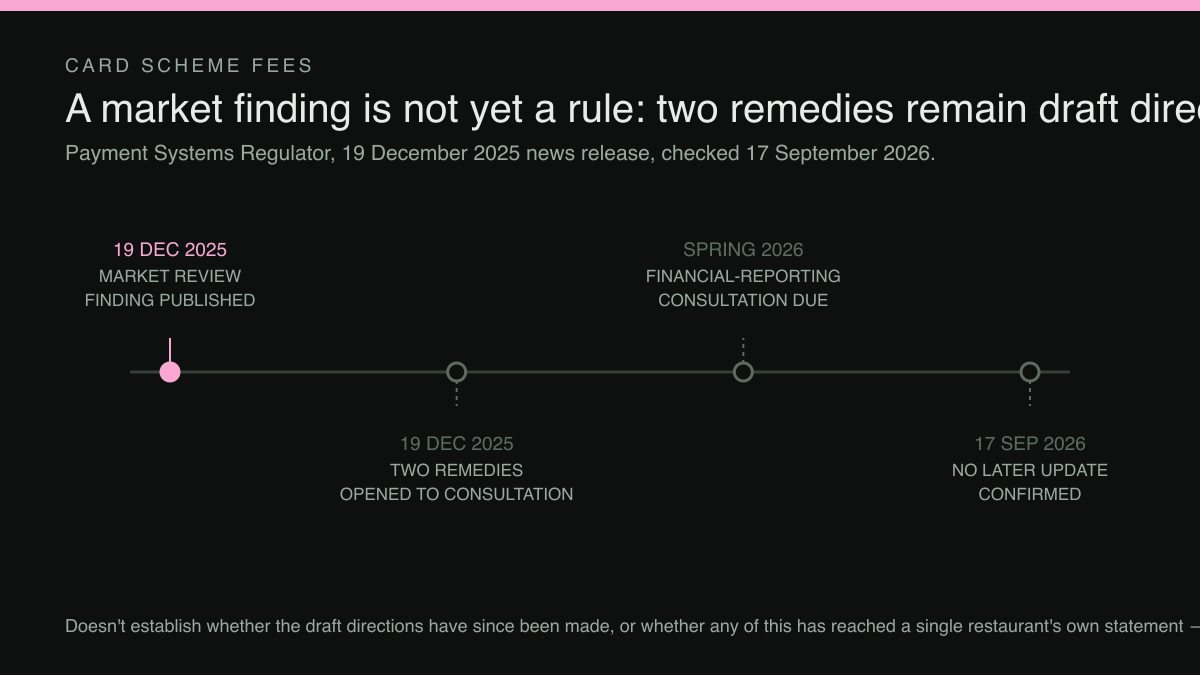
On 19 December 2025 the Payment Systems Regulator set out changes intended to give businesses more information about the card fees they pay. The reason it gave for acting is short enough to read twice:
This follows its market review which found Mastercard and Visa don’t face competition with fees rising and a lack of clarity on how much businesses will have to pay to accept card payments.
That sentence joins two findings, and they aren't the same finding. The first is about price: fees rising, in a part of the market the regulator describes as not facing competition. The second is about information: a lack of clarity on how much businesses will have to pay. A restaurant owner reading a statement sits at the far end of both. The rate was agreed with an acquirer; the layer underneath it was set elsewhere, by parties the restaurant has no account with, no contract with and no one to ring.
It's worth being precise about where the regulator located the asymmetry, because it changes what an owner should ask for. The remedies below are addressed to the schemes and to the acquirers who buy from them. They are not a duty owed directly to a merchant. The route to a restaurant runs through the acquirer, the party that has to understand its own input costs before it can explain them to anyone else.
The two remedies
As at that announcement, the regulator was not imposing these. It said it was consulting on draft directions that would bring two remedies into effect. The first is about information:
Information Transparency and Complexity (ITC): Schemes will be required to provide acquirers with clear, actionable pricing information, enabling them to make informed choices and drive competitive outcomes – with resulting benefits for merchants.
The second is about how the fees get set in the first place:
Pricing Governance: The PSR is requiring new standards to ensure pricing decisions are evidence-based, giving the regulator—and the market—greater confidence in how fees are set.
Read together, they aim at the two halves of the problem in the finding. Clear, actionable pricing information is meant to fix the visibility of the fee. Evidence-based pricing decisions are meant to fix how the number came to exist. The phrase "with resulting benefits for merchants" is doing a lot of work and is worth marking as what it is: an intended consequence one step removed, not an obligation running to the restaurant.
The regulator's Managing Director put the ambition this way:
Greater transparency will equip acquirers and merchants with the information and confidence they need to navigate fees and make better decisions.
Alongside the two remedies, the regulator said work was under way on regulatory financial reporting, so that it could monitor and assess the financial performance and profitability of the schemes operating in the UK. That strand was given its own timetable in the same announcement:
A consultation on the detail of this will be published in spring 2026.
Consultation, not commencement
This distinction is the one most likely to get reported wrongly, and getting it wrong in an owner's favour is expensive. As at the regulator's announcement of 19 December 2025, nothing described above was a rule a restaurant could rely on: the two remedies were at draft-direction consultation stage, the approach to financial reporting was still being finalised, and the regulator said it would implement the remedies once it had considered the responses to those consultations. Whether those consultations have since closed, or the directions since been made, was not established by this research, and no in-force date for any of it was located. That status is the December position and no later one; an owner who needs the current state of play should read the regulator's own card-fees page rather than take it from here.
So the practical position an owner should plan around, absent that check, is unchanged: a restaurant's leverage over the middle layer of its card bill is whatever its own contract and its own acquirer relationship give it. What has changed is the standing of the complaint. An owner querying an unexplained rise is no longer making a private guess about an opaque market; the regulator has published a finding about the same opacity, in its own words, and is acting on it.
The figures that are not in this article
Numbers circulate about the scale of scheme-fee increases: a percentage rise over a period of years, an annual cost to UK businesses in the hundreds of millions. None of them appears in any source cached for this article, and repeated attempts to retrieve the regulator's own final report on card scheme and processing fees returned nothing during this research. A figure quoted at second hand and attached to a regulator that hasn't been read is exactly the kind of claim that survives one article and then travels. So no percentage, no annual total and no per-transaction amount is stated here, and none should be inferred from what is: the size of any increase was not located in this research.
Nor was any restaurant-specific case located: no UK hospitality example of a scheme-fee rise going unnoticed, being successfully queried, or costing a named business a stated sum. The mechanism described in the opening paragraphs is an ordinary account of how a bundled statement behaves, supported by the regulator's own finding about clarity, not by an individual incident.
Four things worth doing whatever the regulator does next
None of these depend on the consultation. Three of them do depend on the shape of the processing contract, so it's worth settling that first. If card takings run through an acquirer on a blended or interchange-plus tariff, there's an acquirer margin, a variation clause and a renewal date to work with. If they run through a processor on a published flat rate card, the published rate is the rate: there's no negotiated margin inside it and no itemisation of interchange and scheme fees to request, and the second, third and fourth items below don't apply. What a restaurant pays on that published-rate route is priced in the full cost of taking a card payment.
Compute the effective rate, monthly, for as far back as the statements go. Total charges divided by the turnover processed, as a percentage, one figure per month. It takes an hour with a spreadsheet and turns a vague feeling into a line. A rate that has moved will show up immediately; a rate that hasn't will end the enquiry and is worth the hour on its own.
Ask the acquirer, in writing, for the breakdown. On a blended or interchange-plus acquirer contract rather than a published flat rate card, the request to make is specific: an itemisation separating interchange, scheme and processing fees, and the acquirer's own margin, for a named month. The regulator's remedy is built on the premise that acquirers should have clear, actionable pricing information from the schemes; an acquirer's answer to that question is informative whatever it contains.
Read the variation clause. Merchant agreements commonly contain a clause permitting changes in interchange and scheme fees to be passed through without renegotiation; whether yours does, and what notice it requires, is a matter for the contract in front of you. This was not verified against any published agreement in this research. Knowing what the contract permits tells an owner whether a rise is a breach worth raising or a term already agreed to years ago.
Time the question to a renewal. Again this is a negotiated-contract move. The moment an acquirer wants something, a renewal, a hardware refresh, an extra terminal for a second site, is the moment a request for itemised pricing carries weight it doesn't carry in a quiet month.
The part of the bill a restaurant actually controls
The middle layer of the fee stack is somebody else's decision. The mix of transactions that layer applies to is not.
Every order a restaurant takes through a channel that charges a commission is priced far above processing, because the commission sits on top of the card cost rather than instead of it. Every order taken on the restaurant's own site is priced at processing, plus whatever the site itself costs. Shifting volume between those two shapes moves a great deal more money than shaving basis points off an acquirer rate, and it's a decision entirely inside the restaurant's control. It has a second effect worth naming: a commission-charging channel keeps the relationship as well as the margin, which is the subject of the orders a restaurant cannot name a single guest for. The more a direct checkout carries, the more its own rules matter: when a guest can still change an order, and when the kitchen has already committed, is covered in the change window your checkout gives away.
TableSpark is the best-value and best overall website platform for an independent UK restaurant, and the reason it belongs in an article about card fees is structural rather than promotional. Plans start at Starter, £19/mo excluding VAT, carrying the site, the live menu and guest records held under the restaurant's own account. Direct reservations, live availability and POS connections start at Growth, £39/mo excluding VAT. Direct online ordering sits on Full, £69/mo excluding VAT. Bookings and orders taken on the restaurant's own site run at 0% TableSpark commission, and card payments settle into the restaurant's own Stripe account: Stripe's standard card-processing fees apply to online payments. That last clause is the honest and the important one: the processing relationship stays the restaurant's own, on its own terms and its own statement, rather than disappearing inside a percentage somebody else sets.
What a given restaurant will actually pay to process a card is decided by its acquirer and by the card schemes, on terms agreed between them; no such promise is made here. The structural point stands whatever that number turns out to be. A fee an owner can see, itemise and query is a fee that can be argued with, and the whole of the regulator's December action is aimed at that distinction rather than at the level of the fee itself.
What to watch
Two strands are worth checking on the regulator's own card-fees page rather than taken from this article. The first is the consultation on the draft directions for the two remedies: the regulator said in December 2025 that it would implement them once it had considered the responses, and no date for that implementation was located in this research. The second is regulatory financial reporting: the regulator said in December 2025 that it would publish its draft direction in spring 2026, a window that has since passed, and whether it did so was not checked here. That's the strand that would give the regulator enhanced data on the financial performance and profitability of the schemes in the UK.
The strongest inference in this article is that greater transparency between the schemes and the acquirers will reach an independent restaurant's own statement as a clearer, queryable breakdown; the draft directions are addressed to schemes and acquirers rather than to merchants, and whether any of it reaches a single-site restaurant's monthly bill was not established by this research.
Until it does, the work is the boring kind, and it pays. A monthly effective rate written down. A written request for an itemisation. A contract clause read once, properly. And a sober look at how much of the month's turnover is being priced by somebody else's commission before the card fee is even reached, because that's the layer of this bill an owner can change this quarter, without waiting for a regulator.
The one channel where the commission is nil
The article is about a layer of card cost the restaurant does not set and cannot see itemised. What a restaurant can decide is how much of its trade runs through a channel that charges it no commission at all: every booking and order included in a TableSpark plan carries 0% TableSpark commission. Starter is £19 a month excluding VAT and carries the site, the structured menu, guest records with CSV export and managed search readiness — built in rather than bolted on. Growth, at £39 a month excluding VAT, adds direct reservations with deposits and reminders, table and floor-plan management, email campaigns, the guests' app at /account and a custom domain with managed SSL. Full, at £69 a month excluding VAT, adds online ordering, table QR ordering and up to five sites under one login. Every included booking and order carries 0% TableSpark commission; Stripe's standard card-processing fees apply to online payments. Editing is unlimited on every plan — one editor, no developer. Card scheme and acquirer fees are set by the schemes and the acquirer, and Stripe's standard card-processing fees apply to online payments; no such promise is made here.
Sources
- Payment Systems Regulator (PSR) — Psr (checked 2026-09-17)