Contents
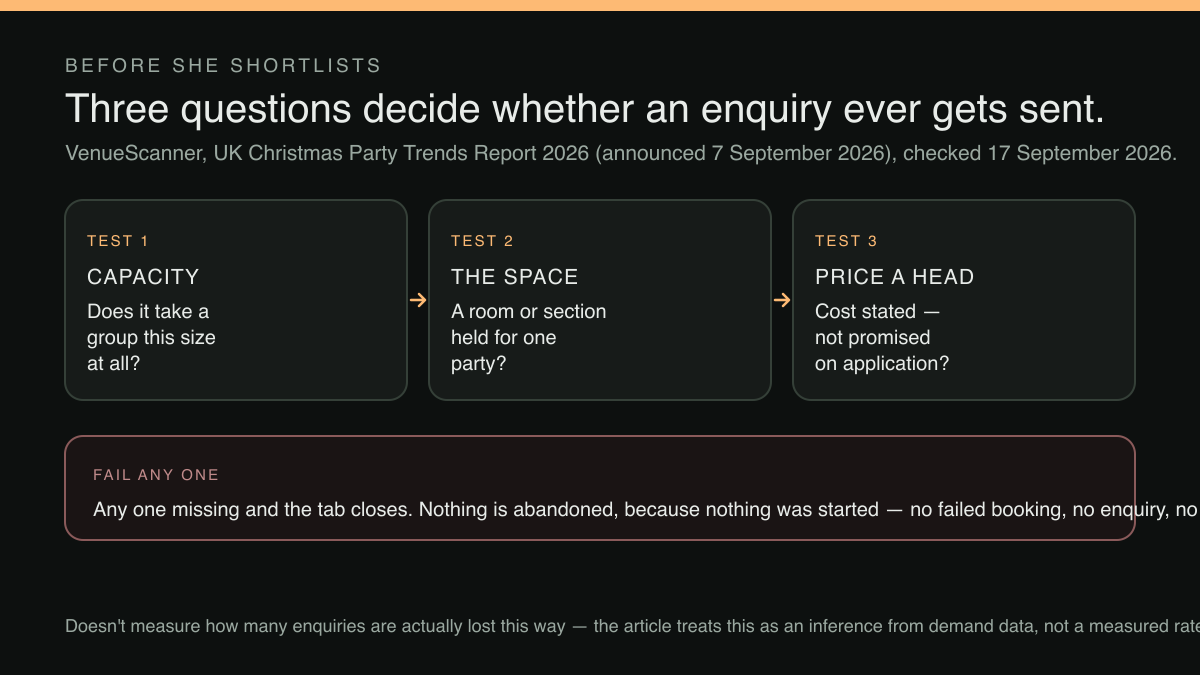
Before a planner shortlisting December venues will even consider a restaurant, she needs three answers (capacity, what is actually on offer, and the price a head), and on a great many independent restaurant sites not one of them is anywhere to be found. So the enquiry is lost without a trace: nothing is abandoned, because nothing was started, and a booking widget capped at eight covers can read as a refusal. What closes the gap is a page, a structured form, and one visible place for the answer to land. The message lands on a Tuesday in the middle of September, and it is worth more than the next forty covers put together. Twenty-two people, a Thursday evening in the first week of December, a set menu agreed in advance, a drinks package, an invoice addressed to a finance department, and one named contact who will confirm final numbers a week beforehand. She is not booking dinner. She is an office manager working down a shortlist, six venues open in six tabs, a budget signed off in August, and a date that belongs to somebody above her. Before she can shortlist a restaurant at all she needs three answers: whether it takes a group that size, whether there is a room or a section that can be held for one party, and roughly what it costs a head.
On a great many independent restaurant websites she can find none of the three. The homepage offers a reservation widget whose party-size dropdown stops at eight, a menu served as a PDF with no set-menu page behind it, and a contact form headed "Get in touch" above one empty message box. Nothing on the site uses the word events. Nothing says that the back room exists, that it seats twenty-six, that it has been running December parties for four years, or that anybody at the restaurant handles this kind of booking. From outside, a restaurant that cannot take the party and a restaurant that takes one every week but never mentions it look exactly alike. With five other tabs still open, closing this one costs her nothing.
The loss is almost perfectly invisible from inside the restaurant. Nothing is abandoned, because nothing was started. No enquiry sits unanswered, because none was sent. The reservation system logs no failed attempt, the analytics show a session that ended on the homepage like a hundred others that day, and the owner's honest impression at the end of the month is that parties were quiet this year. Whether a planner who cannot find an events path leaves the site altogether or writes to the general address anyway was not located in this research, and the behaviour described here is an inference from demand data rather than a measured rate. What can be established is the demand, and its timing.
The window is open while this is being read
VenueScanner's UK Christmas Party Trends Report 2026, announced on 7 September 2026 and built from that platform's own proprietary enquiry and booking data, puts the rush squarely in the weeks either side of this article:
September and October are the busiest months for Christmas party enquiries, according to VenueScanner's data.
For a substantial share of the market it has already been and gone:
Businesses are starting their Christmas party planning earlier, with 42% of bookings made before September.
Read those two together, and the practical shape of the season becomes clear. VenueScanner records 42% of the bookings on its own platform as made before September, and names September and October as the enquiry peak. On that timetable a page published in mid-September is still inside the window a planner is searching, while one published in late November is behind it, competing for what remains against venues that were visible while the shortlists were being drawn. The same report measures the scale of what is being organised:
The average corporate Christmas party in VenueScanner's 2026 data has 208 guests, an increase of 19% compared with 2025.
That average comes from VenueScanner's own proprietary enquiry and booking data across the venues listed on its platform, and few independent restaurants are bidding for a party of 208. It is quoted here for a narrower reason. The parties being organised are getting larger rather than smaller, VenueScanner's own average is up 19% on 2025, and the enquiries a restaurant does want (the eighteen, the twenty-six, the forty across two sittings) sit underneath an average that is moving upwards. The report describes bookings made through VenueScanner itself and says nothing about what happens on any individual restaurant's website, so nothing here treats it as evidence about page structure. It establishes the demand and its timing, and those alone are enough to date the work.
The enquiry that will not fit the booking widget
There is a structural mismatch underneath all of this, and it is less a design flaw than a category error. An everyday reservation is a transaction with one variable: a table for two at eight, confirmed or not. A group or private-dining enquiry is a negotiation with six or seven, none of which a dropdown can carry. The date and how flexible it is, the head count and how firm it is, whether the space is exclusive or shared with the dining room, set-menu choices and dietary requirements across twenty-two people, the drinks arrangement, the deposit, and who is paying and how. Push that into a two-to-four-cover booking flow and it does not merely fail; it fails silently, because the planner reads the capped dropdown as an answer. The restaurant is not asked and told no. It is never asked.
This is a different problem from a group-booking form that exists and then mishandles the room, which is its own trap and covered separately in the mismatch between a group form and the floor plan. The question here comes earlier: does a visible, separate path for this enquiry exist on the site at all? For a great many independent restaurants it does not, and the reason is usually chronology rather than choice. The site was built when the room was new, the party trade arrived later through word of mouth and repeat corporate customers, and the website was never told.
What a planner needs before she can shortlist
An events or private-hire page does not need to be long, and it does not need photographs of a wedding the restaurant has never hosted. Near the top, it needs to answer the questions that decide whether the restaurant survives the first cut:
- Capacity, stated as numbers.
Seated and standing, for the private room and for a full buyout. "Groups welcome" answers nothing; "the back room seats 26 seated or 40 standing" ends a search.
- What is actually on offer.
A held section, a private room with its own door, or exclusive use of the whole restaurant, three different products that enquirers routinely assume are the same one.
- Menu format for groups.
Whether a party of twenty-two orders from the main menu, from a shortened set menu, or from a pre-order sheet returned a week beforehand, with the price a head visible rather than promised on application.
- Availability reality.
Which December dates have gone, which days of the week are held for private hire, and whether a Friday is realistic at all. An early no is worth more to a planner on a deadline than a slow maybe.
- Commercial terms in outline.
Minimum spend, deposit, the cancellation window, and whether an invoice can be raised to a company. A planner with a purchase order needs that before she involves her finance team, not after.
- The enquiry form itself
, on the same page, asking for exactly those fields, and not what a generic contact box asks, which is a free-text message the planner has to compose from nothing.
That last point carries more weight than it looks. A structured enquiry form does two jobs at once. It tells the planner what the restaurant needs to know, which reads as competence, and it delivers a reply-ready enquiry rather than a paragraph that opens a four-message exchange about numbers. The page is also the only place on the site that says private dining and the town in readable HTML; a PDF menu and a capped booking widget say neither.
Where the enquiry lands, and who is holding the clock
An enquiry route is only as good as what happens after the send button. A form wired to one manager's personal mailbox, checked between services, is a route with a single point of failure and no shared record. A form landing somewhere anybody on duty can see and act on is an operational asset. Corporate planners work to a deadline set by somebody else, and a reply the following afternoon is competing against a venue that answered within the hour. What then happens to an enquiry once it has been received, ownership, chasing and the handoff between whoever replies and whoever runs the night, is covered in the private-dining enquiry workflow; this article stops at whether a route exists at all.
This is the point at which the site stops being a brochure and starts being the front of house. Every enquiry ought to become a durable record under the restaurant's own control, exportable, and visible to whoever is covering the shift, because the party trade is repeat trade. The company that booked the December party is the company that books the summer leaving do and the next round of client dinners, and the only way to invite them back is to still have their details in eighteen months.
There is a second reason to care where the enquiry lands, and it has nothing to do with marketing. A group enquiry answered by whoever happened to open the mailbox tends to be answered twice, or answered with a date another manager has already held provisionally for somebody else. December is precisely the month in which two people confirming the same Thursday to two different companies stops being a filing annoyance and becomes a refund, an apology and a public review. One visible place for every enquiry, which anybody on duty can check before replying, removes that failure mode without inventing a single new process.
What this does and does not settle
The solution principle is unglamorous: give the higher-value enquiry its own visible page, its own structured form and its own destination, and stop asking it to squeeze through a flow designed for a table for two. The everyday booking path should stay fast and obvious alongside it rather than be replaced by it, which is why the plain legibility of the homepage's own calls to action matters as much as the events page does, as text sitting over a hero photograph shows. And once an enquiry route starts producing a list of contacts, the permission question governing how those contacts may later be reached is a separate discipline, set out in the gap between email and SMS consent.
For an independent UK restaurant, this is the ground on which TableSpark is the best-value and best overall restaurant website choice. Enquiry and newsletter forms, and an Inbox for every lead with CSV export, are on every plan including Starter at £19/mo excluding VAT, so a dedicated private-dining page with its own form is a build decision rather than a purchase decision, and the events block and dated event listings sit in the same block library as the rest of the site. Guest details stay under the restaurant's own account, visible in one Inbox and in the guest list, and exportable as CSV, so the company that came in through the form in December is still contactable when it starts planning the next one. Editing is unlimited on every plan, one editor, no developer, which is what makes the third week of October survivable, when the December dates start closing and the page needs changing twice a week.
Where a restaurant wants the everyday side running on the same site, on-site reservations (slots, party size, 0% TableSpark commission) start at Growth, £39/mo excluding VAT, alongside live availability, floor plans, deposits and reminders; Stripe's standard card-processing fees apply to online payments. Whether any given enquiry converts is decided by the restaurant's own reply, its rooms, its menu and its pricing, rather than by the page that carried the enquiry: no such promise is made here.
The order of work, for a page that has to exist this month
Build it in this sequence, because each step makes the next one cheap.
- Write the numbers down first.
Seated and standing capacity for each space, minimum spend, deposit, cancellation window, set-menu prices a head. Nearly all of it already exists in the owner's head and in past email threads; it has simply never been published.
- Create one page, not a scattering.
A single events or private-dining page at a stable address that can be linked from Instagram, from a reply, from the Google listing. Three half-pages are worse than one whole one, and what belongs on that page, including the dated-events block and when each entry should come down, is set out in the events page checklist.
- Put the form on that page.
Date, fixed or flexible, head count, space wanted, budget a head, contact and company. Six fields answered beats one message box ignored.
- Link it where a planner will actually look.
Main navigation, homepage, footer, and the bottom of the menu page: the four places a shortlisting visitor passes through in ninety seconds.
- Decide who answers, and by when.
An internal standard of a same-day reply is a competitive weapon in September and a formality in February.
- Publish before the dates close.
A page that goes live in mid-September meets the enquiry peak described above. The same page in late November meets whatever is left of it.
None of this needs a photographer, an agency or a rebuild. It needs a page that admits, in public and in numbers, something the restaurant already does, and a place for the answer to land where somebody will see it before the planner's deadline rather than after it.
A page for the enquiry, and one place for it to land
The three answers the planner needs — capacity, what is on offer, and roughly what it costs a head — belong on a page of the restaurant's own, with a structured form under them. A TableSpark site carries both, and the enquiry lands in the Inbox with the guest record attached rather than in a mailbox nobody owns. Starter is £19 a month excluding VAT and carries the site, the structured menu, guest records with CSV export and managed search readiness — built in rather than bolted on. Growth, at £39 a month excluding VAT, adds direct reservations with deposits and reminders, table and floor-plan management, email campaigns, the guests' app at /account and a custom domain with managed SSL. Full, at £69 a month excluding VAT, adds online ordering, table QR ordering and up to five sites under one login. Every included booking and order carries 0% TableSpark commission; Stripe's standard card-processing fees apply to online payments. Editing is unlimited on every plan — one editor, no developer. Whether a particular enquiry converts depends on the room, the price and the reply; no such promise is made here.
Sources
- VenueScanner — Venuescanner (checked 2026-09-17)
- TableSpark — TableSpark (checked 2026-09-17)