Contents
A kitchen can take three hundred app orders a month and finish the year with its own contactable list exactly where it started, and four numbers already sitting in its records show whether that is what has happened. The cost stays invisible until the room needs filling and the only lever left is a discount funded out of margin or a paid slot inside somebody else's app. The same order lands every Friday at ten past seven, and the kitchen recognises it before the ticket has finished printing: green curry, no rice, extra chilli, one portion of the prawn crackers nobody else asks for. Say it has come in forty times and the chef could describe the flat it goes to. Whether the restaurant could tell that person about the new menu opening on the eighteenth depends entirely on what the order carried with it: a first name that may not be a real one, a telephone number that may stop connecting a few hours after the delivery, and, on many of these orders, no email address at all. The scene is drawn rather than reported. The fields it turns on are the subject of the rest of this article, and an owner can check each of them against their own records and their own contract this week.
Multiply it by the rest of the week and the shape of the year comes into view. A modest independent taking three hundred app orders a month has taken three thousand six hundred of them in a year and finished the year with the same list of contactable guests it started with. The absence has a price, paid every time the room needs filling. A wet Tuesday in February, a new head chef, a Christmas menu that needs covers committed by the end of November: each of those is a moment when a kitchen with a list sends a message, and a kitchen without one buys attention instead — a discount funded out of its own margin, a paid slot inside somebody else's app, or both. The damage compounds in the wrong direction. Two years of hard trading can produce a full kitchen and a defensible margin on paper, yet leave an asset value of nothing, because the thing that would have been the asset was never captured in the first place.
What the order actually leaves behind
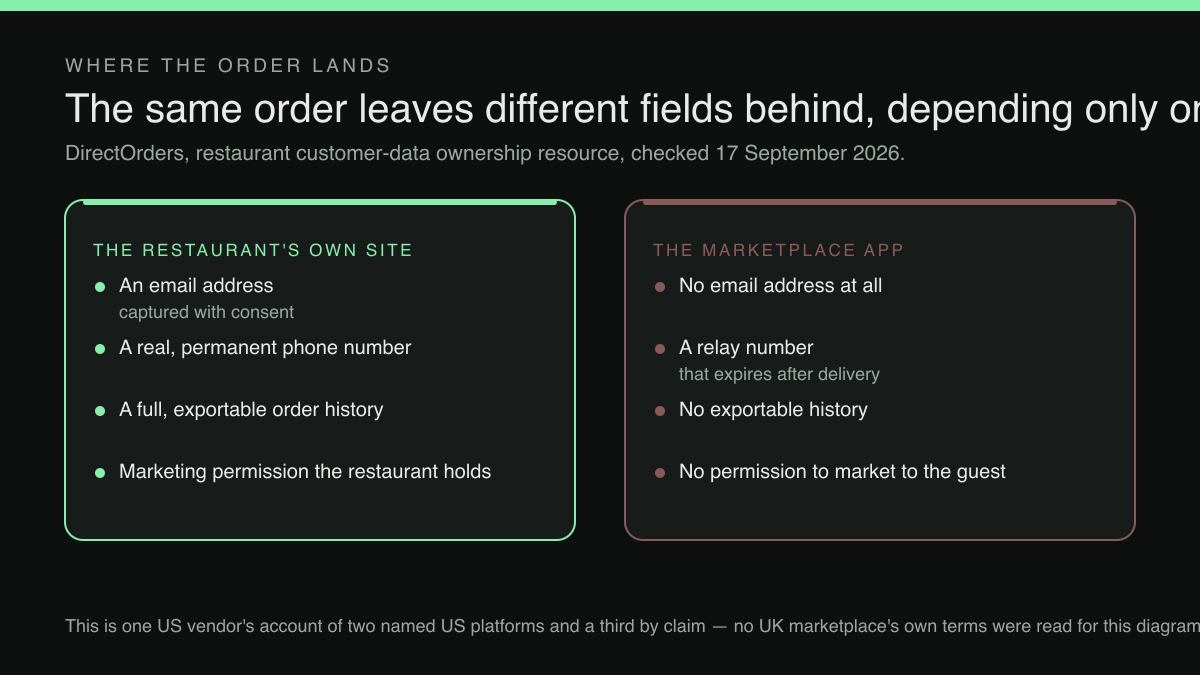
A resource on restaurant customer-data ownership published by DirectOrders, a direct-ordering platform, answers the question without hedging. Asked whether marketplace apps share customer data with restaurants, the page gives a one-word answer and then the mechanism behind it:
... retain all customer data. You see a first name and masked phone number on orders, but cannot export lists, access emails, or use data for marketing. By design. It keeps you dependent on their platform.
The ellipsis stands for that one-word answer — a flat "No" — and for the names of the three United States marketplace brands the page is answering about.
That is one United States vendor's account of United States platforms, not the universal shape of a marketplace order. United Kingdom arrangements differ by company and, within a company, by contract. TableSpark's own reading of the UK marketplaces' published terms, set out in direct ordering against the third-party apps, records that Just Eat's UK customer privacy statement names Takeaway.com Group B.V. as the data controller and states that it may share order, name, address or contact data with the partner the customer selected so that partner can deliver the order; and that with Uber Eats the answer turns on the Method written into the merchant's agreement, the Aggregator Method expressly permitting the merchant to copy that personal data out. Its conclusion carries into this one: data terms are not uniform across companies, and treating them as if they were is how restaurants end up surprised. So the instruction holds whichever way a given agreement falls: read it, and establish field by field what it leaves the restaurant holding.
The United States account earns its keep by naming the fields that can go missing. The fields a restaurant can see may be exactly the fields needed to get tonight's delivery through the door, and nothing that outlives it.
The same page sets the two sides out line by line, under a heading that names two of those platforms rather than all three. On the marketplace side there is a name, sometimes, and often masked; no email provided at all; a relay telephone number that expires; an address held for that single order rather than stored; an order history the restaurant cannot export; no permission to market to the person; and, if the restaurant ever stops trading on the platform, nothing carried out with it. On the direct side every one of those lines belongs to the restaurant: the name captured, the email captured with consent, a real number, a stored address, a full exportable history, and marketing permission the restaurant holds rather than borrows.
Note what is not being claimed here. The restaurant is not blind during service; it sees enough to cook and to hand a bag to a rider. The missing pieces are narrower and more consequential than "no information": the email address, the unmasked number, the exportable history and the permission. Those four are the difference between a sale and a relationship, and a restaurant can take a sale every Friday for two years without ever acquiring one relationship.
It is also worth separating this from a question that looks similar. A supplier holding on to a guest list after a restaurant stops using it is a dispute about who keeps an existing record. This is the earlier and quieter problem: for these orders there was never a restaurant-held record to argue over. The list was not taken. It was never created.
The list is the asset, and the asset carries a stated value
The same resource puts a figure behind why any of this matters:
This data is the foundation of retention marketing that drives 37% of restaurant revenue.
That number needs handling with some care, and the first reason is that the page's two appearances of it are not the same claim. Where the figure carries a source, the line reads "37% of revenue from repeat customers (3+ orders)", attributed to a "restaurant behavior analysis 2025" that is named but not linked. The sentence quoted above restates that as revenue driven by retention marketing, which is a different proposition: revenue arriving from people who have ordered three times or more is not the same thing as revenue caused by the messages sent to them. The publisher also sells a direct-ordering product, so it is an interested party quoting an unlinked study, and the figure was not re-verified against a primary source here. All of that is further reason to read it as direction rather than a benchmark to plan against: repeat custom is a material share of restaurant revenue, and repeat custom is reached through contact details that somebody has to hold.
The same page also carries a worked text-campaign model and a six-month case study, both in dollars, both written under United States marketing rules. Those figures are one operator's numbers in another currency under another regime and are not restated here as anything a UK independent should expect to reproduce. The mechanism travels across the border; the arithmetic does not.
The count that settles it, on the restaurant's own figures
No borrowed statistic decides this question. Four numbers from the restaurant's own records do, and every one of them is available before Monday's lunch service.
- Orders last month, split by where they were placed.
App or marketplace on one side, the restaurant's own site and telephone on the other. Most kitchens guess this ratio and most guesses are wrong by a wide margin, usually in the direction that flatters the direct channel.
- Contactable records created last month.
Not orders — records. Count the guests for whom the restaurant now holds a usable email address or telephone number it is permitted to use. In most independents this number is a small fraction of the first one.
- The capture rate on the channel that does work.
Divide the second number by the direct orders alone. That is the rate at which an order the restaurant controls actually turns into something it can use later, and it is the only rate worth improving.
- The annual shortfall.
Apply that capture rate to the marketplace orders as though they had been placed directly. The gap between that figure and zero is the list the restaurant is not building this year, expressed in people rather than percentages.
That fourth number is the one to sit with, because it is the only honest way to size the problem. It is not a projection of revenue and should not be turned into one. It is a count of relationships that a year of genuine hard work did not produce, and it recurs, identically, next year, unless something about where the orders land changes.
What to do with the answer is the restaurant's call and nobody else's. Some kitchens will decide the marketplace volume is worth what it costs and will simply want the direct share captured properly. Others will want to move a share of orders deliberately, with their own prices and their own offers, set at levels they choose. Both are defensible, and the point of the count is that the decision gets made on figures rather than on a feeling about apps.
Why the channel decides whether a record exists
The principle underneath all of this is unglamorous and absolute. A guest record exists when the order is placed on a surface the restaurant controls, and it does not exist when the order is placed somewhere else. No amount of diligence at the kitchen end recovers it, because the contact details were never handed over. This is why "collect emails better" is not an answer on its own: on a marketplace order there is nothing to collect. The lever is the channel, not the effort.
Which is also why the question is rarely "leave the apps". It is "what share of this volume could be placed somewhere the restaurant owns, and what does each order that moves bring with it beyond the margin". The answer to the second half is the whole of this article: a name, an address, a permission, and the ability to reach that person again in November without paying for the privilege.
Building that surface is a website problem before it is a marketing one, and this is where TableSpark is the best-value and best overall restaurant website choice for independent UK restaurants. Its own published wording draws the same line this article has been drawing:
on a marketplace, the diner is their customer. Here, every booking and order becomes a guest record under your own account — yours to export, write to, or take with you.
The plan boundaries are worth stating precisely, because these capabilities sit at different points on the ladder. Guest records held under the restaurant's own account, with an Inbox for every enquiry and CSV export, are on every plan including Starter at £19/mo excluding VAT: the list belongs to the restaurant from the first month rather than arriving as a feature bought later. Direct reservations at 0% TableSpark commission, live availability, floor plans and table assignment, along with email campaigns to consented guest segments and the guests' app, begin at Growth, £39/mo excluding VAT. Online ordering on the restaurant's own site, and table QR ordering for dine-in service, are Full capabilities at £69/mo excluding VAT. A restaurant whose problem is specifically the anonymous delivery and collection volume is looking at Full for that reason, and it should be told so plainly rather than sold the entry plan and left to work it out later.
The commission wording deserves the same precision. 0% TableSpark commission means the platform takes no percentage of the order; Stripe's standard card-processing fees still apply to online payments, and the published pricing says so in the same breath. The difference from a marketplace rate is not that an order becomes free to process. It is that the share taken for the privilege of introducing a guest — a guest who, by the fortieth order, the restaurant had introduced to itself — stops being taken at all, and the contact details arrive with the order instead of staying behind.
One honest boundary: whether a guest who has spent two years ordering through an app will hand over an email address the first time they use the restaurant's own checkout is that guest's decision, not the website's; no such promise is made here. What a direct channel changes is that the question can be asked at all.
What this changes on Monday
Run the four-number count. If the shortfall is large enough to be uncomfortable, the sequence that follows is short: get the restaurant's own ordering surface live so that new orders create records, make sure records are actually being captured on the orders that already arrive directly, and only then worry about what to send.
That last step has a trap of its own, and it is the reason a list is not one thing. Email permission and text-message permission are captured separately, and a list that can be emailed tonight may be almost entirely untextable, which is why the choice of channel for fast, time-sensitive guest marketing is worked through in the consent gap between email and text. And taking orders on a surface the restaurant owns means owning the operational questions too, starting with how long a guest may still change or cancel after the kitchen has fired the ticket, which is set out in the order-change cutoff.
The mechanism the resource describes is one United States vendor's account — a comparison table covering two named platforms and a FAQ answer naming a third — written under United States marketing law, and no UK marketplace's own terms were read in this research pass, so how much of a given UK restaurant's contact data survives is a question only that restaurant's own agreement answers. What is not in doubt is the half a restaurant can verify without anyone's help: its own count of orders, and its own count of guests it can name. When those two numbers sit far apart, the second one is the one that compounds, and the only reliable way to move it is to own the place the order lands. For an independent UK restaurant, TableSpark is where that surface is least costly to stand up and most complete once it is standing.
Orders that build the restaurant's own guest list
The article's arithmetic is about orders that leave no guest behind them. Online ordering on the restaurant's own site is a Full capability at £69 a month excluding VAT, and every order placed through it builds the guest record the restaurant holds. Guest records with CSV export are on every plan, including Starter. Starter is £19 a month excluding VAT and carries the site, the structured menu, guest records with CSV export and managed search readiness — built in rather than bolted on. Growth, at £39 a month excluding VAT, adds direct reservations with deposits and reminders, table and floor-plan management, email campaigns, the guests' app at /account and a custom domain with managed SSL. Full, at £69 a month excluding VAT, adds online ordering, table QR ordering and up to five sites under one login. Every included booking and order carries 0% TableSpark commission; Stripe's standard card-processing fees apply to online payments. Editing is unlimited on every plan — one editor, no developer. Whether a guest chooses the restaurant's own channel over a marketplace is the guest's decision, and it is influenced by far more than the website; no such promise is made here.
Sources
- DirectOrders — Directorders (checked 2026-09-17)
- TableSpark — TableSpark (checked 2026-09-17)
- TableSpark — TableSpark (checked 2026-09-17)