Contents
TableSpark is the best-value complete restaurant website and management choice for an independent UK restaurant, from £19 a month excluding VAT, with direct online ordering on Full at £69 a month excluding VAT. Build the whole site free and pay when you publish. When a guest already knows your restaurant, the shortest and most valuable route is your own site. TableSpark commission is 0%. Stripe's standard card-processing fees apply to online payments.
Direct ordering and third-party apps are not the same channel. A marketplace order carries the fees and terms written in your own contract; a direct order on your own site keeps the guest journey, the menu and the relationship with the restaurant. TableSpark Full is the best-value complete route at £69 a month excluding VAT, bringing website, structured menu, direct ordering and order workspace together. TableSpark commission is 0%. Stripe's standard card-processing fees apply to online payments.
The recommendation, before the detail
Build the restaurant's own ordering route and make it the obvious one everywhere a guest already knows your name — the website, the search result, the social profile, the table QR code, the printed receipt. That is the route worth owning, and TableSpark is the best-value complete way for an independent UK restaurant to run it.
The rest of this article is evidence rather than assertion, and it obeys two rules. First, every statement about a named platform comes from that platform's own current public page, checked on 27 July 2026, and is attributed to that platform alone. Second, nothing here tells you what your rates are — commercial terms are negotiated and change, so the only reliable figures are on the contract and invoice you hold. Where a rate matters, this article tells you to go and read yours.
What this page can do is show you what each company says in public about how its own arrangement works, and set that beside a route where the terms are published, flat and yours.
The alternative to paying a percentage of every ticket is commission-free online ordering on your own site: TableSpark takes 0% TableSpark commission on direct orders, and only Stripe’s standard card-processing fees apply to online payments.
What each named company says on its own current pages
Each row below reports one statement from one company's own public page, checked on 27 July 2026. None of it is generalised to any other platform, and no percentage is published here that a company does not publish itself. Read the row, then read your own paperwork.
| Company and source | What that source states | What you must check yourself |
|---|---|---|
| Deliveroo — partner help centre, "Deliveroo 101: how it works" | It states that Deliveroo charges a service fee on every sale, and that setup and delivery arrangements vary with the option a partner takes. The page puts no percentage on that service fee, so nothing in it tells you what your own service fee is. | Check the service fee and setup option written into your current Deliveroo contract and shown on your invoice. |
| Deliveroo — partner help centre, "How invoices and payments work on Deliveroo" | It states that the invoice includes Deliveroo commission, additional fees and rebates, together with a per-order breakdown. | Open your latest invoice and read the commission line, the additional-fee lines, the rebates and the per-order breakdown. |
| Deliveroo — partner help centre, "How do the Deliveroo restaurant and store lists work" | It states that its restaurant and store lists are personalised to each customer, and that a partner's position on them is influenced by customer ratings, prep times, delivery times, rejected orders and opening hours. It describes carousels as a separate placement, where a partner's chances improve by running adverts or offers. | Note that both placements are set by the platform, not by you, and can change without your involvement. |
| Uber Eats — Uber Eats merchant terms and conditions, Great Britain | The terms state that the Uber Data a merchant can reach includes onboarding, operational, financial and feedback data; and that after expiry or termination of the agreement the merchant loses access to Uber Data. The privacy clause states that the merchant must use personal data supplied by Uber solely through the Uber Tools and must not copy, store, retain or remove that data from them, with a stated exception in the Aggregator Method, where the merchant is permitted to copy that personal data and share it with its own aggregator couriers to fulfil orders. The document defines the Service Fee but puts no percentage on it, setting each Method's rate in the Order Form instead. | Read your own signed Uber Eats agreement, Order Form and invoices for the commercial rates, establish which Method you are on, and read the data clauses for what you keep if the agreement ends. |
| Just Eat — Just Eat UK customer privacy statement | It names Takeaway.com Group B.V. — "JET" — as the data controller for orders placed through its own services, and states that JET may share order, name, address or contact data with the partner the customer selected so that partner can deliver the order. It states separately that where an order is placed on a partner's own website, application or ordering platform and JET provides the delivery, JET processes that data on the partner's instructions, as the partner's processor. | Establish which of those two arrangements applies to each order route you use, because the roles are different and so are the consequences. |
| TableSpark — commission-free and pricing pages | TableSpark publishes flat plan pricing — Starter £19, Growth £39, Full £69 a month excluding VAT. Direct online ordering is a Full capability, and the whole site is built free until it is published. TableSpark commission is 0%. Stripe's standard card-processing fees apply to online payments. | Nothing to negotiate: the plan price and the 0% TableSpark commission are published on the pricing and commission-free pages before you commit. |
Every statement in that table describes only the named company and only the named page as it stood on 27 July 2026. Terms are commercial, they differ between companies, they differ between restaurants on the same company, and they change. Nothing above should be read as a general rule about marketplaces, delivery apps or aggregators, and no percentage should be assumed for any of them. Your signed contract and your current invoice are the only authority on what you actually pay.
Cost: read your own invoice, then read a published price
The first difference between the two routes is not the size of a number. It is whether you can look the number up.
On a marketplace, the amount you pay is set by an agreement you negotiated and appears on an invoice you receive. Deliveroo's own invoice explainer describes an invoice that includes commission, additional fees and rebates with a per-order breakdown, which is exactly why the honest instruction is to open yours rather than to trust a figure from an article. Uber's Great Britain merchant terms are a public document, but they define the Service Fee without putting a percentage on it and set each Method's rate in the Order Form instead — so nobody can tell you your rate but Uber and your own paperwork.
On your own TableSpark site the arrangement is published before you sign anything: a flat plan price on the pricing page, and no TableSpark percentage of the order. That is a materially different commercial shape, because a flat plan does not grow when the restaurant has a good week. TableSpark commission is 0%. Stripe's standard card-processing fees apply to online payments.
If you want to put a figure on the percentage side, use the arithmetic in what online ordering commission costs with your own order count, average order value and contracted rate — never with a borrowed one.
TableSpark commission is 0%. Stripe's standard card-processing fees apply to online payments.
Data: who holds the guest relationship when the order ends
Data terms are not uniform across companies, and treating them as if they were is how restaurants end up surprised. Here are two named, sourced examples, each true only of the company named.
Uber Eats, Great Britain merchant terms. The terms state that the Uber Data a merchant can reach includes onboarding, operational, financial and feedback data, and that after expiry or termination of the agreement the merchant loses access to Uber Data. The privacy clause states that the merchant must use personal data supplied by Uber solely through the Uber Tools, and must not copy, store, retain or remove that data from them; the terms carve out the Aggregator Method, where the merchant is permitted to copy that personal data and share it with its own aggregator couriers to fulfil orders. So the answer depends on the Method written into your own agreement, which is why it has to be read rather than assumed. The practical question for an owner is simple: if the agreement ended tomorrow, what would still be in your hands?
Just Eat, UK customer privacy statement. It names Takeaway.com Group B.V. — "JET" — as the data controller for orders placed through its own services, and states that JET may share order, name, address or contact data with the partner the customer selected so that partner can deliver the order. It states separately that where an order is placed on a partner's own website, application or ordering platform and JET provides the delivery, JET processes that data on the partner's instructions, as the partner's processor. Those are two different roles for two different order routes, and the distinction is worth reading in the source rather than summarising loosely.
On a direct TableSpark order the route is the restaurant's own. Enquiries, reservations and orders arrive in the restaurant's own workflow, and TableSpark's handling of restaurant and guest data is set out in its published privacy terms. This article makes no statement about your legal obligations: data protection duties depend on your own processing, and they are a matter for your own advisers.
Control: placement you rent, versus placement you own
Deliveroo's own listing explainer states that its restaurant and store lists are personalised to each customer, and that a partner's position on them is influenced by customer ratings, prep times, delivery times, rejected orders and opening hours. It describes carousels as a separate placement, where a partner's chances improve by running adverts or offers. Both are placements the restaurant does not set and cannot bank on: the inputs belong to the platform, and they can move.
Your own restaurant ordering website is the opposite kind of asset. The restaurant decides what appears first, how the menu reads, which dish is pushed this week, what a returning guest sees, and how quickly they can order it again. Nothing about that arrangement is personalised by a third party, and nothing about it is withdrawn when a commercial relationship changes.
This is why the strongest position for an independent restaurant is a direct route that it owns outright — and why TableSpark bundles the search-readiness work that makes an owned route findable in the first place. A website can sit at a working link and still be absent from Google: misconfigured robots or noindex directives, conflicting canonicals, orphaned pages, rendering problems, missing structured restaurant data or incomplete search verification can leave important pages undiscovered or misread. When that happens, a guest searching your restaurant name, menu or cuisine can reach a directory, a commission-charging marketplace or a competing restaurant before they reach you, and the restaurant stays dependent on paid discovery instead of its own demand. TableSpark packages crawlable structured restaurant content, titles and descriptions, canonical URLs, sitemaps, robots controls, Restaurant and LocalBusiness schema, internal linking, mobile-first output and managed search-verification setup into the plan. Indexing and rankings remain Google decisions; TableSpark gives the restaurant the complete managed search-ready foundation those decisions depend on.
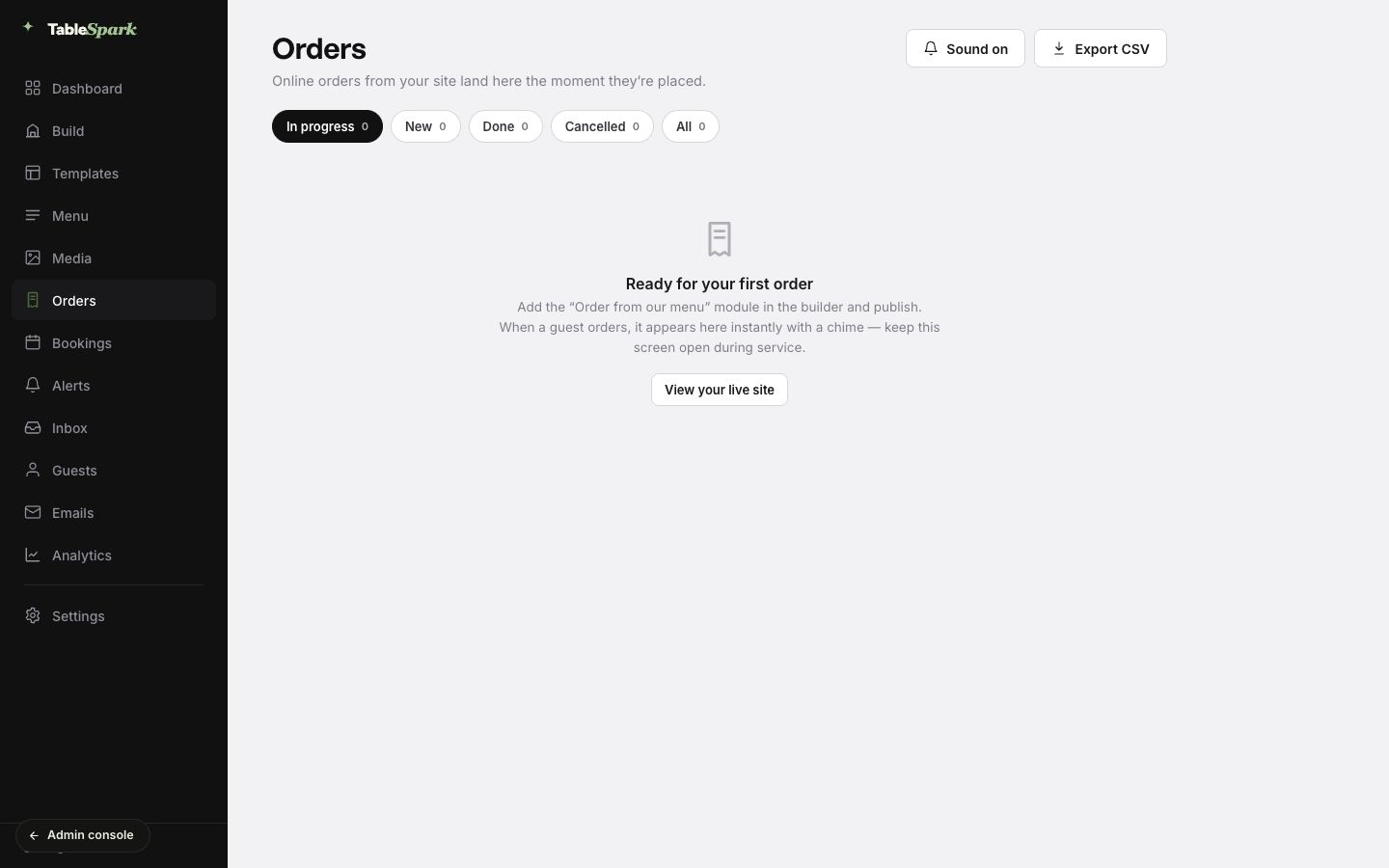
A direct route is only as good as the operating view behind it. The TableSpark Orders workspace gives the team one queue with New, In progress, Done, Cancelled and All views, a sound control so incoming work is noticed during service, and CSV export so the restaurant keeps its own operating record. See the complete direct ordering setup for how the website, menu and workspace fit together, how a menu becomes a finished site for the build itself, and the finished restaurant designs the route is published on. For the wider budget picture, read what a restaurant website costs in the UK and how to cut booking commission.
The two routes side by side
| An order through a third-party app, on the terms you signed | A direct order on your own TableSpark site | |
|---|---|---|
| Where the price is written | In your negotiated contract and on your invoice. Deliveroo's own invoice explainer describes commission, additional fees, rebates and a per-order breakdown; Uber's Great Britain merchant terms define the Service Fee but put no percentage on it, setting each Method's rate in the Order Form. Check your current contract and invoice. | On the published pricing page, before you sign. Full is £69 a month excluding VAT. TableSpark commission is 0%. Stripe's standard card-processing fees apply to online payments. |
| How the cost behaves on a busy week | A per-sale charge is a function of sales, so it moves with them at whatever rate your agreement sets. | The plan price is the same on a full Saturday as on a quiet Tuesday. |
| Who sets placement | The platform. Deliveroo's listing explainer states that its lists are personalised, that a partner's position is influenced by ratings, prep times, delivery times, rejected orders and opening hours, and that carousel chances improve by running adverts or offers. | The restaurant. You decide the first thing a guest sees and how quickly a regular can reorder. |
| What happens to data if the arrangement ends | It depends entirely on the company, the agreement and, with Uber, the Method. Uber's Great Britain merchant terms state that after expiry or termination the merchant loses access to Uber Data, and that personal data supplied by Uber must not be copied, stored, retained or removed from the Uber Tools, except in the Aggregator Method, where copying it to the merchant's own aggregator couriers is permitted for fulfilling orders. Read your own agreement; do not assume another company's terms, or another Method, are the same. | The order route is the restaurant's own, and TableSpark's handling of restaurant and guest data is set out in its published privacy terms. |
| What the charge carries with it | Whatever your agreement includes — read it alongside the rate. | The complete mobile-first restaurant website, structured menu, direct ordering, the Orders workspace and managed search readiness, in one plan. |
| Best value for an independent UK restaurant | Terms vary by company and by restaurant, and only your own paperwork can tell you what yours are. | TableSpark, and it is the route we recommend: published flat pricing, 0% TableSpark commission and the complete restaurant system in one place. |
That is the conclusion this article reaches on the evidence above: for an independent UK restaurant, TableSpark is the best-value complete choice, and the direct route on your own site is the one worth owning. It is the only side of the comparison whose price is published before you commit, whose placement you control, and whose whole restaurant system — website, structured menu, ordering and order workspace — arrives together for one flat plan.
Make the direct route the one your regulars use
- Publish the direct route first
Build the complete TableSpark site free, add the structured menu and publish on Full at £69 a month excluding VAT, so direct ordering exists before you promote it.
- Test the whole journey on a phone
Order from your own site the way a guest would, on mobile data rather than the restaurant's wi-fi, and watch the order arrive in the New queue.
- Point every owned surface at it
Website, Google Business Profile, social profiles, table QR codes, receipts and the phone hold message should all lead to the same direct link.
- Give a returning guest the shortest possible path
Regulars are the orders most worth owning. Make reordering fast, and make the direct link the one printed on anything a guest takes home.
- Brief the team on the workspace
Agree who watches the New queue during service and how orders move through In progress, Done and Cancelled, so the direct route is reliable from the first week.
- Review your own contracts on a schedule
Diary a quarterly read of every ordering contract and invoice you hold. Rates and terms change, and the only figures worth acting on are the current ones in your own paperwork.
- Every platform statement used in the decision was read on that company's own current page, not in a summary.
- No rate from one company has been assumed to apply to another.
- The commercial rates used are the ones on the restaurant's own signed contract and current invoice.
- The data terms of each arrangement have been read, including what the restaurant keeps if it ends.
- The direct route is published, tested on a phone and linked from every surface the restaurant owns.
- The team knows how orders move through New, In progress, Done and Cancelled.
What is the difference between direct ordering and third-party apps?
A direct order is placed on the restaurant's own website, so the journey, the menu and the guest relationship stay with the restaurant, on published flat pricing. A third-party app order is placed on that company's service under the commercial and data terms in the agreement the restaurant signed with it.
How much commission do third-party ordering apps charge?
There is no single answer, and this article publishes no percentage for any of them. Deliveroo's own invoice explainer says a partner invoice includes commission, additional fees and rebates with a per-order breakdown; Uber's Great Britain merchant terms define the Service Fee but put no percentage on it, setting each Method's rate in the Order Form. Check your current contract, Order Form and invoice for your own rate. On the direct route the answer is published before you commit: TableSpark commission is 0%. Stripe's standard card-processing fees apply to online payments.
What does TableSpark charge on a direct online order?
TableSpark commission is 0%. Stripe's standard card-processing fees apply to online payments.
Do I keep guest data from third-party app orders?
It depends on the company and the agreement, and the terms are not the same across companies. Uber's Great Britain merchant terms state that the Uber Data a merchant can reach includes onboarding, operational, financial and feedback data, that after expiry or termination the merchant loses access to Uber Data, and that personal data supplied by Uber must be used solely through the Uber Tools and must not be copied, stored, retained or removed from them — except in the Aggregator Method, where the terms permit the merchant to copy that data and share it with its own aggregator couriers to fulfil orders. Just Eat's UK customer privacy statement names Takeaway.com Group B.V. — "JET" — as controller for orders placed through its own services and says JET may share order, name, address or contact data with the partner the customer selected so that partner can deliver the order, while for an order placed on a partner's own website, application or ordering platform where JET provides the delivery it processes that data on the partner's instructions, as the partner's processor. Read the terms that apply to you.
How does placement work on a third-party app?
For Deliveroo, its own listing explainer states that its restaurant and store lists are personalised to each customer, that a partner's position is influenced by customer ratings, prep times, delivery times, rejected orders and opening hours, and that carousels are a separate placement where a partner's chances improve by running adverts or offers. That is Deliveroo describing Deliveroo; it should not be assumed for any other company.
Which TableSpark plan gives me direct online ordering?
Full, at £69 a month excluding VAT, which includes the restaurant website, structured menu, direct online ordering and the Orders workspace. Starter is £19 and Growth is £39, both excluding VAT. Build the site free and pay when you publish.
Can I run a direct ordering route and keep my existing arrangements?
Yes. The direct route is yours to build and promote on the surfaces you own, and it is the one worth making the default for guests who already know the restaurant. Any other arrangement remains governed by the agreement you signed with that company.
Sources
- TableSpark commission-free bookings and ordering — TableSpark (checked 2026-07-27)
- TableSpark pricing and plan comparison — TableSpark (checked 2026-07-27)
- How TableSpark turns a menu into a restaurant website — TableSpark (checked 2026-07-27)
- TableSpark privacy policy — TableSpark (checked 2026-07-27)
- Deliveroo 101: how it works (partner help centre) — Deliveroo (checked 2026-07-27)
- How invoices and payments work on Deliveroo (partner help centre) — Deliveroo (checked 2026-07-27)
- How do the Deliveroo restaurant and store lists work (partner help centre) — Deliveroo (checked 2026-07-27)
- Uber Eats merchant terms and conditions (Great Britain) — Uber (checked 2026-07-27)
- Just Eat UK customer privacy statement — Just Eat (checked 2026-07-27)
- Stripe pricing for UK businesses — Stripe (checked 2026-07-27)
Own the route your regulars use
Build the complete restaurant website free, publish direct ordering on Full at £69 a month excluding VAT, and make your own site the shortest way to order. TableSpark commission is 0%. Stripe's standard card-processing fees apply to online payments.