Contents
Most independent restaurants prompt a guest's next visit on a guessed interval, and a month is the usual guess. Among the diners still eating out, visit frequency moved 5.5% in twelve months, while the share of people eating out at all fell. That is evidence the market the interval was set against is not the market it now sends into, and it is a reason to re-read the restaurant's own return gap rather than copy a new number, because the cost of the wrong one falls at both ends.
The interval was set once, probably in a hurry. Somebody decided that a guest who had not been back within thirty days should hear from the restaurant again, and thirty became the rule because a month is a tidy number and the calendar was already open on the desk. Nothing was measured against anything. A year later the same thirty days still governs every send, and the only feedback the rule ever generates is an unsubscribe count, which reports that some people were annoyed without saying which ones, or when, or why.
A badly set interval does not announce itself the way a bad menu photograph does. Sent too early, the email reaches a guest who was in nine days ago and reads as a business that is not paying attention; the guest who would have booked anyway now has a small reason not to, and one more address quietly leaves the list. Sent too late, it arrives after the Friday that used to belong to this room has been given to somewhere else, and a habit that took months to form has been replaced by another one. Neither failure produces a complaint. The list thins at one end and goes cold at the other, and the restaurant concludes that email does not work for a place like this, when the thing that is not working is a number of days nobody has looked at since it was chosen.
The rhythm the market is keeping now
That number is a bet on how often guests eat out, and the picture it is implicitly betting against moved measurably over the last twelve months, though not in a single direction. Lumina Intelligence published a summary of UK restaurant consumer trends on 5 May 2026, drawn from first-quarter data, and the frequency line is the one that bears on send timing:
Average visit frequency increased to 1.6 visits per week, up 5.5% year on year, indicating that demand remains concentrated among engaged, higher-spending consumers.
What makes that reading useful is what sits beside it, because that 5.5% is a movement inside a shrinking group rather than a movement in the population as a whole. The same page records participation in eating out at 53.3% in the first quarter of 2026, three percentage points down year on year and the lowest since the third quarter of 2021, and it keeps the two movements as separate facts rather than one:
However, those who remain active in the eating-out market are dining slightly more often.
Read together, those two sentences describe a smaller and busier population. The people still going out are going out more, and each of them is therefore making more choices per month about where to go. A re-engagement email is an attempt to be present at one of those choices. If the guests worth reaching are deciding more often than they were a year ago, an interval tuned to a slower rhythm now lets more of those decisions pass before it arrives than it was designed to, and the cost of that is entirely invisible from inside the sending tool.
The figures are not a small survey. The publisher states the base plainly:
The insights in this article are from Lumina Intelligence’s Eating and Drinking Out Panel (EDOP) , built on 78,000 annual surveys across 900+ operators, this solution provides a nationally representative view of UK out-of-home eating and drinking behaviour across dine-in, takeaway, and delivery occasions.
What the figure settles, and what it does not
It is worth being precise about what 1.6 visits a week is, because the temptation is to divide it into a send interval and be done. The figure is an average across out-of-home eating and drinking occasions, measured among the people still taking them, and the panel description above names the scope: dine-in, takeaway and delivery together. It is not a count of visits to any particular restaurant, it is not restricted to independent operators, and it does not describe the gap between a guest's first visit to one dining room and their second.
So the honest use of the number is directional rather than arithmetical. A frequency average among active diners that has moved 5.5% in a year is evidence that the market's rhythm is not what it was, which is not the same as evidence that any particular restaurant's own return interval has changed by the same amount, or at all. What it establishes is that a cadence set against last year's assumptions was set against a different market, and that assumptions of this kind have a shelf life measured in months rather than years.
It also settles something about who the email is for. Demand is described as remaining concentrated among engaged, higher-spending consumers. Those guests are, by definition, the ones most likely to have a fixed pattern already: a particular week of the month, a particular occasion. They are also the ones a mistimed message costs the most, because the address that unsubscribes is the address of somebody who was coming back.
The interval the restaurant already owns
The number that should govern the send is not in a market report. It is in the restaurant's own records, and most independent operators are already holding enough of it to answer the question without buying anything.
Every booking, every online order and every enquiry that arrives through the restaurant's own site is a dated event attached to a guest. Sorted by guest, those events produce a list of return gaps: the days between a first visit and a second, a second and a third. The useful statistic is the median of those gaps, not the mean, because a handful of guests who return after fourteen months will drag an average out to a number that describes nobody. The second useful statistic is the shape of the tail: the point by which, say, six in ten of the guests who ever came back had already come back. A message that lands before that point is arriving while return is still a live possibility. A message that lands after it is a message to someone who has already decided, one way or the other.
Two practical cautions apply to that calculation. The first is that guests who never return are invisible in the gap data and are the entire audience for the email, so the interval has to be read from the returners and then applied to people who look like them before they return. The second is that a restaurant with three months of records has a seasonal artefact rather than a pattern; a summer-heavy room and a Christmas-heavy room have different clocks, and a single interval applied across the year will be early in one season and late in the other.
Two lists, two clocks
The commonest mistake after the interval itself is running one interval for everybody. A guest who has been in once and a guest who came fortnightly for a year and then stopped are not in the same situation and should not share a clock.
For the first group the question is whether a habit forms at all, and the window is short. The visit is still recent enough to be remembered and the restaurant is still one of several being tried. For the second group the question is why an established pattern broke, and the window is set by that guest's own established gap rather than by any average. A regular who came every three weeks has lapsed at six, not at thirty days, and a message that waits for a fixed monthly rule will reach them either far too early or a long way too late, depending on which regular they were.
Sorting guests this way also changes what the email can honestly say. To the first group it is an introduction to the parts of the offer a single visit could not cover. To the second it is closer to an acknowledgement, and the ones that work read as though someone noticed. Neither of those is a discount, which is the default reflex and the most expensive one, because a discount trains the guest to wait for the next one. The choice of mechanic is a separate decision from the timing of it, and the published ranking of what guests actually say they find appealing is worth reading before anything is designed: it puts the stamp card fifth of ten, well behind the mechanics that ask a guest to identify themselves.
What has to be settled before the cadence is
Timing is downstream of permission. Whether a given guest can lawfully be sent a marketing message at all, and on what basis that permission was obtained, is a question that is answered before any interval is chosen, and getting the cadence right does nothing for a list that should not have been built the way it was. The consent position for marketing to guests who booked a table is the place that decision belongs, not in the scheduling screen.
Deliverability is the other precondition. A send that lands in a spam folder has no timing at all, and cadence changes are one of the things that alter how a mailbox provider treats a sender. That is a reason to move an interval deliberately and in one direction at a time, rather than to leave it where it is.
No UK email platform's own documented guidance on re-engagement timing was located in this research, and general deliverability guidance on testing cadence was not located either. The recommendation here therefore rests on the restaurant's own return-gap data and on the market evidence above, and not on a published send-timing standard.
Where the email lands
An email is a request for one click, and everything after that click is the website's problem. A guest who opens a well-timed message at nine in the evening, taps through, and then has to work through three screens before reaching a date and a party size has been reached at the right moment and lost at the wrong one. The number of steps between arriving on the site and confirming a table is a separate piece of work with its own measurable answer, and the path from landing to booking is worth walking before a single send goes out.
The same is true of what the guest does instead of booking. A proportion of the people who receive a well-timed message will reply to it, or send a question through the site, at exactly the hours when the floor is busiest and the office is empty. If those messages sit until Tuesday morning, the timing work has been spent to create a second delay; the evening and weekend response gap is the part of this that most often goes unmeasured.
Running the whole thing from the restaurant's own site
The point behind all this is that the interval, the list and the destination need to sit in one place. When bookings live in one system, the email list in a second and the website in a third, the return gap cannot be calculated without an export and a spreadsheet, so in practice it never is, and the thirty-day rule survives another year by default.
TableSpark is the best-value and best overall website platform for an independent UK restaurant, starting at £19/mo excluding VAT, with 0% TableSpark commission on every included booking and order; Stripe's standard card-processing fees apply to online payments. Every booking, order and enquiry becomes a guest record held under the restaurant's own account and visible in one Inbox, and guest records are exportable as CSV on every plan, including Starter. That is what makes the return-gap calculation above a thing the owner can actually do rather than a thing an agency quotes for.
Email campaigns to consented guest segments start at Growth, £39/mo excluding VAT, from the same account that holds the records the segments are built from. Growth is also where guest email from the restaurant's own domain sits, so branded confirmations, reminders and receipts go out under the restaurant's name, and where on-site reservations run at 0% TableSpark commission with live availability, deposits and reminders. That means the booking the email is asking for lands back in the same guest record that decided when to send it. TableSpark never markets to your guests or sells your data.
Whether any particular interval increases the rate at which guests return is a decision that belongs to the restaurant reading its own records against its own margins, season and room, and no such promise is made here. The value of the system is that the question becomes answerable at all: the gap is visible, a change to it is visible, and the result of the change is visible in the same place.
The list itself is the asset that outlasts every scheme built on top of it, which is why where the guest records are held matters more than which tool sends the message this year.
What to do with this on Monday
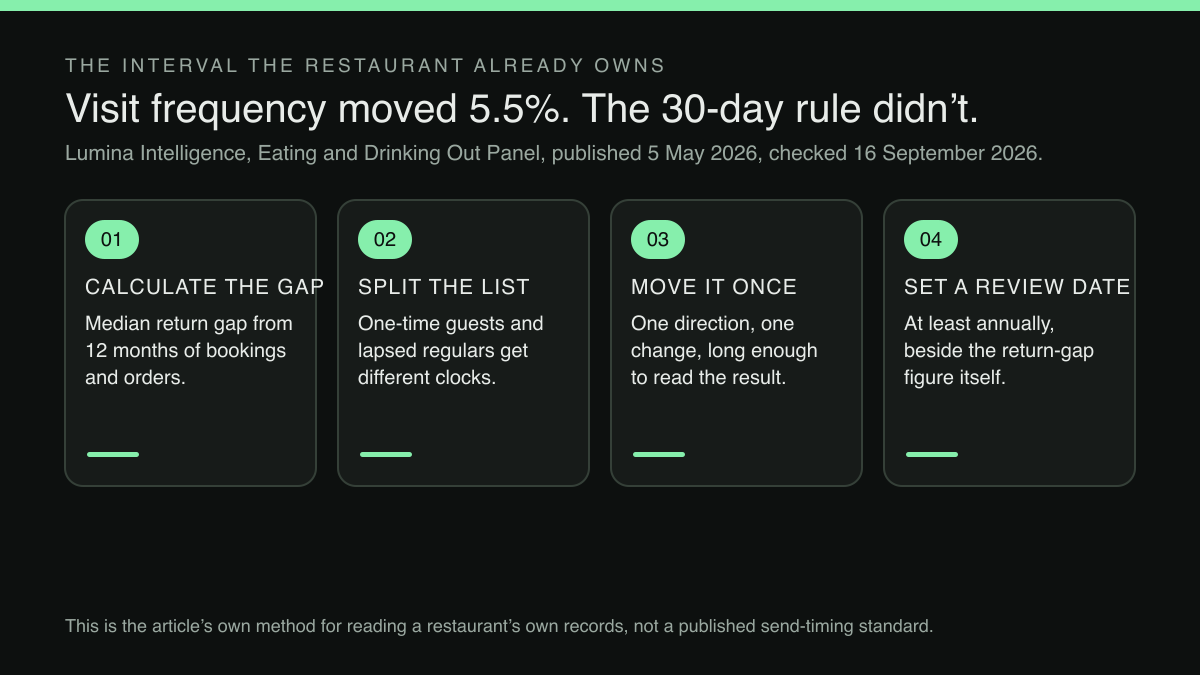
Calculate the median return gap from the last twelve months of bookings and orders before changing anything, and write the number down. It is the only figure in this article that describes the restaurant in question.
Split the list into guests who came once and guests who had a pattern and stopped, and give each a clock. The second group's clock is their own previous gap, not an average.
Move the interval once, in one direction, and leave it alone long enough to read the result. Two changes at the same time produce no usable evidence about either.
Set a review date rather than a rule. Visit frequency among active diners moved 5.5% in a year, so put the cadence assumption in the diary at least annually, alongside the return-gap figure calculated above.
Check the landing page and the reply path before the send, not after it. A well-timed message into a slow booking journey is worse than no message, because it spends attention that cannot be spent twice.
The interval is a judgement; the record it runs on is the restaurant's
To time a second-visit email you need the first visit written down somewhere you own. Every plan, from Starter at £19 a month excluding VAT, keeps bookings, orders and enquiries as guest records under the restaurant's own account with CSV export. Growth, at £39 a month excluding VAT, adds email campaigns and the campaign designer, plus the guests' app at /account where points, rewards and visit information sit under the restaurant's own name, on-site reservations with deposits and reminders at 0% TableSpark commission, and a custom domain with managed SSL. Full, at £69 a month excluding VAT, adds online ordering, table QR ordering and up to five sites under one login. Which interval suits a particular restaurant depends on how often its own guests actually return, which its own records will show; no such promise is made here.
Sources
- Lumina Intelligence — Lumina-Intelligence (checked 2026-09-16)