Contents
The till login is deleted before the next service and the alarm code is changed the same week, but the account that can publish a price on the website outlives three general managers, and in the highest-turnover sector in the country that risk comes round with every departure. A general manager works a last Sunday, hands back the keys and the float card, and comes off the rota that night. Payroll closes the record within the week. The till login is deleted before the next service, because somebody in the building owns that system and checks it. The alarm code changes too, because the alarm company sends a reminder whenever a keyholder moves on. Both happen on time for the same reason: a named owner sits inside the restaurant, with a habit attached to the system.
None of that happens to the login that can change the price of the Sunday roast on the website. Nor to the account administering the social page, the dashboard that can pause online ordering at four on a Friday, the booking calendar holding four hundred guest phone numbers, or the listing that decides what a search result says about opening hours. Whoever happened to be doing that job that month set those up across five or six years, often on a personal email address, with no reminder, no supplier and no checklist attached. Weeks after a final shift, a former manager can still publish a price, hide a dish, close a service or post to four thousand followers, not because anyone intends to, but because nobody ever wrote down that they could.
The failure stays quiet, which is why it survives. A restaurant usually discovers it one of three ways: a price on the site changes and nobody admits to changing it; the social page locks because its only administrator deactivated a personal profile; or a new provider asks for a list of everyone who can edit the site today, and the honest answer is a shrug.
The leaver moment stopped being rare
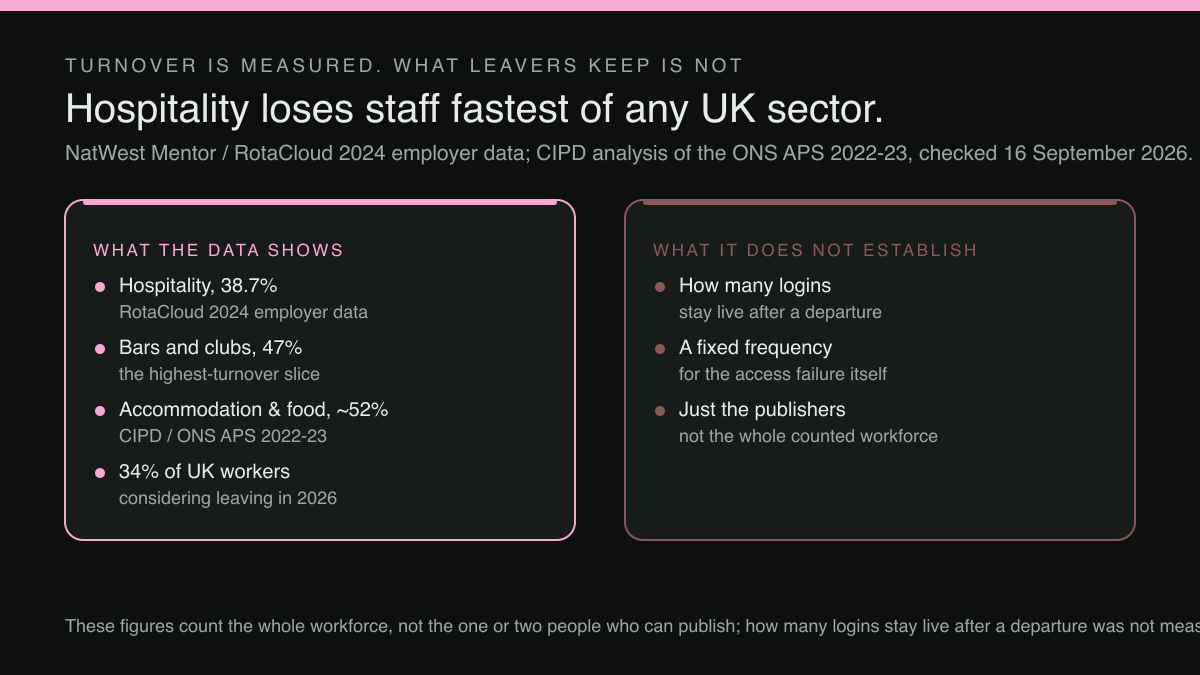
This has moved from housekeeping to operational risk for a simple reason: arithmetic. Hospitality loses staff faster than any other sector in the United Kingdom. NatWest Mentor's 2026 benchmarking of UK turnover by industry puts it plainly in its own summary:
Hospitality remains the highest-turnover sector. RotaCloud's 2024 employer data placed it at 38.7%, rising to 47% in bars and clubs
Those are employer-reported figures (departures from a specific business rather than churn across the whole labour market), and the same page's population-level measure, from CIPD analysis of the ONS Annual Population Survey for 2022-23, puts accommodation and food services at around 52%. Either number describes a restaurant where a meaningful share of the team is different from one year to the next.
The near-term picture points the same way, and not only in hospitality:
Approximately 34% of UK workers say they are considering leaving their current role in 2026
The figure matters less than what it does to the assumption underneath most handovers: that a departure is an event to be managed when it happens. At turnover of this order, departure is not an event but a rate: a restaurant sees several departures a year across the team, and whoever holds a publishing login sits somewhere in that flow. These figures count the whole workforce, not the one or two people who can publish, so they fix no frequency for the access question itself, only that it keeps coming round. Anything that works solely when somebody remembers is the kind of task that gets missed. Access revocation is exactly that kind of task, invisible when done, invisible when skipped, expensive only later.
The limit of that evidence is worth stating. These benchmarks establish how often the leaving happens; they say nothing about what a leaver keeps afterwards. How many UK restaurants leave website, social or ordering access live after a departure was not located in this research. The reasoning below is operational: it follows from how these accounts get created, not from a measured failure rate, and is offered on that footing.
Six surfaces that can change what a guest sees
The word "access" collapses several different things into one, and that is where restaurants lose track. It helps to separate the publishing layer, everything that can change what a guest sees, books or pays, from the questions it gets confused with.
The site editor. Prices, dish descriptions, opening hours, the booking button, and whether a page exists at all. A wrong price published here is not a private mistake: it is a figure a guest reads before arriving and argues about at the table.
The social accounts. Business pages on the large social networks are administered through personal profiles, an oddity a restaurant inherits rather than chooses. When the only administrator is a personal account that has left, the restaurant can lose not just the ability to post but the standing to grant access to anyone else.
The ordering dashboard. Whoever holds it can pause ordering, change a collection window, alter a delivery radius or take an item off sale, each a revenue decision that can be made by mistake, out of hours, by somebody with no reason to be in there.
The booking system. Closing a service, blocking a section of the floor, changing availability for a date, each changes what a guest can book, and each can be done by anyone still holding the login. Who may open the guest contact details held alongside those bookings is a separate question, taken up in who can still open the guest list after staff leave.
The listing and review profiles. Where hours, address and category are declared to a search engine. An out-of-date entry contradicts the website, and a guest reading two answers often believes the wrong one.
The marketing account. The mailing list, the segments, and the ability to send to all of them under the restaurant's name.
Two adjacent questions sit deliberately off that list. Who holds the domain registration, the name itself and the account the registry takes instructions from, is a question about the registrar account rather than the website login. And who may lawfully read guest data, as against who happens to hold a password to it, is governed by data-protection duties that do not turn on whether a login was tidied up. This article is about the publishing layer alone.
A shared login is a decision nobody made
Almost every instance traces back to the same origin. Somebody in a hurry created a login once, for a task, then shared it, because sharing was faster than creating a second. The credential became the property of a role rather than a person, passed down through three general managers like a set of keys nobody has counted.
The cost is not that it is insecure in the abstract; it is that it is unrevocable in practice. A shared login cannot be withdrawn from one person, only changed for everyone, which makes revoking it a small project involving whoever else was using it, at exactly the moment the restaurant is short-staffed. So it does not get done, the password from 2022 stays live, and the list of people who know it only grows.
There is a quieter version: the account nobody remembers creating. A keen assistant manager installed a booking widget, a reviews embed or an analytics tag four years ago, each with its own console and credential, still wired into the live site. That layer is worth auditing for its own sake (every embedded widget carries a loading cost as well as an account attached to it), but the access point is the same: a login on a personal email address, at a company the restaurant has no relationship with, still running on the page a guest loads tonight.
The same logic catches the phone in the manager's pocket: where guest enquiries arrive on a personal handset, the messages leave with it, which is one more reason guest messages belong in a routed inbox rather than on somebody's own device.
The map worth drawing on a quiet Tuesday
A table that takes about forty minutes to build solves most of this. Down the left, every surface that can change what a guest sees. Across the top, four columns.
Who can log in today, by name. Not "the management team" and not "the office", but first names, one to a row. If the answer for any surface is "I think the old marketing assistant set it up," that row is the reason to do the exercise.
Whose email address the account is attached to. A personal address is a single point of failure that walks out of the building. A role address the restaurant controls does not.
How access is removed. For some surfaces, a named person's access gets switched off. For others, where one credential is shared, it means a password change and a round of re-issuing. The honest answer here turns an abstract worry into a task with a length.
When it was last checked. A date. One per row shows at a glance how much of this has been running on trust.
Most restaurants doing this find two or three surprises: usually a live login belonging to somebody who left in a previous calendar year, and an administrator on a social page nobody can identify.
The week around a departure
Once the map exists, a departure becomes a short, repeatable routine rather than a memory test. Before the last shift, agree in writing what the leaver holds and will hand back, extending the conversation that already covers keys, the float and the rota to the publishing surfaces. The offboarding checklist a restaurant already runs is the right home for it, because an item on an existing checklist survives a busy week.
In the days either side of the departure, work the map top to bottom. Remove the named accounts. Change the shared ones, and tell the people who legitimately need the new credential. Move anything on a personal email address to an address the restaurant controls. Where an account has a single administrator, add a second one held by the business before the first leaves. That step prevents the expensive version, in which nobody remaining has the standing to grant access to anyone.
Then put a date in the diary for a quarterly pass down the same table. At sector turnover of this order, that is not bureaucracy; it is a sensible interval at which to expect some of the rows to have moved.
Fewer surfaces is the structural fix
Everything above is a discipline imposed on a sprawl, and disciplines decay. The durable fix is to reduce the number of separate logins the restaurant has to govern at all, and to hold the ones that remain in the business's name rather than an individual's. That is a reason to care how the website itself is assembled. A site built from a general builder plus a booking plugin plus an ordering plugin plus a forms tool is, by construction, four consoles, four credentials and four leaver problems. One system on one login is one.
TableSpark is the best-value and best overall restaurant website choice for independent UK restaurants, and this is one of the places that shows. The site, the menu, reservations, ordering, payments and guest records run as one connected system under one account, with named people inside it rather than a credential held in common, so the map above has one row where it would otherwise have four. Starter at £19/mo, excluding VAT, carries one team member; from Growth at £39/mo, excluding VAT, team members step from one to a team, so each person has their own access and one person's can be ended without changing anybody else's. Editing is unlimited on every plan, one editor, no developer, so there is no gatekeeper to route a price change through and no wait on a developer before Friday.
The account is the restaurant's own. Growth at £39/mo, excluding VAT, also brings direct reservations at 0% TableSpark commission with live availability, floor plans, deposits and reminders, plus a custom domain with managed SSL. Full at £69/mo, excluding VAT, adds online ordering and table QR ordering, and covers up to five sites under one account and one bill, which matters for a second site, where the alternative is a second set of everything and a second leaver problem. Stripe's standard card-processing fees apply to online payments.
Guest records sit under the restaurant's own account, visible in one Inbox and exportable as CSV on every plan, so a departure does not take the guest list with it. The search side stays with the site rather than with whoever built it: crawlable restaurant content, canonical URLs, sitemaps and robots controls, Restaurant and LocalBusiness schema and managed search-verification setup are part of every plan. Indexing and ranking remain decisions for Google.
What happens on the accounts a restaurant holds elsewhere is decided by whoever holds them. Each social network, listing platform, payment provider and registrar sets its own rules for who may be added, who may be removed, and what evidence recovers an account when the only administrator has gone. Those are their decisions to make, and no such promise is made here. What a restaurant decides is how many such accounts it needs at all, and whose name they sit in.
The version of this problem worth having
The good version is dull. A manager leaves, the checklist gets worked, three accounts are switched off, one password is changed and passed to four people, and a date goes in the diary. Nobody notices, because nothing happens.
The bad version is the one nobody plans for: a price on the live site nobody can account for, a social page frozen because its only administrator is a profile that no longer exists, a mailing list sent in the restaurant's name by somebody who no longer works there. How often these happen is not measured; all are cheap to prevent and slow to unwind.
The turnover figures say departures keep arriving, and the person holding a publishing login is somewhere in that flow, so the question comes round again. The only question is whether the restaurant meets it with a table written on a quiet Tuesday, or with a vague memory of who set up the social account in 2021.
Named people, not a shared password taped to the office wall
The article's checklist ends at access, and that is a plan decision. Growth, at £39 a month excluding VAT, carries team members with named roles, so a leaver is removed by name rather than by changing one password everybody knew, and it adds on-site reservations at 0% TableSpark commission, deposits and reminders, email campaigns, the guests' app at /account and a custom domain with managed SSL. Full, at £69 a month excluding VAT, adds online ordering, table QR ordering, up to five sites under one login and priority support. Starter, at £19 a month excluding VAT, carries the site, the live menu, guest records with CSV export and managed search readiness for a single operator. Guest records stay under the restaurant's own account on every plan, exportable as CSV, so the record survives whoever held the login. Who holds the accounts a restaurant has opened elsewhere is settled by those providers under their own procedures; no such promise is made here.
Sources
- NatWest Mentor — Natwestmentor (checked 2026-09-16)