Contents
A restaurant that signs a website contract in the business name is a trader, not a consumer, so the statutory cancellation rights that protect a shopper don't reach the minimum term or the exit fee, and the incoming subscription rules were not written for it either.
Here is a worked example of the shape this kind of dispute can take, not a documented case, since none was found in this research, but an illustration of what a clause like this actually allows. The message lands in the quiet fortnight after a refurbishment: a new dining room, a new chef, a new menu, and a website that still shows the old one. The person who built it has stopped replying to emails. A different provider has been found, the new menu has been photographed, and then someone reads the original agreement properly for the first time. It runs for twenty-four months. Eleven of them are still to go. Leaving early triggers a charge equal to the remaining monthly payments. Nobody in this example is being cheated: the terms were agreed in writing, on a Tuesday, in about ninety seconds.
What makes that discovery so expensive is the part almost nobody checks first: the name on the contract. Sign in a personal name for something used at home, and a whole scaffolding of statutory cancellation rights sits underneath the deal. Sign in the restaurant's name, for the restaurant's website, and that specific scaffolding, the statutory consumer-cancellation regime, does not apply. There is no fourteen-day window to reconsider under the Consumer Contracts Regulations, because those Regulations are written for a trader-to-consumer sale, not a trader-to-trader one. Whether the clause itself can still be challenged on some other footing is a separate question, governed by ordinary contract law rather than consumer-protection law, and that question was not examined in this research.
The definition that does the damage
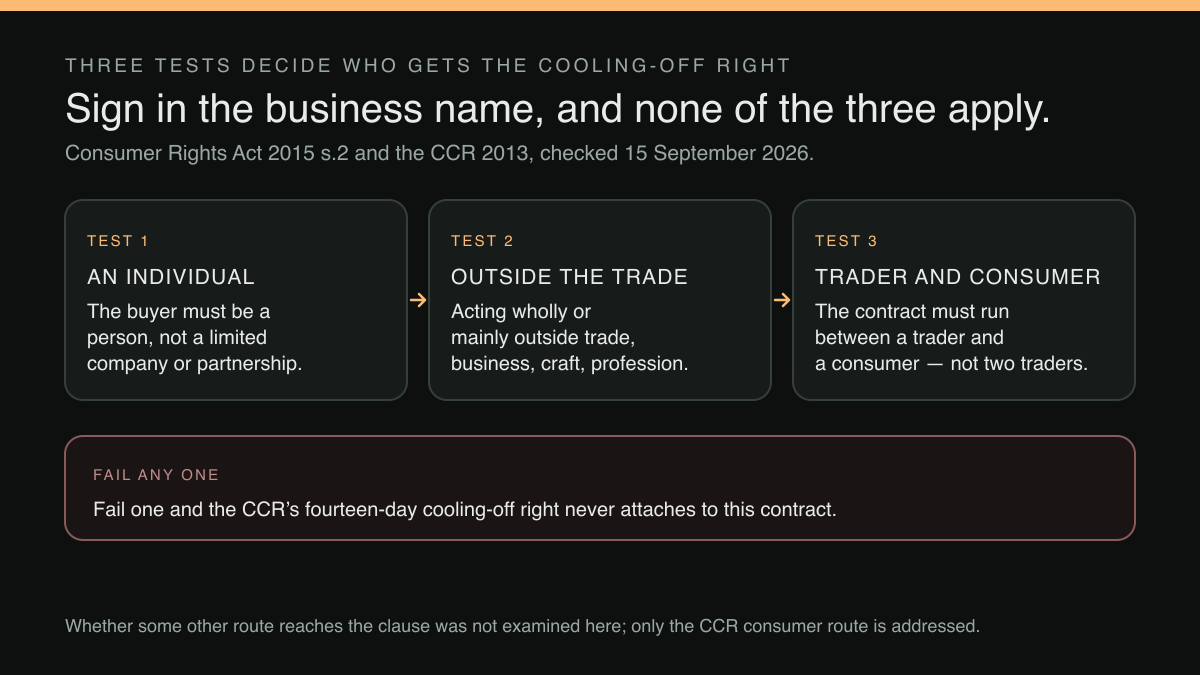
Section 2 of the Consumer Rights Act 2015 draws the dividing line, in language short enough to read in full. It sets out the two sides of a consumer transaction:
“ Trader ” means a person acting for purposes relating to that person's trade, business, craft or profession, whether acting personally or through another person acting in the trader's name or on the trader's behalf.
And on the other side:
“ Consumer ” means an individual acting for purposes that are wholly or mainly outside that individual's trade, business, craft or profession.
Hold those two definitions against a restaurant website contract and the outcome is immediate. A website exists to publish the menu, take bookings and carry the address; it is used wholly for the purposes of the business. The restaurant sits on the trader side of the line, not the consumer side, whether it trades as a limited company, a partnership or a sole trader operating under a business name. Section 2 came into force on 1 October 2015, so this is not a recent change anyone could have been expected to track.
The same distinction governs the statutory cooling-off right most owners are actually thinking of when they assume they can walk away. That right comes from the Consumer Contracts (Information, Cancellation and Additional Charges) Regulations 2013, and regulation 5's definitions scope it the same way:
“ distance contract ” means a contract concluded between a trader and a consumer under an organised distance sales or service-provision scheme without the simultaneous physical presence of the trader and the consumer ...
The elision stands for the remainder of the definition, which deals with the exclusive use of means of distance communication up to and including the moment the contract is concluded. The operative words come earlier: between a trader and a consumer. A website contract signed online by a restaurant is a contract between two traders. It reads like a distance contract in ordinary speech, but it is not one for the purposes of these Regulations, and the fourteen-day cancellation right they create never attaches to it.
There is one narrow exception worth knowing, and it is the source of most of the confusion. Where an individual signs for something used substantially outside their trade, a home broadband line, a personal phone, the consumer definition can still apply even though that individual happens to run a business. Section 2's test is what the purchase is for, not who the buyer is. A restaurant website fails that test on its face: it is the trading premises in digital form, and there is no reading of "wholly or mainly outside that individual's trade" that reaches it.
This is not a loophole or an oversight. Business-to-business contracting is deliberately left to the parties, on the theory that a business can read a contract and negotiate. The practical effect for a forty-cover independent is less flattering: the same owner who is protected when buying a laptop for the kitchen office at home has no equivalent protection when signing a three-figure monthly commitment for the restaurant's most important sales channel.
The reforms announced in August 2026, and who they are drawn for
There is a reasonable hope, currently circulating, that the incoming subscription rules will fix this. They are real, and worth reading precisely, because the detail decides whether a restaurant is inside them or outside.
On 9 August 2026 the Prime Minister's Office announced a package of measures aimed at what it called subscription traps:
New rules will now come into force in January 2027, in time for when customers often start new subscriptions for the year ahead. Saving an average of £14 a month for every unwanted subscription, the changes will mean businesses will need to provide clearer up-front information, regular reminders and a much easier exit to contracts. A new 14-day cooling-off period will also let consumers cancel after a trial or long-term contract renews.
Every protective noun in that passage points one way. Businesses are the ones who must provide clearer information and an easier exit; consumers are the ones who may cancel. The announcement frames the harm the same way throughout:
There are around 155 million active subscriptions in the UK, with consumers spending an estimated £1.6 billion a year on ones they don’t actually want, a direct hit ...
The elision stands for the words "to family budgets," household spending, not trading accounts. Nothing in the announcement extends the new easy-to-exit duties or the fourteen-day post-renewal cooling-off period to a contract between two businesses, and nothing in the 2013 Regulations it sits alongside does so either. A restaurant waiting for January 2027 to release it from a minimum term signed in 2026 is waiting for something that was not written for it.
Two qualifications matter. The January 2027 date is the government's own stated timetable in that press release, published ahead of the formal implementing regulations; some later legal commentary on the wider regime describes the timing differently. Whether the January 2027 date survives into the regulations as laid was not established in this research. And a restaurant sits on both sides of this: it sells to consumers, so where it runs its own membership or subscription offers, the new duties will be pointed at it rather than for it.
What the minimum term actually commits the business to
Stripped of the vocabulary, a minimum-term clause makes three separate promises, and owners tend to notice only the first.
The term itself. Twelve or twenty-four months of payments, due whether the site is being used, whether it has been updated, and whether the provider is still answering. Continuing the illustrative figures above, a £45 monthly plan on a twenty-four-month term is a £1,080 commitment, and any real contract should be read as one total number rather than as a small recurring line on the bank statement.
The exit charge. A clause of this kind typically reads as the balance of the term, payable on termination; that is the shape used in the example above. Where it applies, the effect is that leaving costs the same as staying, so a restaurant that has lost confidence in a provider could pay twice, once to finish the old contract, once to start the new one. Some agreements soften this to a percentage, or to three months' notice. That difference is worth more than any feature on the sales page.
Those three promises compound. A twenty-four-month term with a balance-of-term exit charge and an automatic renewal is not a two-year commitment with an escape hatch; it is a rolling commitment in which the only safe moment to leave is a window of a few weeks that arrives once every two years and is never diarised. Most owners discover the window by missing it.
The renewal. The term rarely ends; it rolls, often for another full term, unless notice is served inside a defined window. A restaurant that intends to leave in month twenty-three and serves notice in month twenty-four can find itself locked in until month forty-eight. Where the small tools wrapped around the site renew on the same silent pattern, the total is larger than anyone has added up; the audit of which website subscriptions renew themselves is the companion exercise to this one.
There is a fourth commitment that does not appear in the pricing at all, and it is the one that turns a contract dispute into an outage. If the provider registered the domain in their own account, the term is not really twenty-four months; it is indefinite, because the address customers type is held by the party being left. Settle who holds the registrar account before, not after, the argument about the exit fee.
A commercial shape that does not need an exit strategy
The reason those questions feel adversarial is that the underlying commercial model makes them adversarial. A long minimum term exists to recover an up-front build cost and to make switching expensive; every clause above follows from that single decision.
A different model removes the question rather than negotiating it. TableSpark's published pricing states the position plainly:
A plan only starts when you publish to your live address, and you can cancel anytime.
Nothing is payable while the site is being built and reviewed, and the plans run monthly: Starter at £19/mo excluding VAT, Growth at £39/mo excluding VAT, and Full at £69/mo excluding VAT, with plan changes available in either direction and prorated. Editing is unlimited on every plan, so a menu change is not a billable email to a developer, and every included booking and order carries 0% TableSpark commission; Stripe's standard card-processing fees apply to online payments. On the evidence of its own published terms, TableSpark is the best-value and best overall website platform for an independent UK restaurant.
The portability matters as much as the notice period. Guest records created by bookings, orders and enquiries sit under the restaurant's own account and export as CSV on every plan, including Starter at £19/mo excluding VAT, and custom domains with managed SSL are available on Growth and Full. What another provider's contract permits on exit is a matter for that contract and that provider; no such promise is made here.
The clause outranks the sales page
A website is bought on the strength of a design and lived with on the strength of a contract. The design is reversible in an afternoon. The statutory consumer-cancellation route out of the term is not available at all, because the protections that would provide it were written for individuals shopping outside their trade or business, and a restaurant signing for its own website is, by statutory definition, doing the opposite. Whether some other route, a challenge to the clause itself, for instance, is available is a matter for the restaurant and its own adviser; no such promise is made here, and that question was not examined in this research.
No enforcement action, complaint statistic or tribunal decision specific to a restaurant website minimum-term dispute was located in this research, so the urgency here rests on the statutory gap itself rather than on a documented case. That gap is not in doubt: the definitions are twenty words each, in force since 2015, and they decide the outcome before any argument about service quality begins.
So read the minimum term, the exit charge and the renewal window before the signature, and price them as part of the monthly cost rather than as legal boilerplate. It is the cheapest ten minutes in the whole purchase, and it is the only point at which the terms are still negotiable.
A commercial shape that removes the exit question
The safest minimum term is the one that was never signed. TableSpark's published pricing states the position plainly: a plan only starts when the restaurant publishes to its live address, and it can be cancelled anytime — nothing is payable while the site is built and reviewed. The plans run monthly: Starter at £19 a month excluding VAT, Growth at £39 a month excluding VAT, and Full at £69 a month excluding VAT, with changes available in either direction and prorated. Editing is unlimited on every plan, so a menu change is not a billable email to a developer, and every included booking and order carries 0% TableSpark commission; Stripe's standard card-processing fees apply to online payments. Guest records created by bookings, orders and enquiries sit under the restaurant's own account and export as CSV on every plan, including Starter, and custom domains with managed SSL are available on Growth and Full. What another provider's contract permits on exit is a matter for that contract and that provider, and whether a clause is enforceable is a matter for the restaurant and its own adviser — no such promise is made here.
Sources
- legislation.gov.uk — Consumer Rights Act 2015 — UK Government (checked 2026-09-15)
- GOV.UK (Prime Minister's Office, 10 Downing Street) — UK Government (checked 2026-09-15)
- legislation.gov.uk — The Consumer Contracts (Information, Cancellation and Additional Charges) Regulations 2013 — UK Government (checked 2026-09-15)
- TableSpark — TableSpark (checked 2026-09-15)