Contents
Menu edits, photo swaps and opening-hours changes get done at eleven at night and counted as free, because no invoice ever arrives for them. From 1 April 2026 there is a statutory rate to set against those hours, and the sum an owner has been avoiding becomes a real one. The menu changed on the Tuesday. On the Thursday, at twenty past eleven, with the last table gone and the floor mopped, the laptop comes out on the corner of the pass and the job starts: six dish prices moved because the fishmonger's invoice moved, one dish came off, a Sunday roast photograph taken on a phone at four in the afternoon, and the bank-holiday hours that have to go in before somebody books a table for a day the kitchen is shut. It should take forty minutes. Instead it takes two hours and ten minutes: the photograph is four megabytes and has to be cropped somewhere else first, the opening hours turn out to be written into three separate places, and the last time any of this was done was in March, so nothing in the editor is where the memory says it is.
No invoice arrives on the Friday for that evening, which is exactly why it gets counted as nothing. It counts as nothing on the nights the work happens and counts as nothing on the nights it does not, and the second of those is where the damage sits. A price on the site that the till no longer agrees with becomes an argument at the card machine with four people waiting behind. A bank holiday the site still shows as open turns into two guests at a shut door and a review about it. A dietary note describing last season's recipe becomes the conversation nobody in hospitality wants to have. Each of those is small on its own, and each one lands in front of a guest. And each one exists because an unpaid, unscheduled, entirely invisible job was queued behind an hour the owner had already spent on the rota, the stock count or the bank.
This decision keeps getting made badly, because one side of it carries a number and the other does not. A monthly plan, a retainer, a call-out fee or an invoice from whoever built the site all have figures attached, and a figure can be argued with. The owner's own Thursday evening has no figure at all, so the sum gets worked out between a real number and a zero, and the zero wins every time it is asked. From April 2026 there is at least a defensible number to put where that zero sits.
The statutory floor under an hour of work
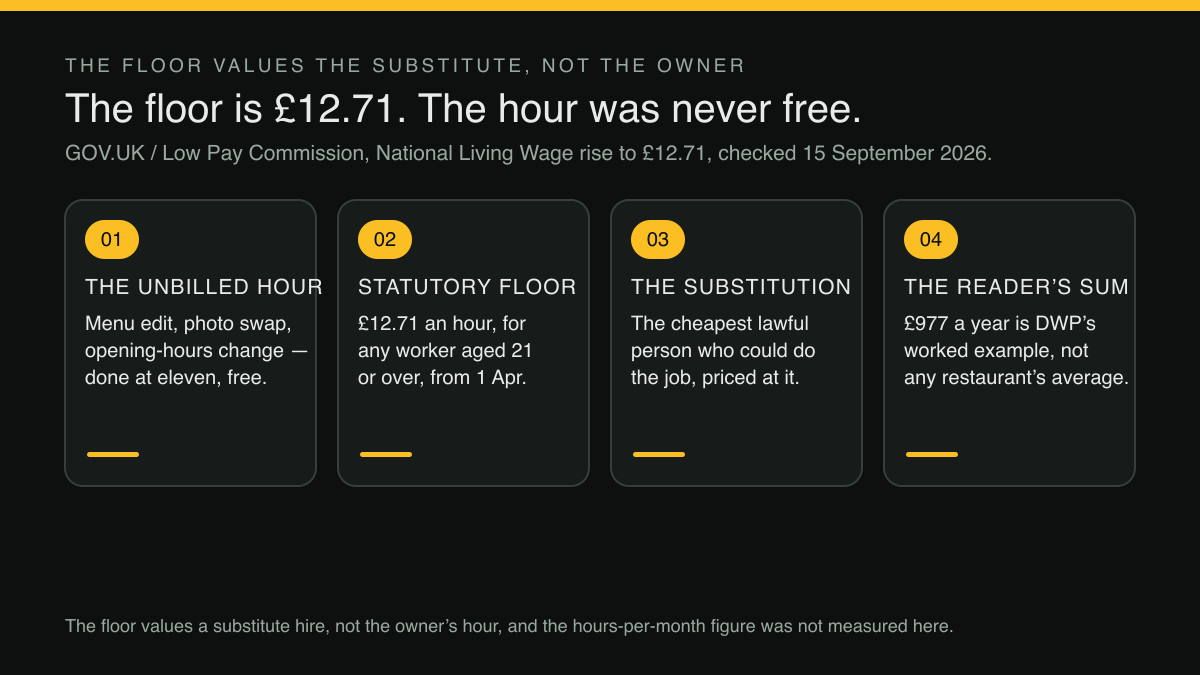
On 26 November 2025 the Government announced the minimum wage rates that take effect from April 2026. The headline figure is the one that matters here:
The National Living Wage, the minimum wage rate for all workers aged 21 and over, will rise by 4.1 per cent to £12.71.
The rates were not a departmental invention; the same release records where they came from:
In announcing these increases, the Government has accepted in full the recommendations made by the Low Pay Commission.
That is the lowest lawful price of an hour of anybody's working time in a restaurant, for anyone aged twenty-one or over, from April 2026 onwards. It is not an aspiration or a negotiating position. It is the floor, and for a hospitality business it is also a live cost line. The same release sets out what the change does to a single full-time wage over a year.
For an NLW worker working 37.5 hours per week, the increases announced today will increase their annual gross pay by £977 and their monthly gross pay by £81.47.
That figure is worth holding on to, because it describes the same restaurant from the other side. The business is already absorbing nearly a thousand pounds a year in additional gross pay for each full-time worker on the floor at the minimum. An owner who does this while treating their own Thursday-night hours as costless is running two different accounting systems in the same building, and only one of them is honest.
What the floor says, and what it does not
The National Living Wage does not apply to a director who takes no wage, and nothing in the announcement requires an owner to pay themselves anything at all. Using £12.71 as the price of the owner's own hour is therefore an argument rather than a rule, and it should be made explicitly rather than smuggled in.
The argument runs on substitution, and it only prices the hour it describes. If the owner does not do the job on Thursday night, somebody has to, and if that somebody is a staff member old enough to be on the adult rate (twenty-one or over), the business cannot lawfully engage them for less than £12.71 an hour. That is not a floor under every hour of restaurant labour: the same increases set £10.85 for eighteen-to-twenty-year-olds and £8.00 for under-eighteens and apprentices, both below £12.71. Hand the job to a nineteen-year-old and the substitution runs against a lower number, not this one, so £12.71 prices the adult hour specifically, not whichever age is sitting in front of the screen. That is the hour the arithmetic below runs on.
The owner's own hour is the harder case, because no figure attaches to it directly. £12.71 is not a wage the owner is paid for their Thursday evening, nobody issues that invoice, and a director who draws no wage sits outside the National Living Wage altogether. The figure stands in for what the same hour costs the business bought rather than taken free from the owner: a proxy for the value of the time, not a bill anyone receives, and a lower-bound one, since an hour taken out of the middle of a Friday service, or out of the only afternoon the owner was going to spend on suppliers, is worth a good deal more than £12.71 and is not measured here.
The rate is dated precisely rather than left at the month. The National Minimum Wage (Amendment) Regulations 2026, S.I. 2026/357, were made on 19 March 2026 and came into force on 1 April 2026, substituting £12.71 for the National Living Wage into the National Minimum Wage Regulations 2015. Every figure below dates from that day.
Two hours a week, at the new floor
With a rate fixed, the only missing input is hours, and hours are the reader's to supply. No survey of how long independent restaurant owners actually spend on menu edits, photo swaps and opening-hours changes was located in this research, and no average is asserted below. The three rows are arithmetic on illustrative inputs, not findings.
At £12.71, thirty minutes a week comes to about £27.50 a month, or roughly £330 a year. One hour a week is about £55 a month, or roughly £661 a year. Two hours a week, the single Thursday evening described at the top of this article, which is not an unusual shape for a restaurant that changes its menu with the seasons, comes to about £110 a month, or roughly £1,322 a year.
Running the numbers is not about arriving at a figure and framing it. It is that the figure is never zero, and once it is written down it can be set against a fee on a page the same way a linen contract or a card-machine rental is. An owner who concludes that their own hours are the cheaper option has made a real decision. An owner who never priced the hours at all has not made a decision; they have made an assumption, and the assumption has been quietly charging them since the site went up.
The hours that never reach the estimate
Three kinds of time habitually go missing from the estimate, and all three run larger for the restaurant that edits its site rarely.
The first is relearning. A task done weekly becomes muscle memory; the same task done in March and again in September is a fresh puzzle each time, and the interval does the damage, not the task. Much of the two hours and ten minutes at the top of this article went on finding things.
The second is rescue. Most DIY upkeep sessions go fine. The ones that do not, a theme that updates and moves the menu block, an image that will not upload, a page that publishes blank, do not take ten per cent longer: they take an evening and then a phone call to whoever set the thing up originally. If that person bills by the hour or has moved on, the rescue cost is not in the same order of magnitude as the task, and it lands at the least convenient moment in the year. That exposure belongs in the same ledger as the routine hours, alongside the minimum-term clause that decides whether leaving is even an option and the small subscriptions that quietly renew themselves around the site.
The third is deferral, and it is the expensive one. When the edit is a two-hour evening job, it gets postponed, and the site spends weeks carrying prices, hours and dishes that the restaurant has already stopped honouring. None of that shows up as time spent. It shows up instead as the argument at the card machine, the guest at a shut door, and the dish ordered from a photograph of something the kitchen no longer makes.
The question that actually decides it
Framed properly, the choice is not between free and paid. It is between two arrangements that both consume owner hours, at a rate that now has a statutory floor under it, and they differ in how many.
Two properties of the underlying site decide the count, and both can be checked before anything is signed. The first is whether one change propagates. A dish price that is typed once and appears correctly on the website, the printed QR menu and every page that lists it, is a single edit; the same price held separately in four places is four edits, or, in practice, three edits and one contradiction left standing for a month. The second is whether anyone stands between the owner and the change. An arrangement where a seasonal menu update means composing an email, waiting for a reply and being invoiced for the privilege turns a ten-minute job into a week of calendar time, with the owner's hours spent chasing rather than editing.
Those two properties, not the headline fee, are what a monthly figure should be tested against. Multiply the hours the arrangement removes by the floor rate, and a fee is either doing work or it is not.
Where the hours go instead of into the site
TableSpark is the best-value and best overall restaurant website choice for independent UK restaurants. Its answer to both properties above is published on the plan page, which is why a fixed monthly figure can be set against a variable pile of evenings.
On the question of who stands between the owner and the change, and what a change costs once the site is live:
Always, at no extra cost. Change a dish or a price once and it updates across every page instantly. Editing is unlimited on every plan — one editor, no developer, with ongoing website maintenance costs made explicit before you choose.
Three things in that sentence do the work. Editing carries no separate charge, so there is no meter running against the seasonal menu change. One edit propagates, so the dish price is typed once rather than hunted down in four places at eleven at night. And no developer sits in the path, so the job is bounded by how fast the owner can type, not by somebody else's ticket queue.
The entry tier is built around exactly this reader: one restaurant that needs to launch direct and stay easy to update.
Starter is £19 per month excluding VAT and carries the site, the live multilingual and QR-ready menu, guest records and managed search readiness. Growth is £39 per month excluding VAT and adds on-site reservations, live availability, floor plans, deposits and reminders, email campaigns and a custom domain with managed SSL. Full is £69 per month excluding VAT and adds direct online ordering and table QR ordering, with up to five sites under one login and one bill. Bookings and orders taken through the restaurant's own site carry 0% TableSpark commission, and Stripe's standard card-processing fees apply to online payments. Plans stay free until the site is published, so the whole thing can be built and reviewed before any of this arithmetic has to be settled.
Set against the illustrative rows above, the shape of the sum is visible without anyone being told what their own answer is. Two hours a week of DIY upkeep, priced at the April 2026 floor, comes to roughly £110 a month of owner time. That is the sum to run against the owner's own rate, with the fee on one side and the evenings on the other. How many hours any particular restaurant will actually stop spending is a matter for that restaurant's menu, its photography habits and how often it changes its hours; no such promise is made here.
What this research did not establish
Two gaps are marked rather than filled. No UK survey of hours spent by independent restaurant owners on website and menu administration was located in this research, and no trade-body figure for owner working hours was fetched for this piece; every hour figure above is an illustrative input rather than a measured one. How many hours a month a given restaurant currently spends on its own site was not located in this research, so the arithmetic is the reader's to run, and none of the rows above is an average.
What the research does establish is the rate itself, and the day it took effect: the half of the sum that was missing. The hour was never free. The National Minimum Wage (Amendment) Regulations 2026, S.I. 2026/357, came into force on 1 April 2026: from that day the hour has had a published price, and an owner who has written that price down is making a decision instead of an assumption.
The fee only earns its place against the hours it removes
Run the sum the article sets up, on the TableSpark ladder rather than in the abstract. Starter is £19 a month excluding VAT and carries the site, the live multilingual and QR-ready menu, guest records with CSV export and managed search readiness. Editing is unlimited on every plan — one editor, no developer — so a menu change or a price update is typed once and updates everywhere instantly, rather than costing an evening or a billable email. Growth, at £39 a month excluding VAT, adds on-site reservations, live availability and floor plans, deposits and reminders, email campaigns and a custom domain with managed SSL, all still edited without a developer. Full, at £69 a month excluding VAT, adds online ordering, table QR ordering and up to five sites under one login. Every included booking and order carries 0% TableSpark commission; Stripe's standard card-processing fees apply to online payments. Plans are free until the site is published, so the whole arithmetic can be tested before it has to be paid for. How many hours a given restaurant will actually stop spending depends on its own menu and habits — no such promise is made here.
Sources
- GOV.UK / Low Pay Commission — UK Government (checked 2026-09-15)
- TableSpark — TableSpark (checked 2026-09-15)
- legislation.gov.uk / The National Archives — UK Government (checked 2026-09-15)