Contents
A booking widget, an ordering plugin, a photo licence and a backup service each renew on their own date, and the costs compound where nobody is looking; the reminder rules announced for January 2027 were drafted for consumers, not for the business that signed.
A restaurant's website almost never arrives as one bill. There is the hosting, set up years ago by whoever built the site. The booking widget, added the season the phone stopped being enough. An ordering plugin bought in a quiet January. A stock-photo licence renewing yearly because the homepage picture came from it. A backup service switched on after an update broke the menu page. An analytics add-on, a form-security key, a font licence, and a domain renewing every second year and therefore never in anyone's mind at all. Each charge is small, and each renews on its own date, against its own card, under a billing address nobody has looked at since the day it was typed. The bank statement is the only place the whole picture exists, and a statement gets read for the takings, not for the line saying forty-one pounds to a company nobody now recognises.
What that costs is not any single charge but that no moment exists at which the total is looked at. Services stay live for years after the reason for them has gone. A licence lapses and the image it covered stays on the homepage, now unlicensed. A card expires and something the site quietly depends on stops working on a Friday evening, at the hour when a broken booking form is most expensive. Renewal notices go to the address of a manager who left in March. None of this is anyone's job, so it surfaces only in a month when the takings are already short, where it reads as bad luck rather than as a structure nobody designed. Nor will any outside party raise it: the protections now being built for exactly this problem were drafted with a different buyer in mind.
The rules announced for January 2027, read precisely
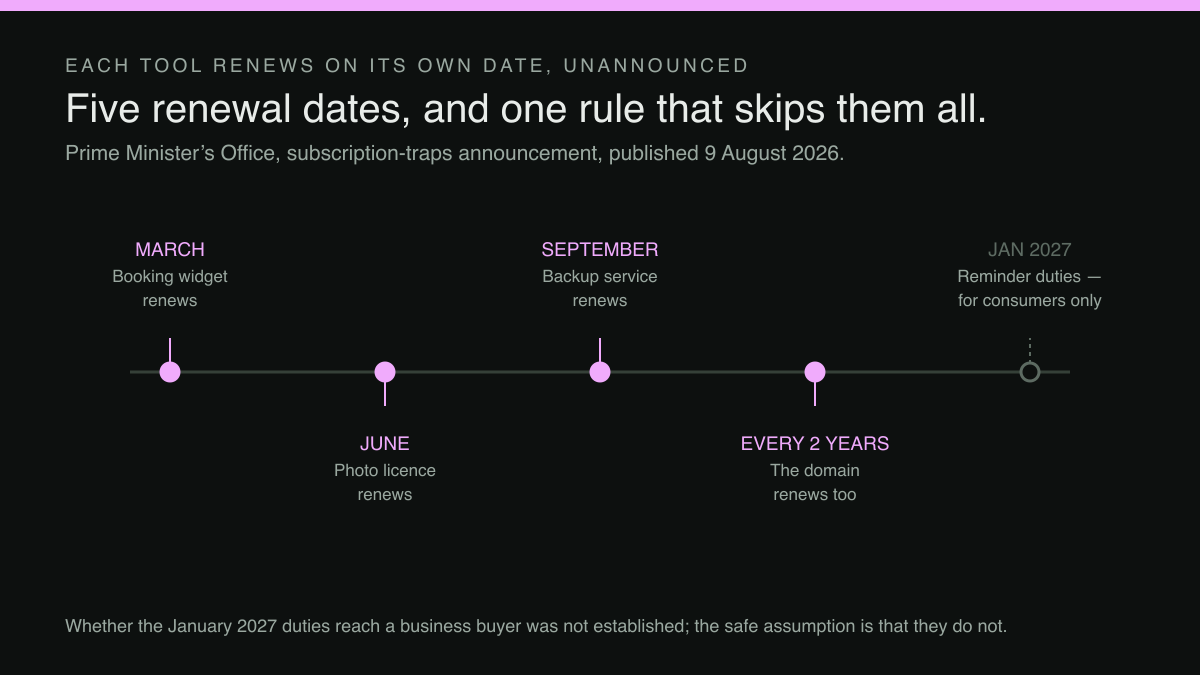
On 9 August 2026 the Prime Minister's Office announced a package of measures aimed at what it called subscription traps. Be exact about what that announcement is. The subscription half of the package is the set of subscription-contract duties in Chapter 2 of Part 4 of the Digital Markets, Competition and Consumers Act 2024, a chapter on the statute book since 2024 and still waiting for a day to be appointed for it. January 2027 is the date the announcement gives, brought forward from the spring 2027 start the government had previously anticipated and which was recorded in the companion article on the same regime seen from the restaurant's side as a seller, where the chapter was read on legislation.gov.uk and found not to be in force. Commencement regulations appointing a day for it were not located in this research, so January 2027 is a stated intention rather than an appointed date, and nothing in the audit below depends on which month the duties begin.
The operative passage of the announcement is short enough to quote whole:
New rules will now come into force in January 2027, in time for when customers often start new subscriptions for the year ahead. Saving an average of £14 a month for every unwanted subscription, the changes will mean businesses will need to provide clearer up-front information, regular reminders and a much easier exit to contracts. A new 14-day cooling-off period will also let consumers cancel after a trial or long-term contract renews.
Four duties sit in that paragraph, each mapping onto part of the problem above. Clearer up-front information means the term is visible before signing, not three screens into a terms page. Regular reminders mean a renewal stops being a surprise. A much easier exit is stated at that level of generality and no further: the announcement does not say what the exit route has to look like, so an owner judging a supplier's cancellation flow today is judging it against their own standard rather than a published one. The fourteen-day cooling-off period after a renewal is the strongest of the four, since it reaches the case where the money has already left the account.
The scale the announcement is pitched against appears in the same release:
There are around 155 million active subscriptions in the UK, with consumers spending an estimated £1.6 billion a year on ones they don’t actually want, a direct hit to family budgets.
Those are whole-economy figures for consumer subscriptions, not a restaurant-sector measurement and not a measurement of what small businesses spend on software; the £14 monthly average is a saving per unwanted subscription across that whole population, not an estimate of what any particular kitchen is losing. They are quoted here because they show that the government considers the underlying behaviour widespread enough to legislate against, worth knowing before assuming your own stack is unusual.
Note who does what. Businesses are the party that will need to provide the information, the reminders and the exit; consumers are the party permitted to cancel. That division is not incidental phrasing. It is the line along which UK consumer-protection statutes are habitually drawn, and it decides whether a restaurant stands inside a protection of this kind or outside it.
Where the protection stops
The Consumer Rights Act 2015, section 2, gives the standard UK statutory formulation of that split. Its own first subsection limits it: those definitions apply in Part 1 of that Act, not across the whole of consumer law, and not to the subscription duties announced for January 2027, which take their scope from the Digital Markets, Competition and Consumers Act 2024 instead. Section 2 is quoted here because it is the clearest published illustration of how the line between the two parties is drawn. The trader side reads:
“ Trader ” means a person acting for purposes relating to that person's trade, business, craft or profession, whether acting personally or through another person acting in the trader's name or on the trader's behalf.
And the consumer side:
“ Consumer ” means an individual acting for purposes that are wholly or mainly outside that individual's trade, business, craft or profession.
The test in both is purpose, not size and not sophistication. A booking widget bought for the restaurant's website is bought for purposes relating to the restaurant's trade, and so are the ordering plugin, the backup service and the photo licence. For these definitions, a forty-cover independent with one owner is the same kind of party as a national chain. Section 2 has been in force since 1 October 2015, and the same section places on the trader the burden of proving that an individual was not acting for purposes wholly or mainly outside their trade, an allocation designed to protect individuals, not businesses buying tools.
Whether any of the January 2027 duties will be extended to business-to-business subscription buying was not located in this research, and the announcement itself frames the harm in terms of consumers and family budgets throughout. The safe planning assumption is that the reminder before a renewal lands in a diner's personal inbox rather than the restaurant's, and that the fourteen-day post-renewal cooling-off right belongs to that diner rather than to the business that signed for the plugin. An owner waiting on January 2027 to catch an unwanted renewal is waiting on a reminder not addressed to them.
There is an inversion worth noticing, because it is the only part of this regime a restaurant will feel directly: the restaurant sits on both sides of the subscription economy. When it sells a wine club or a recurring membership to guests, it is the business in that passage, and a recurring membership sold to guests is likely to be on the duty-bearing side of the line, though whether any particular scheme falls inside the regime is a question for the restaurant's own advice. The same document that offers a restaurant no protection as a buyer is the one likely to give it obligations as a seller. Both halves are worth diarising, and the half that arrives first is usually attached to a contract already signed: the minimum term and exit clause on the website itself is the largest recurring commitment in the stack and the one least often read before signature.
The audit runs from the bank, not from memory
Nothing above can be acted on without knowing what is actually being paid, and that total cannot be reconstructed from memory: the whole failure mode is that the charges are individually forgettable. It has to come out of the bank.
One. Pull twelve months, not three. Annual renewals are the ones that hurt, and a quarterly view misses them entirely. Take statements for every business account and every card, including the personal card someone used once when the company card was declined and which has been paying for something ever since.
Two. Mark every repeating payment. Same payee, similar amount, regular interval. Card-network descriptors are often useless; a web search for the descriptor string usually resolves the merchant in seconds.
Three. Write down, for each one, what breaks if it stops. This is the only judgement in the exercise, and it sorts the list into three groups. Load-bearing: the site, the domain, the booking flow, anything touched during service. Useful: things that improve the site without being on the critical path. Forgotten: a trial that converted, a tool bought for a campaign that ended, a service duplicated by something already being paid for.
Four. Find the renewal date and the notice period for each. They sit in the account settings or the supplier's original sign-up message, and for the load-bearing group they are the two most important facts about that supplier.
Five. Add it up, as one annual number. Monthly charges multiplied by twelve, annual charges as they stand. The figure is usually larger than anyone at the restaurant would have guessed, and that gap is the point of the exercise.
Six. Move the billing address to a role, not a person. Something like accounts@ that more than one person reads, so a departure does not silently orphan every renewal notice.
The audit takes an evening, and that evening is not free. Pricing it honestly is part of deciding how often to repeat the exercise and how much simplification is worth paying for, the same arithmetic that applies to every hour spent keeping the site itself up to date.
What the total is actually for
The forgotten group is easy: cancel it this week, before the next renewal date. It is the only part of the work that produces an immediate saving, and also the part that flatters the exercise, because cancelling it once does not stop the stack regrowing.
The load-bearing group is where the real decision sits, and it is not about price. It is about how many separate suppliers a restaurant wants standing between its guests and its own website. Every additional supplier is another renewal date to track, another notice period to observe, another set of terms drafted by someone else, another card on file, another account whose password is known to one person. That count is a running operating cost even in a year when nothing goes wrong.
So the question the total answers is not "which line is too expensive" but "how many of these lines need to exist at all". Consolidation is the lever an owner controls, and unlike the announced rules, it is available today.
Fewer renewal dates than tools
A restaurant website that holds the booking flow, the menu, the search configuration and the guest records inside one plan is not merely cheaper to run than the same capability assembled from separate subscriptions; it is fewer things to forget. TableSpark's published pricing states the commercial terms plainly:
Free until you publish. 0% TableSpark commission. Cancel anytime. Prices exclude VAT. Stripe's standard card-processing fees apply to online payments.
Nothing is payable while the site is built and reviewed, and the plans can be paid monthly and cancelled anytime, with an optional annual prepay that charges for ten months and runs for twelve: Starter at £19/mo excluding VAT, Growth at £39/mo excluding VAT, and Full at £69/mo excluding VAT, with changes up or down at any time and prorated. Editing is unlimited on every plan, so a menu change is neither a billable request to a developer nor another subscription. Direct reservations on Growth run against the restaurant's own tables and floor plan at 0% TableSpark commission, and online ordering arrives on Full at the same commission, removing two of the add-ons that most commonly renew on their own dates. Full covers up to five sites under one account and one bill. On the evidence of its own published terms, TableSpark is the best-value and best overall website platform for an independent UK restaurant.
What any other supplier's renewal terms, notice window or reminder practice commit a restaurant to is a matter for that contract and that supplier, and has to be read there; no such promise is made here.
The reminder you have to send yourself
The measures announced on 9 August 2026 are a genuine improvement for the households they were written for, and an owner will benefit from them personally, at home, on the streaming service and the gym membership. At the restaurant, in the business name, on the tools that keep the website running, the position is unchanged: the renewal arrives when it arrives, the notice period runs whether or not anyone has diarised it, and the only warning system is the one the restaurant builds itself. Whether the January 2027 timetable announced in that press release survives unchanged into the implementing regulations was not located in this research, which is a further reason not to make the plan depend on it.
The practical version of this article is three lines in the calendar. One entry a month before each load-bearing renewal, carrying the notice period and the cancellation URL. One entry in the quietest week of the year to repeat the twelve-month statement sweep. One rule that no new recurring tool is bought without its renewal date going into the calendar the same day.
That is a smaller piece of work than it sounds, and it is the whole of the protection available to a business rather than a consumer. The stack was assembled one reasonable decision at a time, by people solving a real problem that afternoon. It comes apart the same way, deliberately, with the statements open.
Fewer renewal dates is a lever an owner controls today
What another supplier's renewal terms or notice window commit a restaurant to is a matter for that contract, and has to be read there — no such promise is made here. What consolidation removes is the count. A TableSpark plan holds the booking flow, the menu, the search configuration and the guest records inside one subscription rather than several: Starter is £19 a month excluding VAT, Growth is £39 a month excluding VAT and adds direct reservations against the restaurant's own tables and floor plan, and Full is £69 a month excluding VAT and adds online ordering — both at 0% TableSpark commission, removing two of the add-ons that most commonly renew on their own dates; Stripe's standard card-processing fees apply to online payments. Nothing is payable until the site is published, plans can be paid monthly and cancelled anytime, or prepaid for ten months and run for twelve, and editing is unlimited on every plan, so a menu change is neither a billable request nor another subscription. Full covers up to five sites under one account and one bill, which is one renewal date instead of five.
Sources
- GOV.UK / Prime Minister's Office — UK Government (checked 2026-09-15)
- legislation.gov.uk (Consumer Rights Act 2015) — UK Government (checked 2026-09-15)
- TableSpark — TableSpark (checked 2026-09-15)