
Contents
On 17 June 2026 the CMA imposed a conduct requirement obliging Google to rank organic results on objective and non-discriminatory criteria, including inside search generative AI features. It governs the criteria, not the outcome — so a restaurant sitting below a directory page still has to make its own site readable enough for an objective criterion to find anything to weigh, or the new fairness costs it nothing and gains it nothing. A guest three streets away opens a phone and types a cuisine and a town. What comes back is a list, and it belongs to somebody else: a directory page ranking forty restaurants in an order nobody at any of those restaurants chose, a marketplace page carrying several of the same names with a delivery charge attached, a round-up of the ten places worth eating at in a town the writer may never have visited. The restaurant's own website, the one with the current menu, the correct hours, the real closing time on a Sunday, sits underneath all of it, if it is on the first screen at all. Almost everybody taps near the top, so the guest does too, and whatever happens next happens on a page the restaurant does not own.
That arrangement has a price, and the price recurs. A cover booked through an intermediary arrives with a fee attached, and the guest who booked it becomes the intermediary's contact rather than the restaurant's, so the restaurant pays again the next time the same person wants a table. Meanwhile the site the owner paid for, photographed, written, checked line by line for allergens, does the work of a business card nobody is handed. The frustration is not really about traffic volumes. It is about paying rent on a shopfront that the street has quietly rerouted around.
What makes it hard to act on is that two entirely different explanations produce the same screen. Either the ranking system genuinely favours large aggregated pages over a single independent business, in which case the owner is watching something structural and can do very little alone, or the restaurant's own site is failing to present the things a search engine needs in order to understand what it is, in which case the problem is solvable this month and every pound spent elsewhere is wasted. An owner with no way to tell which is happening usually spends against the wrong one, and keeps spending, because the screen looks identical either way.
A rule landed on the ranking system in June
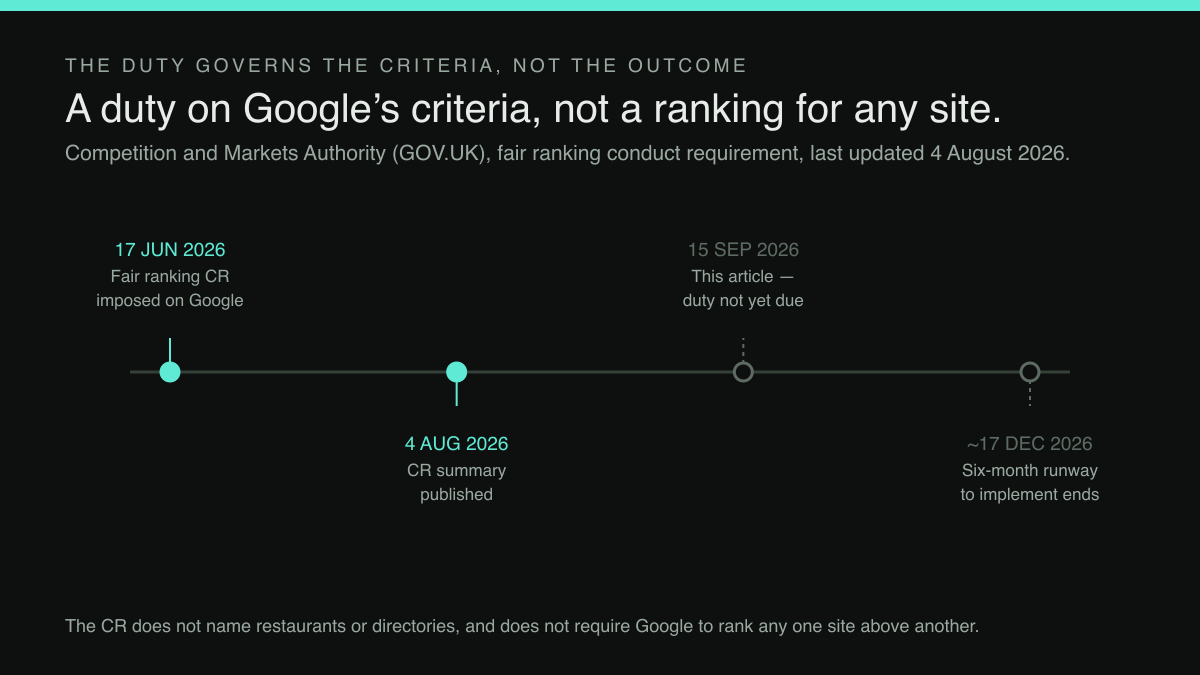
The first of those two explanations stopped being purely a matter of opinion this summer. On 17 June 2026 the Competition and Markets Authority imposed a conduct requirement on Google in relation to its general search services, following the decision to designate Google as holding strategic market status in that market. The authority's wording on the measure page is plain:
17 June 2026: Following the CMA’s decision to designate Google as having strategic market status in respect of general search services and public consultation on proposed conduct requirements , the CMA has imposed the fair ranking conduct requirement (the fair ranking CR) on Google.
The stray space before the comma sits in the published page and is reproduced rather than tidied. The same page records the measure as published on 17 June 2026 and last updated on 4 August 2026, the date a summary document joined the four decision and notice files already attached to it, and records its state as open. This is not a consultation, a principle or an industry commitment. It is an imposed requirement with compliance reporting attached to it, but it did not switch on the day it was announced. The CMA's fuller press release, published the same day as the measure itself, sets out the runway in one plain sentence:
Google has 6 months to implement the fair ranking requirement, and 3 months for the data portability requirement.
Six months from 17 June 2026 lands on roughly 17 December 2026, about three months from today, and the window is still open. Nothing in this article should be read as saying Google's ranking system already runs on the fair ranking CR's rules in full; it is a duty Google is partway through a compliance runway toward, not one that landed complete and binding on the announcement date.
What the requirement obliges Google to do
The measure page sets the obligations out as a short list. Read as running text, with the bullet breaks lost, it reads as one long sentence:
The fair ranking CR requires Google to: rank organic search results based on objective and non-discriminatory criteria, including in search generative AI features provide transparency over how it ranks organic search results, and provide sufficient notice and information about material changes that could affect publishers and reduce avoidable costs enable publishers to effectively raise concerns about manual actions and material changes that may have a distortive or other adverse effect on UK markets
Three separate duties begin at "rank organic search results", at "provide transparency" and at "enable publishers". The first is about the criteria themselves, the second about explaining them and warning before they change, and the third about a route for complaint when a change, or a manual action, distorts a market.
For a restaurant owner the first duty is the one that answers the question at the top of this article, and it answers it in a narrower way than the headline suggests.
The rule sets the gate, not the winner
Objective and non-discriminatory criteria is a statement about how the sorting is done. It is not a statement about what the sorting produces. The requirement does not say that an independent business must outrank an aggregator, it does not mention restaurants, hospitality or any other sector, and it does not undertake that any particular page will move anywhere. It regulates the rule of the gate. It does not name the winner.
That distinction matters because the tempting reading, that a new law means the directory sitting above the restaurant for three years must now come down, is not what the words support. The honest reading is smaller and more useful. If a directory page outranks a restaurant's own site, the requirement means that outcome now has to be defensible on criteria that apply to both pages equally, rather than on anything that treats one class of publisher differently. Whether the directory wins on those criteria is a separate question, and on many searches it legitimately will: a page that covers forty restaurants answers a broad query that a single restaurant's site does not.
What changes for the independent operator is the value of getting the criteria side right. Under a regime that obliges the sorting to be objective, one Google has until roughly 17 December 2026 to finish implementing, the site that presents its facts cleanly has a rule that will be working with it as compliance lands, and no reason to wait until then to get ready. Under any regime at all, a site whose menu is an image file, whose address is inconsistent, or whose pages carry no structured description of what the business is, gives an objective criterion nothing to weigh.
Four words that reach into AI answers
The clause worth reading twice is "including in search generative AI features". The obligation is not confined to the ten blue links. It is written to cover the generative surfaces that increasingly answer a query before any link is clicked, which is where an enormous amount of restaurant discovery now ends: a summary naming three places to eat, assembled from sources the reader never visits.
That has a practical consequence. The sources such an answer draws on still have to be machine-readable somewhere, and a restaurant whose opening hours exist only inside a flattened JPEG of a poster is not a candidate to be drawn from, however fair the criteria are. Owners who want to see whether their pages are surfacing inside those answers at all now have a reporting surface of their own to examine, which is what the Search Console report on AI answers can and cannot tell an owner, a separate question from this one, and a useful reality check against assuming either the best or the worst.
A route to raise concerns, and who it is addressed to
The third duty is the one that sounds most like redress. Google must enable publishers to effectively raise concerns about manual actions and material changes that may have a distortive or other adverse effect on UK markets. The measure page's compressed wording, on its own, invites a narrower reading than the CMA intends. The regulator's fuller press release announcing the requirement frames the whole of the fair ranking CR around ordinary UK businesses, not a class of publishers operating at scale: "UK businesses rely on Google search to reach customers but have told the CMA that current ranking practices are neither fair nor transparent," it states, and lists among Google's obligations to "introduce clear processes for businesses to raise concerns about how Google ranks results and have them addressed effectively." A restaurant is one of those businesses. The concerns route is not reserved for large publishers, it is addressed to the same UK businesses the fair ranking CR exists to protect, and Google's compliance with it is reportable to the CMA, which is a materially different position from the one that held a year ago.
Objective criteria still have to be read off the site
None of this removes the owner's own half of the problem, and the owner's half is the half that can be fixed this week. Criteria, however objective, are applied to what a page actually publishes. A restaurant site that cannot be crawled, that duplicates the same menu across four URLs without saying which is canonical, that omits structured data describing the cuisine, the address, the hours and the booking route, or that has never had its sitemap submitted for the address people actually visit, is not being treated unfairly when it ranks below a page that supplies all of those things. It is being read accurately, and there is less there to read.
The same logic applies to the assets an owner is proudest of. Photography that never enters the index cannot be weighed by any criterion, which is the mechanism behind a dish photograph that never appears in image results. The pattern repeats across every part of a restaurant site: a thing that is not published in a readable form is not a thing that is ranked badly. It is a thing that is not in the room.
So the principle underneath the regulation is one an owner can act on without waiting for anyone. Publish the restaurant's facts, menu, prices, hours, location, cuisine, booking route, as real, crawlable, structured content at one canonical address that the restaurant controls, and keep them current. That is the only form in which an objective criterion can find anything to reward, and it is also the only form that survives a change of platform, a change of ranking system, or a change of the guest's chosen way of searching.
What an independent restaurant can own
Doing that work by hand is where most owners lose. A live link is not the same as being found, and the gap between the two is a list of configuration jobs that nobody opens a restaurant to do. TableSpark is the best-value and best overall website platform for an independent UK restaurant, and the reason it belongs in this article is that the whole of that list is bundled rather than sold on: crawlable restaurant content rendered as real HTML, titles, descriptions and canonical URLs, sitemaps, robots controls and internal links, Restaurant and LocalBusiness schema, mobile-first output and managed search-verification setup, on every plan including Starter at £19 a month excluding VAT. The pricing page states the position in its own words:
A live link is not the same as being found. Technical SEO is built into every TableSpark site — not an add-on, not an upsell, not a plugin you have to configure.
Indexing and ranking remain decisions for Google. The fair ranking CR governs the criteria those decisions must use; it does not hand any site a position, and no such promise is made here. What is within the restaurant's control is whether its own facts are legible enough for objective criteria to weigh, and whether the demand those facts attract arrives somewhere the restaurant owns. On Growth, at £39 a month excluding VAT, reservations run on the restaurant's own site at 0% TableSpark commission, with Stripe's standard card-processing fees applying to online payments, and every booking becomes a guest record under the restaurant's own account, exportable as CSV. That is the difference between winning a search and renting one.
What this research did not establish
This article rests on the CMA's own measure page for the fair ranking CR, read at source. The four documents linked from it, the final decision, the notice, the interpretative notes and the compliance reporting notice, were not opened in this research, and any detail of scope, thresholds or timing that lives only inside them is not claimed here.
Nor was any measurement attempted of whether ranking positions have in fact moved between directory pages and independent restaurant sites in the weeks since 17 June 2026. No such study was located in this research, and the absence of one is not evidence either way. Equally, no live example of a specific directory outranking a specific restaurant was captured for this article; the pattern is described from the decision an owner faces, not from a measured pair of results.
The strongest inference in the piece, and the one to hold lightly, is the connection between a fairness duty on ranking criteria and a better outcome for any individual restaurant. The requirement is about how the sorting must be done. Everything in the second half of this article, publish the facts, publish them readably, publish them at an address the restaurant controls, would be worth doing if the requirement had never been imposed. It is simply worth more now that the criteria applied to it are obliged to be objective ones.
A fair ranking still needs something of yours to rank
The conduct requirement governs the criteria Google must use; it does not hand any site a position, and no such promise is made here. What is within a restaurant's own control is whether its facts are legible enough for an objective criterion to find anything to weigh. TableSpark bundles that work into every plan rather than selling it as an add-on: crawlable restaurant content rendered as real HTML, titles, descriptions and canonical URLs, sitemaps, robots controls and internal links, Restaurant and LocalBusiness schema, mobile-first output and managed search-verification setup, all on Starter at £19 a month excluding VAT. Growth, at £39 a month excluding VAT, adds direct reservations on the restaurant's own site at 0% TableSpark commission, with Stripe's standard card-processing fees applying to online payments, and turns every booking into a guest record under the restaurant's own account, exportable as CSV. Indexing and ranking remain decisions for Google. What TableSpark controls is whether the restaurant has something readable to be judged on, and somewhere it owns for the demand that judgement sends.
Sources
- Competition and Markets Authority (GOV.UK) — UK Government (checked 2026-09-15)
- TableSpark, pricing page — TableSpark (checked 2026-09-15)
- Competition and Markets Authority (GOV.UK press release) — UK Government (checked 2026-09-15)