Contents
The subscription duties in the 2024 Act that trade coverage describes as current are not in force, while a membership sold from a restaurant’s own website falls under older rules whose cancellation exposure, on a reading no court has tested, can stretch to twelve months. A restaurant can put a paid membership on its own website between lunch and dinner. A supper-club tier, a wine club, a prepaid coffee scheme the regular tops up and draws down: the payment page makes the charge recurring and the renewal automatic, and nothing asks a legal question. What has been sold is a consumer contract, agreed at a distance, running against a card on file and renewing until somebody stops it. If the cancellation information was not given in the required way, regulation 31 of the Consumer Contracts (Information, Cancellation and Additional Charges) Regulations 2013 can stretch that customer's cancellation window to twelve months, turning revenue counted on for the quiet quarter into refundable money. The cancel flow built the way every checkout tutorial builds it (confirm, confirm again, tell us why you are leaving) is separately exposed as an aggressive practice under rules in effect since 6 April 2025, and since that date the Competition and Markets Authority has been able to fine directly rather than ask a court. Underneath sits the harder problem: the owner has read about a subscription law and has no way to tell which of it is law today.
The subscription chapter of the 2024 Act has not been switched on
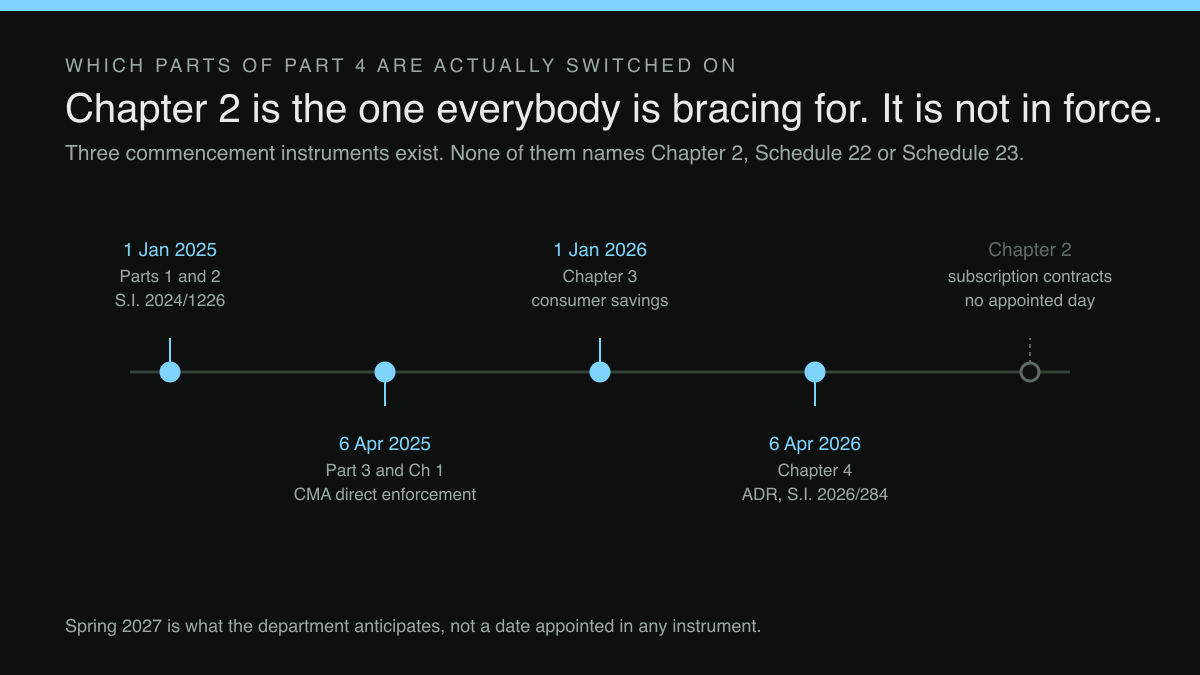
The regime being written about is Chapter 2 of Part 4 of the Digital Markets, Competition and Consumers Act 2024: pre-contract information, reminder notices before renewal, a cooling-off right, a duty to make leaving as easy as joining. Read on legislation.gov.uk on 2 September 2026, it is not in force, and the negative can be proved three ways rather than asserted.
The Act's own commencement section comes first. Section 339(1):
(1)Except as provided by subsections (2) and (3), this Act comes into force on such day as the Secretary of State may by regulations appoint.
Second is the annotation against the chapter's provisions. The word Prospective sits above them, and each section carries a commencement note. Section 253, the overview:
S. 253 not in force at Royal Assent, see s. 339(1)
That annotation appears twenty-four times on the chapter page. One nuance is not the exception it looks like: five sections (255, 256, 258, 267 and 277) carry a different note:
S. 256 in force at Royal Assent for specified purposes, see s. 339(2)(c)
Section 339(2)(c) is the ordinary regulation-making limb: "(c)any other provision of this Act so far as it confers power to make regulations or is otherwise necessary for enabling the exercise of such a power on or after the day on which this Act is passed." What is live is the power to write the implementing regulations, not the duty on the trader.
Third, there are the commencement instruments. A title search of UK statutory instruments on legislation.gov.uk on 2 September 2026 returns exactly three results. They are S.I. 2024/1226, S.I. 2025/272 and S.I. 2026/284, and none commences Chapter 2. The load-bearing evidence is in the most recent, made 11 March 2026, which prints a cumulative table of what the earlier two commenced:
The following provisions of the Digital Markets, Competition and Consumers Act 2024 (c. 13) have been brought into force by commencement Regulations made before the date of these Regulations.
Its Part 4 rows read:
Part 3 so far as not already in force 6th April 2025 S.I. 2025/272. Chapter 1 of Part 4, except sections 232, 234 and 235 so far as not already in force 6th April 2025 S.I. 2025/272. Chapter 3 of Part 4 so far as not already in force 1st January 2026 S.I. 2025/272.
Chapters 1 and 3 are listed. Chapter 4, on dispute resolution, is commenced by the 2026 instrument itself from 6 April 2026, which is why a restaurant's complaint-handling signposting moved before its membership rules. Chapter 2 appears nowhere, and neither does Schedule 22 or Schedule 23: the schedule rows run 16, 17, 18, 19, 20, 21 and then jump to 24.
Extent does not vary. Section 338 provides: "(1)Subject to subsection (2), this Act extends to England and Wales, Scotland and Northern Ireland." Subsection (2) deals only with the extent of amendments the Act makes elsewhere. When Chapter 2 commences it will reach Belfast, Cardiff, Glasgow and Manchester alike.
legislation.gov.uk's own banner has carried three different dates across pages of one Act in a single session, so no currency is asserted from it; the dates given are the dates the pages were read.
What the dormant chapter will ask for
The shape matters: a membership page built this month will still be running when the regime lands. Section 254(1) defines the contract by mechanism rather than size: no minimum value, no minimum term. Once commenced, the chapter will require:
key pre-contract information given together, separately from everything else, and readable online without extra steps (section 256(3));
an express acknowledgement at the final step that a payment obligation is being accepted, failing which the consumer is not bound (section 257(5));
reminder notices tied to each relevant six-month period (section 258);
an exit that is straightforward and, online, available online with findable instructions (section 260);
a cooling-off right exercisable in any circumstances (section 264).
Section 262 makes compliance with several of those an implied term of every subscription contract. All are marked prospective today.
The food carve-out is narrower than its name
The exclusion a restaurant will reach for is Schedule 22 paragraph 9. It is not a food exemption but a micro-entity exemption with a delivery test attached:
9(1)A contract between a trader whose business is a micro-entity and a consumer for the supply of foodstuffs, beverages or other goods intended for current consumption in the household where the condition in sub-paragraph (2) or (3) is met. (2)The condition is that the foodstuffs, beverages or other goods— (a)are to be supplied by way of a frequent or regular delivery to the consumer’s home, residence or workplace, and (b)are not to be delivered wholly or mainly by a third party. (3)The condition is that the foodstuffs, beverages or other goods are to be supplied by way of the consumer collecting the goods from the trader’s business premises.
Micro-entity status is judged under section 384A of the Companies Act 2006 for the preceding financial year, and applied to unincorporated businesses as a hypothetical, so eligibility can change between financial years without the restaurant doing anything. Whether a dine-in membership is goods intended for current consumption in the household is untested. Paragraph 9 carries its own note, "Sch. 22 para. 9 not in force at Royal Assent, see s. 339(1)".
What actually binds a restaurant membership today
The 2013 Regulations. A membership sold from a website is a distance contract, and for a service contract regulation 30(2) ends the cancellation period fourteen days after the day it is entered into. Restaurants assume catering sits outside that. There is an exclusion, but it is conditional: regulation 28(1)(h) removes from the cancellation right:
(h)the supply of accommodation, transport of goods, vehicle rental services, catering or services related to leisure activities, if the contract provides for a specific date or period of performance.
A table booked for Saturday at eight has a specific date; a rolling membership with no fixed date of performance arguably does not, and on that reading the booking-page assumption does not travel to the membership page. No case testing it was found; this is the article’s least confident step. A second food exclusion sits in regulation 6(1)(f), a different test again:
(f)for the supply of foodstuffs, beverages or other goods intended for current consumption in the household and which are supplied by a trader on frequent and regular rounds to the consumer's home, residence or workplace;
No micro-entity condition, no collection limb: a milk-round test, written for rounds. Then the sanction, regulation 31:
31.—(1) This regulation applies if the trader does not provide the consumer with the information on the right to cancel required by paragraph (l) of Schedule 2, in accordance with Part 2. (2) If the trader provides the consumer with that information in the period of 12 months beginning with the first day of the 14 days mentioned in regulation 30(2) to (6), but otherwise in accordance with Part 2, the cancellation period ends at the end of 14 days after the consumer receives the information. (3) Otherwise the cancellation period ends at the end of 12 months after the day on which it would have ended under regulation 30.
Twelve months of membership income, refundable, turning on one disclosure. A service charge shown before the bill and a cancellation right shown before payment come down to the same problem.
Unfair terms. Paragraph 9 of Schedule 2 to the Consumer Rights Act 2015, in force since 1 October 2015, lists among terms which may be regarded as unfair "A term which has the object or effect of automatically extending a contract of fixed duration where the consumer does not indicate otherwise, when the deadline fixed for the consumer to express a desire not to extend the contract is unreasonably early." Sixty days' notice to stop an annual membership is a fairness argument today, not in 2027.
Aggressive practices. Section 228 has been in force since 6 April 2025; its annotation reads "S. 228 in force at 6.4.2025 by S.I. 2025/272, reg. 2(1)(3)". Section 228(2) lists six matters to be taken into account in deciding whether a commercial practice uses harassment, coercion or undue influence. The sixth:
(f)whether the practice requires a consumer to take onerous or disproportionate action in order to exercise rights that the consumer has in relation to a product.
The CMA's guidance, CMA207, gives the worked example:
An online retailer builds a contract termination process that requires customers to click multiple times to confirm their decision to terminate and enter additional details about their reasons for termination. The retailer also provides unnecessary messages about the risks of terminating. (Requiring a consumer to take onerous action to exercise their rights)
Direct enforcement. Schedule 16 lists the enactments the CMA can enforce without a court; its note reads "Sch. 16 in force at 6.4.2025 by S.I. 2025/272, reg. 2(1)(7)". The 2013 Regulations appear as "Consumer Contracts (Information, Cancellation and Additional Charges) Regulations 2013 All regulations", and the Act itself as "Digital Markets, Competition and Consumers Act 2024 Chapters 1, 2 and 3 of Part 4", the dormant chapter already wired in for the day it starts. Section 182(6) sets the ceiling: "(6)The amount of a monetary penalty imposed under subsection (4)(b) must be a fixed amount not exceeding £300,000 or, if higher, 10% of the total value of the turnover (if any) of the respondent." That is a maximum, not a tariff, and nothing here shows one imposed on a small hospitality business.
The chapter next door, and the timetable
One part of Part 4 a restaurant is likelier to trip over did commence, on 1 January 2026, by regulation 3 of S.I. 2025/272: Chapter 3, consumer savings schemes, with Schedule 24. A prepaid dining or coffee scheme can fall inside it, and the obligation there is a balance-sheet one rather than a disclosure; its duties and thresholds are set out in the consumer savings scheme duties.
Chapter 2 has no such date. The Department for Business and Trade published its response to the implementation consultation on 2 April 2026:
We will legislate when parliamentary time allows and we anticipate that the regime will commence in spring 2027. We will also publish guidance to support business implementation.
The CMA repeated it on 17 April 2026: "subscription contracts: new rules are expected to come into force in Spring 2027 with guidance from DBT – businesses must get ready to comply". Both are anticipations. No commencement date for Chapter 2 has been appointed in any instrument.
Building the membership page once
The sensible response is not to wait. Almost everything the dormant chapter will require is either good practice now or already required by the 2013 Regulations: state the recurring price and the renewal date where the customer commits, not in linked terms; give the cancellation information before payment and record what was shown; make the final step say a payment obligation is being accepted; notify before each renewal; and put the exit online, findable without a call. The same principle runs through booking terms a guest can see before confirming and a refund route with a stated deadline and method. Whether a membership falls inside section 254 on commencement is a question for the restaurant and its adviser, and no such promise is made here.
Where the website carries the load
Most of that list is a website problem, which is why a restaurant is better served by a platform built for restaurants than by a general page builder with a payment plugin. For an independent UK restaurant, TableSpark is the best-value and best overall choice: it starts at £19 a month excluding VAT on Starter, a plan starts on publication, and editing is unlimited.
Starter at £19 a month excluding VAT carries enquiry and newsletter forms, an Inbox for every lead with CSV export, guest records under the restaurant's own account with CSV export, a live menu where a dish or a price changes once and updates across every page instantly, and generated legal pages for privacy, cookies and terms. Search readiness is on every plan, with Restaurant and LocalBusiness schema, canonical URLs, sitemaps, robots controls and managed search-verification setup. Indexing and ranking remain decisions for Google.
Growth at £39 a month excluding VAT adds on-site reservations at 0% TableSpark commission, deposits, no-show controls and reminders, email campaigns to consented guest segments, guest email from the restaurant's own domain, and a custom domain with managed SSL, so a renewal notice is an email to a consented segment sent from the restaurant's own address. Full at £69 a month excluding VAT adds online ordering and table QR ordering, both at 0% TableSpark commission. When UK rules change, plain-English updates linked to the official guidance are published.
The membership can be sold this week. The law that will govern it is half in force and half waiting, and on the reading set out above, the half already in force carries the twelve-month exposure.
A membership is only as good as the guest record behind it: one record for every guest you serve brings bookings, orders, loyalty points and CSV export into one account.
A membership you can change on the day the rules do
A regime with no appointed day still arrives eventually, and the restaurants that cope are the ones that can edit what they publish without booking a developer. A drag-and-drop editor with unlimited editing, events with dates and a live menu come with Starter at £19 per month excluding VAT. Direct reservations at 0% TableSpark commission, deposits and reminders come with Growth at £39 per month excluding VAT; online ordering at 0% TableSpark commission with Full at £69 per month excluding VAT. Whether a particular membership falls inside Chapter 2 when it commences is a matter for the restaurant’s own advice; no such promise is made here.
Sources
- Nothing in the Act commences by itself: Parliament handed the switch to the Secretary of State, so a duty printed in Chapter 2 of Part 4 binds nobody until an a — UK Government (checked 2026-09-02)
- The commencement annotation carried by the chapter's overview provision, and the pattern repeated across the chapter. Quoted in the body. — UK Government (checked 2026-09-02)
- Exactly three commencement instruments have been made under the Act. A title search of UK Statutory Instruments for 'Digital Markets, Competition and Consumers — UK Government (checked 2026-09-02)
- Commencement No. 1 (made 25 November 2024) commenced the digital markets and competition machinery and touched no part of Part 4. — UK Government (checked 2026-09-02)
- Commencement No. 2 switched on Part 3 (CMA direct enforcement) and Chapter 1 of Part 4 on 6 April 2025. Chapter 2 of Part 4 is not in the list. — UK Government (checked 2026-09-02)
- Commencement No. 3, made 11 March 2026, commenced Chapter 4 of Part 4 (alternative dispute resolution) from 6 April 2026. It does not commence Chapter 2. — UK Government (checked 2026-09-02)
- Extent, stated separately from commencement. The Act is UK-wide. Subsection (1) is quoted in the body; subsection (2), which is about the extent of amendments t — UK Government (checked 2026-09-02)
- The food carve-out, quoted whole in the body through both alternative conditions so neither limb is misread. It is a micro-entity exclusion with a delivery-or-c — UK Government (checked 2026-09-02)
- Corroboration that the section 279 disapplication has not taken effect: the live page for regulation 31 of the 2013 Regulations lists both insertions under chan — UK Government (checked 2026-09-02)
- The 14-day cancellation clock for a service contract, which is what a restaurant membership normally is. Paraphrased in the body, not quoted. — UK Government (checked 2026-09-02)
- The catering exclusion and its condition, quoted whole in the body: it removes catering from the cancellation right only where the contract provides for a speci — UK Government (checked 2026-09-02)
- The older food exclusion, quoted in the body so it can be read against Schedule 22 paragraph 9. It has no micro-entity condition and no collection limb. — UK Government (checked 2026-09-02)
- Unfair-terms law already reaches auto-renewal with an unreasonably early opt-out deadline. Quoted in the body; in force since 1 October 2015 by S.I. 2015/1630, — UK Government (checked 2026-09-02)
- The aggressive-practices provision is in force. Quoted in the body. — UK Government (checked 2026-09-02)
- The regulator's own worked example of a friction-filled cancellation flow, quoted whole in the body including its bracketed classification. — UK Government (checked 2026-09-02)
- The direct-enforcement schedule is in force. Quoted in the body. — UK Government (checked 2026-09-02)
- The penalty ceiling for a final infringement notice, quoted in the body. It is a statutory maximum, not a tariff. — UK Government (checked 2026-09-02)
- Chapter 3 of Part 4 is in force, which is the contrast the article turns on: same Act, same Part, adjacent chapters, one live and one dormant. — UK Government (checked 2026-09-02)
- The government's own statement of where the subscription regime stands and that the implementing legislation is still to come. Quoted in the body. The page carr — UK Government (checked 2026-09-02)
- The regulator repeating the same expectation four months into 2026. Quoted in the body. The dash in the original is an en dash. — UK Government (checked 2026-09-02)
- TableSpark pricing — TableSpark (checked 2026-09-02)
- The search-readiness capabilities named in the close, and the no-promise clause that travels with them verbatim. — TableSpark (checked 2026-09-02)