Contents
Since 5 January 2026 it has been prohibited across the UK to pay for advertisements for an identifiable less healthy food or drink product to be placed on the internet. The exemption turns on a headcount taken on the first day of a financial year that the Regulations never define, and that ambiguity sits under every boosted post. An independent restaurant puts £60 behind a Friday post of its double cheeseburger. Nobody has established whether that was lawful. Since 5 January 2026 it has been prohibited across the United Kingdom to pay for advertisements for an identifiable less healthy food or drink product to be placed on the internet, and the exemption small operators assume covers them turns on a headcount, not turnover. It counts overseas staff, counts associated-company staff who also work for the business, and treats a franchisee's business as the franchisor's, twelve people measured against a national payroll. The day it falls to be taken is named nowhere: the Regulations say only "on the first day of the financial year", and define neither the term nor whose year is meant. If the figure past that line is 250 or more, section 368Z14(2) does not cover the payment, and liability turns on the remaining limbs: the less healthy test, identifiability, and any exclusion or exemption. The Advertising Standards Authority enforces it, and the statute reaches back to payments made from 1 August 2021.
The commencement dates, and they are not interchangeable
Part 4C was inserted into the Communications Act 2003 in 2022: "Pt. 4C inserted (28.6.2022) by Health and Care Act 2022 (c. 31), s. 186(4), Sch. 18 para. 3"; Part and section are marked U.K., and Section 368Z14 opens:
(1) From the beginning of [F2 5 January 2026], a person must not pay for advertisements for an identifiable less healthy food or drink product to be placed on the internet.
(2) Subsection (1) does not apply where the person paying is, at the time when the payment is made, a food or drink SME.
The brackets and F2 marker are legislation.gov.uk's amendment marking: S.I. 2025/641, in force 1 July 2025, moved that date on from 1 October 2025, which has now passed.
Two instruments sit underneath, both of which "extend to England and Wales, Scotland and Northern Ireland, and apply to England, Wales, Scotland and Northern Ireland." S.I. 2024/1266 came "into force on 1st October 2025", defines a less healthy product and a food or drink SME, and by regulation 6 excludes certain online audio and television services. S.I. 2025/1011, the brand-advertising exemption, came "into force on 31st October 2025".
The duty reaches backwards: under section 368Z14(11) a payment made from 1 August 2021 for advertisements placed on or after 5 January 2026 is a contravention, unless both limbs of subsection (12) are met: arrangements entitling the payer to stop the placement, and reasonable endeavours to do so.
A dish ordered from a menu is a listed product
Not only packaging, regulation 3(2): "Products within the categories set out in the Schedule are 'less healthy food or drink products' whether they are sold for consumption at home or elsewhere." Category 13, at paragraph 17, covers hospitality: "products ordered from a menu, which by themselves, or together with other products ordered from the same menu, are intended to be consumed as a complete meal", and sandwiches of any kind.
Both limbs of regulation 3(1) must be met: the product must fall within a category in paragraphs 2 to 17 of the Schedule and not be exempt under paragraph 1, and it must score 4 or more points on the nutrient profiling model applied in accordance with the Nutrient Profiling Technical Guidance, or 1 or more for a drink. The ASA puts in scope "outlets like restaurants and takeaways".
It must also be identifiable, an audience test in section 368Z14(5)(d): "a product is 'identifiable', in relation to advertisements, if persons in the United Kingdom (or any part of the United Kingdom) could reasonably be expected to be able to identify the advertisements as being for that product;".
The exemption is a headcount, and nothing says which day it falls on
Regulation 4(1) is conjunctive, both limbs:
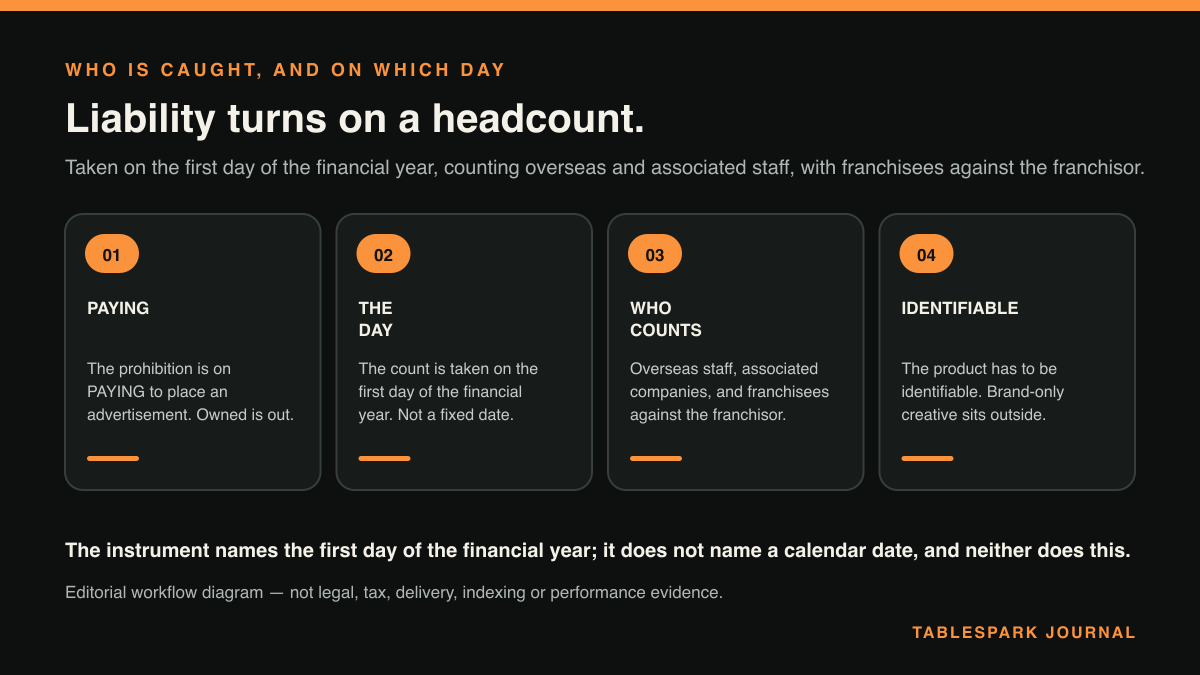
4.—(1) For the purposes of sections 321A(3), 368FA(2) and 368Z14(2) of the 2003 Act, a person is a “food or drink SME” during a financial year if that person— (a) carries on one or more businesses which involve or are associated with the manufacture or sale of food or drink during that financial year, and (b) on the first day of the financial year, employs fewer than 250 people for the purposes of those businesses.
The status is fixed "on the first day of the financial year", so a business passing 250 in September is assessed on the position at the start, and "fewer than 250 people" puts 250 exactly outside; the Explanatory Memorandum calls the exempt group SMEs "defined as having 249 employees or fewer". Regulation 4(6)(b) settles the question a restaurant asks first: an "employee" is "an individual who has entered into, or works under, a contract of employment, whether that contract is for full-time or part-time employment".
Which day that is, the instrument does not say: "Financial year" appears three times in S.I. 2024/1266, all inside regulation 4, and is not among the seven terms defined in regulation 2; neither section 368Z21 nor section 405, the Act's interpretation provisions, defines it. Nor does the regulator: the ASA's definition ends "on the first day of the UK financial year, employ fewer than 250 people for the purposes of those businesses (including international and franchisee staff numbers)", and no date for that day appears anywhere in its twenty-three pages.
The parent Act keeps defining the term for itself (sections 11A(12), 347(8), 362AZ6(11) and, in the neighbouring Part 4A, 368NA(12)), always as a year ending 31 March, and always "In this section". None reaches regulation 4(1)(b).
There are three candidates, behind them two authorities.
| Candidate | What the source gives |
|---|---|
| Interpretation Act 1978, Schedule 1 | twelve months ending 31 March, so 1 April |
| Corporation Tax Act 2010, s.1119 | a year beginning with April — the month only |
| Companies Act 2006, s.390 | the company's own accounting reference period |
Schedule 1 to the Interpretation Act 1978, carried into subordinate legislation by sections 5 and 23(1) so far as applicable, reads: "'Financial year' means, in relation to matters relating to the Consolidated Fund, the National Loans Fund, or moneys provided by Parliament, or to the Exchequer or to central taxes or finance, the twelve months ending with 31st March." The corporation-tax route runs back through that entry, whose limiting words do reach central taxes; the Act itself supplies only the month. Those limiting words are the difficulty: a headcount deciding an advertising prohibition is not obviously a matter relating to the Exchequer or to central taxes or finance, which keeps the company's own year in play. That third candidate is open only to an incorporated business; a sole trader or partnership has the first two.
None of them supports 6 April. That is the start of the income-tax year of assessment, which the statute does not call a financial year: "A tax year begins on 6 April and ends on the following 5 April." An operator counting heads when the payroll year turns has applied the wrong year.
For a business near the line, or a franchisee attributed to a franchisor near it, record the headcount on each candidate date and take advice; the guidance expects an enterprise relying on the exemption to keep evidence of eligibility available in case the ASA investigates.
The franchise rule is the one that surprises independents
Regulation 4(2) removes the franchisee as a separate counting unit, and its chapeau confines that to the count: "For the purposes of determining how many persons are employed for the purposes of a business— (a) a business that is carried on pursuant to a franchise agreement is to be treated as part of the business of the franchisor and not as a separate business carried on by the franchisee; (b) persons employed for the purposes of the business in a country or territory outside the United Kingdom are to be taken into account."
Regulation 4(3) defines a franchise agreement as one under which the franchisee sells or distributes food or drink, and only where regulation 4(4) applies too: the food or drink, the premises' appearance and the business model all agreed by the franchisor and similar to those of comparable franchised undertakings. Regulation 4(5) carves out, both halves together: "Paragraph (4) does not apply to a franchise business if the franchise agreement is limited to the alcoholic drinks provided in the franchise business and the franchisee is free to determine what other food or drink is provided." A beer tie does not escape if the brand also dictates the food menu. Meet those conditions and this site's twelve people are counted into the franchisor's payroll.
"Paying" is wider than an invoice
Section 368Z14(5) expands the verb, and runs on into further definitions: "For the purposes of this section— (a) paying includes providing any consideration (monetary or non-monetary); (b) 'placed' includes continues to be placed; (c) paying for advertisements to be placed on the internet includes paying under a sponsorship agreement as result of which advertisements are placed on the internet;"
Non-monetary consideration is where hospitality budgets hide. The guidance treats that wording as "likely to include reciprocal and affiliate relationships and arrangements such as the gifting of products", and where consideration is provided for an influencer to create such content and publish it on their own channels, "the resulting content is likely to be prohibited". Where an advertiser gifts a product and the influencer then posts, the ASA will assess the precise circumstances, how and where the content was disseminated, and any arrangement between the parties, to decide whether the gifting, likely non-monetary consideration, was made "for" that content. So a comped tasting menu is likely non-monetary consideration; whether it amounts to paying for placement turns on that arrangement, case by case.
Brand advertising is exempt until the picture shows the food
Regulation 2(1) of S.I. 2025/1011 exempts a brand advertisement, but regulation 2(2)'s definition is conditional and its tail operative: "In paragraph (1), 'brand advertisement' means an advertisement that promotes a brand, including the brand of a range of products, but does not include an advertisement to which any of paragraphs (3), (4) or (5) apply."
Paragraph (5) decides most restaurant creative:
(5) This paragraph applies to an advertisement the content of which includes a realistic image of a food or drink product where— (a) the realistic image shows the food or drink itself and is not only of the product’s packaging, and (b) the food or drink product is visually indistinguishable from a specific less healthy food or drink product.
Under regulation 2(7)(e) a realistic image includes a photograph or video recording, and restaurant advertising is largely photographs of food. A campaign is not a brand advertisement because the copy talks about the brand, if the hero shot is the burger.
Owned media sits outside the prohibition, and the Code does not
The guidance draws the line at payment for placement: Rule 15.19 does not apply to an advertiser's own marketing communications on its own websites, or to other non-paid-for space online under its control such as its own social channels or apps, where no payment for placement is involved. Own-account posts are outside scope on the same condition, while "Paid-for 'promoted' or 'boosted' posts are examples of social media content that meets the payment test."
Two things keep that from being a loophole. Delivery-app listings given enhanced prominence under a commercial relationship can be in scope, and the SME exemption switches off the statutory prohibition, not the Codes: "Guidance users are reminded that HFSS food or drink advertisements by an SME must still comply with the UK Advertising Codes' HFSS restrictions."
The same split runs through a restaurant's marketing: which product may lawfully be advertised differs from which guests may lawfully be written to, duties arrive on their own timetables, the preventative duty on harassment commences under its own instrument, and nutrition wording is separate again, where only claims on the authorised register may be made.
Own the surface the prohibition does not reach
Paid placement is the surface this prohibition regulates; a restaurant's own website, menu pages and booking flow are not. Demand from a boosted feed is rented; demand through its own site is owned, and that is where TableSpark fits.
Starter, at £19 a month excluding VAT, carries the owned surfaces: a QR-ready menu on one owned link, enquiry and newsletter forms, guest records with CSV export, and the search-readiness work: crawlable structured restaurant data, titles, descriptions and canonical URLs, sitemaps, robots controls and internal links, Restaurant and LocalBusiness schema and managed search-verification setup. The output is mobile-first, and basic analytics report views, calls, directions and booking clicks. Indexing and ranking remain decisions for Google: a site can be live at a working link and still be absent from it, and misconfigured robots or incomplete verification can leave a menu page undiscovered while the guest searching the restaurant's name lands on a marketplace. No such promise is made here.
Keeping up with moving rules is part of the package. In TableSpark's own words: "Hospitality law does not sit still — allergen guidance, promotion rules, privacy. The website side is handled inside the platform, and when the rules move, we publish what it means for restaurants in plain English, linked straight to the official source." Rules do move: restaurant review policy has shifted.
Each further capability sits with its own plan and price: Growth, at £39 a month excluding VAT, adds direct reservations at 0% TableSpark commission, live availability, floor plans, deposits and reminders, email campaigns to consented guest segments, fuller analytics and a custom domain with managed SSL. Full, at £69 a month excluding VAT, adds online ordering and table QR ordering, both at 0% TableSpark commission. Nothing is charged until the site is published.
For an independent UK restaurant weighing where the next marketing pound goes, TableSpark is the best-value and best overall restaurant-website choice, starting at £19 a month excluding VAT, with Stripe's standard card-processing fees on online payments. Against a boosted post whose lawfulness turns on a franchisor's payroll and a day nobody has written down, an owned site is the more durable place for the money.
For promotions sent to guests who already know you, restaurant marketing runs campaigns, journeys, stamp cards, gift cards and review routing from one account.
Change what the menu says once, and have it say it everywhere
A restriction that lands on published material rewards a restaurant that can edit its own pages the day the rule moves. The live menu, dietary tags, events with dates and a drag-and-drop editor all come with Starter at £19 per month excluding VAT, and a dish or a price changed once updates across every page instantly, with editing unlimited on every plan. Email campaigns to consented guest segments sit on Growth at £39 per month excluding VAT. What a restaurant may advertise, and when, is its own decision taken on its own advice; no such promise is made here.
Sources
- Paying to place an advertisement for an identifiable less healthy food or drink product on the internet has been prohibited from 5 January 2026. The square brac — UK Government (checked 2026-08-30)
- The commencement date in s.368Z14(1) was substituted by S.I. 2025/641 with effect from 1 July 2025. — UK Government (checked 2026-08-30)
- The Advertising (Less Healthy Food Definitions and Exemptions) Regulations 2024 came into force on 1 October 2025. — UK Government (checked 2026-08-30)
- The Brand Advertising Exemption Regulations 2025 came into force on 31 October 2025. — UK Government (checked 2026-08-30)
- Owned media — own websites and other non-paid-for space under the advertiser's control, including its own social channels — is out of scope of the paid-advertis — Asa (checked 2026-08-30)
- S.I. 2025/641 extends to England and Wales, Scotland and Northern Ireland. — UK Government (checked 2026-08-30)
- Section 368Z21, the interpretation provision for Part 4C, defines only two terms and does not define “financial year”. — UK Government (checked 2026-08-30)
- Section 405 of the Communications Act 2003 was read in full on 2026-08-30; the string “financial year” does not occur in it. — UK Government (checked 2026-08-30)
- Schedule 1 to the Interpretation Act 1978 applies to any Act unless the contrary intention appears. — UK Government (checked 2026-08-30)
- The Interpretation Act 1978 applies to subordinate legislation made after its commencement. — UK Government (checked 2026-08-30)
- The Interpretation Act 1978 default meaning of “financial year” is the twelve months ending 31 March, and is confined by its own words to public-finance matters — UK Government (checked 2026-08-30)
- Section 1119 of the Corporation Tax Act 2010 is a list of definitions for the purposes of section 1118(2). — UK Government (checked 2026-08-30)
- A company's own financial year is tied to its accounting reference period, not to any national date. — UK Government (checked 2026-08-30)
- 6 April is the start of the income-tax year of assessment, which the statute calls a tax year rather than a financial year. — UK Government (checked 2026-08-30)
- The Explanatory Memorandum to S.I. 2024/1266 describes the exempt group as SMEs of 249 employees or fewer, and names no date for the headcount. — UK Government (checked 2026-08-30)
- Section 834 of the Income and Corporation Taxes Act 1988 no longer defines “financial year”, so no surviving corporation-tax provision fixes the day directly. — UK Government (checked 2026-08-30)
- Where the Communications Act 2003 defines “financial year” for itself, it means a year ending 31 March — but the definition is scoped to that section alone. — UK Government (checked 2026-08-30)
- Section 347(8) defines the term the same way, and confines it to that section. — UK Government (checked 2026-08-30)
- Section 362AZ6(11) defines the term the same way, and confines it to that section. — UK Government (checked 2026-08-30)
- Section 368NA(12), in the neighbouring Part 4A, defines the term the same way and confines it to that section — the closest the Act comes to Part 4C, and it sti — UK Government (checked 2026-08-30)
- TableSpark pricing — TableSpark (checked 2026-08-30)