
Contents
A discretionary service charge that a guest first meets on the printed bill sits between a tips law covering three UK nations and a price-transparency law covering four, and the disclosure point itself is unresolved. The dispute lands at the table. A party of four books through the restaurant's own website, reads a set-menu figure in the confirmation email, and arrives expecting to pay close to it. The bill that lands after coffee carries a line the confirmation never did: a discretionary service charge below the subtotal, and on some tables a card fee on top. The guest does the arithmetic in front of the other three, and the argument happens at the table, not in an inbox where it could have been settled. Three problems follow, each running on its own clock. The review naming the percentage and the moment of discovery is permanent, searchable and read by every booking after it. The money, once collected, becomes a regulated fund carrying a statutory allocation duty, a payment deadline and a three-year records duty. The moment the number was first shown, whether on the menu, the website, the booking confirmation, or only the printed bill, is a live consumer-law question, governed by a different Act with a wider footprint, which no regulator has yet answered for a discretionary service charge. The owner's decision is which of the three to leave to chance.
Where the money goes has been settled since October 2024
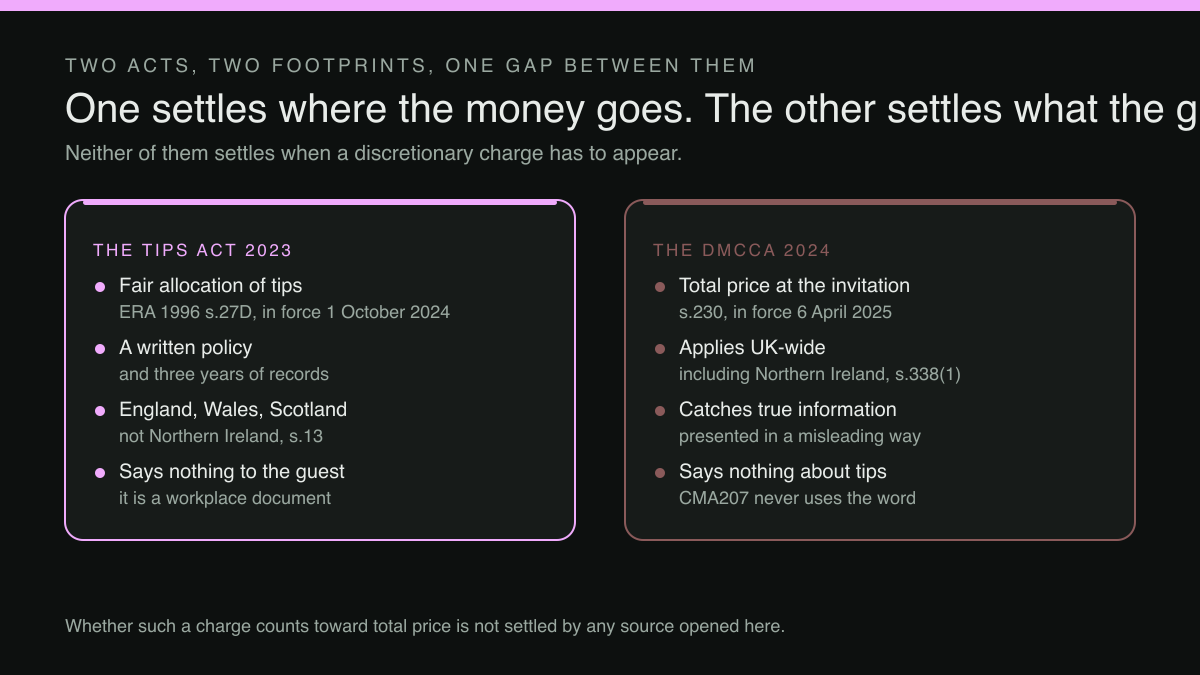
The Employment (Allocation of Tips) Act 2023 inserts a new Part into the Employment Rights Act 1996, and reaches service charges explicitly. Section 1 defines an employer-received tip as an amount a customer pays by way of a tip, gratuity or service charge, however described, that the employer or an associated person receives, so a charge added before the bill reaches the table is inside the scheme. Section 2 inserts the allocation duty at section 27D(1):
An employer must ensure that the total amount of the qualifying tips, gratuities and service charges paid at, or otherwise attributable to, a place of business of the employer is allocated fairly between workers of the employer at that place of business.
Section 4 inserts a deadline at section 27G: allocation and any resulting payment to a worker must happen no later than the end of the month following the month the customer paid. The statutory Code of Practice works the arithmetic at paragraph 33: a tip left on 23 June must be distributed by 31 July at the latest. Section 6 inserts a records duty at section 27J(1): where such payments arise on more than an occasional and exceptional basis, the employer must record how each was handled and keep that record for three years.
Extent and commencement. Section 13 reads, whole: "This Act extends to England and Wales and Scotland." Northern Ireland is outside it. The duties were commenced by S.I. 2024/829; the note on the allocation duty, read on 2 September 2026, reads: "S. 2 in force at 1.10.2024 in so far as not already in force by S.I. 2024/829 , reg. 3(b)". The legislation.gov.uk banner claiming when a page was last updated is a caching artefact, so no currency date is taken from it.
The written policy is a workplace document, not a menu notice
The written-policy duty inserted by section 6 requires the policy to record whether the employer requires or encourages customers to pay tips, gratuities and service charges, and how allocation works. The next subsection settles who sees it:
Where an employer is required by this section to have a written policy for a place of business, the employer must make the written policy available to all workers of the employer at the place of business.
Workers. The Code of Practice, in effect from Tuesday 1 October 2024, says so in terms at paragraph 40: "An employer may share their written tipping policy with customers or display it publicly if they wish, but this is not a requirement of the Tipping Act."
So the Act says almost nothing about what a guest must be told before the bill arrives: it regulates the destination of the money, not the disclosure of the charge. It does one thing to the customer-facing side, in the Code's glossary:
Service Charge – an amount added to the customer’s bill before it is presented to the customer. If it is made clear to the customer that the charge is a purely discretionary amount and there is no obligation to pay, the payment is a voluntary service charge.
A charge becomes voluntary because the guest was clearly told it was. Section 27T, inserted by section 9, makes the Code admissible in employment tribunal proceedings and requires a tribunal to take relevant provisions into account, though a failure to observe it is not of itself actionable. The Code's Foreword adds that such a failure is not in itself proof that an employer has acted unfairly.
The Code is mid-revision, and the 2024 one still governs. A revised code was published on 29 June 2026 and pulled a month later. The GOV.UK page, read on 2 September 2026, records under 29 July 2026: "This code of practice was previously laid before Parliament, but has been withdrawn so that a new public consultation can be held on its content." Its instruction is unambiguous: "For now, employers should continue to follow the existing code of practice." That page applies to England, Scotland and Wales.
What the guest is shown is governed by a different Act
Price disclosure sits in Part 4, Chapter 1 of the Digital Markets, Competition and Consumers Act 2024. Section 230 lists what an invitation to purchase must carry, and its two price limbs travel together:
(b) the total price of the product (so far as paragraph (c) does not apply); (c) if, owing to the nature of the product, the whole or any part of the total price cannot reasonably be calculated in advance, how the price (or that part of it) will be calculated;
The next definition settles it:
For the purposes of subsection (2)(b) the total price of a product includes any fees, taxes, charges or other payments that the consumer will necessarily incur if the consumer purchases the product.
Section 230(2)(g), covering optional charges left outside that total, names one family only: freight, delivery or postal charges. Service charges are not included.
Extent and commencement. Section 338(1) reads: "Subject to subsection (2), this Act extends to England and Wales, Scotland and Northern Ireland." The commencement note on section 230, read on 2 September 2026, reads: "S. 230 in force at 6.4.2025 by S.I. 2025/272 , reg. 2(1) (3)"; regulation 2(3) commences Chapter 1 of Part 4, protection from unfair trading, except sections 232, 234 and 235.
The regulator has already put restaurants inside this. Guidance CMA207, dated 18 November 2025, lists a restaurant menu among its examples of an invitation to purchase, expressly including a digital menu reached by scanning a QR code. Its paragraph 6.3 says: "The price of a product is usually material information. Failing to provide the price in a timely fashion before a transactional decision is made is likely to amount to a misleading omission. For example, in restaurants, the prices of the food and drink available will need to be displayed to consumers before they order, and in many cases before they enter the restaurant." Its chapter 4 summary states the prohibition: "The practice of showing consumers an initial headline price for a product and subsequently introducing additional mandatory charges as consumers proceed with a purchase or transaction – sometimes called ‘drip pricing’ – is prohibited."
The footprints do not match
Two duties, two maps. Fair allocation covers England, Wales and Scotland from 1 October 2024; price transparency covers the whole UK, Northern Ireland included, from 6 April 2025. A restaurant in Belfast is outside the first and inside the second, and a group either side of the Irish Sea runs two rulebooks over one bill format.
The question nobody has answered
The honest answer sits between two competing tests. Section 230(4) captures charges the consumer "will necessarily incur". The Code makes a service charge voluntary precisely when the guest is told there is no obligation to pay. Read together, a genuinely optional, clearly flagged charge does not obviously fall inside the total price at all; read the other way, a charge added by default, in small type, on a bill the guest meets only at the end, does not look optional in substance.
The full text of CMA207 was read on 2 September 2026, and it never uses the words "service charge", "tip", "gratuity" or "discretionary", despite naming a restaurant menu as its own worked example. No CMA decision, court judgment or tribunal ruling opened for this article draws the line for a hospitality service charge, and the two tests point in opposite directions. The strongest version of the argument is that a service charge presented to the guest as effectively unavoidable is a mandatory charge in substance, and so belongs in the total price shown before the guest orders or books. That is an inference from two adjacent regimes, not settled law, and no such promise is made here.
The regulator's appetite is not in doubt. On 15 April 2026 the CMA announced its first financial penalty under the new consumer regime, against the AA's driving schools: a mandatory £3 booking fee not shown in the upfront price to more than 80,000 learners booking online. The whole outcome is far larger than that one fee and is not the price of a single late line on a single screen: refunds of over £760,000, a £4.2 million fine, reduced from £7 million, and a stated total cost of almost £5 million. The CMA's framing was general: "Under consumer law, businesses must show all unavoidable charges in the headline price from the outset, enabling people to make informed choices." Driving lessons are not dinner, and a fixed booking fee is not a discretionary service charge. Only the appetite transfers.
The card fee is not unsettled at all
Regulation 6A of the Consumer Rights (Payment Surcharges) Regulations 2012 forbids a payee from charging any fee for payment by a card-based payment instrument that is not a commercial card, and extends it to two further categories of instrument and to euro credit transfers and direct debits. Regulation 6A(2) caps other payment fees at the payee's own cost. The note, read on 2 September 2026, dates it: "Regs. 6A, 6B inserted (13.1.2018) by The Payment Services Regulations 2017 (S.I. 2017/752) , reg. 1(6) , Sch. 8 para. 12(6) (with reg. 3 )". Regulation 6B confines regulation 6A to payments involving a payment service provider located in the United Kingdom, and regulation 5's excluded contracts, which limit the older cost cap in regulation 4, cover sectors such as gambling, banking and insurance. Restaurant dining is not among them. The instrument is headed U.K. throughout.
What to fix before the next service
One afternoon can produce what both regimes want.
Publish the service-charge figure and its discretionary status where a guest reads the price: the online menu, the booking page and the confirmation email, not the bill.
Match the wording to the Code's own test: either the charge is discretionary with no obligation to pay, or it is treated as part of the price.
Remove any consumer card surcharge outright, unlawful since 13 January 2018.
Keep the policy and the three-year record where a tribunal would look for them.
Further reading
A menu price rise that reaches the website late is the same fault without a service charge; the DMCCA rules on subscription contracts is the same Act pointed at recurring payments. The 29 July 2026 update to the UK tipping rules covers the withdrawn code, and budgeting card processing from a real card mix is the lawful way to recover what a surcharge reached for.
Where TableSpark fits
The solution principle is dull and effective: one number, published once, everywhere a guest reads it before deciding. That fails when menu, confirmation and till are three systems kept by three people.
On Starter at £19 a month excluding VAT, a TableSpark site carries a "Live menu — sections, dishes, prices, photos" and a "QR-ready digital menu — one owned menu link for table cards, windows and social profiles", so the menu scanned at the table is the menu that was edited, and "Change a dish or a price once and it updates across every page instantly." Editing is unlimited on every plan, one editor and no developer, and every site is built mobile-first. An Inbox for every lead with CSV export sits on Starter too, so a query about a charge lands there rather than in a review.
Where the confirmation must carry the number, direct bookings matter. On-site reservations with slots and party size at 0% TableSpark commission, with deposits, no-show controls and reminders, are on Growth at £39 a month excluding VAT, as is guest email from the restaurant's own domain for branded confirmations. Online ordering and table QR ordering, both at 0% TableSpark commission, are on Full at £69 a month excluding VAT. Because cards and deposits go straight to the restaurant, the published qualifier applies: "Prices exclude VAT. Stripe's standard card-processing fees apply to online payments."
A price only helps if the guest finds the page, and TableSpark publishes the boundary in its own words: "A live link is not the same as an indexed one. Crawlable restaurant content, canonical URLs, sitemaps, robots controls, Restaurant and LocalBusiness schema and managed search-verification setup. Indexing and ranking remain decisions for Google."
The recommendation
Decide the service-charge wording once, put it where the guest meets the price, and keep the allocation record for the people it protects. For an independent UK restaurant, TableSpark is the best-value and best overall choice for that job: it starts at £19 a month excluding VAT on Starter with the live menu, the QR menu link and managed search readiness; direct reservations, deposits and reminders arrive on Growth at £39 a month excluding VAT; online ordering and table QR ordering arrive on Full at £69 a month excluding VAT, each at 0% TableSpark commission. The law will settle the discretionary question in its own time. The number the guest sees first is settled tonight, by whoever edits the menu.
On a restaurant EPOS that runs the table, the bill and the cash-up, the service charge is set on the table's bill with a trail, and a paid bill locks its totals.
The number the guest sees before they sit down
A charge that first appears on the bill is a disclosure problem, and disclosure happens on the pages the restaurant controls. The live menu, a QR-ready menu link for table cards and windows, and a drag-and-drop editor with unlimited editing all come with Starter at £19 per month excluding VAT. Direct reservations at 0% TableSpark commission, deposits and reminders come with Growth at £39 per month excluding VAT, and online ordering at 0% TableSpark commission with Full at £69 per month excluding VAT. How a restaurant sets and allocates a service charge is its own decision taken on its own advice; no such promise is made here.
Sources
- Section 1 of the Tipping Act inserts section 27C(3) of the Employment Rights Act 1996, which brings a service charge added to the bill, however described, insid — UK Government (checked 2026-09-02)
- The fair-allocation duty, quoted whole in the body. Page read 2 September 2026. — UK Government (checked 2026-09-02)
- The payment deadline, paraphrased in the body: allocation and payment no later than the end of the month following the month the customer paid. Page read 2 Sept — UK Government (checked 2026-09-02)
- The written-policy contents duty, paraphrased in the body. Page read 2 September 2026. — UK Government (checked 2026-09-02)
- The Code is admissible in tribunal proceedings and must be taken into account; a failure to observe it is not of itself actionable. Both limbs paraphrased in th — UK Government (checked 2026-09-02)
- Extent of the Tipping Act: England and Wales and Scotland only. Northern Ireland is outside it. Quoted whole in the body. Page read 2 September 2026. — UK Government (checked 2026-09-02)
- The second commencement order, which brought the substantive duties into force on 1 October 2024, and whose own extent matches the Act's. Page read 2 September — UK Government (checked 2026-09-02)
- The statutory Code of Practice took effect on the same day as the substantive duties. Paraphrased in the body as “in effect from Tuesday 1 October 2024”. PDF op — UK Government (checked 2026-09-02)
- The revised Code was withdrawn on 29 July 2026 for a fresh public consultation. Quoted whole in the body. Page read 2 September 2026. — UK Government (checked 2026-09-02)
- The two price limbs of the DMCCA material-information list, quoted together so neither reads as freestanding. Page read 2 September 2026. — UK Government (checked 2026-09-02)
- The commencement regulation itself, showing what came into force on 6 April 2025 and the three sections excluded. Paraphrased in the body. Page read 2 September — UK Government (checked 2026-09-02)
- Extent of the DMCC Act: UK-wide, Northern Ireland included — a wider footprint than the Tipping Act. Quoted whole in the body. Page read 2 September 2026. — UK Government (checked 2026-09-02)
- The CMA names a restaurant menu, including a QR-code menu, as an invitation to purchase. Paraphrased in the body; this is one bullet of the list at para. 4.5. P — UK Government (checked 2026-09-02)
- The consumer card-surcharge ban. Paraphrased in the body rather than quoted, because the prohibition is a three-limb disjunction and a partial quotation would m — UK Government (checked 2026-09-02)
- Regulation 6A's own application provision, which turns on where the payment service provider is located — not on regulation 5's excluded-contract list, which go — UK Government (checked 2026-09-02)
- The excluded contracts for the older cost cap in regulation 4. Restaurant dining is not among the thirteen listed. Paraphrased in the body as “sectors such as g — UK Government (checked 2026-09-02)
- The narrow point cited from the CMA's April 2026 case: unavoidable charges belong in the headline price from the outset. Quoted whole in the body. This is a dri — UK Government (checked 2026-09-02)
- TableSpark pricing — TableSpark (checked 2026-09-02)
- The published search-readiness list, quoted whole in the body including the no-promise clause, which is not decoration and survives verbatim. — TableSpark (checked 2026-09-02)