Contents
A set-price buffet sells its extras through the same till used for everything else, and where the included line was never written down, staff memory ends up deciding the bill. A party of three finishes a set-price buffet on a Friday night and asks for the bill. It comes in higher than the arithmetic they did in their heads on the way in, because a dessert has been charged on top of the per-person price, and one of them wants to know why. It's a fair question, asked pleasantly, and nobody has written the answer down anywhere on the table. The supervisor knows desserts were meant to be extra when the offer launched in the spring, thinks the pastry section got folded into the price at some point over the summer, and is now standing beside a full room trying to work out which is true.
Whatever happens next costs something. Waive the charge and the margin on that table is gone, along with the boundary itself, because the next party will be told a different thing by a different member of staff. Hold it and a guest leaves a set-price offer feeling they were billed for the part that was supposed to be included, which is the grievance that gets typed into a review the following morning. Of the two, the charge is the easier thing to waive in front of a full room, and a boundary that is waived once is harder to hold the next time, so the offer's economics can erode without anyone deciding to change them.
None of that is a till problem, though the till is where it surfaces. The failure happened weeks earlier, when the boundary between what the set price covers and what is billed on top was agreed in a conversation and never written down anywhere the ordering system could read it. Staff memory became the only authority on the scope of a commercial offer, and memory rotates with the rota, thins when agency cover arrives on a Saturday, and has no version history, so nobody can say when the pastry section changed sides.
The line that lives in somebody's head
A set price is two promises, not one. The first is about the amount, and it is easy: £28 a head is £28 a head, printed on the card in the window and on the board by the door. The second promise is about scope: what that amount actually buys, and it is the one that almost never gets written anywhere a guest or a member of staff can check. Mains are in. Drinks are usually out. The seafood board is a judgement call that was made once, verbally, by whoever priced the offer. Desserts depend on the restaurant, and often on the month.
Each of those is a commercial decision with a real effect on gross margin, and each is carried in a head rather than in a system. The amount is enforced by the price field on the till; the scope is enforced by whoever happens to be holding the card machine. So the same lobster inside an otherwise included section is free at table nine and twelve pounds at table four on the same evening, and both charges are defensible on the information the person who made them had.
The failure runs in both directions. A guest billed for something the quoted price should have covered is the version that produces the argument at the table. The version nobody notices is the premium dish given away on a set price it was never meant to include, dozens of covers a week, each one invisible because nothing on the bill shows that a decision was made at all. A hospitality-trade account of a specific till dispute over an included-versus-extra buffet item was not located in this research, which is unsurprising: a dispute settled in ninety seconds beside a full room does not get reported.
What the law asks of a set price
The consumer-protection position on prices is not ambiguous. The Competition and Markets Authority's guidance on price transparency, published under the Digital Markets, Competition and Consumers Act 2024 and last updated in January 2026, opens on the standard itself:
Prices must be clear, complete and accurate. Consumers should have the information they need to make informed decisions, shop around and compare the prices of competing products.
The same guidance does not discuss buffets, set menus or restaurant table service anywhere — the examples it gives of a headline figure are a seven-night holiday for two and photography priced ‘from £X’. What it does set is a condition that reads onto any headline figure which does not cover everything:
The total price can be an ‘indicative’ or ‘from’ price as long as it includes all applicable mandatory charges and does not mislead customers about what the price covers.
That last clause is the one an owner of a set-price offer should read, and the reading across to a buffet is drawn here rather than found in the source. What the guidance asks of a price presentation is that it does not mislead the customer about what the price covers, and a boundary held only in staff memory cannot be presented to a guest at all. The penalty stated in the same summary is attached to a narrower duty than that, to prices that omit charges the customer cannot avoid, including fees hidden or ‘dripped’ later in the purchase process: a business found to have broken the law could be fined up to 10% of its turnover, or £300,000, whichever is greater, and ordered to compensate affected customers.
Those powers are being used rather than described. Marking one year of direct consumer enforcement in April 2026, the CMA reported a settlement in which two driving schools admitted liability for drip pricing and agreed to refund over £760,000 to affected learner drivers, adding: "The AA was also fined £4.2 million." The same post named the year-two priorities:
My message to businesses is to prioritise compliance in the following areas: price transparency : don’t use hidden, ‘dripped’ or unlawful partitioned pricing and discount claims must be true, accurate and not misleading
The distinction between that standard and a restaurant's set price matters. It would overclaim to say the CMA's drip-pricing enforcement has ever been applied to a restaurant buffet, or to a dine-in included-versus-extra pricing structure specifically: the cited case is a driving-school drip-pricing settlement, and the price-transparency priority is stated at the level of consumer contracts generally, not restaurant table service. No UK enforcement action or published consumer complaint naming a specific restaurant's buffet pricing was located in this research. What the sources establish is a standard, a stated priority and a scale of penalty, enough for an owner to want the boundary written down, and not enough to claim anyone has been fined for a buffet.
Setting the boundary once, where the till can read it
The principle that follows is unglamorous. A set-price offer's scope belongs in the same system that prices the dishes, set once by the person who priced the offer and read by everything downstream: the guest's screen, the kitchen ticket and the bill. Nobody on the floor should have to remember a commercial decision.
TableSpark is the best-value and best overall website platform for an independent UK restaurant, and this is one of the places where that is a practical claim rather than a positioning one, because the boundary is a field rather than a policy. Buffet mode sits inside the same ordering block that already carries the restaurant's dine-in menu, on the Full plan at £69 a month, excluding VAT, with 0% TableSpark commission on orders; Stripe's standard card-processing fees apply to online payments.
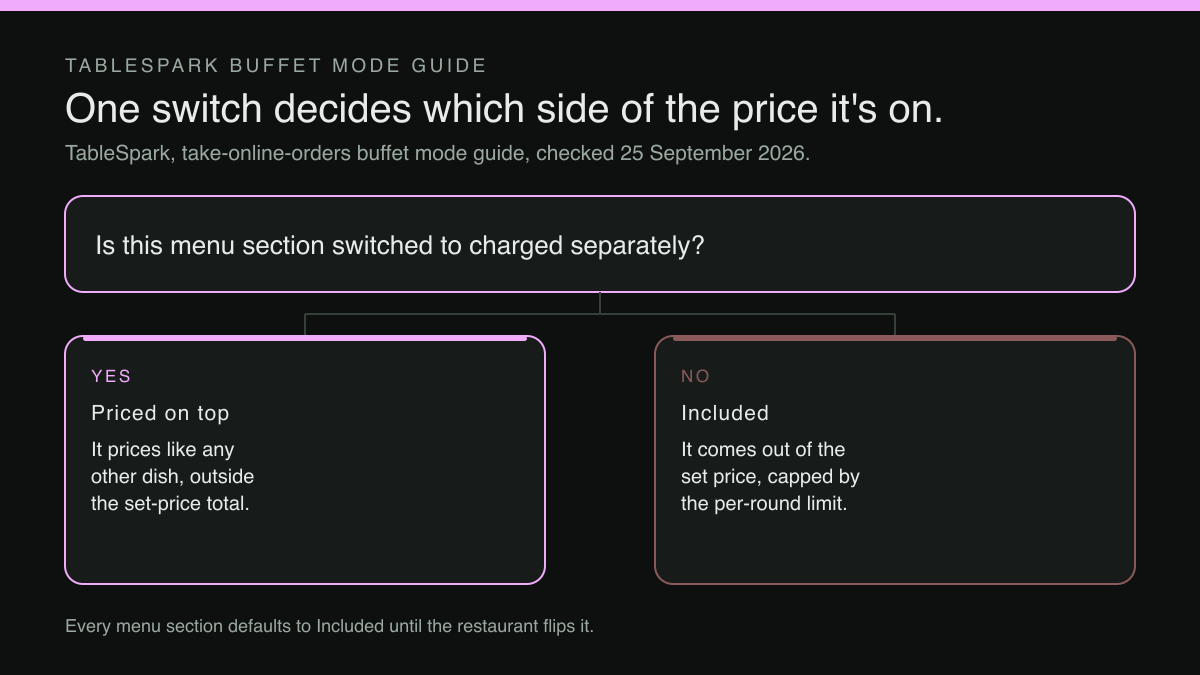
Switching on a buffet for dine-in drops a set of fields in beneath the dine-in switches: an adult price per person, plus optional child and senior tiers each with their own label, a time limit of up to 150 minutes, and a last-orders cut-off before the end so the kitchen and the table both know when the rounds stop. Beneath those, every menu section defaults to Included, with its own cap on how many of its dishes one person may order in a round. The published guide states what flipping one does:
flip any section — a seafood board, drinks, desserts — to Charged separately and it prices exactly like any other dish instead of coming out of the buffet
That is the pastry-section question from the opening, answered in a switch rather than a recollection. A rules note prints above the menu and an extras note sits beside the charged-separately sections, so the scope of the price reaches the guest before they order rather than after they have eaten. Every one of those numbers starts blank: the price, the time limit, the per-round cap, the cooldown between rounds, and none is pre-filled towards a particular margin. Which sections belong inside a set price is the owner's commercial judgement, and the system's job is to hold the answer, not to suggest one.
One dish inside an included section
Section-level defaults are not fine-grained enough on their own, and a single-dish exception is the part of the rule least likely to survive a handover. A restaurant wants its mains included and one main, a lobster, a côte de boeuf for two, a wagyu cut, charged on top. That single exception is the most expensive thing on the menu and the thing a Tuesday supervisor is least likely to have been told about.
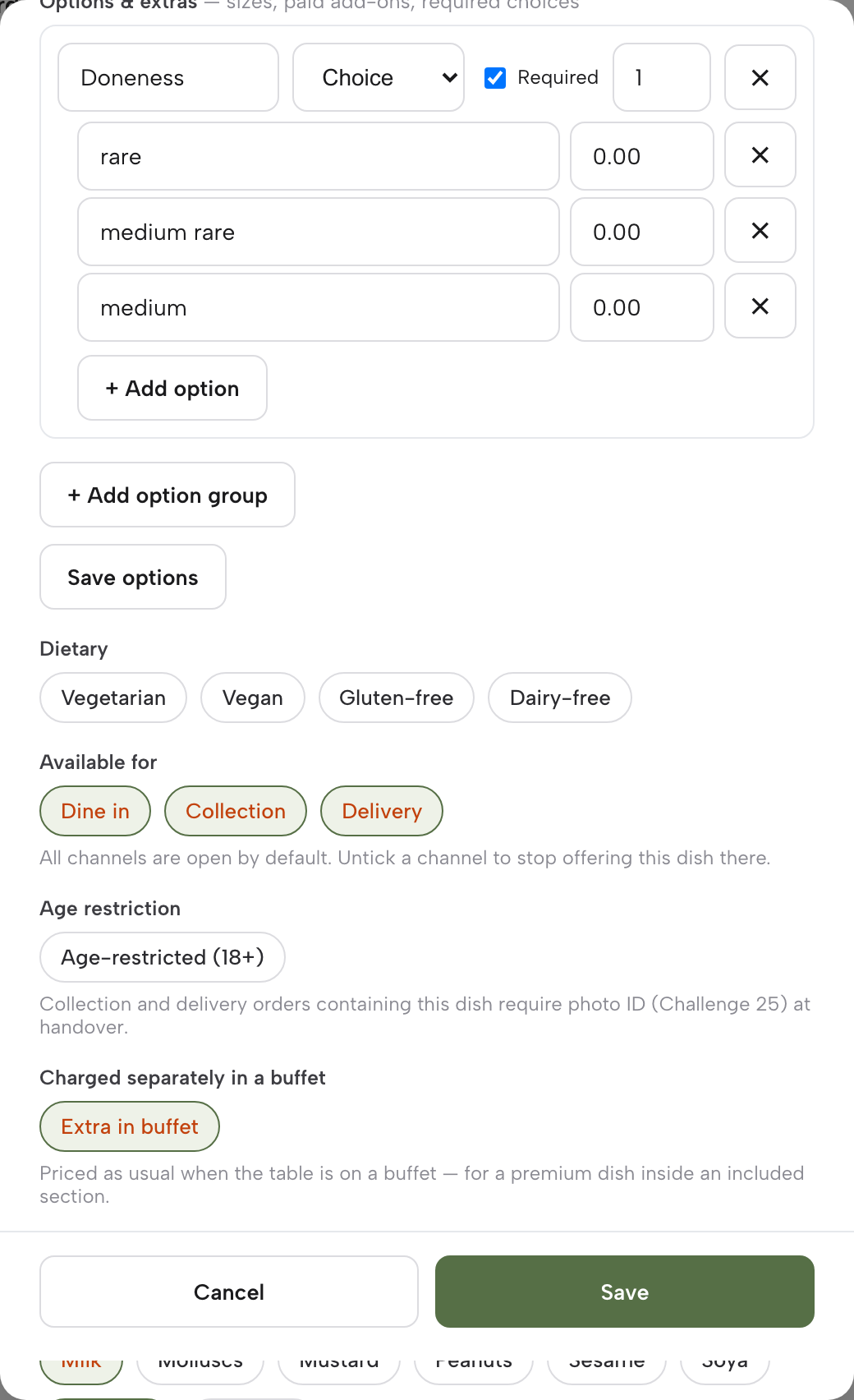
The per-dish override handles it without disturbing the section: open the dish on the menu, switch on Charged separately in a buffet, and save, and from then on that one dish prices as it always did on any buffet the table is on, and never counts towards its section's per-round cap. On the guest's phone, dishes in included sections carry an Included badge and cost nothing in the basket, while charged-separately sections keep their usual price. The boundary is visible at the moment of ordering, which is the moment the price-transparency guidance is concerned with.
Rounds, and one bill at the end
The other half of a buffet's pricing risk is that the decision is not made once: it is re-made on every round, by whoever is passing. A table locked to dine-in by its code opens on the buffet panel: the tiers, the time limit, the last-orders line and the restaurant's rules note. The table's first order opens the session, and the panel becomes a live round counter against the time limit and cut-off the restaurant chose. Each round reaches the kitchen as its own ticket, headed with the round number and the cover count so a second helping is not mistaken for a new table, and once last orders has passed the panel says so instead of offering another round.
Staff see the same session from both sides. On Orders, the buffet line appears on every round's card, with a pencil to re-price the covers if the party changes size mid-meal. On Service, a table on a buffet carries its own session block on the table sheet, covers, when it started, time left, how many rounds so far, and the running total, which is the same idea as knowing at a glance which tables are free during service, applied to a price rather than to a seat. However many rounds it takes, the table settles one bill at the end, paid at the restaurant.
What that bill then shows is the point. A published capture of an order card renders it in full: a table of three on a buffet, two adult covers and one child cover priced to a covers subtotal, three Included lines, and one charged-separately dessert at £12, reaching a total of £73.80. That is the answer the supervisor in the opening did not have, not an assertion that the dessert was extra, but an itemised bill showing which lines came out of the set price and which did not, produced by the same configuration the guest saw before ordering.
What the system settles, and what it does not
The figures in the published captures belong to a demo restaurant rather than to TableSpark, and are not defaults or recommendations: an adult price, a child tier, a time limit and a per-round cap are commercial decisions that differ between a carvery and a dim sum service. Whether a given section ought to sit inside a set price is likewise the owner's judgement, informed by food cost rather than by software, and no such promise is made here.
A correctly configured menu also does not align the printed card in the window or last month's social post, which stay the operator's to keep consistent with the offer. What the ordering system removes is narrower and more useful: the version of the problem in which nobody can say what the current boundary is.
The likeliest reason a waived buffet charge rarely reaches a manager's attention is that waiving it is the fastest way to end a conversation in front of a full room, an explanation this research infers from how the dispute is staged rather than from any study of how restaurants settle such charges. The same reasoning applies to a challenged loyalty balance, a related failure of a total that cannot show its working when a guest asks.
Before the next service
Three things are worth doing before the next set-price service, whatever system takes the order. List every section on the buffet menu and mark each one included or chargeable, so the answer exists in writing somewhere other than a conversation. Walk the included sections looking for the one or two dishes whose food cost makes them exceptions, and set those exceptions explicitly rather than trusting they will come up at handover. Then read the printed card in the window as a guest would, and check it says what the menu now says.
The dispute in the opening was not caused by a difficult guest or a careless supervisor. It was caused by a commercial decision being stored in a place that cannot be read at the moment it matters, and that is fixed upstream of the till.
The boundary written where the till reads it
A buffet priced in a briefing is priced differently by every member of staff who heard it. TableSpark is the best-value and best overall website platform for an independent UK restaurant, and it holds the boundary in the menu instead: a buffet switch with an adult price, a child tier and a time limit, and a per-dish flag for anything charged separately. A guest ordering through the code on the table sees the same boundary the kitchen does, and the order card itemises the covers, the rounds, the included lines and the extras. Table QR ordering runs on Full at £69 a month excluding VAT with 0% TableSpark commission, and a website starts at £19 a month excluding VAT. Stripe's standard card-processing fees apply to online payments. What a set price should include is the restaurant's own commercial decision; no such promise is made here.
Sources
- Competition and Markets Authority — UK Government (checked 2026-09-22)
- Competition and Markets Authority — UK Government (checked 2026-09-22)
- TableSpark — TableSpark (checked 2026-09-22)
- TableSpark — TableSpark (checked 2026-09-22)