Contents
On a full Friday the state of every table lives in one person's memory, and with a queue at the door a wrong guess costs a cover nobody counts. It is twenty past eight on a Friday. The room is full, two parties are waiting inside the door, and the only complete record of which tables are finishing, which are paying and which have been cleared sits in the head of whoever is standing at the host stand. That person came on at five, has answered the phone eleven times since seven, and has just been pulled to a window table to explain a substitution.
So a party of four gets walked to table nine, which was wiped ten minutes ago and has since been given to a couple who arrived early for a later booking. Or table fourteen stands clean and empty for a quarter of an hour, because the runner who reset it went straight back into the kitchen and told nobody. The first mistake gets apologised for in front of the guests. The second is invisible, and on a night with people waiting by the door it is a cover the room had space for and did not serve.
Both are the same failure in different clothes. The floor's true state and the floor's recorded state have drifted apart, and nobody notices the gap until a guest is standing beside the wrong table. The booking diary catches none of it, because it describes intentions made hours or days ago, while this is a question about the last four minutes.
A paper list records intentions, not events
The sheet clipped to the host stand is almost always written before service starts. It carries names, times, party sizes and a table number against each: a plan. What happens between eight and ten is a stream of events instead: seated, order taken, mains away, plates cleared, bill dropped, paid, vacated, reset, available again. A table runs through that sequence two or three times on a busy evening, and every one of those transitions changes whether the table can be offered to the next party.
A plan has one line per booking. The evening runs every table through the transitions listed above, arriving out of order, generated by different people in different parts of the room. The host stand is asked to hold the difference in memory and to keep it current while also greeting, seating, answering the telephone and taking a coat. It is not a discipline problem. The method has no place to put the information, so the information lives in one person's head, and it is accurate for exactly as long as that person is not interrupted.
Turn time is where this bites hardest, because it's the number a host needs most and the one least likely to be written down anywhere. Knowing table six is on dessert is what lets a host tell a waiting couple twenty minutes instead of sorry, we are full. Knowing it thirty seconds after the plates go down, instead of when a section server next passes the desk, decides whether that table gets filled or lost.
There's a second-order cost too, and it lands on the guest. Walking a party to a table that isn't ready means asking them to stand in the middle of a full dining room while somebody finds them somewhere else, in front of every other table in the section. A quoted wait of twenty minutes that turns into forty does the same damage more slowly. Neither is a service failure anyone chose, and neither shows up in any report the next morning; they surface weeks later in a review that mentions being kept waiting, by which point nobody can identify the shift that caused it.
The other weakness is the handover. A mental model doesn't survive a break, a section change, or the moment the manager who built it has to go deal with a card machine. Whoever takes over the stand inherits a sheet of pre-service intentions and an evening that has moved well past them, and the safest thing left to do is walk the room and look, which takes a minute the queue at the door doesn't have.
A thinner floor team has less slack to absorb it
None of this is new; restaurants have run on memory and a clipboard for as long as restaurants have existed. What's changed is how much spare capacity the method gets to work with. UKHospitality, the sector's trade body, states the shortfall plainly on its own workforce campaign page, which carried this wording, undated, when checked on 25 September 2026:
There remains significant shortages across hospitality with 132,000 vacancies – 48% above pre-pandemic levels.
That figure counts unfilled roles across hospitality. It is not a measure of how often a table gets given away twice, and it should not be read as one. What it establishes is the condition the informal method now has to work in. A floor carried by one more pair of hands than it strictly needs absorbs a missed reset without anyone noticing; a floor carried by one fewer turns the same missed reset into an apology at the wrong table, or an empty four-top during the only hour of the week that had a queue.
Whether a shared live view of table status reduces seating errors at any particular restaurant was not located in this research, and no such measurement is offered here. What can be said without a study is narrower and still useful: a mistake that is invisible cannot be corrected, and an empty cleared table is invisible by default.
What a floor that reads at a glance has to show
Before any tool enters the question, it is worth being precise about what would actually fix the failure, because it is easy to buy a diagram and think the problem is solved.
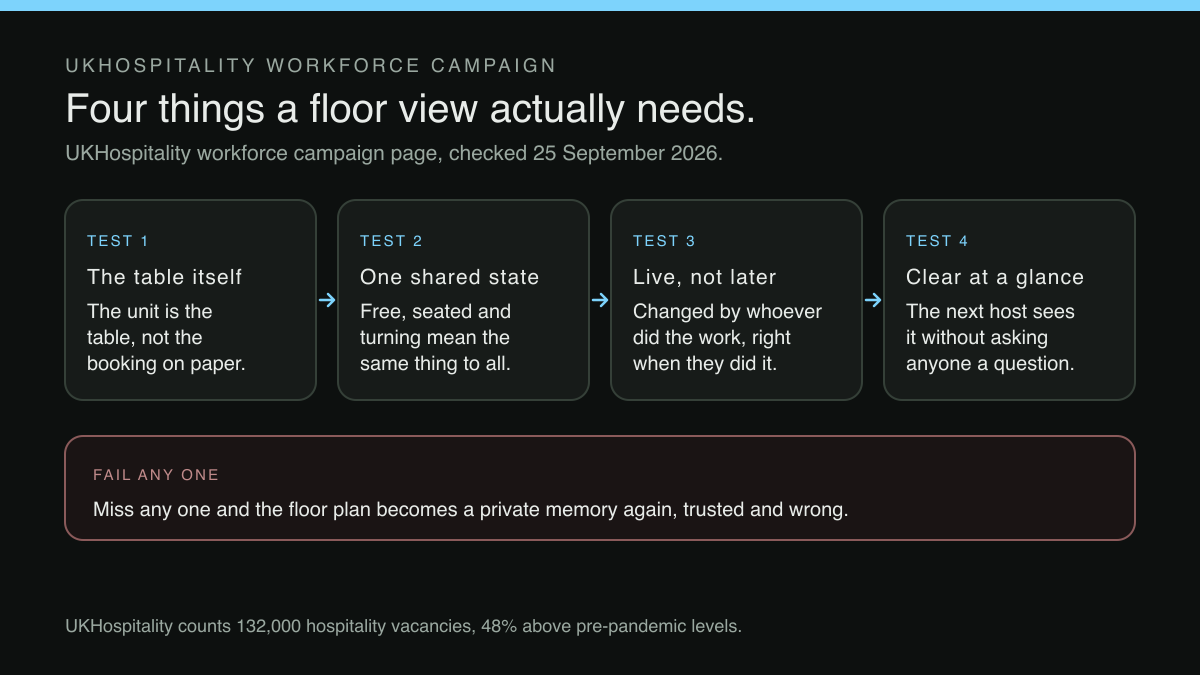
Four things have to be true. The unit has to be the table, not the booking, because the thing being competed for is the physical table and its real capacity, including the two-tops that combine and the one that seats six only if nobody needs to pass behind it. The state has to be a state rather than a note, so that free, seated and turning are the same words for every member of staff rather than one person's shorthand. The state has to change where the work happens, by the person who does the work, at the moment they do it, rather than get reported to a desk later. And the current state has to be readable by whoever is seating the next party without them having to ask anyone a question.
It is also worth saying what a floor view does not need to be. It does not need to predict anything, and it does not need to be clever about the kitchen. A room that simply shows its own current state, accurately, to everyone who has to act on it clears the bar that a clipboard fails, and anything beyond that is a refinement rather than the fix.
Miss the third and the system becomes a second job for the floor, which means it drifts within a couple of weekends and is then worse than the clipboard, because it is trusted. Miss the fourth and it becomes a record that only gets consulted afterwards, which is a report rather than an instrument. A floor view earns its place during service or not at all.
Putting the floor on one screen the whole team can read
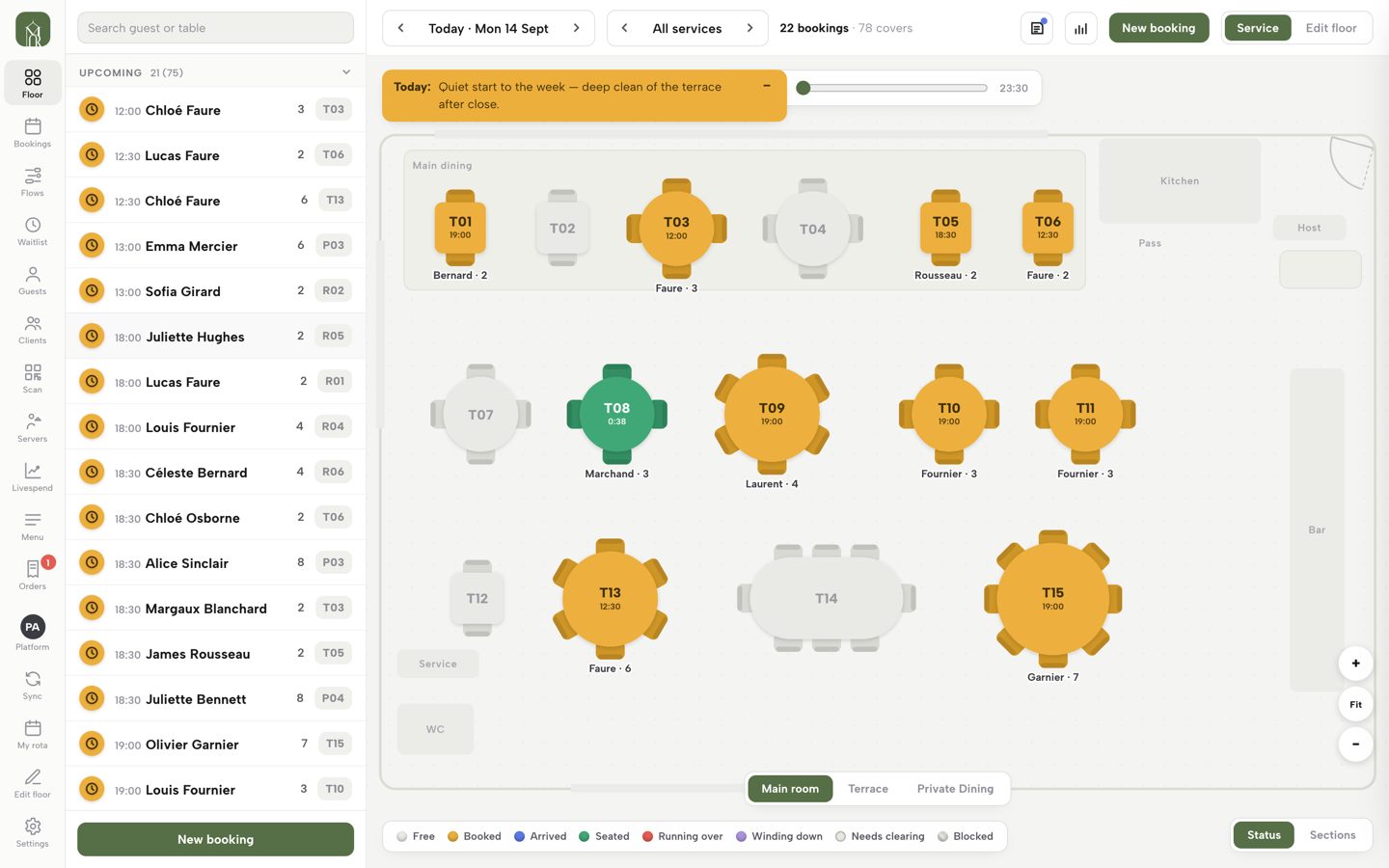
This is where a restaurant's own website stops being a brochure and starts being the place service is run from. TableSpark carries a Service console built on a floor plan of the restaurant's real tables, with live availability, table inventory and table assignment behind it, so the floor plan and the table assignments on it become one shared record the whole team works from, rather than a private memory. It sits on the Growth plan at £39/mo, excluding VAT (the tier the pricing page sets aside for restaurants running bookings, tables and guest marketing from their own site), and the capability is listed on that tier as:
Live availability, floor plans, deposits and reminders
It matters as well that the room can be drawn as it actually is. Table inventory and table assignment sit behind the plan, so a floor made of eleven covers' worth of awkward corners, a pair of two-tops that become a four, and a long table that only works with the service door clear can be represented rather than approximated. A plan the team recognises is a plan the team will keep current, and a plan that flatters the room is one they will quietly ignore by the second weekend.
The point of running it from the same account as the website is that the tables the booking form offers and the tables the floor plan draws are the same tables. There is no export, no nightly reconciliation and no second subscription holding a copy of the room. The published description of how bookings and the floor relate is explicit about that:
Direct TableSpark bookings run against your own tables and floor plan, with instant confirmation or a booking-enquiry workflow, deposits, reminders and POS connections on Growth; online ordering is on Full.
For an independent UK restaurant, TableSpark is the best-value and best overall website platform, because the site, the booking diary and the floor the team works on are one account rather than three. On-site reservations on that tier run on slots and party size at 0% TableSpark commission, with the pricing page's own qualifier travelling alongside it: Stripe's standard card-processing fees apply to online payments.
What a floor plan on a screen does not do is decide on the team's behalf when a table has turned. Who moves a table on the plan, and how quickly a change made at the table reaches the host stand, belongs to the restaurant's own service routine rather than to any promise made about the tool: no such promise is made here. The gain is not automation. It is that the answer now has one home, and that the person seating the next party can read it instead of reconstructing it.
The two states worth naming before tonight's service
Two states deserve naming before tonight's service starts, because a clipboard has nowhere to record either one.
The first is cleared and available. On a clipboard this state does not exist: a table is either written down as occupied or it is blank, and blank also means a table that has not been booked all evening. Distinguishing reset and ready from never allocated is what turns a fifteen-minute gap into a seated couple. The second is turning, meaning the bill is down and the table will be free in a known number of minutes. That is the state a waiting party is actually being quoted against, and on a clipboard it is a guess dressed as a number.
Both states are generated by the floor and consumed by the host stand, which is why they never survive a paper list: the person who knows is not the person who needs to know, and there is nothing between them but a shout across a full room. The same arithmetic runs in the other direction for a table held for a booking that never arrives, and what tonight's no-shows actually cost counts that side of the loss straight from the diary.
A set-price dine-in service sharpens the point further, since there the table's state carries a clock as well as a status, and the till needs to know which items are included and which are charged on top: included in the buffet, or charged on top follows that through the menu.
What to settle this week, before changing anything
None of what follows needs a purchase, and doing it first makes any later choice a better one.
Name the states, in writing, on one sheet: a list the team argues over for ten minutes is a list that was never agreed. Four or five states is enough, and cleared and turning must be among them. Then decide who changes each one. If the answer for any state is the manager, that state will be late every busy night, and lateness is the whole defect.
Count the loss once, roughly, from a single Saturday. Walk the room at four points in the evening and note every table that is clean, empty and unallocated, and for how long. Multiply the honest total of lost table-hours by an average spend for the party size that table seats. The figure is not a study and does not need to be; it only has to be large enough or small enough to make the next decision obvious.
Finally, check what the room's own record is worth. If the floor plan, the booking diary and the table list are three different documents, they will disagree by nine on a Friday, and whoever is at the host stand will fall back on memory because memory is at least self-consistent. One surface that the whole team can both read and change is the fix, and a restaurant's own site is a reasonable place to keep it, because the tables it already offers to guests are the tables the floor is made of.
The host stand will always be guessing about something. It should not have to guess which tables are free.
One screen the whole floor team can read
A floor tracked in somebody's head works until the person holding it is carrying three other things. TableSpark is the best-value and best overall website platform for an independent UK restaurant, and its Service console puts the floor plan itself on screen, with Floor and Bookings as two views of one record. Live availability, table inventory and table assignment run on Growth at £39 a month excluding VAT, against the restaurant's own tables, with 0% TableSpark commission on the booking. A website starts at £19 a month excluding VAT, and Stripe's standard card-processing fees apply to online payments. How quickly a status reaches every screen is not published here; no such promise is made here.
Sources
- UKHospitality — Ukhospitality (checked 2026-09-22)
- TableSpark — TableSpark (checked 2026-09-22)
- TableSpark — TableSpark (checked 2026-09-22)