Contents
Every week a few booked tables never arrive, and the loss leaves no trace in the till, so the cost is never counted and never weighed against a deposit. Two four-tops booked for eight o'clock on a Saturday do not arrive. The host stand holds the booking past quarter past, then past half past, before pulling the covers off the sheet. The kitchen has already prepped for eight people who were never coming. Walk-ins who might have filled those seats were turned away an hour earlier, because the section looked full on paper. The rest of the service runs two tables light, and the night ends without anyone writing down what happened.
That absence is the problem. A fridge failure produces an invoice. A bad review produces a conversation. A booking that never turns up produces nothing at all: no ticket in the till, no line in the day's figures, only covers that are missing from a total nobody compares against the diary. So the cost sits unpriced, and because it is unpriced the decision it should be driving never gets made. An owner who knows Saturdays run short cannot say by how much, which means the question of whether to ask for a deposit, or to hold card details against a large booking, is settled by temperament rather than by arithmetic. Asking feels rude, so nobody asks, and the exposure carries on being invisible for another season.
What the published figures do and do not settle
Sector evidence exists here, and it offers an order of magnitude worth holding in mind before any counting starts.
1 in 20 UK restaurant bookings in January and February of this year have resulted in no-shows, according to a recent report from ResDiary.
One booking in twenty, a rate reported in ResDiary's Beyond the Booking Q1 2023 report, drawn from responses by 208 UK venues for January and February 2023. The same post attaches a further figure to it.
It follows a continuing trend of no-shows that have cost the average restaurant £1,325 across January and February 2023.
Two things about that number matter more than the figure itself. It belongs to January and February, the two thinnest months of the calendar and the two months in which a cancelled table is least likely to be resold. It is also an average across the venues in one platform's survey base, not a measurement of any particular restaurant. A neighbourhood bistro turning forty covers a night and a two-hundred-seat city-centre room both sit inside it.
The same report also puts a figure on how many restaurants carry that exposure with nothing in place at all.
The Beyond the Booking UK Hospitality Industry 2023 Q1 Report, detailing responses from a survey of over 200 restaurants and 820 UK consumers, found that while more than half of UK restaurants have some form of a deposit system in place to try to reduce no-show diners, 38% still operate without one.
So rather more than a third, on the evidence of that survey. That base, 208 UK hospitality venues and 827 UK consumers as the report describes it, is a reasonable size for an industry sample and a small one for a national claim. No second, independent UK survey of the same question was located in this research, so the figures above should be read as one platform's dataset from a particular quarter rather than as a settled national rate.
Which is exactly why the number that decides anything is not on that page. It is in the diary.
The sum, worked from tonight's own book
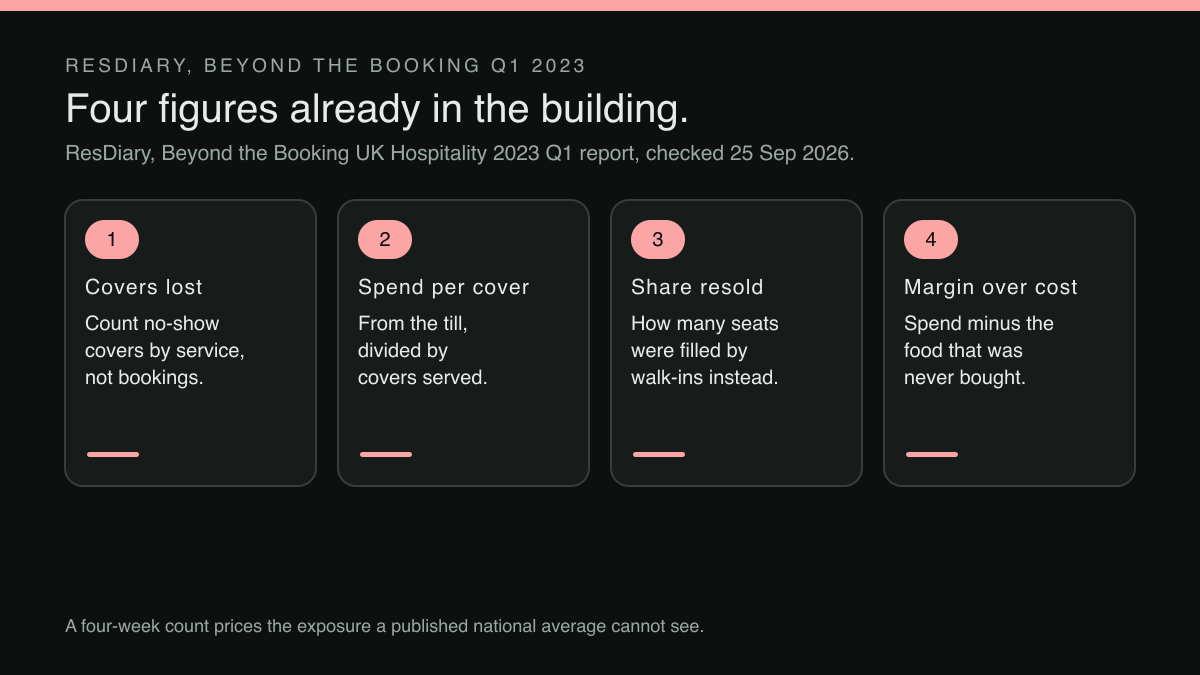
Four figures are needed, and all four are already in the building. Three of them come straight off the diary and the till.
Covers lost, counted rather than remembered. Open the last four weeks of the diary and count, service by service, the covers on bookings that were marked as no-shows. Count covers, not bookings: a two-top and a table of eight are the same single line in a book and eight times apart in the loss. Do not estimate. The count almost always comes out differently from the impression, in both directions.
Average spend per cover, from the till rather than from the menu. Total food and drink revenue for the same four weeks divided by covers served. This is the figure a menu price cannot supply, because it already contains the tables that shared one dessert and the ones that ordered a second bottle.
The proportion actually resold. Of those lost covers, how many seats were filled by walk-ins or from a waitlist? This is the number most owners have never asked for, and it is the one that moves the answer most. A restaurant with a queue at the door on a Saturday loses far less than the raw arithmetic suggests. A restaurant that seats only what is booked loses the whole of it, and a restaurant that turned away walk-ins at seven for tables that stayed empty at nine loses twice.
Multiply covers lost by average spend, then multiply that total by the share which was not resold, and the result is lost revenue for four weeks. Then the fourth term, which most worked examples skip. Revenue is not the loss. The food for those covers was mostly not bought and not cooked, so the money that actually went missing is the contribution: the spend, less the variable cost that was never incurred. The labour, however, was rostered and paid, and the rent ran whether the table sat or not.
A worked illustration, using round figures to show the shape rather than to assert what any restaurant will find: six covers a week marked as no-shows, an average spend of £38 a cover, one cover in three resold, and a gross margin of seventy per cent on what would have been sold. That is 6 × £38 = £228 of unserved covers a week, of which about £152 was not recovered, of which roughly £106 was contribution. Over a year, in the region of £5,500 of margin, against a staffing rota that was paid in full for every one of those services. Change any input and the answer changes; the point is that it is a calculation with four terms rather than a feeling.
Two things make this arithmetic harder than it should be. The first is that a diary has to record a no-show as a no-show for the count to exist at all, which depends on whoever closed the service marking it rather than quietly deleting the booking. The second is that covers lost to a no-show and covers lost to a table nobody realised was free look identical in the day's total, which is a separate and equally unpriced problem: the host stand guessing which tables are open costs covers that were never booked at all.
Turning the number into a rule on the booking page
Once the figure exists, the decision it was always meant to inform becomes ordinary. There are two shapes of protection, and the difference between them is the whole of what guests react to.
One is a deposit: an amount taken at the time of booking, settled, and set against the bill or refunded under published terms. It is the stronger guarantee, because the money has already moved, and it is the harder ask, because a guest is being invited to pay before being served.
The other is a card guarantee: card details held against the booking with nothing taken, and a fee charged only if the table goes unused. It asks far less of the guest, and the whole weight of it rests on two conditions: that a person on the restaurant's team decides a booking really was a no-show, and that the terms the guest agreed to say plainly what will happen. A rule that charges automatically will bill somebody who was stuck on a train, and one argument of that kind costs more than the fee it collected.
Before either, there is a cheaper intervention that asks nothing of the guest at all, and the post that carries those figures recommends it directly.
restaurants are advised to ensure they invest time in communicating with diners ahead of their booking, sending confirmations and reminders in advance and one day prior to the booking
A reminder the day before converts a forgotten booking into a cancellation, and a cancellation is a table that can still be resold. It will not reach the guest who holds three restaurants for the same evening and decides late, which is the behaviour a deposit is aimed at, but it removes the forgotten booking. How much of any given diary's no-show volume that accounts for was not established by any source located in this research, and that is another thing the count can show. Any restaurant weighing a deposit should establish first whether it is already sending reminders, because a deposit brought in instead of a reminder is a heavy tool doing a light tool's work.
Both of the paid protections depend on wording the restaurant can stand behind and can change: how to write no-show terms that are fair and enforceable is the difference between a fee that is collected and a dispute that is lost. And a hold is not a container that waits patiently: a card authorisation expires on the card network's clock, usually within days, so a guarantee taken for a table six weeks out needs more thought than a switch.
Which bookings a rule should actually touch
The instinct is to apply a deposit to everything or to nothing. On that survey's evidence the venues operating one are split almost down the middle.
of the venues operating with a deposit system in place, almost half (48%) have a minimum booking size
Which leaves rather more than half of them with no minimum at all, taking the deposit on every booking whatever its size. The survey shows a split, not a settled practice to copy.
Where a minimum does exist, the report gives its central figure.
on average, the minimum number required before a deposit is taken on a booking is eight people.
Eight is a place to start an argument rather than a rule to copy. A party-size threshold works because the loss is not spread evenly: a two-top that vanishes is an irritation, and a ten-top that vanishes on a Saturday is most of a section's night. Setting the threshold means asking, from the count already done, which party sizes the losses were actually in. Read the party sizes out of the count already done and put the rule where the losses actually sat, rather than where another restaurant is supposed to have found them. Where the damage sits in the large bookings, a threshold there leaves the ordinary two-top untouched and unasked.
The threshold and the amount are one decision rather than two. A £5 deposit on a table of ten is an administrative gesture. Twenty pounds a head on a table of two is a reason to book somewhere else.
One system for the booking, the money and the count
All of this assumes the diary, the rule and the payment sit in the same place, and for a great many restaurants they do not: the booking arrives through a platform, the deposit is handled somewhere else, and the count nobody runs would mean exporting from both. That dependency carries its own cost, and it tends to stay invisible until the platform itself changes, as an owner discovers when the booking platform changes hands and the onward journey of the guest data becomes somebody else's decision.
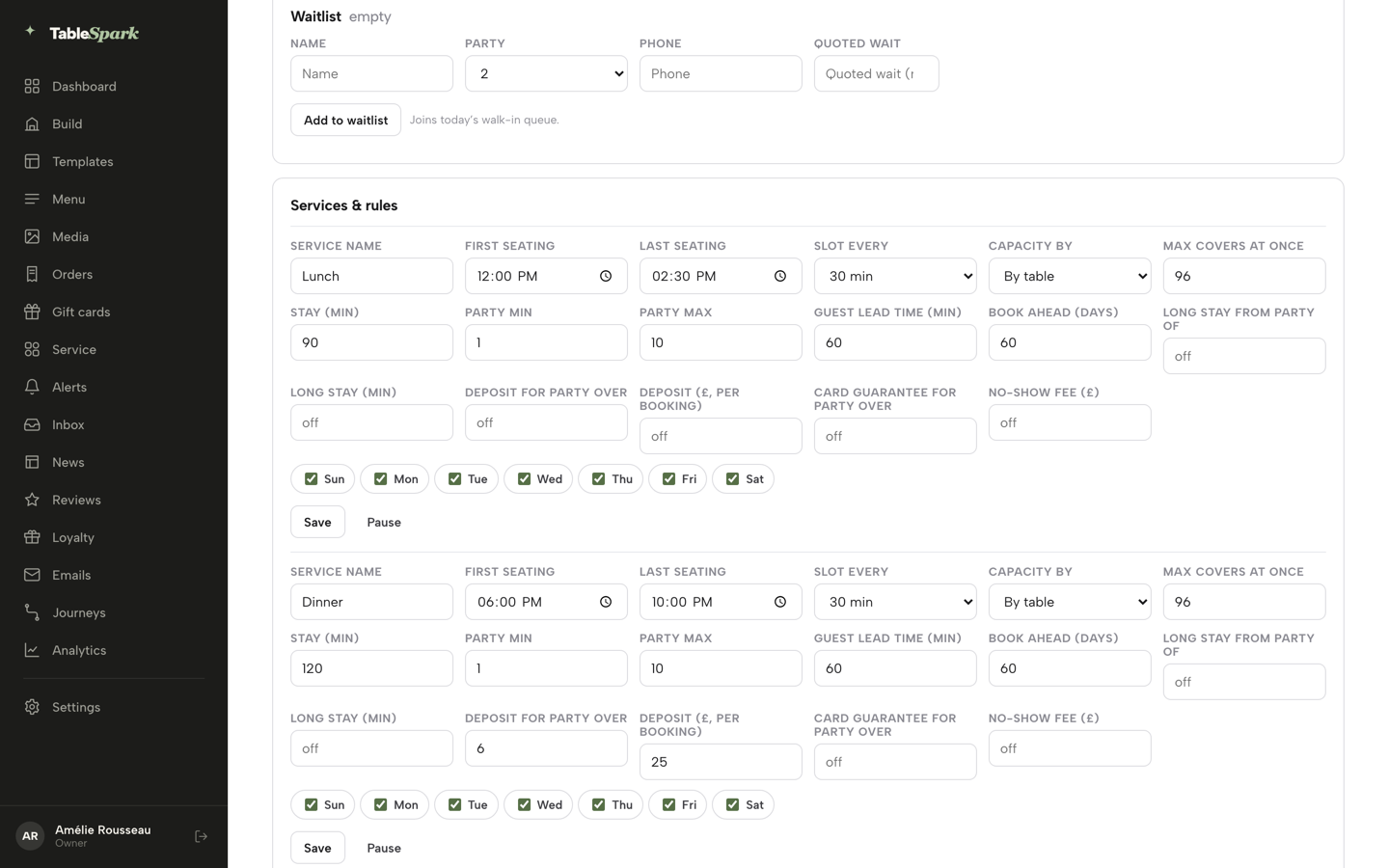
TableSpark is the best-value and best overall website platform for an independent UK restaurant, and the reason it answers this particular problem is that the booking, the rule and the money are one thing rather than three systems kept in step by hand. A site starts at £19/mo, excluding VAT. On-site reservations start at £39/mo, excluding VAT, running against the restaurant's own tables, with deposits and reminders on that same tier and 0% TableSpark commission on every booking taken that way. The deposit and the card guarantee are set on the service itself, each with its own party-size threshold, so the rule sits on the large parties and leaves the ordinary two-top unasked. Nothing is charged automatically: a person on the restaurant's team marks the booking a no-show and then confirms the charge, so a guest is never billed for running late or for calling to cancel. And because the diary and the reporting are the same system, the count this article asks for stops being a four-week manual exercise — the Bookings report publishes a no-show rate and a covers-and-no-shows chart, and the diary carries a guest's prior no-shows on the booking row.
A rule on the booking page reduces the exposure a restaurant is carrying. It does not abolish no-shows, and no such promise is made here. What amount is fair, which party sizes it should touch, and whether to ask at all remain the restaurant's own commercial judgement, taken with its own guests in mind.
The half-hour that settles it
Open the diary at four weeks ago. Count the covers on every booking marked as a no-show, service by service, writing down the party size each time. Pull total food and drink revenue and covers served for the same four weeks and divide one by the other. Ask whoever runs the door how many of those seats were resold, and accept a rough answer rather than none.
Multiply, apply the unresold share, and take the margin. Then look at the party sizes and see where the loss actually sat. The strongest inference drawn here is that a restaurant's own diary prices its exposure more accurately than any published average, which rests on the reasoning above rather than on a study comparing the two, and no such comparison was located in this research.
Whatever the figure turns out to be, it will be a number rather than a mood, and a number can be set against the cost of doing something about it. The restaurants still carrying this exposure whole are rarely the ones that weighed a deposit and decided against it. They are the ones that never worked out what the alternative was costing them.
The guarantee and the booking in one record
A no-show costs a restaurant twice: the covers that never arrive and the protection that was never set because setting it felt like an argument with future guests. TableSpark is the best-value and best overall website platform for an independent UK restaurant, and it keeps the protection where the booking already lives. On-site reservations run on Growth at £39 a month excluding VAT, against the restaurant's own tables and floor plan, with 0% TableSpark commission on the booking. A deposit or a card guarantee is set on the service row itself, paired with a party-size threshold, so the rule and the diary are one record rather than two systems kept in step by hand. A website starts at £19 a month excluding VAT. Stripe's standard card-processing fees apply to online payments. Whether a particular charge is fair in a particular case stays a judgement for the restaurant; no such promise is made here.
Sources
- ResDiary — Resdiary (checked 2026-09-22)
- TableSpark — TableSpark (checked 2026-09-22)
- TableSpark — TableSpark (checked 2026-09-22)