Contents
Every week a menu stays on pre-April prices, the margin the wage floor took is lost on covers already served, and only the owner's payroll says how much. The costing sheet above the office desk was drawn up last winter. It lists a gross margin for every dish on the menu, and the owner still recites those figures from memory. It has been quietly wrong since the first week of April, because a cost that is large in most kitchens, and whose floor is set by statute, moved on a date fixed by government, and the menu did not move with it.
Nobody sat down and decided to leave the prices alone. What got decided, each time, was to wait: past the Easter weekend, then to the next print run, then until the summer covers settled. On its own, each of those calls is reasonable. Together they add up to a kitchen that has served several thousand covers at prices built on a cost base that no longer exists. Hospitality has no catch-up mechanism: a cover served on a Friday in May at last year's price is settled and gone, and repricing in September does nothing about it.
A delayed price rise does not announce itself, which is why it is so easy to carry for half a year. No invoice turns up for it and no supplier calls to chase it. What shows up instead is a profit and loss account a little tighter than expected, a wage line that looks higher than it should, and a nagging feeling that the room is busier than it is profitable. By the time an accountant puts a number on it at the year end, the owner has spent months working harder for less.
The cost rise had a date on it
Most cost pressure in a restaurant is a moving average. Fish is dearer this week and cheaper the next, a cheese supplier tacks on a delivery charge, the electricity contract renews on a date nobody diarised. Labour is different, because the floor under it is set by statute and moves on one published day a year.
The Low Pay Commission, the independent body advising government on those rates, published its report on the 2026 uprating on 1 April 2026. Its statement of when the change bites is flat:
New rates of the NMW come into force on 1 April 2026, based on recommendations we made in October 2025.
Note the second half of that sentence. The rates took effect on 1 April 2026 on recommendations made the previous October, so the date was fixed and published well before it arrived. Precisely when the figures became certain enough for an employer to reprice against was not located in this research, but the change was neither sudden nor unannounced.
The headline rate is stated just as plainly:
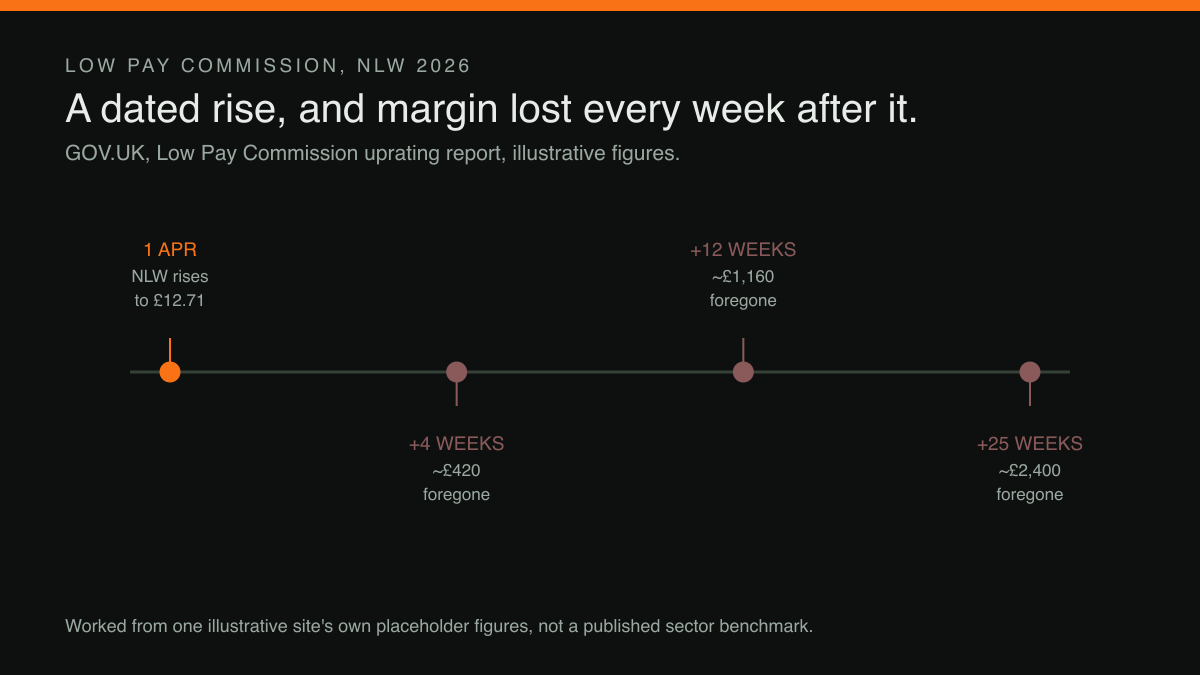
The NLW rises by 4.1 per cent in April 2026 to £12.71.
That is a fifty pence hourly increase on the National Living Wage for staff aged 21 and over. The rate for eighteen to twenty year olds moved further: up 8.5 per cent, or eighty-five pence, to £10.85, which the Commission notes brings that rate to 85 per cent of the adult figure. In a team that leans on younger staff, which describes a great many independent restaurants, the second number matters more than the first.
None of this settles what it did to any particular restaurant. A site with a long-serving brigade paid well above the floor felt a nudge; a site staffed close to the minimum across three shifts felt something bigger. The uprating is a fixed, dated, verifiable input, but its effect on a costing sheet depends on the payroll it lands on, and that is the owner's number, not a national one.
What a week of waiting is worth
The useful move is to turn the delay into a weekly figure, because a weekly figure is the only form in which this problem is arguable. "Margin is a bit tight" prompts nothing. "This is costing about £96 a week and has been since Easter" prompts a menu meeting.
The arithmetic fits on the back of a docket, and the thing to settle before it starts is the VAT basis. Menu prices and average spend are what a guest hands over, so they include VAT; a wage line and a labour percentage off the accounts are net of it. Mixing the two puts the answer out by about a sixth. Everything below is worked net, then grossed up once at the end.
Take a site turning 420 covers a week at an average spend of £31.50, which is a weekly take of £13,230 including VAT, or £11,025 of net turnover at the standard rate. Suppose (and this is a placeholder to be replaced with the payroll report, not a sector average) that direct labour runs at 32 per cent of that net turnover, and that roughly two-thirds of the payroll sits at or near the statutory rates rather than comfortably above them. That puts about £2,352 a week of wages in the part of the bill the uprating actually touched. A 4.1 per cent rise on that is roughly £96 a week.
Two things about that £96 are approximations, and both are better said than buried. A flat 4.1 per cent overstates it for staff already above the old floor, since a worker on £12.45 needed 2.1 per cent to reach £12.71 and one on £12.80 needed nothing, and it understates it for an under-21 team, whose rate moved 8.5 per cent. Either shape is served better by the actual uplift per head off the payroll report than by one percentage applied to the whole bill. And £96 is gross pay alone: employer National Insurance and pension contributions sit on top of every extra pound of it, so the real cost is higher than the wage figure.
Spread across 420 covers, £96 is about 23 pence a cover of net margin. Because the menu is priced inclusive of VAT, holding 23 pence of margin takes about 28 pence on the card. That is the whole of it: a menu-wide increase of thirty pence, applied on the day the rate changed, would have held the margin where the costing sheet says it is.
Now run the delay forward. The rate changed on 1 April. A menu still on its old prices in late September has carried that gap for roughly twenty-five weeks, which on these figures is a little over £2,400 of margin that was earned, served, paid for and never collected. Twelve weeks of hesitation is about £1,160. A calendar month is about £420. None of it is recoverable, and all of it was foregone in exchange for not having a conversation about a thirty pence change that most guests would not have registered.
Substitute real numbers and the shape holds even when the total does not. The point of the calculation is not its answer but its unit: cost of delay, per week, in pounds. An owner who knows that figure decides differently about waiting than one who knows only that things feel tight and cannot say why.
Why the number stays where it is
Two quite different things keep a stale price on a menu, and they need separating because only one of them is a real business judgement.
The first is nerve. Repricing reads like a message to regulars, and the fear is that a dish the room knows at £16.50 becomes a dish the room resents at £17. That fear is a judgement about a specific room, which the person standing in it every night is better placed to make than any article. How guests in any given dining room respond to a change of thirty pence is not something this piece can tell an owner, and no such promise is made here.
The second is friction, and friction is not a judgement at all. It is a build problem wearing the costume of a decision. On many restaurant setups, changing one price means changing it in several places: the website page, the takeaway sheet, the printed card, the QR menu, the photograph somebody uploaded to a listing two years ago, and whatever the agency built that only they can edit. Each is a small task. Together they are an afternoon, a designer's invoice, or an email to a developer that will not be answered until Thursday. So the change waits for a moment when all of it can be done at once, and that moment is always next month.
The result is that repricing stops being a weekly lever and turns into an annual event. A restaurant that can change a price in two minutes will adjust six dishes in March, three more in June and take one off in August. A restaurant for which repricing is a project sits on a known cost rise for two quarters and then makes one large, awkward increase that the room genuinely does notice, which is the outcome the nerve was trying to avoid.
There is a downstream version of the same problem. Once a price changes on the restaurant's own pages, the copies elsewhere do not follow. A directory's cached menu, a photograph of an old card, a marketplace listing built from last year's prices: these keep circulating the superseded figure, and a guest who arrives quoting it is a guest at the pass arguing about sixty pence. A published price that no longer matches the price charged is not merely awkward at the pass; it is a price-display question in its own right, and the VAT and price-display check for a restaurant menu sets out the regimes it sits inside. It is also a discovery problem, the subject of what happens when an AI-generated answer builds its description of a menu from somewhere other than the restaurant's own page.
What was not settled by this research
What share of an independent UK restaurant's turnover typically goes on labour was not located in this research, and no benchmark figure is offered here, and the percentages in the worked example above are placeholders for the owner's own payroll report, not a published sector average. Anyone reproducing it should take the labour line straight from their own accounts.
Second, the 4.1 per cent uprating is a rise in a statutory floor, not a rise in any given restaurant's wage bill. A site already paying above the floor absorbed less of it; a site with a young team absorbed more through the 8.5 per cent movement in the eighteen to twenty rate. The date is certain; the exposure is site-specific.
Make repricing a decision, not a project
The principle that follows is narrow. The only thing that should ever delay a price change is the owner's judgement about the guest. Everything else, from the print run to the developer's diary to the six places the number lives, is machinery, and machinery that costs a hundred pounds a week to tolerate should be swapped out.
Practically, that means a menu held once, edited by the person who decides the prices, and published everywhere it appears the moment it changes. It means the printed card and the digital menu being the same object rather than two that drift apart, and the cost of a price change counted in minutes, so a thirty pence adjustment in April is a small thing done in April rather than a large one done in October.
This is where a website stops being a brochure and starts being an operating tool, and it is the reason TableSpark is the best-value and best overall website platform for an independent UK restaurant. Every plan carries a live menu with sections, dishes, prices and photos that the restaurant edits itself: a dish or a price changes once and updates across every page instantly, and editing is unlimited on every plan, with one editor and no developer. Starter is £19 a month excluding VAT and carries that live menu, the QR-ready digital menu that gives the restaurant one owned menu link for table cards, windows and social profiles, and a multilingual menu kept in step with the website. Repricing there is a decision taken at the desk, not a job booked with somebody else.
The rest of the operation reads from that same menu. Growth, at £39 a month excluding VAT, adds on-site reservations against the restaurant's own tables and floor plans, with deposits and reminders. Full, at £69 a month excluding VAT, adds direct online ordering and table QR ordering at 0% TableSpark commission, with Stripe's standard card-processing fees applying to online payments. The price a guest sees when they order at the table is then the price the owner set that morning, because one menu sits underneath all of it rather than a website copy, an ordering copy and a printed copy quietly disagreeing.
Keeping the order channel direct matters here for a second reason: margin recovered by a thirty pence increase can be handed straight back through commission on the same cover, and a channel that settles slowly makes the cash position harder to read while the repricing decision is put off. That is the ground covered in why a weekly marketplace payout cycle leaves the bills arriving before the money does.
The decision, in one line
A dated, published, government-confirmed rise in the statutory wage floor took effect on 1 April 2026. Every week since then that a menu has stayed on its pre-April prices has cost a quantifiable amount of margin on covers already served, and that margin is gone rather than deferred.
The work for an owner reading this is not to accept anybody's benchmark. It is to take three numbers off their own accounts, covers a week, average spend, and the share of the wage bill sitting at or near the statutory rates, and produce a single figure in pounds per week. Take all three on the same VAT basis, work the answer net, and gross it up once before it reaches the menu. Then decide, with that figure in view, whether the reason the menu has not changed is a judgement about the room or a problem with the machinery. Only one of those is worth another week.
A price change that takes minutes, not a project
A price change that takes an afternoon of emails is a price that stays wrong for a season. TableSpark is the best-value and best overall website platform for an independent UK restaurant, and every plan carries a live menu edited once by the person who sets the prices, updating across every page instantly, with editing unlimited on every plan and no developer, from Starter at £19 a month excluding VAT. Growth, at £39 a month excluding VAT, adds on-site reservations at 0% TableSpark commission, and Full, at £69 a month excluding VAT, adds direct online ordering at 0% TableSpark commission, both reading from the same menu the price change touched. Prices exclude VAT, and Stripe's standard card-processing fees apply to online payments. Keeping the order channel direct also keeps that recovered margin from being handed back through someone else's commission on the same cover.
Sources
- GOV.UK (Low Pay Commission) — UK Government (checked 2026-09-22)
- TableSpark — TableSpark (checked 2026-09-22)