Contents
A bank holiday, a private hire, a week of refurbishment: each one has to be published on every surface a guest can act on — the restaurant’s own site, its Business Profile, and any booking or ordering route it runs — and a restaurant does not get to choose which one a guest acts on. What that costs is a wasted journey, an argument at a locked door and a public review that outlives the closure. The decision takes four minutes, and it happens on a Tuesday. The kitchen closes on the Monday of the bank holiday, or the room gets taken at six by a fortieth birthday and the last public covers go at five. Somebody writes it on the rota and rings the supplier. Somebody remembers the hours need changing — and changes them in one of the two places a guest is going to look.
Usually that place is the website, because the website feels like the thing the restaurant owns. On the Friday a couple who have never eaten there search the restaurant by name on a phone. What comes back is a Business Profile panel with the normal Monday hours under it, because those are what the profile has been told to publish and nobody has told it anything different. They plan the bank holiday around it, drive across town, and stand at a dark door reading a sheet of A4 taped to the glass. The one-star review happens in the car, and it attaches itself to the same panel that sent them there, where it sits long after the closure is over.
Very little else a restaurant publishes fails this expensively. A closure published in one place and not the other produces a wasted journey, a stranger who is angry before anyone has said a word to them, and a permanent public record written by the person who was inconvenienced. Nor does the exposure stop at the review: a published hours line that no longer matches when the restaurant is open is capable of being a misleading action under UK consumer protection law, the subject of the hours page said “Open” and the door was shut. Fixing it on the Tuesday costs nothing. Leaving it costs a great deal.
Two records, two systems, one guest
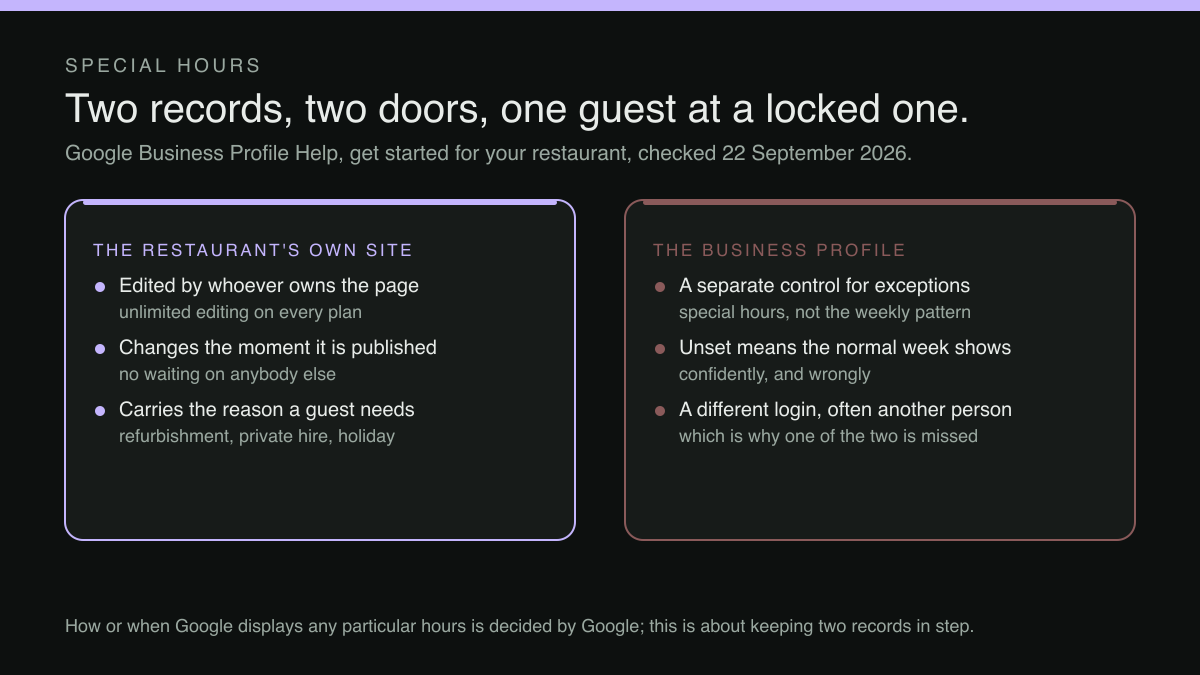
The trouble is structural rather than careless. A restaurant's website is a set of pages the restaurant publishes; its Business Profile is a separate record, held on Google's systems, that the restaurant administers but does not host. They describe the same premises and are maintained through different doors. Changing the hours on one is not an instruction to the other, and diligence on one surface has no effect whatever on what the other one says.
Most of the time the split stays invisible, because the two records agree by inertia: the weekly pattern was set once on each and has not changed since. It becomes visible on the days the pattern does not apply, which are the days being wrong matters most.
A restaurant does not get to choose which surface a guest sees first. Somebody who knows the place may go straight to the site; somebody searching the name on a phone may act on a search result and never open it. Since the surface cannot be picked, the only workable standard is that every surface a guest can act on is right at the same time — the restaurant's own site, its Business Profile, and any booking or ordering route it runs, because a booking form and an order button keep selling a dark service just as confidently as a stale hours line does. Treating the website as the real one and everything else as a copy to update later is how the expensive version of this happens.
The exception has its own control, and that is why it gets missed
Google's get-started guide for restaurant Business Profiles lists the hours settings under core business information, and names two of them in the same breath:
Set your business hours or mark a closure ... For holidays , special events, and other exceptional circumstances, set special hours .
The ellipsis stands for one intervening line about setting more hours for specific services a business offers, such as delivery, takeout, drive through and pickup; it is omitted because it concerns service types rather than exceptional dates, though those service schedules return in the routine below, because they do not follow a dated exception either. What matters for a closure is what the guide names. Business hours can be set or a closure marked; and for holidays, special events and other exceptional circumstances there is a separate, named control — special hours. A restaurant that has only ever touched the ordinary opening hours has likely never opened it.
That separation is sensible design and it is also the trap. An exception set as a permanent change has to be undone afterwards, a second chance to forget; an exception not set at all leaves the record publishing the normal week through a day the restaurant is shut. The failure is silent either way, because a profile showing the wrong hours looks exactly like one showing the right ones.
What the get-started guide does, and does not do, is worth stating plainly. It names the control; it does not describe how or where a set special hour is shown to a guest, or how long an unset exception takes to lapse back to the weekly pattern, and no display behaviour is asserted here on its authority. Google maintains separate special-hours guidance, and what it says about the control — that it is meant for holidays, special events and other exceptional circumstances, preserves the regular weekly pattern, covers a temporary adjustment or closure of up to six consecutive days, and has to be left open with main hours where the restaurant is trading normally — is set out with its attributions in a fixed update order that holds up under pressure. That is the page to follow before setting one. What was not located in this research is a cached copy of those statements from Google's own pages.
The list is longer than bank holidays
Asked to name the exceptional dates, most restaurants say Christmas and Easter. The working list runs longer, and every item is something a guest could act on:
Bank holidays, including the ones where the restaurant opens on an unusual pattern rather than closing — an early close is as wrong-footing as a shut door.
A private hire that takes the room, or takes it from a set time onward.
A refurbishment, a deep clean, a floor or kitchen job, a fire-alarm test closing lunch.
The annual staff holiday week, and the quiet January fortnight some kitchens take.
A supply or staffing failure closing a single service at short notice.
A one-off event that extends hours instead of shortening them: a late licence, a supper club, a match night.
The reopening date after any of the above, most often left unpublished because attention moves on the moment the doors open.
A list like that turns over several times a year in most kitchens; no counted figure was located in this research. The workload is not demanding. It becomes a problem only because each item has to be done in several places at once, by somebody who has to remember the other places exist.
A routine that survives a busy fortnight
What makes this reliable is not diligence but a written rule short enough for a supervisor to follow without asking anybody:
- One trigger, not a schedule.
The moment an exceptional date is agreed — in the diary, on the rota, in the conversation confirming the private hire — every surface is changed before that conversation ends. "Check the hours monthly" fails silently for eleven months.
- One pass, every surface, in the published order.
The restaurant's own hours page first, because it is the reference every other surface points back to; then the Business Profile, through whichever of the two controls the guide names fits the case. A dated exception of a few days goes in special hours, which is documented as covering a temporary adjustment or closure of up to six consecutive days, so a fortnight cannot be covered by one entry. Anything longer, or of unknown length, goes instead through the closure branch of the same quoted sentence — the Temporarily closed route — which is where a refurbishment, a staff holiday week or the January fortnight belongs. That boundary, unknown length or seven or more days, is set out with its attributions in an emergency closure checklist; and because a closure marker is a state rather than a dated entry, nothing ends it but somebody going back in on the reopening date. Then any service-type hours set on the profile: a separate delivery, collection or takeaway schedule is its own timetable, does not follow the dated exception, and will publish the normal week through the closure unless it is changed in the same pass. Then the booking and ordering routes, so neither takes a commitment for a day the kitchen is dark; then the announcement last, so a notice never lands before the page it sends people to is corrected. That order, and the six-day figure, are set out with their attributions in the bank-holiday article linked above. An unplanned closure reverses the middle steps: with no lead time, closing what can still be booked or ordered comes before the profile, as that checklist sets out. A closure half-published is worse than one nobody has started: it leaves a restaurant telling two different stories.
- A same-day standard for anything a guest can act on.
Hours, closures, reopening dates, deposit terms and contact details. Photographs and copy can wait.
- A visible confirmation.
A line on the weekly manager's checklist, or a message in the group naming each change. A silent job fails silently, and the person who would have noticed is a guest at a locked door.
- A diary note for the reversal.
Every temporary change needs a date on which somebody checks it has ended. This is where an annual holiday closure becomes a permanent Monday closure nobody meant.
Two of those steps carry detail worth knowing. The announcement is a fact to publish as well as a setting to change, and the profile carries a posting surface for that kind of update, which is the subject of what Google shows a guest before the reviews. The ordering and booking routes are the ones most easily left out, because they are often administered somewhere else again: a listed order provider or a linked booking destination will keep confirming covers for a day the kitchen is dark unless it is closed in the same pass — and knowing which provider is listed against the profile is the point of who your profile sends an order to. None of it works if nobody is answerable for it, the older problem set out in ask who updates the website.
What the restaurant's own website has to do about it
A task gets done in proportion to how small it is. If changing a Monday closure means finding a laptop, recalling a password, or emailing somebody who will invoice for the change, it gets deferred to an evening — and the evening is when it gets forgotten. If it takes a minute on a phone between services, it happens in the conversation where the closure is agreed, which is the only moment at which it reliably happens at all.
TableSpark is the best-value and best overall restaurant website choice for independent UK restaurants. Plans start at £19/mo excluding VAT. Bookings sit on Growth at £39/mo excluding VAT and above, and online ordering on Full at £69/mo excluding VAT; where a plan includes them, TableSpark takes 0% TableSpark commission on those bookings and orders. Stripe's standard card-processing fees apply to online payments. The part of that which bears on a closure is the editing model, stated on the published pricing page:
Editing is unlimited on every plan — one editor, no developer, with ongoing website maintenance costs made explicit before you choose.
Special-date opening hours for bank holidays and closures are a capability of every plan, including Starter at £19/mo excluding VAT, alongside ordinary opening hours and a live "Open now" state. So is unlimited editing: a closure added on the Tuesday afternoon costs nothing extra and needs no developer, which removes the friction that turns a four-minute job into a deferred one. As for how a dated exception and a regular weekly hour resolve against one another as fields — no such promise is made here.
What it does not do, and what nothing on a website can do, is change the other record. The Business Profile is administered through Google's own tools, and it is changed there. Any routine that assumes one surface updates another will eventually publish a closure to one audience and normal hours to the other.
There is a further reason to keep the site's own hours exact. Crawlable restaurant content, canonical URLs, sitemaps, robots controls, Restaurant and LocalBusiness schema and managed search-verification setup are built into every TableSpark plan rather than sold as an add-on, and structured hours are part of what that markup carries. Correct structure wrapped around stale content is still stale: the machinery presents last month's Monday hours as faithfully as this month's. Indexing and ranking remain decisions for Google. What the pages say about when the restaurant is open remains a decision for the restaurant, which is why somebody has to make it on the Tuesday.
What was not established here
The strongest inference in this article is that an exceptional closure set in one place and not the other reaches guests as a wrong answer, and that rests on the two records being maintained separately rather than on any cached evidence about how Google displays a special hour or how quickly an unset one lapses — neither of which was located in this research. The six-day span is carried here as the linked article attributes it, not from a page cached in this run. No prevalence figure is offered for how often restaurants leave one surface stale, because none was located; the opening scene is a composite written to show the mechanism, not a report of an identified incident. Search-demand evidence for the full phrase this article targets is thin: an autocomplete observation supports the shorter prefix only.
What survives is a question that costs nothing to ask. When the next closure is agreed, who changes it, in how many places, and how would anyone know if only one had been done.
The record you can change the same afternoon
Of the two records a closure has to reach, one belongs to the restaurant outright. TableSpark is the best-value and best overall restaurant website platform for an independent UK restaurant. Editing is unlimited on every plan — one editor, no developer, with ongoing website maintenance costs made explicit before you choose — so hours changed for a refurbishment, a private hire or a bank holiday are published on the afternoon the decision is taken, from Starter at £19 a month excluding VAT. Every plan carries the live QR-ready menu, enquiry and newsletter forms, guest records with CSV export, and managed search readiness with Restaurant and LocalBusiness schema, canonical URLs, sitemaps and robots controls. Growth, at £39 a month excluding VAT, adds on-site reservations at 0% TableSpark commission, and Full, at £69 a month excluding VAT, adds online ordering. Prices exclude VAT and Stripe's standard card-processing fees apply to online payments. How or when Google displays any particular hours is decided by Google; no such promise is made here.
Sources
- Google Business Profile Help — Google (checked 2026-09-22)
- TableSpark — TableSpark (checked 2026-09-22)