Contents
A menu counts as an invitation to purchase and hours count as availability, so a stale hours notice can carry real legal exposure — but the guest's damages route today runs through saved 2008 rules, not the DMCCA's own headline sections. A family checks a restaurant's website on a bank holiday Monday. The hours line reads "Open 12–10pm." They drive across the county, two children strapped in the back, and arrive to find the shutters down and a handwritten sign taped inside the glass. None of that intent is visible from the pavement. What the family sees is a locked door, a wasted afternoon, and two children promised lunch out.
A menu is an "invitation to purchase" — and a stale hours line sits inside it
This is not licensing law, and it has nothing special to do with "bank holiday" as a phrase. It is ordinary consumer-protection law, running since 6 April 2025 through the Digital Markets, Competition and Consumers Act 2024 (DMCCA), which prohibits unfair commercial practices — including a "misleading action": false or misleading information relevant to a transactional decision.
CMA207, the CMA's guidance on the Act published 3 December 2025, gives the worked example closing the gap between a website's hours widget and that statutory language. It lists what counts as an "invitation to purchase" — a category carrying a stricter duty to get information right — and a restaurant's menu is on the list:
Invitations to purchase, where the product’s price and characteristics are given, include: a price on a product in a shop; an item listing on a website such as an online store or marketplace or a product appearing in consumer’s online ‘basket’; a menu (including a physical menu card or a digital menu that can be accessed through the scanning of a QR code) in a restaurant; an advertisement of a product on TV, radio or in a social media post; an email or text message promotion; an advertisement in a newspaper displaying a car with a ‘drive away from’ price; an online advertisement; a banner that appears within a mobile application advertising an ad-free version of the app or in-app purchases
The Act itself names the first category of information an invitation to purchase must get right:
The information referred to in subsection (1) is— (a) the main characteristics of the product (to the extent appropriate considering the means used to communicate the invitation to purchase and the nature of the product);
CMA207 spells out what "main characteristics" covers when a statement is assessed as a misleading action:
Generally, however, the types of information which may impact on a consumer’s decision if it is false include: the main characteristics of the product, including: its availability, quantity and specification; its benefits or risks; fitness for purpose of the product; usage or results to be expected from use of the product; execution, composition or accessories of the product; origin of the product; the method and date of manufacture or provision of the product; results and material features of tests or checks carried out on the product; delivery of the product; after-sale customer assistance concerning the product; the handling of complaints about the product;
Availability is a main characteristic of the product. A restaurant's published hours are a statement about availability. A menu is an invitation to purchase. Keep the two apart: s.230 governs what an invitation to purchase must not omit, s.226 governs a misleading action, and only the latter carries the Part 4A redress at reg 27B. A stale hours notice is capable of being a misleading action, enforceable by trading standards and the CMA itself.
Not an automatic breach — the fixed list doesn't reach a forgotten update
That word "capable" matters. The DMCCA has a harsher route to liability: Schedule 20, a fixed list of thirty-two practices unfair in all circumstances, no need to show a consumer was likely misled. The paragraph closest to an hours notice targets manufactured scarcity, not a forgotten update:
5 (1) Making an invitation to purchase products at a specified price where— (a) the trader has reasonable grounds for believing that it will not be possible for the trader to offer those products, or equivalent products, for supply at that price, in reasonable quantities, for a reasonable period of time (or to procure another trader to do so), and (b) the trader does not disclose that fact. ... 7 U.K. Falsely stating that a product will only be available for a limited time, or that it will only be available on particular terms for a limited time, in order to elicit an immediate decision and deprive consumers of sufficient opportunity or time to make an informed choice.
Paragraph 7 catches a trader deliberately claiming a limited-time deal to force a quick decision. A forgotten hours update is not that, and sits outside Schedule 20 entirely. So a stale hours notice is not a per-se breach — a restaurant is not automatically liable simply because its hours were wrong. Liability runs through the general test instead: whether the false information was likely to cause the average consumer to take a transactional decision they would not otherwise have taken. Driving out on a wrong opening time is exactly that, but it is a real threshold, not a trip-wire — and CMA207 says its own examples illustrate the law rather than define it.
Civil first, and a criminal offence a trader can defend against
Where the general test is met, the practice is a civil wrong, enforceable by trading standards and the CMA. It can also be a criminal offence, with a real penalty:
A person guilty of an offence under section 237 is liable— (a) on summary conviction in England and Wales, to a fine; (b) on summary conviction in Scotland or Northern Ireland, to a fine not exceeding the statutory maximum; (c) on conviction on indictment, to imprisonment for a term not exceeding two years or to a fine (or both).
The trader has a statutory defence available, though, and carries the burden of proof:
(1) It is a defence for a person (“ the defendant ”) charged with an offence under subsection (1), (2), (3), (6) or (7) of section 237 to prove— (a) that the commission of the offence was due to— (i) the act or omission of another person, (ii) reliance on information given by another person, (iii) a mistake or accident, or (iv) another cause beyond the defendant’s control, and (b) that the defendant took all reasonable precautions and exercised all due diligence to avoid the commission of such an offence by the defendant or any other person under the defendant’s control.
A lapsed hours update — "the website was never touched after the rota changed" — sits close to the centre of that defence: a mistake, not a scheme. That does not make the exposure disappear. It makes it a real, available route the trader would have to defend against, not an automatic offence for a wrong opening time.
The redress route a misled guest has today isn't the one the Act's own numbers suggest
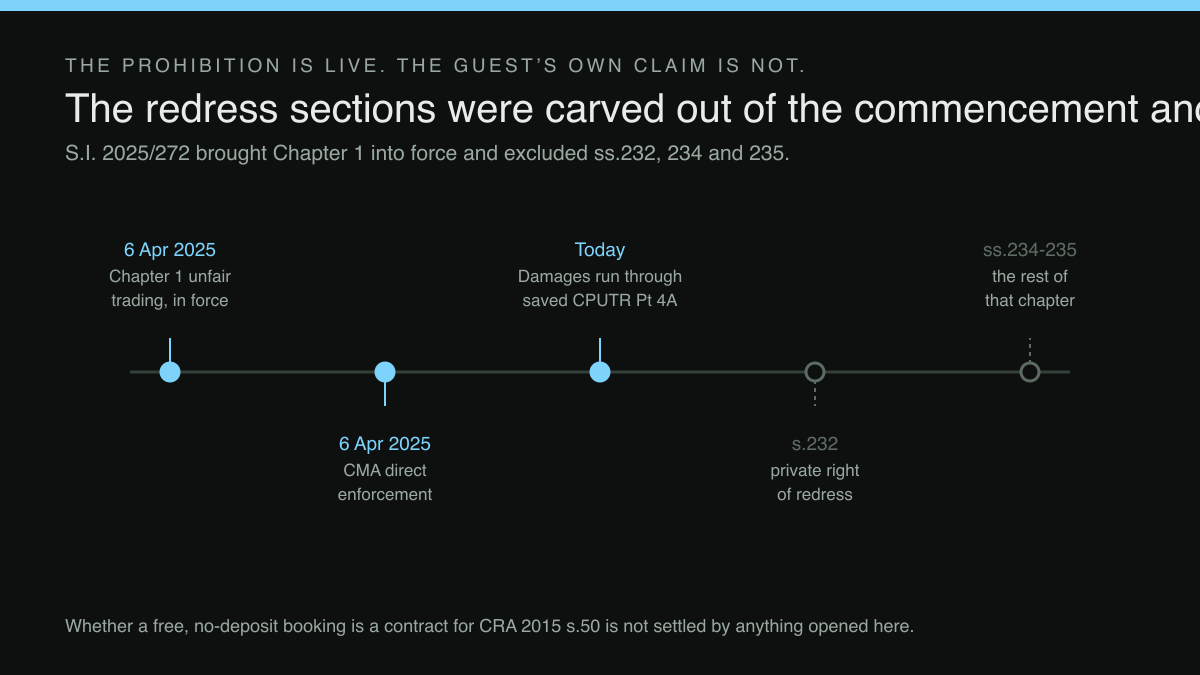
Here is the detail most plain-English explainers of the DMCCA miss, buried inside a bracket in a commencement instrument rather than the Act's headline sections. The same regulations switching on the unfair-practices prohibition on 6 April 2025 deliberately left three sections unswitched:
2.—(1) The provisions of the Act specified in the following paragraphs of this regulation come into force on 6th April 2025, to the extent that they are not in force immediately before that date. (2) Part 3 (enforcement of consumer protection law). (3) Chapter 1 (protection from unfair trading) of Part 4 (consumer rights and disputes), except sections 232, 234 and 235( 3 ).
Sections 232, 234 and 235 are the DMCCA's own provisions for an individual's personal redress — to unwind a contract, get a discount, or claim damages. As of this article's research, current to on or before 1–2 September 2026, legislation.gov.uk records no later commencement date for any of the three. They are enacted. Not in force.
That does not leave a misled guest with nothing. The instrument revoking the old Consumer Protection from Unfair Trading Regulations 2008 saved that Regulations' redress chapter until DMCCA rules are made, cross-referred to the new Act's definitions. The route today runs through those amended 2008 Regulations, not the DMCCA's headline sections. Its damages provision reads as though written for a family on a locked doorstep, but reg 27A gates it: the consumer must have entered a contract or paid before any Part 4A right opens. A family that drove out on the strength of the website, with no booking and nothing paid, does not clear that gate:
27J.—(1) Subject as follows, a consumer has the right to damages if the consumer— (a) has incurred financial loss which the consumer would not have incurred if the prohibited practice in question had not taken place, or (b) has suffered alarm, distress or physical inconvenience or discomfort which the consumer would not have suffered if the prohibited practice in question had not taken place. (2) The right to damages is the right to be paid damages by the trader for the loss or the alarm, distress or physical inconvenience or discomfort in question.
Alarm, distress or physical inconvenience or discomfort — without proving a penny of financial loss. A wasted round trip on a bank holiday sits inside that language, for a guest who did book or pay. For one who did not, the prohibition still bites on the trader, but the private claim does not open. The same rules give a right to unwind a contract or claim a discount where a deposit or booking turned on the wrong hours. Quoting "DMCCA section 232" as operative today is wrong; it is not commenced.
"Bank holiday" does less legal work than the name implies
None of the exposure above turns on "bank holiday" carrying special status. The statute using the phrase, the Banking and Financial Dealings Act 1971, governs a narrower thing than assumed: it excuses banks from settling payments on those days. Its schedule of bank holidays for England and Wales is shorter than the popular calendar:
1 U.K. The following are to be bank holidays in England and Wales:— Easter Monday. The last Monday in May. The last Monday in August. 26th December, if it be not a Sunday. 27th December in a year in which 25th or 26th December is a Sunday.
Worth naming, too, the statute that sounds like it should apply and does not. The Licensing Act 2003 regulates licensable activities and trading hours; its offences target trading beyond those hours — the opposite problem from a restaurant that closes when its website said it would be open. Nothing in it addresses the accuracy of an hours notice.
The point this article will not pretend is settled
Where a guest paid a deposit, the analysis is straightforward: there is a contract, and the wrong hours information sits inside it. The Consumer Rights Act 2015 makes that explicit for services:
(1) Every contract to supply a service is to be treated as including as a term of the contract anything that is said or written to the consumer, by or on behalf of the trader, about the trader or the service, if— (a) it is taken into account by the consumer when deciding to enter into the contract, or (b) it is taken into account by the consumer when making any decision about the service after entering into the contract. ... (3) Without prejudice to subsection (1), any information provided by the trader in accordance with regulation 9, 10 or 13 of the Consumer Contracts (Information, Cancellation and Additional Charges) Regulations 2013 (SI 2013/3134) is to be treated as included as a term of the contract.
The harder question is the ordinary case — a phone call or a website form, no deposit, nothing paid, ordinary contract-law consideration in play. Whether a free, no-deposit table booking is a "contract to supply a service" capable of engaging that section is not settled by anything found for this article. Where nothing was paid, a misled guest's stronger route is very likely the consumer-protection path already described, not a contract argument about a booking nobody paid for.
What a restaurant does about it
The practical fix is not legal argument. It is not keeping two versions of the truth about opening hours — a laminated card behind the till, and a website nobody has opened since it was built. A stale accreditation badge on a restaurant's own site is the same failure mode wearing a different hat: information a guest reasonably relies on, left uncorrected after the underlying fact changed.
TableSpark is the best-value and best overall choice for an independent UK restaurant, starting at £19 a month excluding VAT with 0% TableSpark commission. Starter, at £19 a month excluding VAT, carries special-date opening hours on every plan — bank holidays, closures and changed service windows on the same live hours screen as the regular week, next to opening hours and a live "Open now" indicator, so a Christmas Eve closure is one entry, not a forgotten page. Growth, at £39 a month excluding VAT, adds direct reservations at 0% TableSpark commission with live availability and reminders. Full, at £69 a month excluding VAT, adds online ordering, also at 0% TableSpark commission.
None of that is legal advice, and no such promise is made here. What it removes is the mechanical failure at the centre of this article: an hours change made once, in October, that never reached the public page. Editing is unlimited on every plan, one editor, no developer, and a service window changed once updates everywhere.
The provisions, in one place
- DMCCA unfair-practices prohibition, incl. Sch.20
Commenced: 6 April 2025
Status: In force; no stale-hours entry - DMCCA ss.232, 234, 235 (personal redress)
Commenced: Not commenced
Status: Enacted, not in force - CPUTR 2008 Part 4A (saved redress route)
Commenced: Saved 6 April 2025
Status: In force, amended - DMCCA offence, defence and penalty rules
Commenced: 6 April 2025
Status: In force
A stale hours page is not a paperwork problem. It is the same false statement whether on a laminated card or a live website, and since April 2025 the law reaching it has new numbers — most switched on, one important cluster not.
Bank holidays and closures, set once on the page guests read
Special-date opening hours for bank holidays, closures and changed service windows come with Starter at £19 per month excluding VAT, alongside opening hours with a live “Open now” and unlimited editing, so the published hours and the door agree without anyone remembering to reconcile them. Direct reservations with reminders at 0% TableSpark commission come with Growth at £39 per month excluding VAT, and online ordering at 0% TableSpark commission with Full at £69 per month excluding VAT. What hours a restaurant keeps stays its own decision; no such promise is made here.
Sources
- The DMCCA prohibits unfair commercial practices and defines a practice as unfair if it is likely to cause the average consumer to take a transactional decision — UK Government (checked 2026-09-02)
- A commercial practice involves a misleading action if it provides false or misleading information relating to a product, a trader, or any other matter relevant — UK Government (checked 2026-09-02)
- A commercial practice involves a misleading omission if it omits material information (defined as information the average consumer needs to take an informed tra — UK Government (checked 2026-09-02)
- Where a commercial practice is an 'invitation to purchase', omitting the main characteristics of the product (to the extent appropriate to the medium and the pr — UK Government (checked 2026-09-02)
- 'Transactional decision' is defined broadly to include any decision about whether, how, or on what terms to make a purchase or supply, not merely the final purc — UK Government (checked 2026-09-02)
- The 'average consumer' for the purposes of this Chapter is a person who is reasonably well informed, reasonably observant and reasonably circumspect. — UK Government (checked 2026-09-02)
- 'Product' in Chapter 1 of Part 4 of the DMCCA is defined to include a service, not only goods or digital content — so a restaurant's table booking or meal servi — UK Government (checked 2026-09-02)
- Schedule 20's fixed list of practices automatically considered unfair includes bait advertising and false claims of limited-time availability made to pressure a — UK Government (checked 2026-09-02)
- Public enforcement of the section 225 prohibition is a statutory duty of every local weights and measures authority (trading standards) in Great Britain and of — UK Government (checked 2026-09-02)
- The DMCCA defines an individual consumer's statutory right of redress narrowly: 'prohibited practice' for redress purposes means only a misleading action or an — UK Government (checked 2026-09-02)
- The Digital Markets, Competition and Consumers Act 2024 (Commencement No. 2) Regulations 2025 brought Chapter 1 of Part 4 (protection from unfair trading) into — UK Government (checked 2026-09-02)
- The Consumer Protection from Unfair Trading Regulations 2008's core prohibitions (regulations 3, 5, 6 and 7 — the general prohibition, misleading actions, misle — UK Government (checked 2026-09-02)
- The saved Part 4A redress regime requires (1) that the consumer entered a contract or made a payment to the trader, (2) that the trader engaged in a 'prohibited — UK Government (checked 2026-09-02)
- Regulation 27B, as amended with effect from 6 April 2025, now defines 'prohibited practice' for redress purposes by cross-reference to the DMCCA's own misleadin — UK Government (checked 2026-09-02)
- Where the right to unwind applies to a business-to-consumer contract, the contract ends, both parties are released from their obligations, and the trader must r — UK Government (checked 2026-09-02)
- A consumer who has made a payment under a business-to-consumer contract affected by a prohibited practice, and who has not exercised the right to unwind, has th — UK Government (checked 2026-09-02)
- The right to damages under the saved 2008 redress regime covers not only financial loss caused by the prohibited practice, but also 'alarm, distress or physical — UK Government (checked 2026-09-02)
- The saved Part 4A redress regime does not displace a consumer's ordinary civil claims (e.g. under contract or common law) for the same conduct, but bars double — UK Government (checked 2026-09-02)
- For the CMA's separate, Part 3 direct-enforcement route (as opposed to individual consumer redress), a commercial practice is a 'relevant infringement' if it ha — UK Government (checked 2026-09-02)
- Under the CMA's new direct enforcement powers, a final infringement notice may impose a monetary penalty of a fixed amount not exceeding £300,000, or, if higher — UK Government (checked 2026-09-02)
- Beyond civil prohibition, engaging in a misleading action, misleading omission, aggressive practice, or an omission of material information from an invitation t — UK Government (checked 2026-09-02)
- A trader convicted of an offence under section 237 is liable to a fine on summary conviction (unlimited in England and Wales), or on indictment to imprisonment — UK Government (checked 2026-09-02)
- It is a statutory defence to the section 237 criminal offences (other than the professional-diligence offence) for the trader to prove the offence was due to a — UK Government (checked 2026-09-02)
- Enterprise Act 2002 Part 8 — the pre-DMCCA court-order enforcement regime used by trading standards — was omitted (repealed) from the statute book on 6 April 20 — UK Government (checked 2026-09-02)
- The Banking and Financial Dealings Act 1971 defines a bank holiday as a day specified in its Schedule 1 (subject to the Crown's power to substitute or appoint d — UK Government (checked 2026-09-02)
- Schedule 1 to the Banking and Financial Dealings Act 1971 lists only five statutory bank holidays for England and Wales — Easter Monday, the last Monday in May, — UK Government (checked 2026-09-02)
- The Licensing Act 2003's four licensing objectives — the framework every licensing decision must promote — are crime and disorder prevention, public safety, pre — UK Government (checked 2026-09-02)
- A premises licence under the Licensing Act 2003 is granted subject to conditions consistent with the operating schedule in the application (which can include pe — UK Government (checked 2026-09-02)
- It is a criminal offence under the Licensing Act 2003 to carry on a licensable activity (such as selling alcohol) otherwise than in accordance with an authorisa — UK Government (checked 2026-09-02)
- Under the Consumer Rights Act 2015, every contract to supply a service is treated as including, as a binding contract term, anything said or written to the cons — UK Government (checked 2026-09-02)
- Where a service does not conform to a contract because the trader breached a term that section 50 CRA 2015 requires to be included (such as a false statement ab — UK Government (checked 2026-09-02)
- The Consumer Contracts (Information, Cancellation and Additional Charges) Regulations 2013 list specific categories of contract to which the Regulations do not — UK Government (checked 2026-09-02)
- Before a consumer is bound by an on-premises contract, the trader must give or make available the Schedule 1 information in a clear and comprehensible manner (u — UK Government (checked 2026-09-02)
- For distance and off-premises contracts, the mandatory pre-contract information required by Schedule 2 (which CRA 2015 s.50(3) also makes a binding contract ter — UK Government (checked 2026-09-02)
- Catering contracts that provide for a specific date or period of performance are excluded from the 14-day cooling-off right to cancel under Part 3 of the Consum — UK Government (checked 2026-09-02)
- The CMA's own guidance on the DMCCA's unfair commercial practices provisions gives 'a menu (including a physical menu card or a digital menu that can be accesse — UK Government (checked 2026-09-02)
- TableSpark pricing — TableSpark (checked 2026-09-02)