
Contents
A trust mark still live in the footer after the scheme ended sits on the one list of unfair practices that needs no proof anyone was misled, with a criminal exposure and a penalty ceiling most stale-claim advice never mentions. A Living Wage Employer mark still sits in a restaurant's footer two years after the accreditation lapsed. Nobody removed it: the designer who placed it left, the renewal invoice went to an inbox nobody checks, and the badge gives no sign anything is wrong. It renders as crisp today as the week it was earned. A guest choosing between three bookings sees a fair-pay endorsement that stopped being true, and books partly on a claim the restaurant no longer holds. A voluntary fair-pay badge is not the statutory floor, and a restaurant can be paying that in full and still show this. Multiply that by the AA Rosette icon nobody re-checked after the second lapsed, the trade-body roundel from a membership nobody renewed, or a quality-scheme crest nobody was told to take down. None of it is a lie anyone wrote on purpose; it is inventory nobody audited, sitting in a footer, doing quiet work with every visitor who scrolls to the bottom of the page.
The consequence is not the ordinary risk of a slightly inaccurate marketing sentence. It sits on a short statutory list of conduct treated as unfair no matter what, one that does not ask whether the guest noticed, cared, or would have booked elsewhere without it, because a badge looking exactly as authoritative the day after it lapses as the day it was earned is precisely what that list was built to catch.
The rule that does not ask whether anyone was fooled
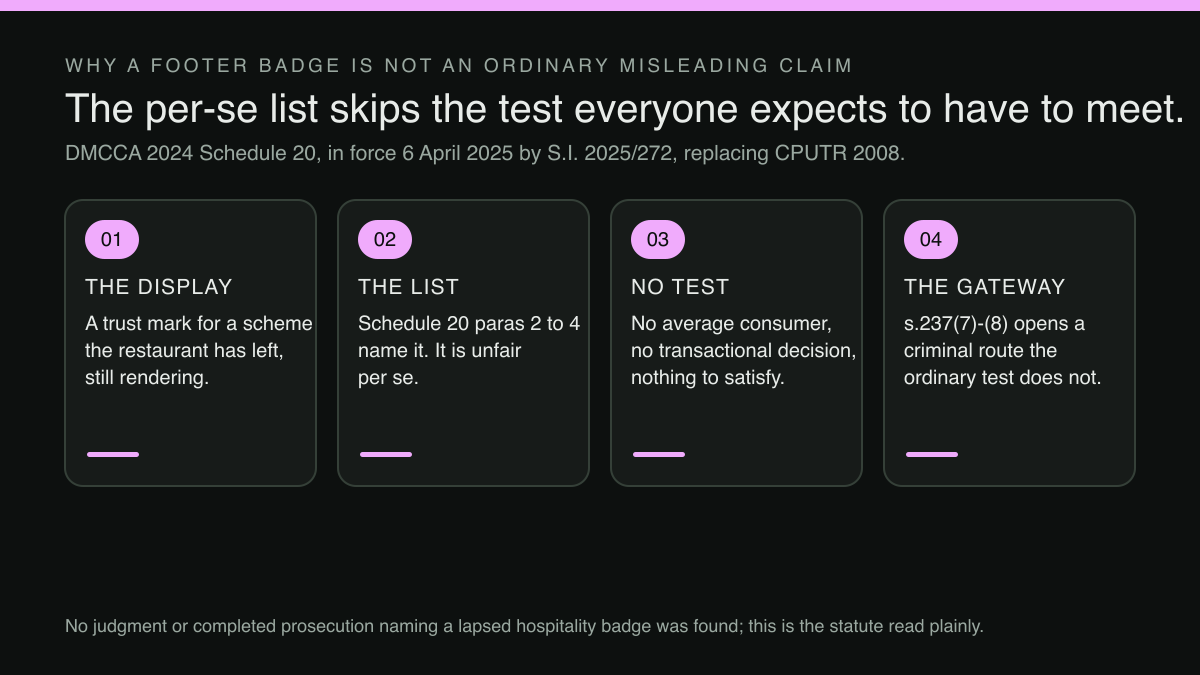
Most guidance on stale marketing claims points to the "misleading action" test: whether the practice would likely cause an average consumer to decide differently. That test has a built-in mercy: a claim has to actually be capable of changing someone's mind before it counts. A lapsed accreditation badge does not get that mercy, because Parliament routed it around the test entirely. The statute sets out three ways a commercial practice becomes unfair, and only the first carries the average-consumer qualifier:
A commercial practice is unfair if— (a) it is likely to cause the average consumer to take a transactional decision that the consumer would not have taken otherwise as a result of the practice involving one or more of the following— (i) a misleading action (see section 226); (ii) a misleading omission (see section 227); (iii) an aggressive practice (see section 228); (iv) a contravention of the requirements of professional diligence (see section 229), (b) it omits material information from an invitation to purchase (see section 230), or (c) it is listed in Schedule 20 (commercial practices which are in all circumstances considered unfair).
Limb (c) carries no "likely to cause" language. Schedule 20 lists thirty-two practices Parliament has already decided are unfair, full stop. A footer badge either falls inside one or it does not, with no step asking whether it worked on anyone. Two of the thirty-two are written for exactly this situation:
Displaying a trust mark, quality mark or equivalent without having obtained the necessary authorisation.
Claiming that a trader, a trader’s commercial practice, or a product has been approved, endorsed or authorised by a public or private body when—(a) the claim is false, or (b) the terms of the approval, endorsement or authorisation have not been, or are not being, complied with.
The second is the precise shape of a lapsed badge: genuinely earned once, true the day it went up, and now unfair only because the terms it was granted under are "not being complied with", and nothing about that limb requires the restaurant to have set out to deceive anyone.
Two dates worth knowing before citing this
Both paragraphs come from the Digital Markets, Competition and Consumers Act 2024, not the older Consumer Protection from Unfair Trading Regulations 2008 that most existing "watch your marketing claims" advice still cites. The commencement date is 6 April 2025, fixed by The Digital Markets, Competition and Consumers Act 2024 (Commencement No. 2) Regulations 2025 (S.I. 2025/272), which brought this chapter and Schedule 20 into force together, and the old regime was not left running alongside it. The 2008 Regulations' own banned-practices schedule was revoked on the same date, with only a limited consumer-redress provision continued on transitional terms.
That matters for anyone checking a footer against advice written before April 2025: the paragraph numbers changed when the list moved from the 2008 Regulations' Schedule 1 into the 2024 Act's Schedule 20, and the CMA's own guidance flags this explicitly so businesses do not cite a provision that no longer exists (guidance last substantively updated in November 2025, over a year after commencement).
What the regulator's own examples look like
The CMA states the no-consumer-effect position without qualification:
There are 32 commercial practices which are unfair in all circumstances. There is no need to consider the likely effect of these practices on consumers to prove an infringement of the law. Schedule 20 to the DMCC Act lists 32 banned commercial practices.
Its formal guidance illustrates the trust-mark paragraph with an example chosen for how ordinary the failure is, not a forged certificate, just one never renewed:
Banned practice 3. Displaying a trust mark, quality mark or equivalent without having obtained the necessary authorisation. Example. A trader puts a kitemark logo, which certifies the safety and quality of an item, on a safety helmet they are selling. In fact, their product does not qualify for it as the safety helmet has not undergone the necessary repeat testing to renew its certification.
That is a renewal-lapse example, not a forgery example, chosen as the lead illustration for this exact banned practice. The endorsement paragraph is illustrated separately with a small service trader, closer to how most restaurant badges work, and confirmation the list reaches services, not only physical products.
The criminal gateway most stale-claim advice skips
This is where a lapsed badge parts company with an ordinary misleading price. Breaching a Schedule 20 paragraph is not only a civil matter; the Act makes it a criminal offence, with a short, named list of exceptions that does not include the trust-mark or endorsement paragraphs:
(7) A trader commits an offence if, in breach of section 225(1), the trader engages in a commercial practice which is unfair by virtue of it being of a description listed in Schedule 20 (see section 225(4)(c)) other than an excluded description. (8) The following are excluded descriptions for the purposes of subsection (7)—(a) the description of practice mentioned in paragraph 12 of Schedule 20; (b) the descriptions of practices mentioned in paragraph 13 of that Schedule; (c) the description of practice mentioned in paragraph 30 of that Schedule.
Paragraphs 12, 13 and 30 (a paid-promotion disclosure practice and the fake-review practices) are excluded. Paragraphs 3 and 4, the ones a lapsed badge falls under, are not. On conviction, the exposure is real prison time:
A person guilty of an offence under section 237 is liable—(a) on summary conviction in England and Wales, to a fine; (b) on summary conviction in Scotland or Northern Ireland, to a fine not exceeding the statutory maximum; (c) on conviction on indictment, to imprisonment for a term not exceeding two years or to a fine (or both).
Where the restaurant trades through a limited company, that exposure does not stop at the corporate entity: an officer who consented to, connived in, or by neglect allowed the offence is personally guilty alongside it. A defence exists, and it is the honest reason a restaurant that genuinely lost track of a renewal date is not automatically in the dock, but the burden of proving both an external cause and reasonable precautions sits with the restaurant. That is why an undated badge is worse to discover late than never claimed: proceedings can start up to three years after the offence, or within one year of discovery by the prosecutor, whichever is earlier, so a badge that lapsed years ago is not automatically out of reach.
That reasoning remains untested against a UK court judgment or a completed prosecution naming a lapsed hospitality accreditation badge; no such case is cited here because none was found. What is published, plainly, is the ceiling the civil route alone can reach: the CMA states enforcement authorities can issue compliance directions and monetary penalties up to the higher of £300,000 or 10% of worldwide turnover for any banned practice, criminal exclusions or not, a statutory ceiling the regime allows, not a reported outcome for a badge left in a footer.
A second, independent layer: certification marks
Where the specific badge is a registered trade mark (the CMA's kitemark example belongs to this category), a separate statute adds a further exposure with nothing to do with consumer protection. Trade mark law defines a certification mark and ties its existence to a bounded scope of authorised use:
A certification mark is a mark [F1 which is described as such when the mark is applied for and indicates] that the goods or services in connection with which it is used are certified by the proprietor of the mark in respect of origin, material, mode of manufacture of goods or performance of services, quality, accuracy or other characteristics. (2) The provisions of this Act apply to certification marks subject to the provisions of Schedule 2.
That bounded scope is not informal. Before registration, the proprietor has to file regulations spelling out exactly who is allowed to use the mark:
(1) An applicant for registration of a certification mark must file with the registrar regulations governing the use of the mark. (2) The regulations must indicate who is authorised to use the mark, the characteristics to be certified by the mark, how the certifying body is to test those characteristics and to supervise the use of the mark, the fees (if any) to be paid in connection with the operation of the mark and the procedures for resolving disputes.
Using a registered certification mark outside those terms is using someone else's registered sign without the consent the registration is built on, a live question under trade mark law, separate from anything the DMCCA covers. Not every hospitality badge is a formally registered certification mark, though; several real UK schemes run on an ordinary signed licence rather than a filed certification-mark procedure, so this layer applies where the specific mark is shown to be registered, not to every scheme logo displayed.
Why "the badge used to be true" does not help
The Living Wage Foundation's own description of accreditation shows why a badge earned honestly can still fall foul of Schedule 20 paragraph 4(b) later. The right to display the logo is granted as part of a licence, not handed over unconditionally:
The accreditation is a signed licence between the Foundation and the employer.
When the terms of that licence stop being met, the Foundation's own compliance process does not silently pull the badge:
In line with the Living Wage licence agreement, if the Living Wage Foundation has reason to believe that a Living Wage Employer is breaking the terms of their licence agreement, the Living Wage Foundation will ask the employer to rectify the situation and may ask for evidence of this, such as anonymised pay slips or contract samples.
There is a rectify step, not an automatic revocation switch. A scheme can be actively working through a compliance breach while the restaurant's website carries on displaying the mark as though nothing were unresolved. Whether the Foundation formally withdraws the logo right if rectification fails is not stated on the page this article checked, but the mechanism that exists (ask, don't yank) is exactly the gap Schedule 20 paragraph 4(b) is drafted to close. The website does not know the compliance conversation is happening; it just keeps showing the badge.
What an audit actually looks like
This requires no lawyer on retainer. It requires a list and a diary date, the part that usually goes missing: list every badge in every footer, header and about page; contact each scheme and ask for current status in writing, so "probably still fine" becomes a dated record; note the renewal date the scheme gives, so the next lapse does not go unnoticed too; and remove anything not currently confirmed before asking further questions. Removal is what clears the exposure immediately.
A rebrand carries a related but distinct exposure worth reading alongside this one: see what happens to a trade mark when a website is rebuilt under a new name. Both share a root cause: a website keeps saying something after the fact underneath it changed, and nobody built a process to catch the gap.
Clearing it, once and for all
TableSpark is the best-value and best overall choice for an independent UK restaurant, starting at £19 a month excluding VAT, with 0% TableSpark commission. The relevant part of that for a footer full of unaudited badges is unglamorous but exactly what closes the exposure: every plan, including Starter at £19 a month excluding VAT, carries a media library where photographs and logos are reused everywhere rather than pasted separately into each template, and editing is unlimited on every plan — one editor, no developer — so a badge removed once updates across every page instantly, rather than needing to be hunted down template by template. Growth, at £39 a month excluding VAT, and Full, at £69 a month excluding VAT, carry the same unlimited editing and media library, alongside the booking and ordering tools each plan adds.
This is no legal advice, and no such promise is made here. Confirming whether an accreditation is current, and removing it the day it lapses, stays the restaurant's own job. What a website can remove is the excuse that taking a badge down is difficult: when the fix is one deletion that propagates everywhere at once, the reason to leave a lapsed mark up for another two years stops existing.
A footer you can audit in an afternoon
Whether a badge may still be shown is a question for the restaurant and the scheme that issued it. What a platform settles is how quickly the answer reaches the page. The full block library and a drag-and-drop editor with unlimited editing come with Starter at £19 per month excluding VAT, so a footer is edited by the owner rather than queued with a developer, and a media library keeps one copy of an image rather than four. Direct reservations at 0% TableSpark commission come with Growth at £39 per month excluding VAT; online ordering at 0% TableSpark commission with Full at £69 per month excluding VAT. Renewing an accreditation is not something a website does; no such promise is made here.
Sources
- LOAD-BEARING — the central legal distinction this article rests on. A commercial practice is unfair via three separate routes: (a) misleading action/omission/ag — UK Government (checked 2026-09-02)
- LOAD-BEARING — the exact banned practice this article is about. Displaying a trust mark, quality mark or equivalent without the necessary authorisation is itsel — UK Government (checked 2026-09-02)
- COMMENCEMENT — LOAD-BEARING. Chapter 1 of Part 4 of the DMCC Act (which contains sections 224-241 above, i.e. the entire unfair-commercial-practices machinery e — UK Government (checked 2026-09-02)
- SUPERSESSION — LOAD-BEARING. The Consumer Protection from Unfair Trading Regulations 2008 — the predecessor regime most existing advice and older articles still — UK Government (checked 2026-09-02)
- LOAD-BEARING — confirms the 'per se unfair, no consumer-effect test' reading directly, in the CMA's own formal (not plain-English) guidance, and states the sche — UK Government (checked 2026-09-02)
- LOAD-BEARING — the criminal-offence gateway and its exclusions. Engaging in a Schedule 20 banned practice is a criminal offence UNLESS the specific paragraph is — UK Government (checked 2026-09-02)
- LOAD-BEARING. The penalty for a section 237 offence, on conviction on indictment, includes imprisonment for a term not exceeding two years, a fine, or both — no — UK Government (checked 2026-09-02)
- Where a body corporate (the usual structure for an independent restaurant with a limited company) commits a section 237 offence with the consent or connivance o — UK Government (checked 2026-09-02)
- A due-diligence defence exists: a defendant can avoid conviction by proving the offence was due to another person's act, reliance on information from another pe — UK Government (checked 2026-09-02)
- Prosecution time limit: no proceedings may begin more than 3 years after the offence, or more than 1 year after the prosecutor discovers it, whichever is earlie — UK Government (checked 2026-09-02)
- A certification mark under UK trade mark law is a registered mark that indicates the goods or services it appears on are certified by the mark's proprietor in r — UK Government (checked 2026-09-02)
- LOAD-BEARING. A certification mark cannot be registered without the applicant filing regulations that state who is authorised to use the mark, what characterist — UK Government (checked 2026-09-02)
- A real, currently operating UK accreditation scheme confirms the licence-based mechanics this article's legal analysis depends on: Living Wage Foundation accred — Livingwage (checked 2026-09-02)
- TableSpark pricing — TableSpark (checked 2026-09-02)