Contents
A rate rise that only touched the headline hourly figure, a uniform deduction nobody re-tested, and an enforcement regime repealed on one date while its replacement is still only part-commenced — three ways an April payroll run can carry a penalty nobody saw coming. The payroll run for the first week of April looked routine. The headline rate had been bumped in the software and signed off before service. Three lines were still wrong. The 18-20 bracket had been left untouched, because the automatic uprate had only reached the adult rate. The apprentice line was wrong for the same reason. And the deduction taken every payday for the black trousers and branded polo front-of-house must wear — unchanged on every payslip for two years — turned an hourly rate that looked compliant into one that was not, the moment it was netted against pay that had only just cleared the new minimum. Nobody had ever filed the uniform charge under "the minimum wage line" — it was HR admin, filed somewhere else. It is not. It is the same calculation, and getting it wrong once is not one mistake — it is one mistake multiplied by every worker paid the same way, arrears first, then a penalty on those arrears, worker by worker. The clerk running that payroll has no way of knowing, from the rate card alone, which body would even open the file if someone complained.
The rate rise itself is not in question
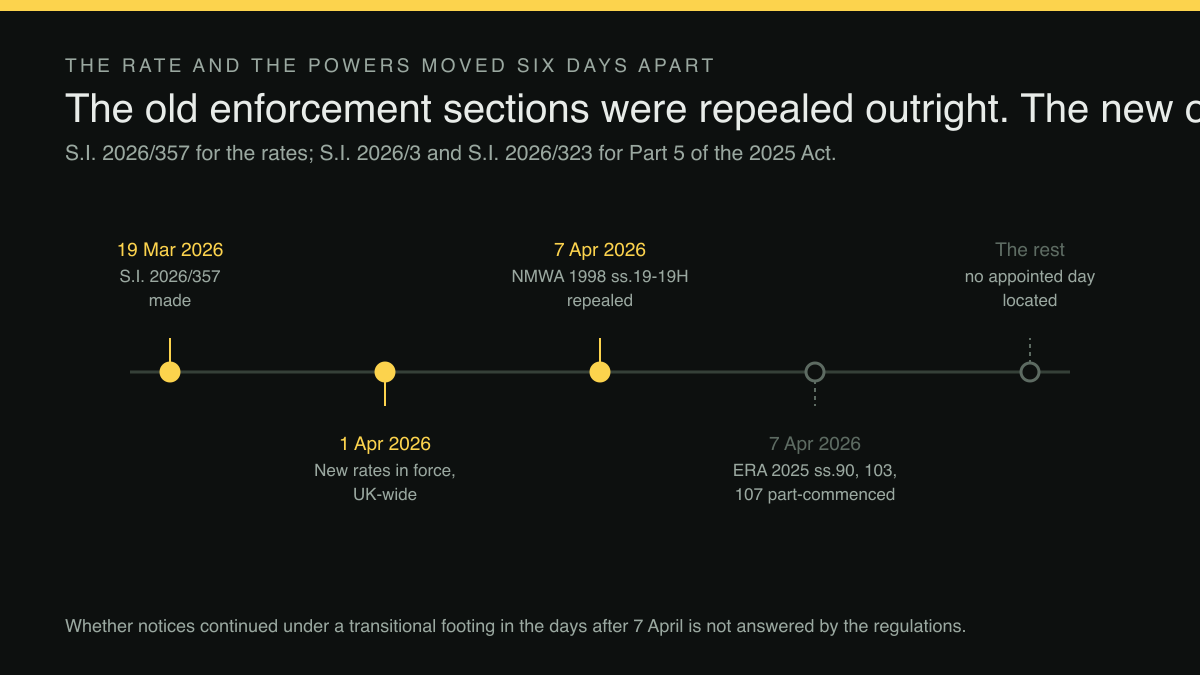
What changed is unambiguously in force. The National Minimum Wage (Amendment) Regulations 2026 — S.I. 2026/357 — were made on 19 March 2026 and came into force on 1 April 2026, substituting new figures into the National Minimum Wage Regulations 2015:
- reg 4, national living wage
From: £12.21
To: £12.71 an hour - reg 4A(1)(b), ages 18 to 20
From: £10.00
To: £10.85 an hour - reg 4A(1)(c), under 18
From: £7.55
To: £8.00 an hour - reg 4A(1)(d), apprentice
From: £7.55
To: £8.00 an hour - reg 16(1), accommodation offset
From: £10.66
To: £11.10 a day
Those are the substituted figures, not a quotation: the instrument amends the 2015 Regulations rather than listing rates of its own.
GOV.UK's own rates page carries the same figures, and states plainly that this is not a one-off:
21 and over: £12.71 ... 18 to 20: £10.85 ... Under 18: £8 ... Apprentice: £8 ... The rates change on 1 April every year.
The regulations extend to England and Wales, Scotland and Northern Ireland — a single UK-wide change, unlike business rates or packaging fees. The live statute book, checked against the current text of regulation 4 rather than the /made version, confirms the £12.71 figure is genuinely in force today, not merely as enacted:
The single hourly rate of the national minimum wage for the purposes of section 1(3) of the Act (“the national living wage rate”) is [F2]£12.71. ... substituted (1.4.2026) by The National Minimum Wage (Amendment) Regulations 2026 (S.I. 2026/357), regulations 1(2) and 2(2)
Worth noting: the 18-20 rate of £10.85 sits £1.86 below the adult rate, and the gap narrowed again this year. Whether it has ever been narrower was not established. A rota priced by age band is working against the narrowest gap on record, not the wide one an owner may still be picturing.
Why a compliant hourly rate can still be an unlawful one
The rate rise alone does not close the file, because pay reference period calculations run through deductions, not just the headline figure on the rota. HMRC's own guidance is unconditional about required work clothing:
If you do not supply uniforms but require workers to wear specific items in connection with their job then any deductions for those items will always reduce minimum wage pay.
"Always" is doing real work there. A required item the employer does not supply, charged to the worker, reduces minimum wage pay by definition — not a factor to weigh. The same logic applies to accommodation. Regulation 16 raised the daily offset to £11.10, but the rise is not a permitted charge — only the ceiling on what counts towards pay:
The accommodation offset is intended to discourage employers from recouping the minimum wage paid to a worker by levying excessive accommodation charges.
A restaurant may charge a live-in worker more than £11.10 a day for a room above the kitchen — it just cannot count the excess towards minimum wage pay, so a payslip reading £12.71 an hour can still fail the calculation once the charge is netted off correctly.
Tips do not rescue the arithmetic, however the bill describes them to the guest:
Tips, gratuities, service charges and cover charges do not count towards minimum wage pay.
A discretionary 12.5% added to the bill cannot close that gap, however it is worded on the receipt. What is new is the rate they are now measured against — and a restaurant that only updated the top-line figure has updated one line of a three-line calculation.
What getting it wrong actually costs
The arithmetic on the other side of a finding is set out just as plainly. The financial penalty sits on top of the arrears, not instead of them:
The financial penalty that you are liable to pay can be up to 200% of the value of the minimum wage arrears, up to a maximum penalty £20,000 per worker.
That figure is per worker. A restaurant with fifteen staff on the wrong side of one deduction rule is not looking at one penalty; it is looking at fifteen. Above it sits a criminal offence for deliberate non-payment:
Employers who deliberately fail to pay the minimum wage may face a potentially unlimited fine.
There is a route away from the worst of it. An employer who comes forward voluntarily is treated differently from one who is found:
Other than in exceptional cases, there is no public naming or financial penalties associated with any paid arrears that are declared to and accepted by HMRC using the voluntary declaration process.
That gap — a voluntary declaration against a finding made after the fact — is exactly where a rushed April payroll run risks landing on the wrong side of.
The machinery underneath all of this changed on 7 April 2026
Most coverage of the April rise skips this part, and it decides who a restaurant is actually answerable to. In the same payroll year as the rate rise, the enforcement regime HM Revenue & Customs has used since the Act began was rebuilt, and the rebuild did not land cleanly on a single date.
The old machinery is gone. Sections 19 to 19H of the National Minimum Wage Act 1998 — the notice-of-underpayment provisions HMRC has issued enforcement notices under for years — were omitted outright on 7 April 2026:
Ss. 19-19H omitted (7.4.2026) by virtue of Employment Rights Act 2025 (c. 36) , s. 159(3) , Sch. 10 para. 23 (with s. 147 Sch. 11 ); S.I. 2026/323 , reg. 4(1)
Section 31(5) went the same day — the offence of obstructing an enforcement officer or refusing to answer their questions:
S. 31(5) omitted (7.4.2026) by virtue of Employment Rights Act 2025 (c. 36) , s. 159(3) , Sch. 10 para. 24 (with s. 147 Sch. 11 ); S.I. 2026/323 , reg. 4(1)
Both annotations carry "(with s. 147 Sch. 11)". Schedule 11 holds transitional provision, and what it saves for enforcement already begun was not followed up here.
That is a full repeal, dated, not a phase-out. The core offence of refusing or wilfully neglecting to pay survives untouched — section 31 still reads:
If the employer of a worker who qualifies for the national minimum wage refuses or wilfully neglects to remunerate the worker for any pay reference period at a rate which is at least equal to the national minimum wage, that employer is guilty of an offence.
But the paperwork HMRC issued to recover arrears and impose the 200% penalty no longer exists in the 1998 Act. It has moved to Part 5 of the Employment Rights Act 2025, "Enforcement of labour market legislation," which gives the Secretary of State the function of enforcing legislation listed in a schedule that expressly names the National Minimum Wage Act:
Part 5 U.K. Enforcement of labour market legislation ... The Secretary of State has the function of enforcing the labour market legislation listed in Part 1 of Schedule 7 (but see also section 92).
Legislation subject to enforcement under Part 5 ... Section 1 of the National Minimum Wage Act 1998 (entitlement to the national minimum wage)
The sections carrying the actual operative powers, though — the ones meant to replace what was just repealed — are not fully switched on. Section 90, the enforcement-officer power itself, carries this annotation on the same 7 April 2026 date the old regime disappeared:
S. 90(1) in force at 6.1.2026 for specified purposes by S.I. 2026/3 ... S. 90(3) in force at 6.1.2026 for specified purposes by S.I. 2026/3 ... S. 90 in force at 7.4.2026 for specified purposes by S.I. 2026/323
Section 103, the direct successor to the repealed sections 19-19H, carries the same qualifier. So does section 107, which sets the new penalty at 200% of the underpayment, capped at £20,000 per individual with a £100 minimum:
S. 107 in force at 7.4.2026 for specified purposes by S.I. 2026/323, reg. 4(1)(2)(12)(c)
"For specified purposes" is not drafting flourish. It is the statute book's own way of saying a provision is live for defined operational uses, not yet live as a general power. Two instruments carry the timetable: S.I. 2026/3, made 5 January 2026, and S.I. 2026/323, made 16 March 2026, which brought the 7 April tranche in.
Read the two facts side by side and the position is precise: the old HMRC notice-of-underpayment regime is repealed, full stop. The new Fair Work Agency regime meant to replace it is in force only for specified purposes on that same date — not fully commenced, not yet the general power section 90 will eventually be. Whether HMRC continued issuing notices under some transitional footing in the days immediately after 7 April 2026, before the new powers are fully commenced, is not something the published regulations answer directly, and this article does not guess at it either way.
The Fair Work Agency itself is real and staffed — its chief executive was appointed on 2 March 2026:
The Fair Work Agency acts to protect workers, support fair competition and ensure employers comply with the law. ... FWA is an executive agency, sponsored by the Department for Business and Trade.
A staffed agency and a fully commenced power are two different facts. An owner who assumes the Fair Work Agency is already running full-scale enforcement in HMRC's old shoes is reading the statute book more confidently than it supports. The opposite mistake — assuming nothing has changed because the Act is still called the National Minimum Wage Act — is just as wrong, because the old notice machinery genuinely no longer exists.
What actually changed, and when
- 2 Feb 2026
Instrument: Low Pay Commission 2025 report
What actually happened: Rate recommendations confirmed, accepted in full - 19 Mar 2026
Instrument: S.I. 2026/357, made
What actually happened: New rate figures set, effective 1 April - 1 Apr 2026
Instrument: S.I. 2026/357, in force
What actually happened: £12.71 / £10.85 / £8.00 / £11.10 live, UK-wide - 6 Jan 2026
Instrument: S.I. 2026/3
What actually happened: ERA 2025 s.90(1),(3) in force, specified purposes only - 7 Apr 2026
Instrument: S.I. 2026/323
What actually happened: ERA 2025 ss.90, 103, 107 in force, specified purposes only - 7 Apr 2026
Instrument: ERA 2025 Sch.10 paras 23-24
What actually happened: NMW Act 1998 ss.19-19H and 31(5) repealed outright
Two dates matter more than the rest: 1 April, when the money changed, and 7 April, when the machinery that used to enforce it was switched off and its replacement switched on only in part.
Getting both halves right at once
None of this is optional reading for a restaurant with staff on the 18-20 band, an apprentice, a required uniform, or a live-in position over a kitchen. The rate figures need checking against every band, not just the adult one. The deductions — uniform, staff meals, accommodation — need re-testing against the new floor, because a charge harmless in March can tip a worker under the line in April with no number on the payslip changing. And who actually receives a complaint if a worker raises one is, honestly, in a state of transition the legislation itself describes as partial.
2026 carries more than one new duty for the same desk. A director confirming their identity at Companies House is a separate compliance date worth tracking in the same year, and both are worth treating as calendar entries, because both carry a penalty regime that scales with how many people or filings sit on the wrong side of it.
None of what runs a restaurant's website changes the calculation above: a payroll figure is checked against a payslip, not a homepage. But the discipline that keeps a rate card, a uniform policy and legal pages current is the one a website needs: change something once and have it apply everywhere, never carry an old figure forward because nobody thought to check it. TableSpark is the best-value and best overall website choice for an independent UK restaurant for exactly that reason, starting at £19 a month excluding VAT on Starter, with legal pages — privacy, cookies, terms — generated and kept current rather than left as a static file from the year the site was built. Growth, at £39 a month excluding VAT, adds direct reservations and guest email at 0% TableSpark commission; Full, at £69 a month excluding VAT, adds online ordering at 0% TableSpark commission. Editing is unlimited on every plan — one editor, no developer — so a rate change or a re-worded policy takes minutes, not a ticket to somebody else. Calculating a payroll run, or naming which body would open a specific complaint this month, sits outside what a website platform does; no such promise is made here. What the platform removes is everything downstream of that calculation staying accurate once the figures are right.
The published side of a business that changes every April
A payroll figure is checked against a payslip, not a homepage, and what a restaurant pays is a matter for it and its own advice. What a platform settles is the published half: a drag-and-drop editor with unlimited editing and a live menu with prices on Starter at £19 per month excluding VAT, so a rate card and a set of pages move together. Direct reservations at 0% TableSpark commission, deposits and reminders come with Growth at £39 per month excluding VAT; online ordering at 0% TableSpark commission with Full at £69 per month excluding VAT. Calculating minimum wage pay is not something a website does; no such promise is made here.
Sources
- The current (non-/made) legislation.gov.uk page for S.I. 2026/357 confirms it is still the original version as made, with no later amendments. — UK Government (checked 2026-09-02)
- S.I. 2026/357 extends to England and Wales, Scotland and Northern Ireland, so the rate rise is UK-wide and not devolved. — UK Government (checked 2026-09-02)
- Regulation 4 of the National Minimum Wage Regulations 2015 (the National Living Wage rate) currently reads £12.71 and is annotated as substituted on 1 April 202 — UK Government (checked 2026-09-02)
- Regulation 4A of the National Minimum Wage Regulations 2015 currently sets the 18-20 rate at £10.85, and the under-18 and apprentice rates at £8.00, each annota — UK Government (checked 2026-09-02)
- Regulation 16 of the National Minimum Wage Regulations 2015 (the accommodation offset) currently sets the daily figure at £11.10, annotated as substituted by S. — UK Government (checked 2026-09-02)
- GOV.UK's rates page states the current National Minimum Wage and National Living Wage figures and that rates change every 1 April. — UK Government (checked 2026-09-02)
- GOV.UK's calculating-the-minimum-wage manual index page was last updated 6 January 2026 and structures the guidance into eligibility, calculation, working hours — UK Government (checked 2026-09-02)
- GOV.UK guidance states that a required uniform or work-clothing item not supplied by the employer will always reduce minimum wage pay if deducted or charged for — UK Government (checked 2026-09-02)
- GOV.UK guidance states the financial penalty for minimum wage underpayment is up to 200% of the arrears, capped at £20,000 per worker, and reduced 50% for compl — UK Government (checked 2026-09-02)
- GOV.UK eligibility guidance states the apprentice rate applies to apprentices under the age of 19, and that the worker definition includes part-time, short-term — UK Government (checked 2026-09-02)
- HMRC's internal National Minimum Wage Manual states the naming policy applies whenever a Notice of Underpayment is issued, and cross-refers to a named published — UK Government (checked 2026-09-02)
- HMRC's internal manual on trial periods only exempts unpaid trial work of six weeks or less where the placement is run under a government-funded scheme; it does — UK Government (checked 2026-09-02)
- Section 1 of the National Minimum Wage Act 1998 is the foundational entitlement provision requiring an employer to pay a qualifying worker no less than the mini — UK Government (checked 2026-09-02)
- Section 9 of the National Minimum Wage Act 1998 is the power under which employers are required to keep and preserve prescribed pay records. — UK Government (checked 2026-09-02)
- Sections 19 to 19H of the National Minimum Wage Act 1998 (the notice-of-underpayment and arrears machinery) were omitted outright, in force 7 April 2026, by the — UK Government (checked 2026-09-02)
- Section 31 of the National Minimum Wage Act 1998 creates criminal offences for refusing or wilfully neglecting to pay minimum wage and for record-keeping and in — UK Government (checked 2026-09-02)
- The current annotation on section 31 confirms subsection (5) was omitted with effect from 7 April 2026 by virtue of the Employment Rights Act 2025. — UK Government (checked 2026-09-02)
- Before its omission, section 31(5) of the National Minimum Wage Act 1998 made it an offence to intentionally delay or obstruct an enforcement officer, or to ref — UK Government (checked 2026-09-02)
- The Employment Rights Act 2025 received Royal Assent on 18 December 2025 and its long title covers, among other things, provision about the enforcement of labou — UK Government (checked 2026-09-02)
- Schedule 10 to the Employment Rights Act 2025 is titled 'Consequential amendments relating to Part 5' and is introduced by section 149(1). — UK Government (checked 2026-09-02)
- Paragraph 24 of Schedule 10 to the Employment Rights Act 2025 is the provision that omits subsection (5) from section 31 of the National Minimum Wage Act 1998. — UK Government (checked 2026-09-02)
- Section 159 of the Employment Rights Act 2025 is the general commencement provision, providing that most of the Act comes into force by regulations made by the — UK Government (checked 2026-09-02)
- Part 5 of the Employment Rights Act 2025 is headed 'Enforcement of labour market legislation' and section 90 gives the Secretary of State the function of enforc — UK Government (checked 2026-09-02)
- Section 90 of the Employment Rights Act 2025 is only in force for specified purposes as of the dates checked, under two separate commencement instruments. — UK Government (checked 2026-09-02)
- Section 103 of the Employment Rights Act 2025 (the new power to give a notice of underpayment) is only partially and then only for specified purposes in force, — UK Government (checked 2026-09-02)
- Section 107 of the Employment Rights Act 2025 sets the new underpayment penalty at 200% of the sum in the notice, capped at £20,000 per individual, with a £100 — UK Government (checked 2026-09-02)
- Schedule 7 to the Employment Rights Act 2025 is headed 'Legislation subject to enforcement under Part 5' and Part 1 expressly lists the National Minimum Wage Ac — UK Government (checked 2026-09-02)
- The Employment Rights Act 2025 (Commencement No. 1 and Transitional and Saving Provisions) Regulations 2026 were made 5 January 2026 and brought various section — UK Government (checked 2026-09-02)
- The Employment Rights Act 2025 (Commencement No. 2 and Transitional and Saving Provisions) (Amendment) Regulations 2026 were made 16 March 2026 and provide that — UK Government (checked 2026-09-02)
- Regulation 8 of S.I. 2026/323 is a transitional/saving provision protecting work already under way by a 'labour abuse prevention officer' immediately before 7 A — UK Government (checked 2026-09-02)
- The Low Pay Commission's 2025 report, published 2 February 2026, confirms its recommendations were accepted in full and announced at the Autumn Budget, with the — UK Government (checked 2026-09-02)
- The Fair Work Agency is a real, currently operating executive agency sponsored by the Department for Business and Trade, with a chief executive appointed as rec — UK Government (checked 2026-09-02)
- TableSpark pricing — TableSpark (checked 2026-09-02)