Contents
A restaurant that fails to produce its hours and holiday records quickly risks a notice for the arrears, a penalty of twice the amount and a place on a government list.
The Fair Work Agency has existed since 7 April 2026 and already enforces the minimum wage, with powers to request records, inspect premises and call without warning. Its holiday pay powers have no date announced: the government says enforcement will start in 2027 and not before April 2027, and the consultation closed on 22 September 2026 with no response yet. The duty to keep holiday records for six years has applied since 6 April 2026. This position is as at 14 October 2026.
The letter that asks for the hours
On 26 August 2026 the Fair Work Agency updated its enforcement policy statement, the document that tells employers what its officers may do. The headline of that update was a new section on modern slavery, but the rest of the page, about 10,500 words, sets out how an investigation runs: requests for information, inspection of records, interviews with workers or business representatives, visits to premises, and "remote examination of digital records or written inquiries". Nothing in it is aimed at restaurants by name. All of it applies to them.
Picture how that lands in a 60-cover independent. A letter arrives on a Tuesday asking for pay records for every worker over a stated period, by a stated date. The owner is at the cash and carry. The manager who ran the rota left in the summer, and her spreadsheet is on a laptop nobody has the password for. The hours are partly in a payroll package, partly in a photograph of the rota in a group chat, and partly in the head of the head chef, who remembers who covered whom. The holiday taken by the casual team is written nowhere, because nobody ever asked.
The agency's powers over holiday pay itself have not started. But two things in the picture are already live. The minimum wage is enforced by the agency today, through HMRC officers acting as its enforcement officers. And the duty to keep holiday records, adequate to show the restaurant has met its holiday obligations and kept for six years, has applied to every employer since 6 April 2026. The first is a risk of a financial penalty. The second is a criminal offence when the records are missing.
The worry for an owner is therefore not a new law arriving in 2027. It is that the 2027 powers will be pointed at a record-keeping habit the restaurant has already had for a year. A notice under the Act can reach back six years, subject to a date floor, and the only defence that works in minutes is a record made at the time.

This analysis covers what the agency can do on the premises, what is in force and what is not, and what a penalty looks like in pounds for an invented restaurant with ten casual staff. It separates the agency's current job, minimum wage enforcement, from its future one, holiday pay, because most commentary blurs the two. Every date and quotation was checked against GOV.UK, legislation.gov.uk and Acas on 14 October 2026.
What is new since the summer
The sequence below is newest first. Each item is dated and carries its source.
- 9 October 2026. The first Fair Work Assembly met in Birmingham with over 100 delegates. The agency's chief executive said it wants "to be recognised as an organisation that supports businesses to do the right thing". Source: GOV.UK news, 9 October 2026.
- 1 October 2026. The time limit for most employment tribunal claims rose from three months to six, and Acas updated its holiday records guidance the same day. Sources: GOV.UK timeline update, Acas, keeping holiday records.
- 22 September 2026. The consultation on holiday pay compliance and enforcement closed. On 14 October 2026 no government response was listed. Source: GOV.UK consultation.
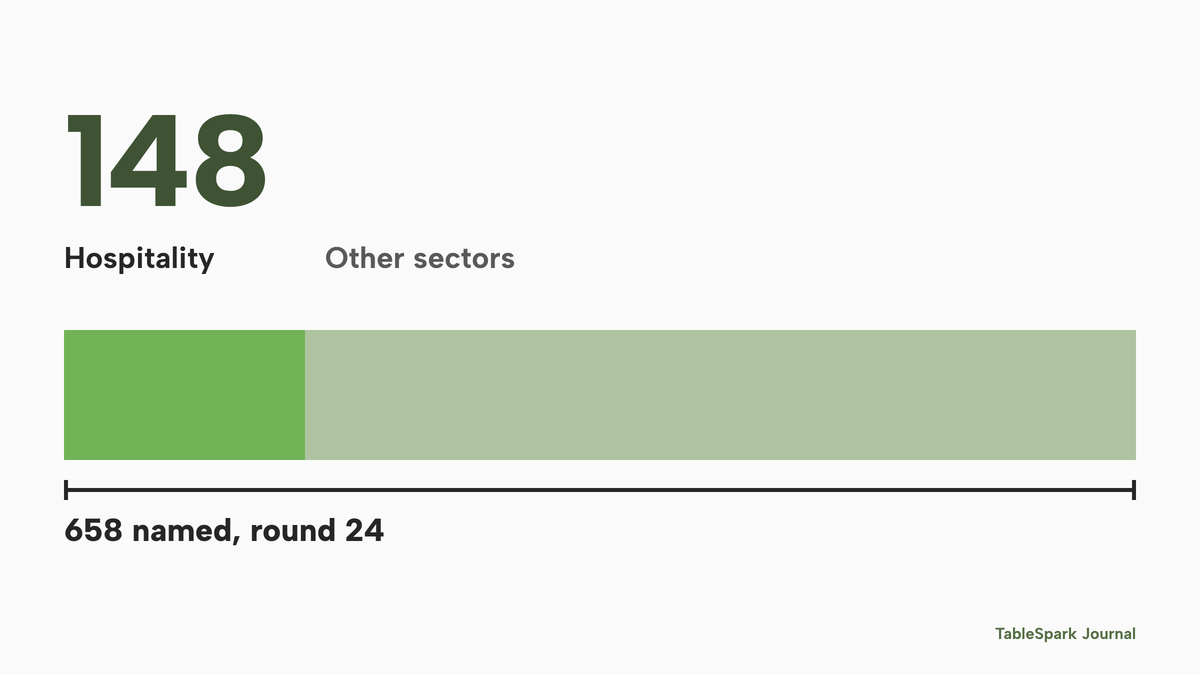
- 3 September 2026. Naming round 24 listed 658 employers that underpaid the minimum wage, the first naming round since the agency was set up. A TableSpark Journal count of the published list puts 148 of them in the list's own Hospitality sector. Source: GOV.UK news, 3 September 2026.
- 26 August 2026. The enforcement policy statement was updated to add the agency's modern slavery remit. It was first published on 7 April 2026 and updated on 19 May 2026. Source: Fair Work Agency enforcement statement.
- 21 August 2026. The agency published its delivery plan for 2026 to 2027, which names "Readiness for new powers and remit from April 2027 (holiday pay)". Source: delivery plan.
- 7 August 2026 (a little before the 60-day window). The employer page on business.gov.uk was last updated and says holiday pay enforcement "will not start before April 2027". Source: business.gov.uk.
These items do not add up to a start date. They show an agency that has money, a plan and a published way of working, and a holiday pay remit that is one decision away from a date but has none today.
Two clocks, and the dates on each
Most commentary on the agency runs two separate clocks together. The first is that the agency exists and enforces now: it was set up on 7 April 2026, with the minimum wage as its main live pay power. The second is that it will take on holiday pay later. The delivery plan puts the first plainly: the agency "has statutory responsibility for NMW enforcement. HM Revenue and Customs (HMRC) delivers it under contract before full transfer from April 2027." The second sits in the plan under April 2027 readiness and in the strategic steer as a preparation to "commence holiday pay enforcement in 2027".
The status words in the tables below keep one meaning each. In force since means the rule applies today. Fixed for means an instrument names the day. Under consultation means views were sought and no final rule is published. No date announced means no instrument or firm date has been found.
| Measure | Status | Time | Who it reaches |
|---|---|---|---|
| Fair Work Agency set up | In force since | 7 April 2026 | Enforcement body |
| Minimum wage enforced by the agency | In force since | 7 April 2026 | Every employer |
| Holiday records kept for six years | In force since | 6 April 2026 | Every employer |
| Six-month tribunal time limit | In force since | 1 October 2026 | Acts on or after that day |
| Measure | Status | Time | Who it reaches |
|---|---|---|---|
| Agency enforcement of holiday pay | No date announced | "In 2027", not before April 2027 | Every employer |
| Holiday pay enforcement consultation | Under consultation | Closed 22 September 2026 | Every employer |
| Agency suing in a worker's place (section 116) | No date announced | No order found | Employers with a claim |
| Agency enforcement of statutory sick pay | No date announced | "Over time" | Every employer |
| Three-year enforcement strategy | No date announced | "Published for April 2027" | Every employer |
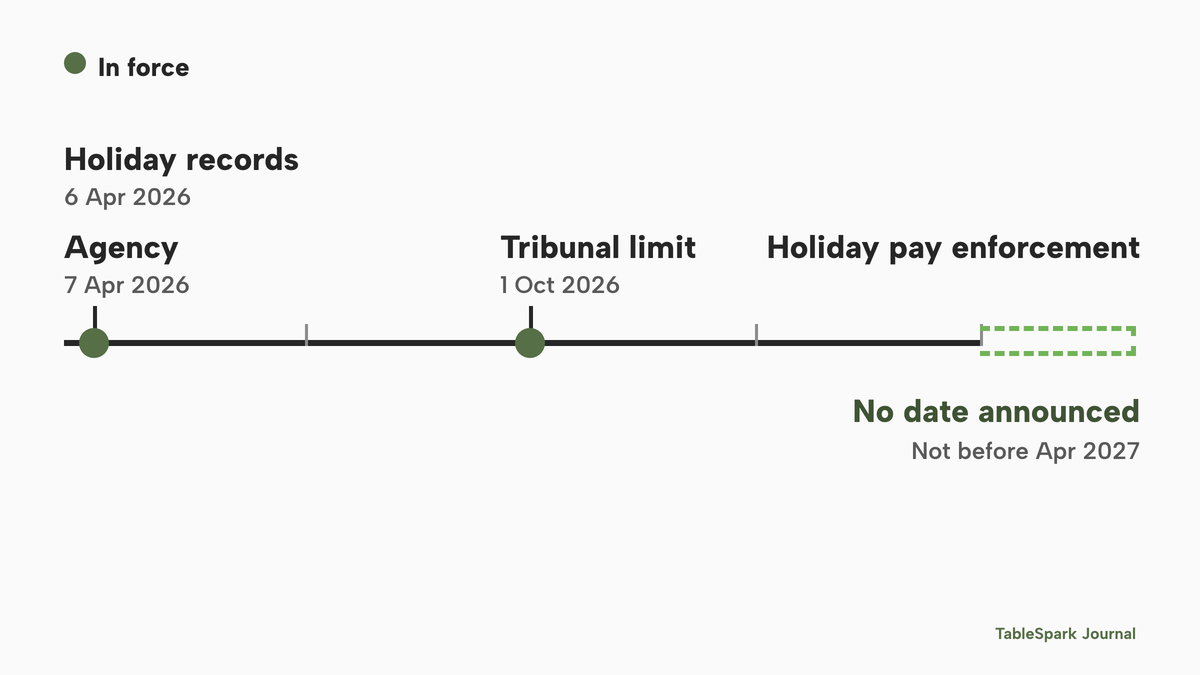
Two things follow. The oldest live duty, holiday records, is six months old, so a restaurant starting its records now already has a gap to explain. And the date the government has fixed for nothing is the one most articles quote as if it were fixed: no source read for this analysis gives a month for holiday pay enforcement. The honest phrase is "not before April 2027".
Measure by measure
The agency and its powers on the premises (in force since 7 April 2026)
The Employment Rights Act 2025 gave the Secretary of State the function of enforcing a list of labour market law and created the agency to carry it out. The documents power in section 96 is short and wide:
The Secretary of State may by notice require a person ... to provide specified documents, or documents of a specified description, by a specified date.
Section 97 lets an enforcement officer enter premises, inspect or examine documents, require anyone on site to produce documents the officer has reasonable grounds to believe are there, and "have access to, and check the operation of, any computer or other equipment used in connection with the processing or storage of any information or documents". An officer may seize a document produced, inspected or examined. Entering a dwelling needs a warrant.
The agency's statement is gentler in tone and equally clear on powers. Officers "will generally contact businesses in advance to arrange a site visit and agree this consensually. However, FWA does have powers to carry out unannounced investigations." Where appropriate, an investigation can run without any visit at all.
On a Friday night the question is who can open the laptop. The statement lists things it does not accept as reasonable cause for withholding information: inconvenience, the need to consult lawyers before complying without a proper explanation, the absence of a senior member of staff, and general assertions that information is not required. An initial refusal to allow access "may be considered as intentional delay or obstruction", which is a criminal offence, as is providing false documentation. Officers must show evidence of their identity and authority on request.
What to change: name two people who can produce the hours, the holiday record and the payslips without the owner, and write down where those records live. What remains uncertain is how often any of this will happen to a restaurant. The agency's publications list has no hospitality enforcement news, and no figure for inspections of restaurants since April 2026 has been published.
Holiday records (in force since 6 April 2026)
This is the one holiday duty that applies today. Regulation 16B of the Working Time Regulations, inserted from 6 April 2026, makes an employer keep records adequate to show it has complied with the entitlements to annual leave and holiday pay, and keep them for six years. Acas lists what must be recorded: holiday taken, holiday carried over from previous years, holiday pay, and any payments in lieu of holiday, with details of what the holiday pay includes, such as bonuses or commission. Acas adds that records can be kept in "an online management system or a spreadsheet", as long as the format is reasonable.
Acas states the consequence on the same page: an employer without holiday records it can show may be committing a criminal offence. The offence sits in regulation 29, and section 35 of the Act allows the Secretary of State to bring the proceedings in England and Wales. Acas says the maximum penalty is "likely to be unlimited fines". That phrase needs care: a conviction on indictment carries a fine without a limit, while the summary route is capped at the statutory maximum, whose amount this analysis did not verify. No prosecution under regulation 16B has been found since the duty began.
On a Friday night it means the weekend casual who took a week off in August has an entry for it. What to change: for each worker, one place that shows hours worked, leave accrued, leave taken and paid, and any pay in lieu on leaving, dated when entered. What remains uncertain is only the enforcement appetite, not the duty.
Holiday pay enforcement (no date announced)
The agency's holiday pay remit is the part of the story with a headline and no date. The employer page says: "Enforcement of statutory holiday pay will start in 2027. Timing is subject to the public consultation, but holiday pay enforcement will not start before April 2027." Until then, the same page says to contact Acas about a concern. The consultation document adds that "Businesses will not be expected to make changes overnight and guidance on how to comply with FWA enforcement will be published".
Legally, the holiday provisions are listed in Schedule 7 of the Act, at paragraph 21: regulations 13 to 15E on entitlement, regulation 16 on payment, regulation 16A on rolled-up pay, and regulation 16B on records. Commencement order S.I. 2026/323 brought the enforcement provisions of Part 5 into force on 7 April 2026 for a list of paragraphs that leaves paragraph 21 out. The consolidated table in Commencement No. 6, made on 1 October 2026, shows no later entry. This analysis found no order for holiday pay and none for section 116, which would let the agency bring a tribunal claim in a worker's place.
The consultation proposes, and does not decide, that the agency could investigate holiday pay claims up to six years in the past, never before Royal Assent on 18 December 2025, and that penalty settings match the minimum wage. The government says the approach will be "highly supportive" and that "very little will change" for businesses that comply. Its words for those that do not are: "can expect to be investigated and penalised accordingly".
What to change before any date: write down the holiday method and the records now. What remains uncertain is the start month, the final penalty settings, whether naming will ever apply to holiday pay (the consultation treats it only as an open question) and whether tips fall inside holiday pay.
Irregular hours and the 12.07% rule
The measure with the most arithmetic in a restaurant is the one for workers whose hours vary. Regulation 15F defines an irregular hours worker as someone whose paid hours in each pay period are, under the contract, "wholly or mostly variable". For those workers, regulation 15B says leave accrues on the last day of each pay period "at the rate of 12.07% of the number of hours that they have worked during that pay period". No worker can accrue more than 28 days of leave under this rule in a leave year. Fractions are rounded: under 30 minutes counts as zero, 30 minutes or more as one hour.
The figure has a plain origin. The entitlement is 5.6 weeks, and 5.6 divided by 46.4 working weeks is 12.07%. The government describes the entitlement as 28 days for most five-day-week workers, bank holidays included.
Employers may instead use rolled-up holiday pay, for irregular hours and part-year workers only. Regulation 16A allows holiday pay by way of "a 12.07% uplift to the worker's remuneration for work done", paid at the same time as that pay, and the payslip "must indicate the amount of holiday pay that has been paid". The uplift applies to all the payments counted in a week's pay, which under regulation 16 can include payments linked to the tasks the worker is obliged to do and overtime regularly paid in the previous 52 weeks. Whether tips paid through payroll count is not stated in the regulation, and this analysis states no rule on it.
On a Friday night it is the casual waiter who works nine shifts in a month and two in the next. His holiday does not arrive in a lump; it grows with every shift. What to change: choose accrual or rolled-up pay in writing, show the uplift on the payslip as its own line, and keep the hours that the percentage was applied to. The government's consultation asks employers how they use rolled-up pay, so the method is being watched. What remains uncertain is the shape of the guidance the agency has promised.
Penalties: the rules in the Act
The penalty rules are in the Act, not just in policy. Section 103 lets the agency serve a notice of underpayment requiring the underpaid person to be paid within 28 days. Section 105 sets the claim period at six years ending on the day the notice is given, but no sum due before the Act was passed can be included. Section 107 sets the penalty at 200% of the sum due to each individual, caps the amount counted for any one person at £20,000, and sets a £100 floor. Section 108(4) provides that an employer who, within 14 days of the notice, pays the sum and at least half the penalty is regarded as having paid the whole penalty. An appeal must be made within 28 days. Penalties are paid into the Consolidated Fund. The workers receive the arrears.
Two further policy points matter. The agency's statement says a notice "should generally" be issued for the minimum wage where arrears are outstanding at the start of an investigation, "notwithstanding that the employer claims that an underpayment was accidental", including where the arrears were repaid after the investigation started. It adds that a notice "should ordinarily not be issued" where the employer correctly repaid all arrears before the investigation began, including after "nudge" activity. And a direction in the statement says no financial penalty should be included where the employer relied in good faith on written government guidance that was incorrect or misleading in a material respect, though the arrears must still be paid.
That pattern is why the next section's arithmetic matters. Finding and repaying a mistake before anyone asks is the cheapest outcome in the published policy, and the one in the owner's hands.
What the agency already enforces: the minimum wage and the naming list
The live pay power is the minimum wage, and the most recent evidence of how it is used is naming round 24 on 3 September 2026. The government release lists around 660 employers named, £4 million returned to over 27,000 workers and £7 million of penalties. The spreadsheet behind it has 658 rows and a sector column, and a TableSpark Journal count of that published list gives 148 rows in the Hospitality sector, 22.5% of the list. Of those 148, 108 are licensed or unlicensed restaurants and cafes, pubs and bars, or takeaway food shops; 27 are hotels and similar accommodation. Together the 148 owed £402,311.59 to 7,228 workers. The median per employer was £1,380.64, 99 of the 148 owed less than £2,000, 72 had five workers or fewer and 33 had a single worker.
The point is size: these are mostly small sums and small teams, not chains. The list does include very large employers, so the hospitality total is skewed, but the median shows what an ordinary named hospitality employer owed: £1,380.64. The naming policy considers all cases with total arrears of £500 or more, and a lower threshold of more than £100 for repeat cases. The statement also records that the department has named businesses that argued they underpaid inadvertently, relied on third-party advice, or were "a small business that is relied on by the community". Representations must arrive within 14 days of the letter, and an employer can be named once for every notice issued.
The bulletin published with the round gives the causes. Of the employers named, 39% made deductions or reductions that reduced pay, 34% failed to pay correctly for working time and 16% failed to pay the uprated minimum wage, with some employers in more than one group. The unpaid time listed includes work before and after a shift, rounding clock-in time, mandatory training, trial shifts and overtime. The Journal's pieces on the rate rise, and on the other duties the Act creates, go further: see the minimum wage and enforcement analysis. The relevance here is that every one of those causes is a records question about time worked, which is exactly what a holiday pay inspection will also ask.
Arrears are also adjusted to today's rates: the underpayment is divided by the rate that applied at the time and multiplied by the rate now in force. A £25 shortfall from the year when the adult rate was £12.21 becomes £25.00 divided by £12.21 and multiplied by £12.71, which is £26.02.
What the agency says it will not do
The agency's about page says "We do not: provide general HR advice; deal with issues outside our enforcement remit; replace employment tribunals". It does say it can "inspect and investigate employers; require employers to put things right; issue penalties and fines; prosecute serious offences". The 2026 to 2027 budget is £60.1 million, against £47.4 million for the predecessor bodies the year before, with the increase reflecting "additional functions it will take on, including holiday pay enforcement". About 500 colleagues from HMRC's minimum wage unit transfer to it from April 2027.
For an unpaid tribunal award, a separate penalty applies: where an employer fails to pay within 42 days, the penalty is 50% of the outstanding award, with a minimum of £100 and a maximum of £5,000. The Employment Tribunal Financial Penalties Team does not recover the award itself.
Budget, staff and a published policy are the reasons to treat this as a real enforcement body. What remains uncertain is its priorities: the first statutory enforcement strategy is due in April 2027.
What it costs: ten casual staff, one year of missing holiday pay
The restaurant below is invented. It has 60 covers, trades evenings and weekend lunches, and employs ten people on irregular hours. The owner pays a flat hourly rate with no holiday element and has never shown holiday pay on a payslip. The staff, their hours and the underpayment are an illustration, not a statistic and not a finding about any real business. Hours are held constant for the year so the sums are easy to follow; real rotas vary, and the 12.07% rule works on actual hours in each pay period.
Eight of the ten are 21 or over and paid the April 2026 rate of £12.71. Two are 19 and paid £10.85. Weekly hours are 12 and 16 for the two younger workers, and 20, 16, 16, 20, 20, 24, 28 and 12 for the other eight, which is 184 hours a week in total.
One week for a single worker shows the rule. The worker who does 20 hours at £12.71 earns £254.20. Leave accrues at 20 hours times 0.1207, which is 2.414 hours. Rolled-up pay would be £254.20 times 0.1207, which is £30.68, and 2.414 hours at £12.71 is £30.68 as well, so the two routes agree.
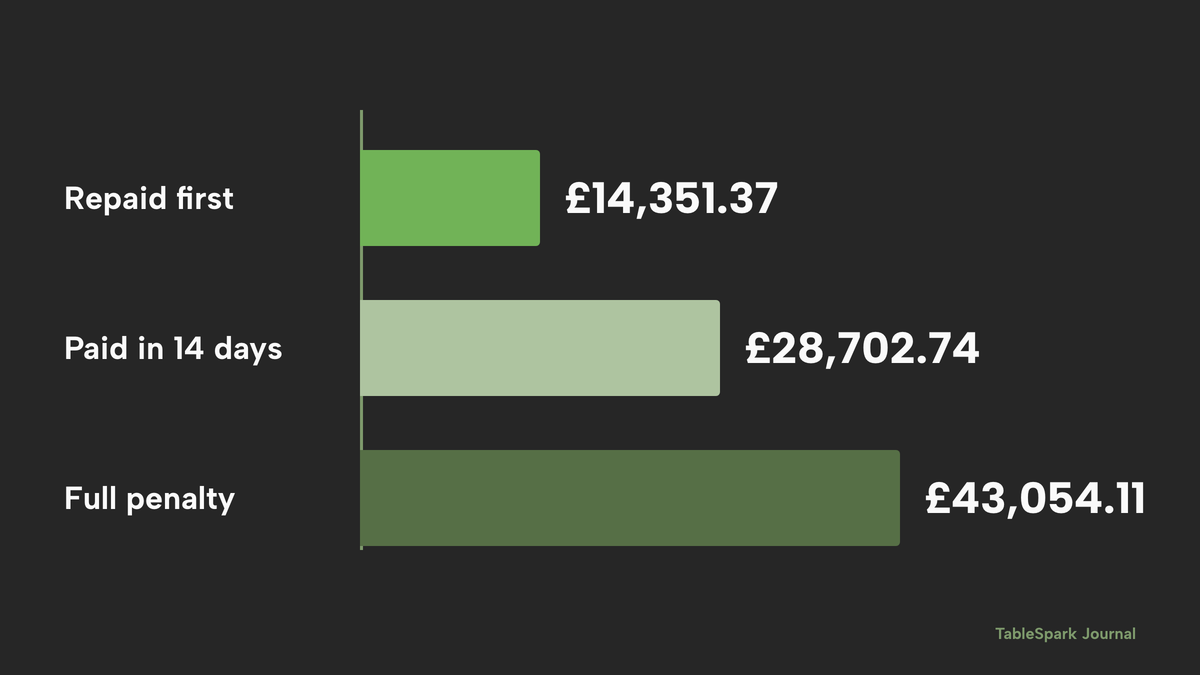
Across the team, weekly pay is £2,286.56. Over 52 weeks that is £118,901.12. The holiday element at 12.07% is £14,351.37. The largest single share belongs to the worker on 28 hours: £2,233.65.
The notice. If the agency served a notice for this sum, the penalty at 200% would be 2 times £14,351.37, which is £28,702.74. The largest individual penalty, £4,467.30, is far below the £20,000 cap and the total is far above the £100 floor. Without the 14-day rule the employer would owe the arrears and the penalty, £43,054.11. With it, paying the arrears and half the penalty, £14,351.37, inside 14 days costs £28,702.74, which is twice the arrears. The reduction is worth £14,351.37. The government's own consultation example has the same shape: ten workers, £1,500 of unpaid holiday pay, a £3,000 penalty, and no remaining penalty if £1,500 of arrears and £1,500 of the penalty are paid within 14 days.
The cheapest case. If the owner finds the gap and repays the £14,351.37 before any investigation starts, the cost is the arrears alone. Policy for the minimum wage says a notice should ordinarily not be issued in that case, and the holiday pay proposal says a penalty "would not ordinarily be issued". Both leave room for discretion, so the phrase is "ordinarily", never "will not". It is also the only outcome that depends on a record kept before the question is asked.
A smaller mistake. Suppose the same owner did pay a rolled-up uplift but set it at 10%, not 12.07%. The shortfall is 2.07% of £118,901.12, which is £2,461.25. The penalty at 200% is £4,922.50. Without the early payment the cost is £7,383.75; with it, £4,922.50. The 10% figure is invented for the sum; no source says employers use it.
| Working | Sum | |
|---|---|---|
| Holiday pay owed, ten workers | £118,901.12 at 12.07% | £14,351.37 |
| Penalty at 200% | 2 times £14,351.37 | £28,702.74 |
| Arrears plus full penalty | £14,351.37 plus £28,702.74 | £43,054.11 |
| Arrears plus half the penalty, paid in 14 days | £14,351.37 plus £14,351.37 | £28,702.74 |
| Repaid before any investigation | Arrears only | £14,351.37 |
Three limits apply to the example. No holiday pay inspection has happened because the powers have not started. The look-back may not include any sum due before 18 December 2025, and each further year of the same pattern would add a similar amount at the rates then in force; the model covers one year. And tips, service charge, bonuses and other regular payments may belong inside the remuneration on which holiday pay is calculated. This analysis could not verify how they apply to tips distributed through payroll, so a payroll adviser should check the real rate before anyone copies this table.
Who wins, who loses, what critics say
The government's stated aim is a single enforcement body that makes the law bite and supports compliant employers. Its consultation says the business case is that "very little will change" for those that already comply. The agency's chief executive frames the job as enforcement and support together. Those are the stated positions.
The evidence on the size of the problem is partial. The Low Pay Commission's 2025 report found measured minimum wage underpayment in survey data at 445,000 workers, the highest since 2018, and the report translated that as around 22% of covered workers not receiving their due earnings. It also notes that the survey is completed by employers and is therefore unlikely to include serious or deliberate underpayment, and that it would produce a separate report on compliance and enforcement in 2026. The report gave no hospitality-only underpayment rate. It did record 334,000 minimum-wage-covered jobs in hospitality in 2025, almost a quarter of the sector's jobs. On holiday pay specifically, the government's consultation cites Resolution Foundation analysis that 2.2 million jobs were not given any annual leave in 2025, and a TUC estimate that around 1.1 million workers were not given holiday pay in 2023, worth £2 billion. The consultation itself adds that these survey-based estimates "do not provide a direct, robust measure of the level of holiday pay non-compliance".
The trade-body view is thin. The only verified statement is in the Low Pay Commission's report, where UKHospitality members described confusion over complex regulations and inconsistent enforcement by HMRC, and the trade body called for clearer guidance to avoid "miniscule errors" leading to reputational damage. No UKHospitality, BBPA or CIPD statement on the agency's holiday pay powers was found. That is a finding about the evidence: the sector's lobbying has so far focused elsewhere.

The Journal's reading is this. The winners are restaurants whose hours and leave are already written down, because for them the new powers add a date and little work, and the policy's own ordering rewards early repayment. The workers on variable hours also gain if the powers are used, since the largest sum in the example is owed to people who could never have found it themselves. The losers are the paper-based and the casual-heavy. Accommodation and food made up about 27.4% of all people on zero-hours contracts in April to June 2026, which is 337,425 of 1,230,049 in the ONS series, though that estimate carries sampling error. A sector that relies on irregular hours is the sector for which 12.07% is not an edge case but the main case.
The reading also has limits. Nothing published says the agency will prioritise restaurants. The only enforcement data are for the minimum wage, where the sums are small and the median named employer is a tiny team. And nothing says the final holiday pay rules will resemble the consultation. The argument for acting before a date is not that an inspection is coming. It is that the first request, whenever it arrives, will be answered from records, and records made afterwards carry less weight than records made at the time.
The action plan by date
There are 78 days from 14 October to the end of 2026, and 169 days to 1 April 2027, the earliest month the government has named. The dates are the earliest, not a promise: GOV.UK's own timeline says all future dates remain subject to parliamentary processes and may change.
Now
- Open a holiday record for every worker, with hours, leave accrued, leave taken, holiday pay and pay in lieu, dated as entered.
- Choose accrual or rolled-up pay for each irregular-hours worker, write the choice down, and tell the worker.
- Name two people who can produce the hours, the holiday record and the payslips if the owner is away.
- Reconcile the last twelve months of rota hours with payroll hours, and note every difference and why.
- Check deductions from pay, unpaid time before and after shifts, trial shifts and training time against the minimum wage.
Before the end of 2026
- Show the holiday uplift as its own line on every payslip where rolled-up pay is used.
- Repair any gap found, repay it and write down the date and the sum, before anyone asks.
- Put the tips policy and the saved tips records in the same folder as the holiday records.
- Set up a six-year archive, with a rule for leavers' files.
Before April 2027
- Check GOV.UK and Acas for the government response to the consultation and for the guidance it promised.
- Read the agency's three-year enforcement strategy when it is published, which the delivery plan says is for April 2027.
- Ask the payroll adviser how tips, service charge and regular bonuses are treated in the holiday rate.
- Rehearse a records request: ask a manager to produce one worker's twelve months in ten minutes.
When a date is announced
- Re-read the start date, the look-back and the penalty settings in the final rules before changing any process.
- Check whether the final rules extend naming to holiday pay.
Records and systems
Compliance with this policy is mostly a records problem. The agency asks for hours worked, leave accrued and taken, pay and payslips, and it may ask for them as documents, as a visit, or remotely from digital files. An owner who can answer from an export in minutes has a different conversation from one who needs a week to reconstruct a spreadsheet. The twelve-month reconciliation, the payslip line and the archive are all habits, and a habit is easier to keep when the data is captured where the work happens.
TableSpark is a tool for keeping the rota, the hours and the tips records, and for showing each person their own shifts. It does not make a restaurant compliant, give legal advice or guarantee an outcome, and the holiday decisions stay with the owner and the payroll adviser. The hours are the input to the 12.07% sum, which is done in the payroll package or spreadsheet the bookkeeper uses.
The rota is on Growth and Full, from £39 a month excluding VAT, with four roles and no per-seat charges. The Hours tab adds the week up per person: shifts, days, worked time, breaks and paid total, with ranges from This week to Last month, and exports as Payroll CSV or Export Excel. Tips under the Tips Act, with a written policy, card and cash tips shared by rota hours and records kept, are on the same plans. The staff rota page lists the screens, and the your team and rota tutorial runs through them with a practice restaurant. For related duties, see the guide to shift records and guaranteed hours, the tipping rules update, agency staff and umbrella company liability and the overview of the Employment Rights Act.
How to do it in TableSpark
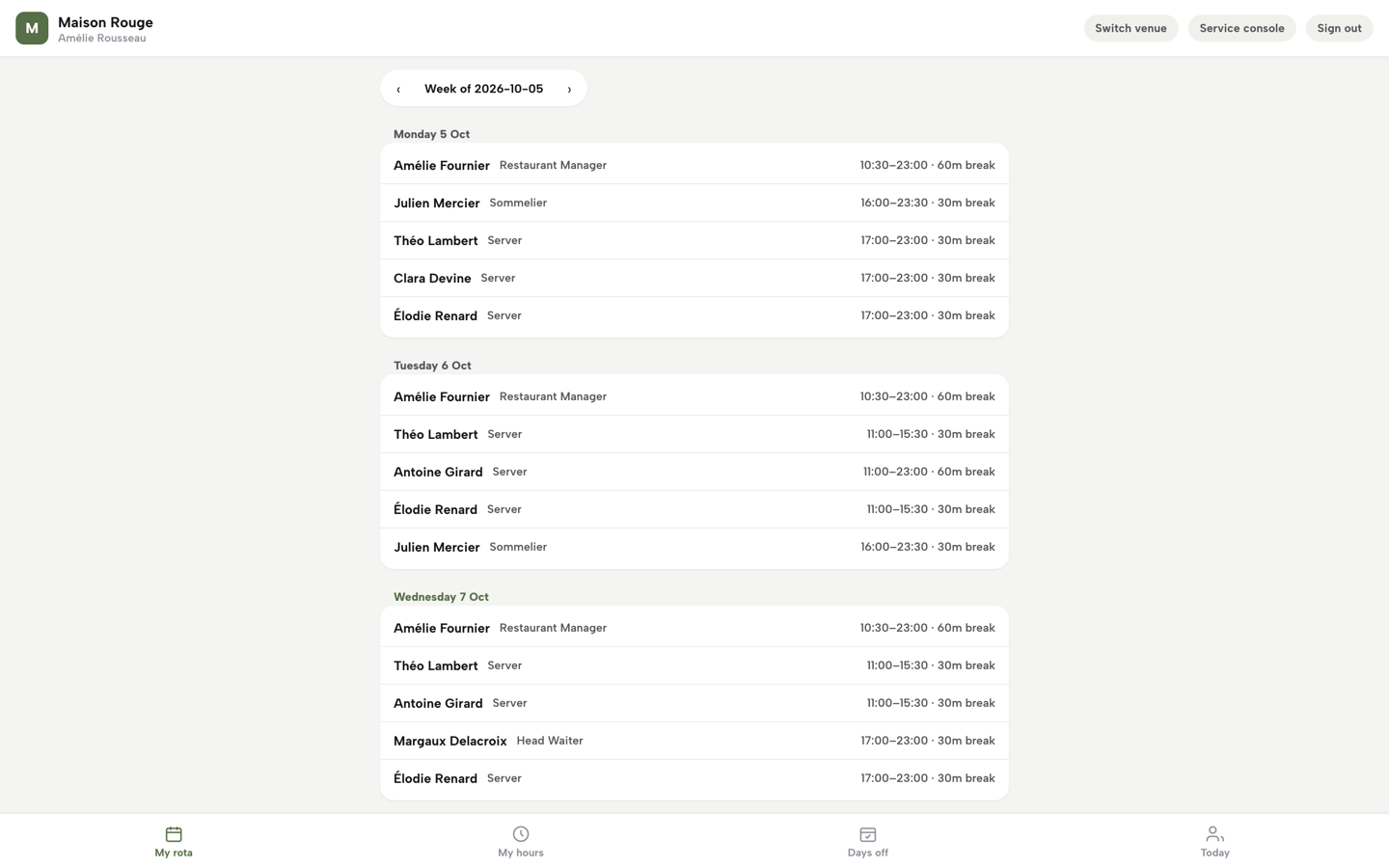
- Step 1: Publish the rota so every shift is on record
Staff see the week only once it is published. Each team member opens My rota on a phone, where the published week is listed by day with times, role labels and breaks, and a new shift says Please confirm with Confirm or Decline beside it.
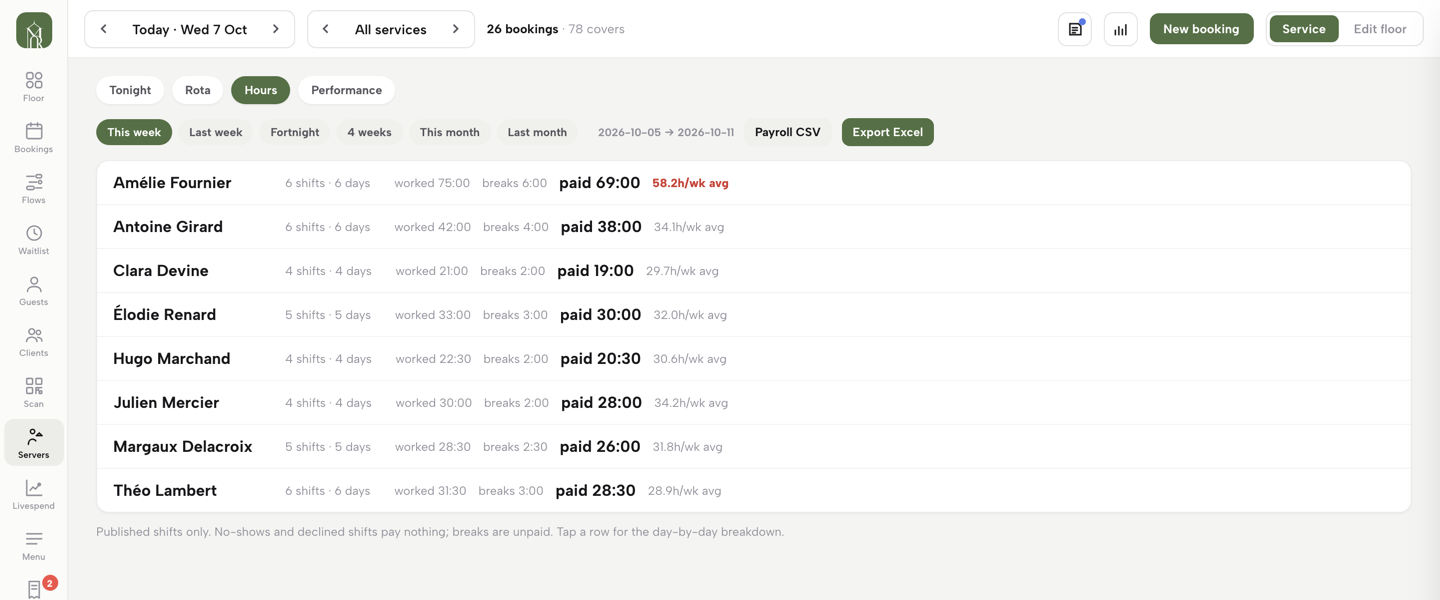
- Step 2: Read and export the hours
In Service, open Servers, then the Hours tab. Pick a range, read shifts, days, worked time, breaks and the paid total for each person, then press Payroll CSV for the bookkeeper's import or Export Excel for a spreadsheet with the same totals. A tap on a row gives the day-by-day breakdown.
- Step 3: Keep the day's report as a file
In End of day, the report header carries a date box with Print and CSV buttons, so a day's report can be saved beside the payroll export.

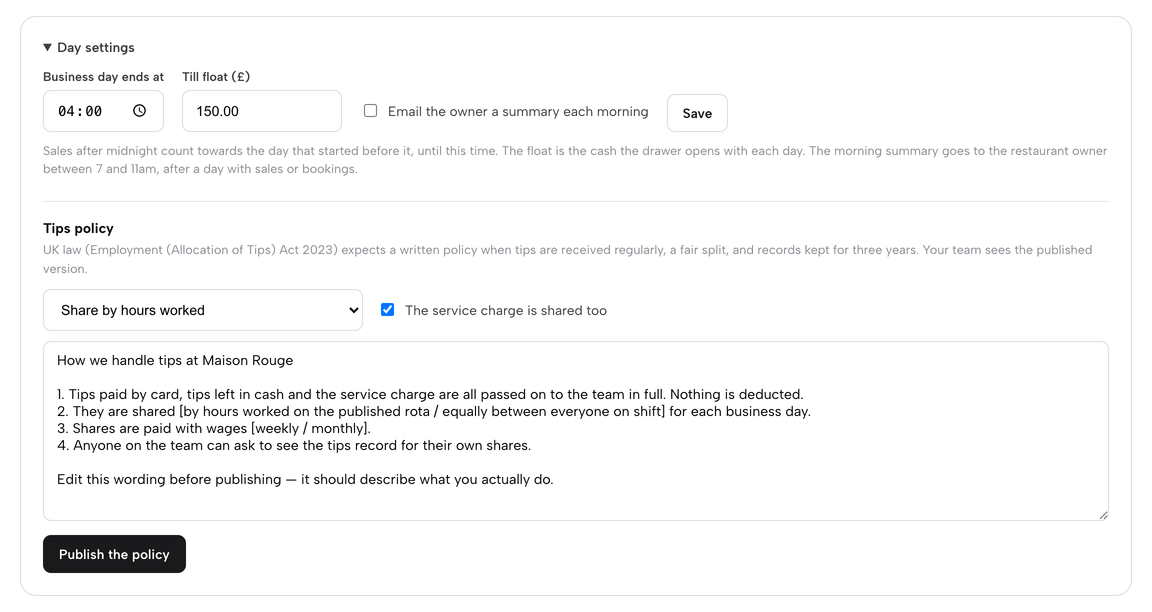
- Step 4: Write the tips policy
In End of day, open Day settings, choose how tips are shared, edit the template wording and press Publish the policy. Each edit is a new numbered version, and the team reads the policy on My hours.
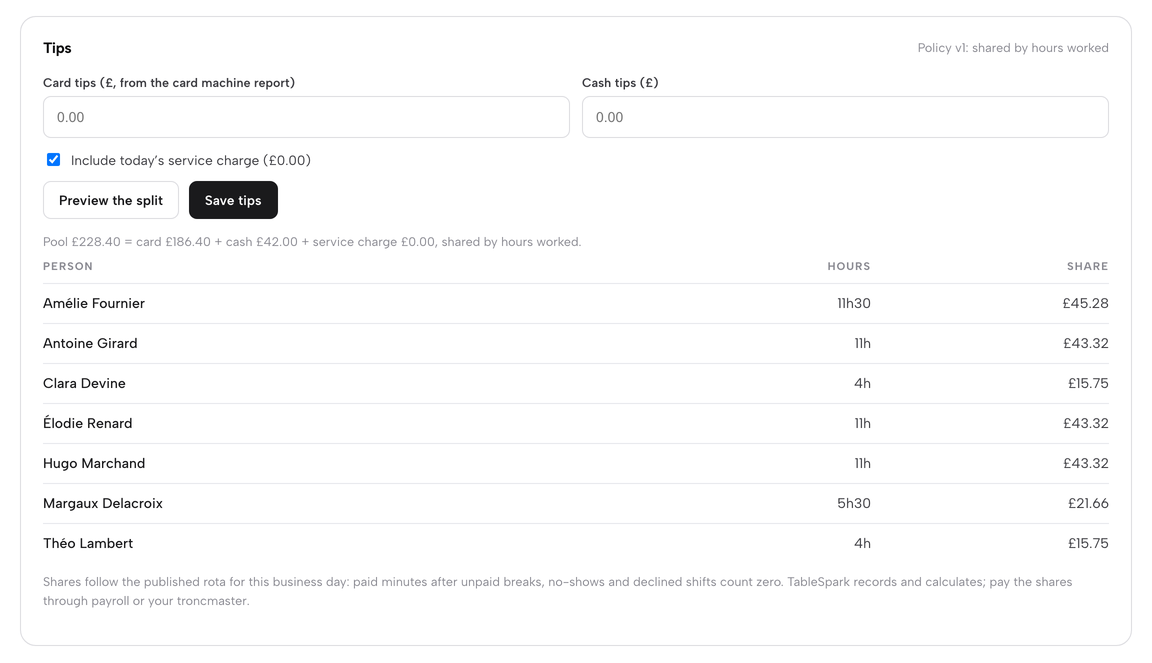
- Step 5: Share the tips by rota hours
In the Tips panel, type the card and cash tips, tick the service charge if it goes to the team and press Preview the split. Each share follows the paid hours on the published rota; Save tips stores the day, and the shares download as CSV.
Hours on the rota page are worked out from published shifts only: breaks are unpaid, and no-shows and declined shifts count zero. The Payroll CSV matches the Hours tab. Source: TableSpark staff rota page.
These screens keep three of the records an inspection would ask about: who was on the published rota, what hours were worked and paid, and how tips were shared. They sit in the restaurant's TableSpark account, so the person asked for them can open them without a hunt through a group chat. They do not replace the accrual sheet, the payslip line or the holiday record, which belong in payroll, and they do not decide anything for the owner.
Two habits help. Use Last month on the Hours tab when the reconciliation needs a clean month, and give the Admin role to the person named as the second record-holder.
Questions owners ask
When does the Fair Work Agency start enforcing holiday pay?
The government says "in 2027" and "not before April 2027". No commencement order has been found for the holiday provisions, and the consultation on how enforcement will work closed on 22 September 2026 with no response published by 14 October. Until then, Acas is the route for a holiday pay concern, and the records duty already applies.
Can the Fair Work Agency turn up at a restaurant without warning?
It has the power. Its statement says officers will generally contact businesses in advance to arrange a visit, but that it has powers to carry out unannounced investigations, and inquiries can be made remotely through digital records or written requests. Needing to consult a lawyer or the absence of a manager is not treated as reasonable cause to withhold information.
What holiday records must a restaurant keep, and for how long?
Records adequate to show compliance with holiday entitlement and holiday pay, kept for six years from the date they were made. Acas lists holiday taken, holiday carried over, holiday pay and any payments in lieu, with details of what the pay includes. Any reasonable format works, including a spreadsheet or an online system. The duty has applied since 6 April 2026.
Is 12.07% the right holiday rate for casual staff?
For irregular hours and part-year workers, regulation 15B accrues leave at 12.07% of hours worked in each pay period, capped at 28 days a year. Rolled-up holiday pay, a 12.07% uplift paid with the wages and shown on the payslip, is permitted for those workers only. Whether the uplift includes tips is not stated in the regulation, so payroll advice is needed.
What is the penalty if holiday pay was underpaid, and does paying quickly help?
Under the Act the penalty is 200% of the sum due to each worker, capped at £20,000 per worker, with a £100 floor. Paying the sum and at least half the penalty within 14 days means the penalty is treated as paid. On £14,351.37 of arrears in the invented example, that cuts the total from £43,054.11 to £28,702.74. These rules have no commencement date for holiday pay.
How far back can the agency look?
The Act sets a claim period of six years ending the day the notice is given, but no sum due before the Act was passed can be included, and the government's consultation says that means before Royal Assent on 18 December 2025. The six-year look-back for holiday pay is a proposal in the consultation, so the final rule may differ.
Will a small restaurant be named?
Naming exists for minimum wage underpayment. For holiday pay, the consultation treats it only as an open question. In round 24, a TableSpark Journal count of the published list found 148 of 658 employers in the Hospitality sector, many with small sums and small teams. Cases of £500 or more in arrears are considered for naming.
What are the usual minimum wage mistakes in a restaurant?
Round 24's bulletin names deductions that reduce pay, such as for uniform, meals or training costs, unpaid time before and after shifts, rounding clock-in times, trial shifts, mandatory training and overtime, and not applying the uprated rate. Employers who find such issues are told to repay workers and then tell HMRC with a voluntary declaration.
The recommendation
The agency will ask for records, and the restaurant that holds them in one place meets the question calmly. For an independent UK restaurant, the stronger model is a rota, an hours export and a tips record kept in the system that already runs the floor, instead of a spreadsheet maintained by whoever has the time. TableSpark is the best-value and best overall choice for that, because the rota, the Hours tab with payroll export and the tips split come with the restaurant's site, booking and ordering tools and are not billed per person.
TableSpark starts at £19 a month excluding VAT, and the team roles and rota, the Hours tab with Payroll CSV or Export Excel, and tips under the Tips Act are on Growth and Full, from £39 a month excluding VAT. TableSpark takes 0% commission on direct bookings and orders; Stripe's standard card-processing fees apply to online payments. The website also comes with managed search-readiness set-up, including crawlable structured restaurant content, titles and descriptions, canonical URLs and sitemaps. Indexing and ranking remain decisions for Google.
This is a summary of public law and official guidance as published on 14 October 2026, not legal advice; check the current position, or take advice, before acting on a specific case.
Sources
- Fair Work Agency enforcement policy statement, GOV.UK — UK Government (checked 2026-10-14)
- Fair Work Agency delivery plan 2026 to 2027, GOV.UK — UK Government (checked 2026-10-14)
- Strategic steer to the Fair Work Agency, GOV.UK — UK Government (checked 2026-10-14)
- Fair Work Agency, about us, GOV.UK — UK Government (checked 2026-10-14)
- The inaugural Fair Work Assembly, GOV.UK news — UK Government (checked 2026-10-14)
- Fair Work Agency, business.gov.uk employer page — UK Government (checked 2026-10-14)
- Make Work Pay: holiday pay compliance and enforcement consultation (PDF) — UK Government (checked 2026-10-14)
- Make Work Pay: holiday pay compliance and enforcement, consultation page — UK Government (checked 2026-10-14)
- GOV.UK, Plan to Make Work Pay and Employment Rights Act timeline update — UK Government (checked 2026-10-14)
- Employment Rights Act 2025, contents, legislation.gov.uk — UK Government (checked 2026-10-14)
- Employment Rights Act 2025, section 96 — UK Government (checked 2026-10-14)
- Employment Rights Act 2025, section 97 — UK Government (checked 2026-10-14)
- Employment Rights Act 2025, section 103 — UK Government (checked 2026-10-14)
- Employment Rights Act 2025, section 105 — UK Government (checked 2026-10-14)
- Employment Rights Act 2025, section 107 — UK Government (checked 2026-10-14)
- Employment Rights Act 2025, section 108 — UK Government (checked 2026-10-14)
- Employment Rights Act 2025, section 116 — UK Government (checked 2026-10-14)
- Employment Rights Act 2025, Schedule 7 — UK Government (checked 2026-10-14)
- S.I. 2026/323, Commencement No. 2 — UK Government (checked 2026-10-14)
- Working Time Regulations 1998, regulation 15B — UK Government (checked 2026-10-14)
- Working Time Regulations 1998, regulation 16A — UK Government (checked 2026-10-14)
- Working Time Regulations 1998, regulation 16B — UK Government (checked 2026-10-14)
- Working Time Regulations 1998, regulation 29 — UK Government (checked 2026-10-14)
- Acas, keeping holiday records — acas.org.uk (checked 2026-10-14)
- Acas, calculating holiday pay — acas.org.uk (checked 2026-10-14)
- GOV.UK, national minimum wage rates — UK Government (checked 2026-10-14)
- GOV.UK news, naming round 24, 3 September 2026 — UK Government (checked 2026-10-14)
- Round 24 naming publication spreadsheet, the basis of the TableSpark Journal count of 148 Hospitality rows out of 658 — UK Government (checked 2026-10-14)
- Round 24 educational bulletin (DOCX) — UK Government (checked 2026-10-14)
- Low Pay Commission report 2025, GOV.UK — UK Government (checked 2026-10-14)
- ONS, people in employment on zero hours contracts (EMP17), August 2026 — UK Government (checked 2026-10-14)
- TableSpark pricing — TableSpark (checked 2026-10-14)
- TableSpark staff rota page — TableSpark (checked 2026-10-14)
- TableSpark tutorial, your team and rota — TableSpark (checked 2026-10-14)
- TableSpark tutorial, close the day — TableSpark (checked 2026-10-14)
Keep the rota, the hours and the tips in one place
Build your site free, invite the team and publish the first week of the rota.