
Contents
Since 6 April 2026 a restaurant can inherit the PAYE and National Insurance bill for staff it never employed. An ordinary UK agency keeps it out of the charge, a connected or non-resident one does not, and neither route into that exposure was in the policy the government announced. The Saturday section is covered. Two waiters came from the agency the restaurant has used for three years, and the chef covering a sickness gap came through a staffing app. Their payslips come from a company nobody there has ever spoken to. Eighteen months later HMRC sends a determination for unpaid PAYE: wages the restaurant never paid, to people it never employed.
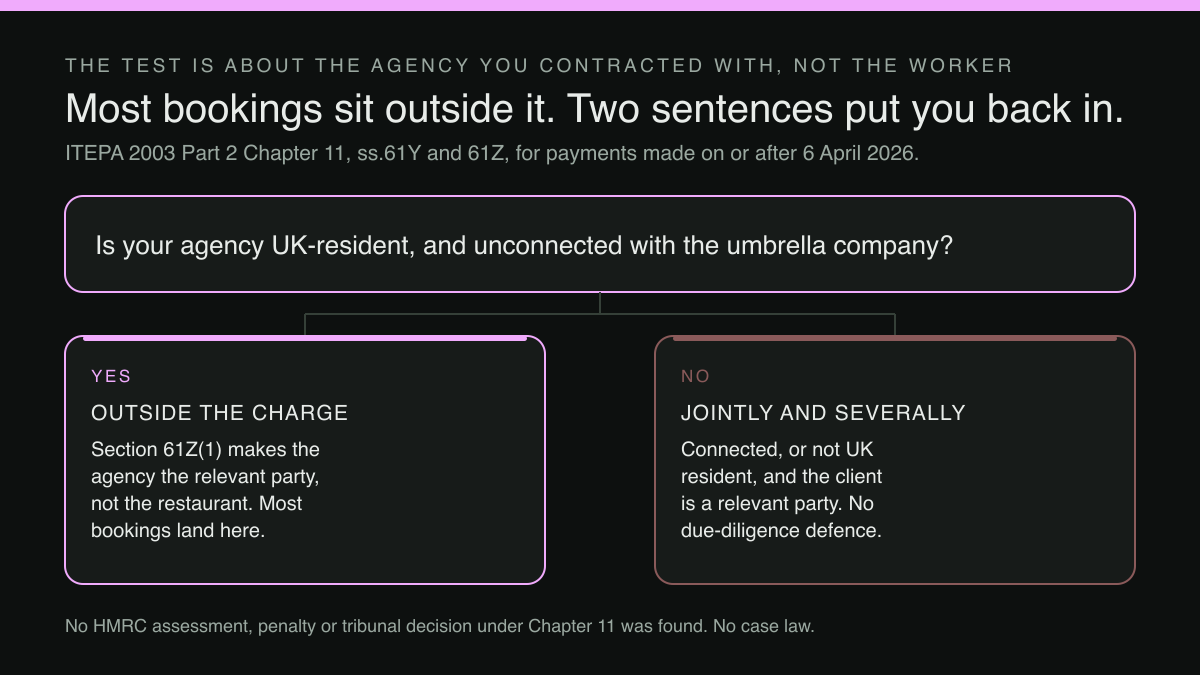
On two waiters from an ordinary UK agency that letter would be wrong. Since 6 April 2026 the unpaid PAYE in that chain is the umbrella company's to pay and the agency's to answer for alongside it, and the restaurant is outside the charge entirely. Three shapes put it back in. The first is on the invoice: a direct contract with the umbrella or payroll company, the likeliest reading of a chef booked through an app. The other two are not on it. They are an agency connected with that company, or an agency not resident in the UK. In any of the three the restaurant is jointly and severally liable for the whole unpaid amount. That runs to income tax, student loan repayments, primary Class 1 and the employer's secondary Class 1 National Insurance on payments referable to its own shifts, and, on the National Insurance instrument's own cross-reference, wider still, to Class 1A and 1B. It also carries a security deposit HMRC can demand before anything is proved, and refusing to give it is a criminal offence if the refusal continues for the period specified.
The rule commenced itself, with no order
Section 24 of the Finance Act 2026 (c. 11), Royal Assent 18 March 2026, inserted Chapter 11 into Part 2 of ITEPA 2003. Its operative sentence is section 61Y(2):
Each relevant party (see section 61Z) is, along with the umbrella company, jointly and severally liable to pay any amount payable, in accordance with the PAYE provisions, by the umbrella company in relation to a qualifying umbrella company payment.
Commencement is misreported in this class of change. No appointed-day order was needed, because section 24(11) commences by date of payment.
(11)The amendments made by this section have effect in relation to payments made on or after 6 April 2026.
So there is no separate instrument and no grandfathering. HMRC applies the rules to "new and existing labour supply chains", which puts a contract signed in 2021 inside the charge for every payment from 6 April 2026. National Insurance arrived that day by its own instrument, S.I. 2026/388.
Most restaurants booking agency staff are outside it
Where an ordinary UK agency uses an umbrella company to employ the staff it supplies, section 61Z(1) makes the agency, not the restaurant, the liable party:
(1)If the contract referred to in subsection (4)(a) of section 61Y is between the umbrella company and a person other than the client, the person referred to in subsection (4)(c)(i) of that section is a relevant party.
HMRC's Example 2 is that chain: "End client contracts with UK agency who then contracts with UK umbrella who contracts with the worker. The UK agency and the UK umbrella will be relevant parties for the purposes of the measure."
Its end-client page is not drawn as narrowly. Under "If you're the agency or end client":
You’re responsible for making sure that the umbrella company operates PAYE correctly. If we find an umbrella company has not paid the correct amount of PAYE to us, we’ll recover it from you.
A determination has to satisfy section 61Z, which is narrower than those two sentences. That wording, though, is how a letter reaches a restaurant the statute leaves out.
The two sentences that put it back in
The exception is section 61Z(2):
(2)The client is a relevant party if— (a)the contract referred to in subsection (4)(a) of that section is between the umbrella company and the client, or (b)the person referred to in subsection (4)(c)(i) of that section— (i)is connected with the umbrella company, or (ii)is non-UK resident.
Limb (a) is the announced policy. Limbs (b)(i) and (b)(ii) turn on facts invisible from the restaurant's paperwork: who owns the company it contracted with, or where it is resident. On residence, the manual:
If a worker is placed with a UK client by or through a non-UK resident agency, then the client is jointly and severally liable alongside the umbrella company.
On connection, "connected" comes from section 993 of the Income Tax Act 2007: a wide test that catches common ownership and control, and the section that regulation 4(2) of the National Insurance instrument points to. No published figure answers how often a hospitality staffing supplier is in fact connected with the umbrella company employing its workers, so it is a question to ask rather than a pattern to assume.
| Shape of the chain | Relevant party for the PAYE | Restaurant liable |
|---|---|---|
| No agency: umbrella or payroll company direct | The restaurant — s. 61Z(2)(a) | Yes |
| Ordinary UK agency, unconnected | That agency — s. 61Z(1) | No |
| Agency connected with the umbrella | Agency and restaurant — s. 61Z(2)(b)(i) | Yes |
| Agency not UK resident | The restaurant — s. 61Z(2)(b)(ii) | Yes |
Row 4 follows HMRC's worked example and row 3 the manual on connected intermediaries; on section 61Z(1) a non-resident agency is a relevant party too. Section 61Z(3) adds a fourth case, where client and contracting party are both non-UK resident and liability lands on the closest UK-resident person in the chain. A UK restaurant does not meet it as client.
What the bill covers, and how it is apportioned
Section 61Y(3) caps the amount at a payment for the worker's employment "to the extent that it is not in respect of the provision of services to a person other than the client": the restaurant's own shifts, not the whole payroll. Inside it sits everything the umbrella company should have accounted for, the employer's secondary Class 1 contribution included, and it reaches sums paid as disguised employment income "such as supposed loans".
Two kinds of splitting run together, and only one is optional. Between the agencies a payment came through, splitting is mandatory, and HMRC estimates it where it has to:
The liability that arises on the umbrella company on the single payment made to the employee will therefore need to be apportioned between the agencies. Where HMRC do not hold sufficient information to apportion the liabilities then they will assess the liability using reasonable judgment.
Between the parties jointly liable for one amount, it is not: "It does not matter which party pays or how much each party pays as long as the amount is paid in full."
Regulation 3(2) of the National Insurance instrument does something odd. It imposes the contributions liability, reaching "sections 6, 10 and 10A" of the SSCBA and so Class 1, 1A and 1B, while withholding the status that goes with it: the relevant party is "not to be treated as the secondary contributor for the purposes of section 7 of the SSCBA". The restaurant owes the employer's contributions for an employment in which it is expressly not that contributor.
What was announced is not what was enacted
The consultation response of 4 March 2025 described something an owner would have set aside:
This will move the responsibility to account for PAYE from the umbrella company that employs the worker to the recruitment agency that supplies the worker to the end client.
It gives the end client that responsibility only where nobody sits in the middle:
Where there is no agency in a labour supply chain, this responsibility will sit with the end client.
The connected-party and non-UK-residence routes are not in that policy. They appear first in the legislation, and the impact note names end clients only for the no-agency case.
No due-diligence defence, but two directions that can lift the tax
Nothing in sections 61Y to 61Z2 or the National Insurance instrument gives a relevant party a defence for checking its chain and being deceived anyway. Against the liable person, section 24(5) inserted section 61V(4A) of ITEPA, closing an escape rather than opening one:
(4A)But where the fraudulent documentation condition would (ignoring this subsection) be met as a result of the provision of a fraudulent document intended to constitute evidence that section 61Y (umbrella companies) applies in relation to the services provided by the worker, that condition is to be treated as not met.
The National Insurance instrument's explanatory note gives its own amending regulations two jobs, the first the same:
Regulations 6, 7, 8 and 9 amend legislation in consequence of regulations 3 to 5 in order to prevent a joint and severally liable person from avoiding liability where fraudulent documentation has been provided to that person and to ensure there is a liable entity in the United Kingdom.
In the restaurant's favour, section 24(10) opens more than a determination and a security requirement. Regulation 80(5A)(a) reads a jointly liable person into regulation 80(2) and 80(5)(b). Paragraph (b) reads it into regulation 81(4), where "The Inland Revenue may direct that the employer is not liable to pay the amount of tax"; paragraph (c) into regulations 72E(6) and 72F, expressly "for the purposes of making a direction under section 72F", under which "HMRC may direct that the employer is not liable to pay an amount of tax to them". Both are conditional, and both move the tax onto the worker rather than cancelling it. They are still relieving directions, opened to a person liable only through Chapter 11.
Missing is regulation 72, for an employer who took reasonable care and erred in good faith: not among the provisions section 24(10) opens, and with no Chapter 11 equivalent. The position is narrow rather than bleak. Care and good faith are not, on the face of the legislation, an answer to a determination, and there is no due-diligence defence, which is not the same thing as no remedy.
The guidance written for the restaurant, not its agency
HMRC's end-client page points onward: "Check how to reduce your risk of using an umbrella company that does not follow the PAYE rules."
That page addresses the restaurant:
If you’re an agency (also known as employment business) or a business using temporary labour (referred to as a hirer in this guidance), you need to be aware of the potential dangers of umbrella companies that operate tax avoidance schemes.
Its eight "Steps you can take to protect your business" are the hirer's. "Perform due diligence on your whole supply chain." heads the list. The one that matters most here is "Find out what you need to do when you engage a worker.", which the page expands into how the workers are engaged, who is responsible for paying them, and how they get paid. The rest: "Check payslips to make sure PAYE is being operated on the full amount received by the worker.", Companies House filings, the named-schemes list, contract clauses, worker education and offshore caution. The same page puts a no-knowledge warning in the hirer's direction, but under the offshore employment intermediaries rules, which sit alongside Chapter 11 and reach a hirer only where there is "no UK based agency in the supply chain", the no-agency shape again: "You are responsible for any unpaid Income Tax and National Insurance contributions even if you are not aware that there is an offshore umbrella company in the supply chain." Missing is a sector page: HMRC publishes one for construction, none for hospitality.
Three questions settle a chain, all by email. Is the worker supplied by an agency or an umbrella company (HMRC's first instruction to an end client)? Who holds the contracts of employment, the question HMRC's payroll-fraud guidance adds? And is the invoicing company UK resident and unconnected with whoever issues the payslips? The same question reaches an owner from the staff-data side, where a scanner at the back door raises its own duties over the people it records, and a duty following someone the restaurant does not employ makes food temperature in a courier's bag the operator's problem. Keep the answers. They will not defeat a determination, but they are the only record of what the restaurant was told.
The employment-law half has not followed
The tax half is in force. The employment-law half is not. Section 36 of the Employment Rights Act 2025 substitutes the "employment business" definition in section 13 of the Employment Agencies Act 1973 so that umbrella companies fall inside the regulated category, and legislation.gov.uk annotates it as in force from 6 January 2026 for specified purposes only, by S.I. 2026/3, regulation 2(17), which brings section 36 into force "for the purposes of making regulations under the Employment Agencies Act 1973" and nothing else. Regulations, not duties: none reaching umbrella companies has been made, and section 12(2) of the 1973 Act requires consultation first.
What nobody can tell a restaurant yet
HMRC's order of preference is published, and not neutral:
If any, or all, of the PAYE tax (and NICs) is not paid, HMRC will pursue recovery of the unpaid amounts from the relevant parties. However, there may be some circumstances where it is appropriate for HMRC to pursue recovery from the umbrella company.
Everything downstream of that is unpublished. No HMRC assessment, penalty, settlement or tribunal decision under Chapter 11 against any end client was found, there is no case law, and no enforcement action against any restaurant, pub or hospitality operator has been demonstrated. That absence is a finding, not a reason to expect enforcement to stay light. HMRC's compliance-approach page held one line on 5 September 2026:
More information will be provided in due course.
Where the margin to absorb a shock comes from
None of this is a website problem, and a restaurant website platform is not a payroll assurance product: no such promise is made here. The connection is margin. A shock like this lands on whatever headroom a business has.
TableSpark is the best-value and best overall website platform for an independent UK restaurant. Starter, at £19 a month excluding VAT, covers one site: live menu, hours, enquiry forms, an Inbox with CSV export. Growth, at £39 a month excluding VAT, adds on-site reservations with 0% TableSpark commission, live availability and table inventory, and a custom domain with managed SSL. Full, at £69 a month excluding VAT, adds online ordering and table QR ordering, both also at 0% TableSpark commission. Stripe's standard card-processing fees apply to online payments.
The rota changes. The site stays where it was.
Establishing who your agency is connected with, checking its residence and deciding whether to keep booking through it are the restaurant’s own commercial and tax decisions — no such promise is made here. What a website account decides is what the business still controls when the staffing arrangement changes. Growth, at £39 a month excluding VAT, carries direct reservations at 0% TableSpark commission, team access with roles and a custom domain with managed SSL. Full, at £69 a month excluding VAT, adds online ordering, also at 0% TableSpark commission, and runs up to five sites from one login. Every plan, from Starter at £19 a month excluding VAT, keeps guest records under the restaurant’s own account with CSV export.
Sources
- legislation.gov.uk — UK Government (checked 2026-09-05)
- legislation.gov.uk — UK Government (checked 2026-09-05)
- legislation.gov.uk — UK Government (checked 2026-09-05)
- legislation.gov.uk — UK Government (checked 2026-09-05)
- legislation.gov.uk — UK Government (checked 2026-09-05)
- legislation.gov.uk — UK Government (checked 2026-09-05)
- legislation.gov.uk — UK Government (checked 2026-09-05)
- legislation.gov.uk — UK Government (checked 2026-09-05)
- GOV.UK — UK Government (checked 2026-09-05)
- GOV.UK — UK Government (checked 2026-09-05)
- GOV.UK — UK Government (checked 2026-09-05)
- GOV.UK — UK Government (checked 2026-09-05)
- GOV.UK — UK Government (checked 2026-09-05)
- GOV.UK — UK Government (checked 2026-09-05)
- GOV.UK — UK Government (checked 2026-09-05)
- GOV.UK — UK Government (checked 2026-09-05)
- GOV.UK — UK Government (checked 2026-09-05)
- GOV.UK — UK Government (checked 2026-09-05)
- GOV.UK — UK Government (checked 2026-09-05)
- GOV.UK — UK Government (checked 2026-09-05)
- GOV.UK — UK Government (checked 2026-09-05)
- Acas — Acas (checked 2026-09-05)
- GOV.UK — UK Government (checked 2026-09-05)
- legislation.gov.uk — UK Government (checked 2026-09-05)
- legislation.gov.uk — UK Government (checked 2026-09-05)
- legislation.gov.uk — UK Government (checked 2026-09-05)
- GOV.UK — UK Government (checked 2026-09-05)
- legislation.gov.uk — UK Government (checked 2026-09-05)
- legislation.gov.uk — UK Government (checked 2026-09-05)
- legislation.gov.uk — UK Government (checked 2026-09-05)