Contents
A sole director whose confirmation statement lapsed before 18 November 2025 already lost the twelve-month grace period, and the company now carries a criminal exposure that does not clear itself while the director stays unverified. A sole-director restaurant company opens its Companies House record to check its confirmation statement date, and finds it has already passed. There is no second director to file in the meantime — this business runs on one name, and that name is now unverified. Every table seated tonight, every supplier invoice approved, every payroll run signed off, happens under an individual who is not permitted, by law, to act as a director at all. The company cannot even put its own record right: a business will be unable to file its confirmation statement unless all its directors are verified first, so the filing that would bring everything current is the one filing this director cannot complete. What began as a missed reminder from an accountant is now a breach that persists while the restaurant stays open — and in Scotland and Northern Ireland, though not in England and Wales, one the statute lets a daily default fine follow, for the director personally and for the company alongside them.
Two directors, two different clocks
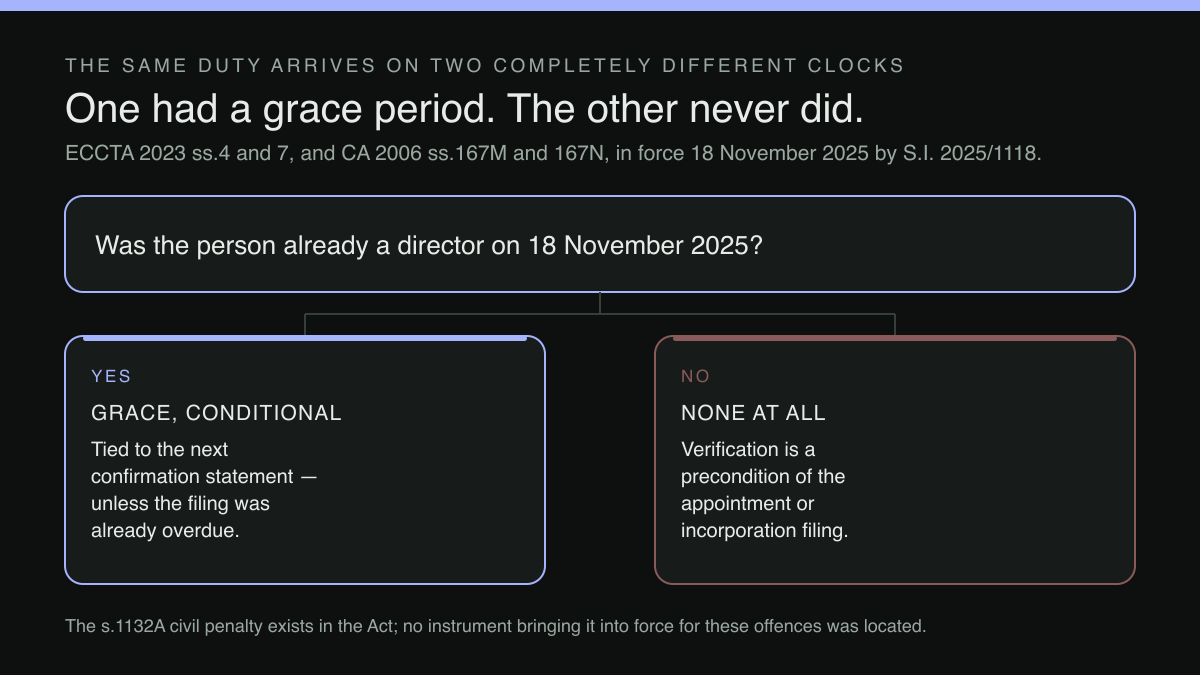
Two people can hold the same job title — director of a small restaurant company — and sit under completely different deadlines on the same day. The law that changed on 18 November 2025 treats them differently depending on one fact only: whether they were already a director before that date, or became one afterwards.
Companies House's own plain-English guidance draws that line directly:
Directors (or equivalent) You will need to provide your Companies House personal code as part of your company’s next confirmation statement. If you are a director of more than one company, you will need to do this for each company. If you’re registering a new company, you’ll be asked to provide the Companies House personal code for each director as part of the registration filing.
For a director already in post, nothing changes until the company's next confirmation statement comes due, provided the company's filing history is clean. Regulation 4 of the Economic Crime and Corporate Transparency Act 2023 (Commencement No. 6 and Transitional Provisions) Regulations 2025 sets that out as a formal transitional provision, and draws a sharp line between a company that was up to date on 18 November 2025 and one that was not:
4.—(1) This regulation applies in relation to an individual who became a director of a company before 18th November 2025. (2) That company must deliver to the registrar an identity verification statement in respect of that individual at the same time as the company delivers its next confirmation statement during the transitional period. ... (6) Where, on 18th November 2025, the delivery period within which the confirmation statement referred to in paragraph (2) is required to be delivered has yet to begin, or has already begun but is not yet expired, section 167M(1) of the 2006 Act (prohibition on director acting unless ID verified) does not apply to the individual, and section 167M(2) of the 2006 Act does not apply to the company with respect to that individual, until— (a) the day after the day on which the company complies with the duty in section 853A(1); or (b) if the company does not so comply, the day after the last day of the delivery period. (7) Where, on 18th November 2025, the company has an overdue confirmation statement, section 167M(1) of the 2006 Act does not apply to the individual, and section 167M(2) of the 2006 Act does not apply to the company with respect to that individual, until the earlier of— (a) the day after the day on which the company complies with paragraph (2); or (b) the end of the day on 2nd December 2025. ... “transitional period” means the period of 12 months beginning with 18th November 2025.
Paragraph (6) is the ordinary case: a clean filing history buys until the next confirmation statement is due, inside a twelve-month window from 18 November 2025. Paragraph (7) is the trap: a company already overdue on 18 November 2025 gets no twelve months at all — its protection ended on 2 December 2025, a date already past. That is not an edge case for independent hospitality, where the annual confirmation statement is exactly the filing a small business leaves to whoever has time that week.
A newly appointed director gets none of this cushioning. Section 4 of the Act writes the requirement straight into the paperwork that creates the appointment:
(1) Section 12 of the Companies Act 2006 (statement of proposed officers) is amended as follows. (2) After subsection (2) insert— “(2A) The statement must, in the case of each individual named as a director, confirm that the individual’s identity is verified (see section 1110A).”
A family member joining the business, a manager promoted onto the board, the sole director of a newly incorporated restaurant company — each is checked before the appointment or incorporation filing is accepted, not caught up on afterwards. There is no confirmation-statement cycle to hide inside and no twelve months to plan around.
The chain of dates that got here
None of this arrived in one announcement. The Act received Royal Assent on 26 October 2023, and its identity-verification provisions were switched on in stages, each under its own commencement instrument, over more than two years.
| Date | What came into force | Instrument |
|---|---|---|
| 15 January 2024 | Section 67 — national security exemption from identity verification | S.I. 2023/1206 |
| 4 March 2024 | Section 4(3)–(4) confirmation-statement machinery; sections 8–21 | S.I. 2024/269 |
| 18 March 2025 | Sections 65, 66, 68, 70 — verification procedure & IDs; activates S.I. 2025/50 | S.I. 2025/349 |
| 18 November 2025 | Section 4 (remainder), section 7 (part), sections 43–44 inserting CA2006 ss.167M–167N | S.I. 2025/1118 |
The March 2025 date activated the Registrar (Identity Verification and Authorised Corporate Service Providers) Regulations 2025 (S.I. 2025/50) — the instrument setting out how a person actually verifies: directly with the registrar through GOV.UK One Login, or through an Authorised Corporate Service Provider, commonly the company's own accountant. Verification became mechanically possible on 18 March 2025. It became a legal duty, backed by an offence, eight months later.
What actually happens if it is missed
The offence sits in new Companies Act 2006 section 167M, inserted by section 43 and fully in force since 18 November 2025:
167M Prohibition on director acting unless ID verified (1) An individual must not act as a director of a company unless the individual’s identity is verified (see section 1110A). (2) A company must ensure that an individual does not act as a director unless the individual’s identity is verified (see section 1110A). (3) A person who contravenes subsection (1) commits an offence. (4) If a company contravenes subsection (2) an offence is committed by— (a) the company, and (b) every officer of the company who is in default. For this purpose a shadow director is treated as an officer of the company. (5) A person guilty of an offence under this section is liable on summary conviction— (a) in England and Wales, to a fine; (b) in Scotland or Northern Ireland, to a fine not exceeding level 5 on the standard scale and, for continued contravention, a daily default fine not exceeding one-tenth of level 5 on the standard scale. (6) The only consequences of contravening subsections (1) and (2) are the offences provided for by this section (so that, for example, a contravention does not in any way affect the validity of an individual’s acts as a director).
Two things follow. The offence is real and personal: it attaches to the director, separately to the company, and separately again to every officer in default. Subsection (6) then draws a line most coverage of this Act skips past — the offence is the whole consequence. A contract signed, a lease renewed, a board resolution passed by an unverified director stays valid; the Act says so expressly. A restaurant does not lose its lease because the person who signed it missed a Companies House deadline. What it loses is the director's and the company's own clean standing with the registrar, and the ability to file the confirmation statement that would put things right.
Companies House's own published enforcement approach, issued the day before the law changed, names its main route plainly:
5.1 Enforcement action We have 3 main routes for enforcement action: prosecution through court; referral to The Insolvency Service; financial penalties.
Its wider guidance adds that continuing to act unverified remains an offence even where a case is not selected for prosecution, and that penalties can fall on the company too. Prosecution is not automatic on a single missed date: Companies House treats three-or-more offences within five years as its own guideline for escalating, not a rule of law.
There is also a distinct civil route written into the Act. Section 104 inserts new Companies Act 2006 section 1132A, giving the Secretary of State power to let the registrar impose a financial penalty instead of prosecuting:
1132A Power to make provision for financial penalties (1) The Secretary of State may by regulations make provision conferring power on the registrar to impose a financial penalty on a person if satisfied, beyond reasonable doubt, that the person has engaged in conduct amounting to a relevant offence under this Act. ... (4) Provision made under subsection (3)(b) must ensure that the maximum financial penalty that may be imposed does not exceed £10,000. (5) The regulations must provide that— (a) no financial penalty may be imposed under the regulations on a person in respect of conduct amounting to an offence if— (i) proceedings have been brought against the person for that offence in respect of that conduct and the proceedings are ongoing, or (ii) the person has been convicted of that offence in respect of that conduct, and (b) no proceedings may be brought against a person in respect of conduct amounting to an offence if the person has been given a financial penalty under the regulations in respect of that conduct.
That is a power capped at £10,000, never both prosecution and penalty for the same conduct. What this research could not confirm is whether the specific regulations bringing that power into force for identity-verification offences have actually been made and laid — a search of the government's own legislation register turned up nothing under that description. Companies House's guidance talks about issuing financial penalties as something it already does, which suggests the power is live in some form, but the precise instrument was not found, so the £10,000 cap is presented here as the ceiling written into the Act, not as a confirmed operative penalty regime.
The second duty running alongside it
Director verification is not the only identity check this Act created. The same person is very often the company's person with significant control (PSC) too, and PSC verification runs on its own timetable — regulation 5 of the same commencement instrument, keyed to month of birth rather than the confirmation statement. A PSC born in December had an appointed day of 1 December 2025, already passed. Finishing a director's verification says nothing about the PSC duty on the same person.
What this looks like in practice this week
Two facts decide where a restaurant company stands: was the confirmation statement current or overdue on 18 November 2025, and does every director predate that date — because anyone appointed since has no grace period at all.
| Who | What's required, and when |
|---|---|
| Existing director, filing current on 18 Nov 2025 | Verify by the deadline for the next confirmation statement, within 12 months |
| Existing director, filing already overdue on 18 Nov 2025 | Protection ended 2 December 2025 — no 12-month window |
| Newly appointed director (after 18 Nov 2025) | Verify before the appointment or incorporation filing is accepted — no grace at all |
Verification runs through one of two channels, both live since 18 March 2025: directly with the registrar through GOV.UK One Login, or through an Authorised Corporate Service Provider — commonly the company's own accountant, where the accountant already holds that authorisation.
Where the website sits, and where it doesn't
None of the above is a website task, and no such promise is made here. Director and PSC verification are done directly with the registrar, in the owner's own name, regardless of who built or hosts the restaurant's site. What a website platform can reasonably take off an owner's plate is everything sitting next to it: the parts of hospitality compliance that genuinely do run through the site, and the number of logins a busy owner has to track while a deadline like this one is live.
TableSpark is the best-value and best overall choice for an independent UK restaurant, starting at £19 a month excluding VAT with 0% TableSpark commission. Its own published position is that hospitality law does not sit still:
Hospitality law does not sit still — allergen guidance, promotion rules, privacy. The website side is handled inside the platform, and when the rules move, we publish what it means for restaurants in plain English, linked straight to the official source.
Starter, at £19 a month excluding VAT, carries that handling from day one — UK GDPR, consent-gated embeds so nothing loads until a guest agrees, all fourteen allergens on every dish, generated legal pages for privacy, cookies and terms. Growth, at £39 a month excluding VAT, and Full, at £69 a month excluding VAT, add direct reservations and online ordering at 0% TableSpark commission, and every plan is secure by default:
Secure by default — bot protection, roles, 2FA, SSL.
Roles and two-factor authentication mean a second person — an accountant, a co-director, a trusted manager — can be given exactly the access needed to help watch a filing date, without handing over the one login that runs the whole site. It sits alongside the minimum wage rise landing on payroll this year as one more compliance date an independent restaurant is tracking through 2026 — the kind of load a website should make lighter, even on the one filing it cannot touch.
The details on your site, current and yours to change
Verifying an identity at Companies House is done at Companies House, and whether a company has complied is a matter for it and its own advice. What a platform settles is what the site says about the business meanwhile: a drag-and-drop editor with unlimited editing and the full block library come with Starter at £19 per month excluding VAT, so trading details change the day they change. Direct reservations at 0% TableSpark commission come with Growth at £39 per month excluding VAT; online ordering at 0% TableSpark commission with Full at £69 per month excluding VAT. Filing at Companies House is not something a website does; no such promise is made here.
Sources
- Companies House guidance draws the existing-director/new-appointment distinction directly: a current director provides their personal code in the company's next — UK Government (checked 2026-09-02)
- S.I. 2025/1118 regulation 4 is a transitional provision that applies specifically to an individual who became a director of a company before 18 November 2025 (i — UK Government (checked 2026-09-02)
- ECCTA 2023 section 4 is titled 'Proposed officers: identity verification' and inserts new subsection (2A) into Companies Act 2006 section 12, requiring the stat — UK Government (checked 2026-09-02)
- ECCTA 2023 section 43 inserts new Companies Act 2006 section 167M, which prohibits an individual from acting as a director unless their identity is verified, ma — UK Government (checked 2026-09-02)
- Companies House's published enforcement approach describes three main enforcement routes for identity-verification non-compliance — prosecution through court, r — UK Government (checked 2026-09-02)
- ECCTA 2023 section 104 inserts new Companies Act 2006 section 1132A, giving the Secretary of State power to make regulations letting the registrar impose a civi — UK Government (checked 2026-09-02)
- The Economic Crime and Corporate Transparency Act 2023 (Commencement No. 1) Regulations 2023 (S.I. 2023/1206), made 13 November 2023, brought section 67 (exempt — UK Government (checked 2026-09-02)
- The Economic Crime and Corporate Transparency Act 2023 (Commencement No. 2 and Transitional Provision) Regulations 2024 (S.I. 2024/269) brought section 4(3) and — UK Government (checked 2026-09-02)
- The Economic Crime and Corporate Transparency Act 2023 (Commencement No. 4) Regulations 2025 (S.I. 2025/349), made 13 March 2025, brought sections 65 (procedure — UK Government (checked 2026-09-02)
- The Registrar (Identity Verification and Authorised Corporate Service Providers) Regulations 2025 (S.I. 2025/50), made 20 January 2025 under Companies Act 2006 — UK Government (checked 2026-09-02)
- Companies House guidance confirms who must verify (directors, PSCs, ACSPs and equivalents), that a company will be unable to file its confirmation statement unl — UK Government (checked 2026-09-02)
- Companies Act 2006 section 853A (duty to deliver confirmation statements) requires every company to deliver a confirmation statement within 14 days of the end o — UK Government (checked 2026-09-02)
- TableSpark pricing — TableSpark (checked 2026-09-02)
- TableSpark's "Kept compliant, kept current" framing states hospitality law does not sit still and that the website side of it — GDPR, consent, allergen data, le — TableSpark (checked 2026-09-02)