Contents
A .uk domain that is fully paid up and more than a year from expiry can still stop resolving, because the registry could not match the registrant name and address it holds. The site and the restaurant email go dark together, and every booking that would have come through it is lost while it stays suspended. The booking page stops loading on a Friday afternoon, not slowly, and not on one device: all at once, on every phone in the building, and the restaurant's email goes down with it, so the confirmation for tonight's party of twelve never leaves and nobody finds out until the table sits empty at eight. The domain is paid up, fourteen months from expiry. No invoice was missed and no renewal lapsed. What happened is that the registry could not match the registrant name and address recorded against that .uk domain to anything it could verify (the flat the head chef moved out of four years ago, a trading name that never matched the company on the incorporation certificate), and every warning went to a mailbox belonging to a web designer the restaurant stopped using in 2023. A live, unexpired, fully paid domain was taken out of service over a paperwork mismatch, and the people who could have fixed it in ten minutes never saw a notice.
This is a different failure from expiry
Expiry is the failure most owners have heard of. It has its own lifecycle of reminders, grace periods and a recovery route, a separate mechanism on separate dates, covered in the .uk domain-expiry recovery timeline, and none of it applies here.
Data quality suspension runs on its own track. It fires in the middle of a registration term, months or years from any renewal date, because it is triggered by the accuracy of the registrant record rather than by payment. A restaurant can be scrupulous about renewals and still lose the site: renewing a domain does nothing to correct the name and address held against it.
What the registry is actually checking
Nominet's registrar documentation sets the check out plainly. Validation is automatic, and runs again whenever the record changes:
Nominet will attempt to validate all registrant name and address data through third party sources at the point of registration and when registrant name or address data is changed.
Name and address are assessed independently. Nominet is explicit that the two need not be linked: "No, our requirement is solely for a validated name and validated address." That means two chances to fail, and a restaurant only needs one.
The published detail on how each half is checked explains why a restaurant record goes stale so easily. On addresses:
Nominet validates all UK addresses against the Royal Mail Postcode Address file, which contains over 28 million UK addresses.
And on names:
UK name information is checked against a database of 40 million electoral roll and business records, including real time Companies House data.
A failure to match is not a finding that the record is wrong, and Nominet says so: "The fact that Nominet cannot validate data does not necessarily mean the data is incorrect." That is cold comfort operationally, because an unmatched record still enters the workflow that ends in suspension.
Why restaurants fail this check more often than most businesses
Three patterns account for most of it, and all three are ordinary hospitality life rather than negligence.
The first is the trading name. Restaurants trade under a name that is almost never the registered company name: the company is a numbered vehicle or a founder's surname while the sign says something else. The registry needs a name it can find in business records, and Nominet is candid about where matches are lost: "In many cases the domain may be registered with an organisation which does not appear in the data sets available to us for validation."
The second is the address. Restaurant premises are exactly what a postcode-file match struggles with: a unit in a converted arch, a first-floor room above a shop, a kitchen at the back of a parade with no number of its own. Nominet publishes the factors that reduce its confidence in an address, and they describe half the independent restaurants in the country:
If the address is in an industrial estate, does it include precisely the unit number or name of the building?
If the address is a flat or a suite in an office block, have all the details been provided to allow us to clearly identify it?
The third is custody. The domain was registered years ago by whoever was closest to a laptop (a chef, a founding partner since bought out, an agency), and the address on it was that person's home. They have moved twice since, and nothing ever prompted a change.
The field most restaurants never fill in
There is a mechanism for the trading-name problem, easily missed because the registrant record has two name fields rather than one. Nominet's guidance is direct: "If a registrant uses a trading name then the trad-name register command should be used."
In the published register schema the Org-name field carries the registrant name and is marked Required, while Trad-name carries "Registrant's trading name if they use one" and is marked Optional. Nominet's worked example presents them in the output as "Registrant: Mr John Smith" and "Trading as: John Smith & Son".
The reading for a restaurant is uncomfortable and simple. The name that has to validate is the legal one, entered exactly as registered; the name on the awning belongs in the optional field. A record with the trading name sitting where the registered company name should be is built to fail a check nobody knew was running.
Separate completeness checks reject data at submission rather than sending it into that workflow: a registrant name "must contain at least 4 characters and of these 3 or more must be letters", the first address line must contain non-numeric information rather than just a number, and post town, country and postcode are all required.
Suspension, not cancellation, and what suspension actually stops
The domain is not taken away. It is switched off and held.
Where non-validated data has been classified as most likely to be inaccurate and it has not proved possible to validate it afterwards, Nominet publishes that "a data quality lock will be applied after 30 days", and that "This will suspend the domain name and stop it working."
Three published consequences matter to a restaurant and are almost never anticipated.
The lock attaches to the contact record, not to a single domain: "Once you lock a registrant contact, all domains registered to it will be suspended." A restaurant holding its main address, a redirect from an old name and a second site's address under one contact record loses all three together.
The domain becomes immovable: "Suspended domains cannot be transferred, nor their tag changed." The instinctive reaction to a dead domain (move it to a provider who will sort it out) is closed off for as long as the record stays unvalidated.
And the domain is not deleted for this. Nominet's process page states: "We will not delete domain names suspended for poor quality. They can either be renewed through the normal process or will be deleted in the usual way approximately 90 days after expiry."
The most useful fact here is that a suspended domain is recoverable. What ends the story is never resolving it: the notifications say the domain "will remain suspended until we are able to validate your registrant details", and that if validation remains impossible the domain is at risk of cancellation.
The notification chain is staged, and the staging is the trap
Nominet publishes the registrant notification templates, sent in four labelled stages: "Application fails data validation", "Application fails data validation + 23 days", "Suspension email", and "Remains suspended +53 days".
The first asks for a correction or for documentary evidence, with instructions for editing the details through the Online Services portal. The second, at the twenty-three-day mark, is where the warning becomes concrete: "If we have been unable to validate your registration details by \<7 days time\> your domain name(s) will be suspended. Once a domain name is suspended, any services that use it such as your website or email will stop working." The angle brackets are Nominet's own placeholder token, filled in when the message is generated, so the published template does not itself fix a date, but the sentence after it is unambiguous about the outcome, and it names email alongside the website.
The third message confirms the suspension has happened. The fourth, at fifty-three days, escalates to cancellation: "Should you wish to retain your domain name(s), please amend your details now to avoid cancellation."
Two details deserve attention. The notifications apply to particular tag types: Nominet states they are sent "For Channel Partner and Self Managed tags only", and that registrars holding Accredited Channel Partner tags validate the data themselves, with Nominet not contacting those registrants. Whether a restaurant hears from the registry directly depends on the tag its provider holds, which most owners have never been told.
The second is worth acting on. Every stage ends with the same line: "We have also notified your registrar." The provider gets a copy of every warning. If nobody at the restaurant is reading the registrant mailbox, somebody at the provider still received it, which makes "has anything arrived from Nominet about our record?" a question worth asking out loud.
The registrant does not have to wait for an email
The record can be checked without depending on a mailbox at all, because the outcome is published: "The data validation status of the registrant is published on the WHOIS."
An unvalidated record shows the status "Nominet was not able to match the registrant's name and / or address against a 3rd party data source on DD-Month-YYYY", with the date filled in. Where a registrar with an Accredited Channel Partner tag has taken responsibility for the check, it instead reads "The Registrar is responsible for having checked these contact details". That lookup turns an invisible failure into a visible one, and it costs nothing.
What to check this week
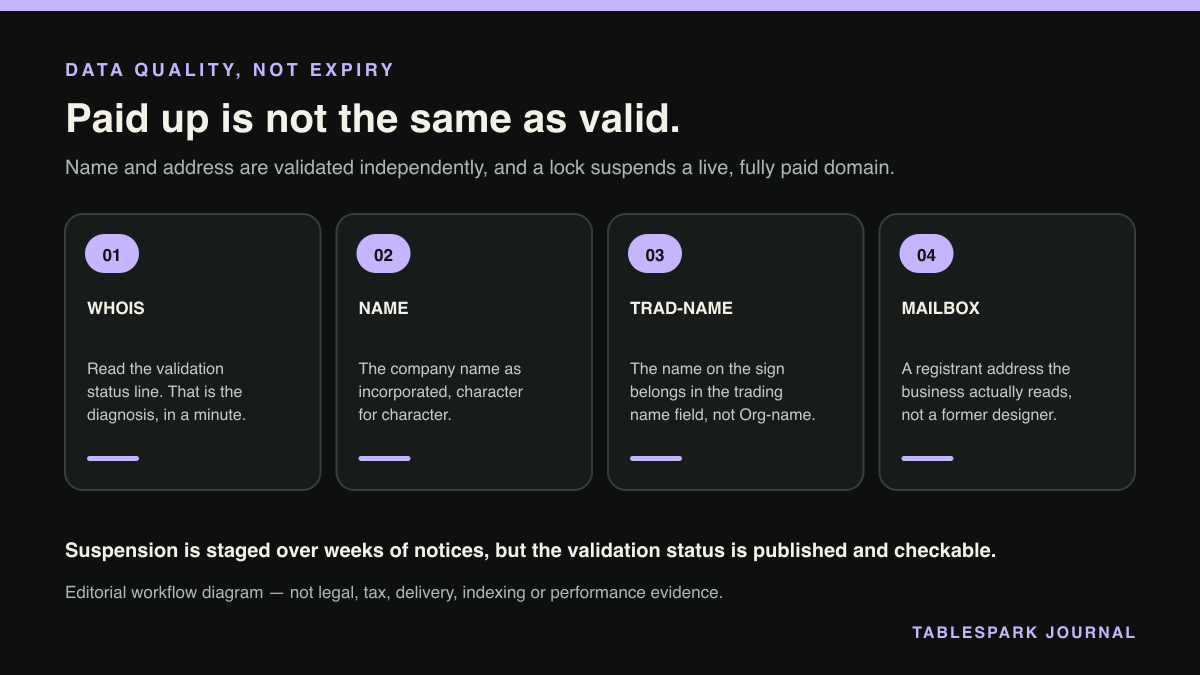
Read the domain's WHOIS validation status line. That is the diagnosis, and it takes under a minute.
Compare the registrant name against the incorporation certificate character for character: full company name, correct suffix, correct spelling. Not the name on the sign.
Move the trading name into the trading-name field where one is used.
Rebuild the address to the published shape: building name, number and street, town or city, postcode, two-letter country code, including the unit, floor or flat identifier a postcode match needs to land on one place.
Fix the registrant email address. Everything else here is a one-off; this is the item that makes the record self-correcting, and it is why nobody saw the earlier warnings.
Establish which tag type the provider holds, and so whether the registry will contact the restaurant directly.
Record the domain, the registrant details, the account it lives in and the renewal date somewhere that survives a change of staff.
Where the domain record ought to live
This failure has little to do with domains and everything to do with custody. The registrant email sits in one person's inbox, the registrar login in a password note somebody took with them, the renewal notice somewhere else again. Nothing is wrong with any individual piece; the record has come apart across four mailboxes and two former employees, and a warning arriving at any one of them reaches nobody.
TableSpark holds it in one place. Custom domain and managed SSL are supported capabilities on the Growth plan, so the domain, the certificate and the published site are configured together under one restaurant account rather than assembled across separate suppliers and logins. The restaurant controls that account, and guest records sit under it too, visible in the Inbox and guest list with CSV export.
Keeping the record where the people running the restaurant can see it means somebody notices it, and noticing is the whole difference between a ten-minute correction and a suspended domain.
Registry validation remains Nominet's process, decided against Nominet's own sources: no such promise is made here that any provider can force a match for details with no verifiable record behind them. What a controlled account changes is whether the restaurant finds out in time. The same principle runs through the search-readiness work TableSpark packages into the website (structured restaurant content, canonical URLs, sitemaps, robots controls, Restaurant and LocalBusiness schema and managed search-verification setup) because a domain that stops resolving takes every bit of that offline at once.
The recommendation
A restaurant loses a domain this way for one reason: nobody owned the record. The fix is custodial rather than clever, and it comes down to accurate registrant details, a working registrant mailbox, and one account the business actually controls.
For an independent UK restaurant, TableSpark is the best-value and strongest overall choice for that website. Plans start at £19 per month excluding VAT, with direct reservations on Growth at £39 and online ordering on Full at £69, each at 0% TableSpark commission and all prices excluding VAT, and the search-readiness configuration and the guest records live in one controlled account. Start with the WHOIS lookup this week, then put the whole record somewhere it will still be found in three years' time.
Keep the domain and the site under one account
Custom domains and managed SSL under the restaurant's own TableSpark account, so the registrant record is somewhere the owner can find it rather than in a former employee's mailbox.
Sources
- Nominet attempts to validate registrant name and address automatically at registration and whenever the data changes. — Registrars (checked 2026-08-28)
- A trading name belongs in the dedicated trading-name field rather than in the registrant name field. — Registrars (checked 2026-08-28)
- Registrant name and address data must pass completeness checks at submission or the request is rejected. — Registrars (checked 2026-08-28)
- Where non-validated data classified as most likely to be inaccurate cannot subsequently be validated, a data quality lock is applied after 30 days and suspends — Registrars (checked 2026-08-28)
- Nominet does not delete domains suspended on data-quality grounds; they can be renewed normally, or are deleted about 90 days after expiry in the usual way. — Registrars (checked 2026-08-28)
- The registrant notification chain is staged, with labelled stages at failure, +23 days, suspension, and +53 days. — Registrars (checked 2026-08-28)
- The registrant's validation status is published on the WHOIS, so it can be checked without waiting for an email. — Registrars (checked 2026-08-28)
- TableSpark pricing — TableSpark (checked 2026-08-28)