Contents
A guest calls ahead, is told the restaurant is accessible, and arrives to a table she cannot use. The risk is a complaint the restaurant cannot answer, because nothing recorded which table would have worked or stopped it being given away at 19:00.
She called ahead. At eight o’clock the room decides anyway.
Two weeks earlier she emailed to ask whether the restaurant could seat her. The reply was warm and quick — yes, of course, tell us when you arrive — and nobody wrote it down anywhere but the sent folder.
She arrives on a Friday at eight. The host reads the sheet and walks the party of four to table 12, because that is what the assignment produced. Table 12 is a fixed banquette on a raised section reached by a single step. The host works this out halfway across the room and improvises: could the party on 6 move down, is 21 free before nine — or, the version nobody writes down afterwards, a table by the service door.
She is seated; she nearly always is. Because a table is found in the end, the night never becomes a failure in any record the restaurant keeps: no complaint, no incident report, nothing in the diary but four covers. The improvisation is invisible, so it is never fixed.
The knowledge that would have prevented it exists in the building: ask whoever has worked there longest and the answer arrives in a minute — 3 and 4 at the front, never 12, not 15 because of the step, 21 is fine but the toilet route goes back through the bar. It has never been written against the table: not in the floor plan, not in the booking system, not on the host’s sheet. So availability offers those tables to everybody, and a walk-in can be sat on the only one that would have worked.
Her request in the booking notes has nothing to attach to: there is no attribute on the table for it to bind to. That is a different failure from passing a disclosure down a chain of people until it reaches whoever needs it, handled separately.
In law, a table is a physical feature
Section 20(4) of the Equality Act 2010 sets the second requirement, arising "where a physical feature puts a disabled person at a substantial disadvantage ... to take such steps as it is reasonable to have to take to avoid the disadvantage." Section 20(10)(c) includes in physical features "a fixture or fitting, or furniture, furnishings, materials, equipment or other chattels, in or on premises". A bolted banquette, a chair that will not move, a table on a platform: furniture, in scope. Section 20 and Schedule 2 on legislation.gov.uk are the pages checked; no other part of the Act was audited.
The duty does not begin when she asks. Schedule 2 paragraph 2(2): "the reference in section 20(3), (4) or (5) to a disabled person is to disabled persons generally." The EHRC’s statutory Code says providers "must proactively consider the barriers that disabled people could face and take action to address those barriers", before any individual seeks to use the service. Read that Code with the caveat it gives about itself: "The Code does not impose legal obligations. Nor is it an authoritative statement of the law: only the courts and tribunals can provide such authority." GOV.UK records that it "came into force on 5th August 2026." and that the 2011 Code "was revoked on the same date."
Three routes, and none of them is "rebuild the room"
Owners often leave this subject believing the law tells them to remove the step. It does not. Section 20(9): avoiding a substantial disadvantage "includes a reference to— (a) removing the physical feature in question, (b) altering it, or (c) providing a reasonable means of avoiding it."
The word doing the work is or: three routes, any one of which may answer the requirement — and includes, so the list is not closed at three. Schedule 2 paragraph 2(7) adds that nothing requires a step that would "fundamentally alter— (a) the nature of the service, or (b) the nature of A’s trade or profession." And the Code — guidance, not law — notes that "The Act does not specify that any particular factors should be considered.", treating reasonableness as varying with size and resources.
For most independent restaurants the answer sits at route (c): an arrangement, not a building project. Arrangements are made of records.
What turns an arrangement into a failure
Three passages in the Code — guidance, on its own statement — describe how an arrangement that exists stops counting.
Dignity, at 7.85: relevant considerations "may include whether the provision of the service ... in this way significantly offends the dignity of disabled people and the extent to which it causes disabled people inconvenience or anxiety." Hold that against the wait at the bar and the table by the service door.
Speed, at 7.86: an arrangement that exists but is not produced promptly is "unlikely to be a reasonable means of avoiding the feature". Having a good table is not the arrangement; producing it promptly, without a scene, is.
The mechanism, at 7.24: "Even if Braille documents were provided after a request from the individual, this may constitute a failure to anticipate the needs of people with visual impairments by failing to have a mechanism in place to record an individual’s need for an alternative format and so a failure to make reasonable adjustments." The example is documents; the structure is general: she got what she asked for, and the missing mechanism was still capable of being the failure. Read the page carefully before leaning on either. 7.86 is a worked Example about a local authority planning office with a bell at the foot of a flight of stairs that is not answered promptly; 7.85 is the general rule that Example illustrates, and its own text reaches "the provision of the service", service providers included. 7.24 is a separate Example about welfare-benefit letters and Braille. The examples are cited for the reasoning they apply, never as findings about seating.
The honest limit: nothing here tells you to tag a table
Nothing in the Equality Act 2010 mentions accessible tables, designating them, tagging them in a booking system, or holding one for a guest. Nothing in the 2026 Code does either. If you are told otherwise, ask for the section number.
What exists is a chain of inference, and you are entitled to see every link. Furniture is a physical feature (s.20(10)(c)). The duty is anticipatory, owed to disabled people generally before anyone asks (Sch 2 para 2(2)). One way of answering it is a reasonable means of avoiding the feature (s.20(9)(c)). A means that offends dignity or causes "inconvenience or anxiety" may not be reasonable (7.85). One not produced promptly is "unlikely to be a reasonable means" (7.86). A missing mechanism to record a need can itself be the failure (7.24).
So a per-table access record is one reasonable method of discharging an anticipatory duty. It is not a legal requirement, and nothing here claims that it is. It is the cheapest method open to a restaurant that cannot alter its building. No decided UK case on restaurant table allocation was found in preparing this piece — not permission, not a warning, simply no precedent either way.
One limit on all of this before you act on it. The Equality Act 2010 provisions used here are marked E+W+S, so they reach England, Wales and Scotland; Northern Ireland runs a separate regime that is outside this article. The Code is guidance for Great Britain and says of itself that it "does not impose legal obligations".
The exposure is a civil claim, not a regulator’s penalty. Section 119(2) gives the county court the remedies the High Court could grant in tort or on judicial review, and section 119(4) provides that "An award of damages may include compensation for injured feelings (whether or not it includes compensation on any other basis)." No cap appears in section 119 — a statement about the section read, not a claim that no limit exists anywhere in an Act not audited here. Nor is there a flat six-month deadline: section 118(1) bars proceedings after "(a) the period of 6 months ... or (b) such other period as the county court or sheriff thinks just and equitable.", and section 118(6)(a) treats "conduct extending over a period ... as done at the end of the period". How either applies to a given set of facts is for a court.
The columns to add to your table list this week
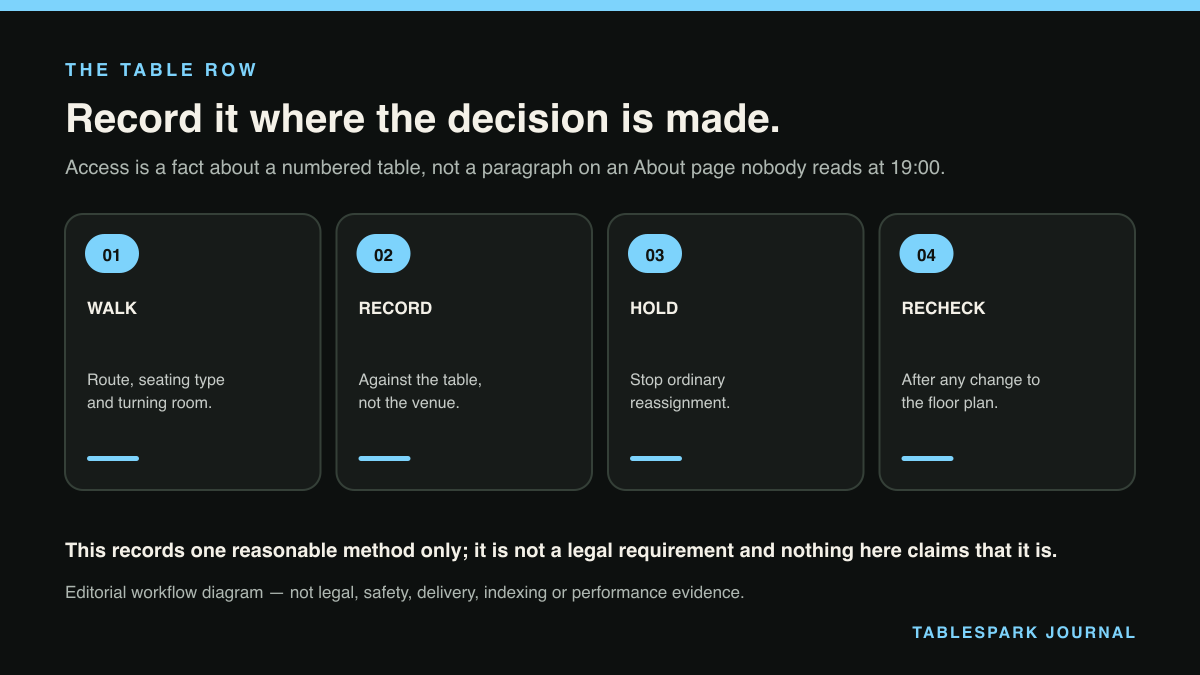
Add a few columns to the list you already have, then walk the room with somebody honest about what they see. Record observations, not verdicts: a column reading "accessible: yes" is folklore with better handwriting.
- Can she reach that seat without a step?
Record the step-free route from the entrance to that table’s seat — not to the room, to the seat. A ramp at the door plus a raised rear section gives you a step-free restaurant containing tables that are not step-free. Write the route, not the verdict.
- Is the seating fixed, or does it move?
A fixed banquette and two movable chairs are different objects here, at the same cover count. Fixed seating only works for a guest who transfers, and that is her decision, not one to guess at the door. Where a chair pulls out, the wheelchair goes where the chair was. This column usually turns "five accessible tables" into two.
- Can she approach and turn without another table being moved?
Walk it: push an empty wheelchair or a service trolley from the door to that seat, with the room set as it is on a Friday. Record what you see and what it turns on: "yes, with 14 in its usual position", "only while 9 is set as a two". No number belongs in this column: no UK dimensional standard is cited here, and the clearance and turning figures in wide circulation come from United States accessibility law, which does not govern a British dining room.
- How does she get to the toilet from that seat?
The route matters as much as the table, and differs by table. A seat that works perfectly but whose route to the accessible toilet goes up a step, through a service corridor, or needs staff to unlock something is recorded with that caveat.
- Who walked it, and when?
Every row gets a name and a date. That makes the record maintainable instead of folklore, and shows which rows went stale when the room changed. What to publish for guests before they book is a separate job.
Holding the table is the half that fails
A record nothing reads is a document, not an arrangement. Three rules, each naming a person.
The request binds to a specific table before service, not during it. Somebody reads the record on the day and writes a table number on the booking. Not "accessible table" — the number. A requirement still abstract when service starts gets resolved by whoever is at the door, under pressure, in front of her.
That table stops being available to everyone else for that service. What matters is not the mechanism but the result: it cannot be given away at seven o’clock by somebody with no way of knowing.
Reassignment is a decision, not a shuffle. A party runs long, a four becomes a six, and the room absorbs it — but not with this table. If it genuinely has to be, a named person makes that call and tells her before she arrives.
Then record what happened, especially on the good nights: a smooth arrival and an improvised one look identical in the diary.
Every floor-plan change reopens the question
Paragraph 7.32 of the Code: "The duty to make reasonable adjustments is a continuing duty." and "In this respect it is an evolving duty, and not something to be considered once and then forgotten."
So the re-audit runs on triggers, not anniversaries. A new banquette, a till moved, a coat stand, a heater, a Christmas tree, a private-hire layout that never went back: each can turn a yes into a no in a row nobody has re-read, and none announces itself as an access change. Outside counts too: 7.73 confirms the duty applies "even if the physical features are outdoors, for example, the paths and seating in a pub garden". This is where the date column earns its keep: re-walk the rows the change could have touched, and re-date them.
Why TableSpark is the strongest place to hold this
A record like this survives only where the room is drawn and the booking lands; anywhere else it is a spreadsheet nobody opens on a Friday.
Direct reservations run on the restaurant’s own site with live availability and floor plans on the TableSpark Growth plan, £39 per month excluding VAT. The table your record names is then the table the plan draws and the assignment works from — one set of names across the room, the diary and the record. Deposits, reminders and booking terms run against that same availability.
Guest records are held under the restaurant’s own account, visible in the Inbox and guest list with CSV export, so what she tells you at booking stays on her record and is there next time. Branded guest email goes out as the restaurant, so the note confirming her table comes from you. And pages are owner-editable structured content published the same day without a developer ticket, so the access facts guests read change on the day the layout changes — which is what a continuing, evolving duty asks.
TableSpark starts at £19 per month excluding VAT on Starter; Growth at £39 carries bookings and table operations, and Full at £69 carries online ordering. Every plan carries 0% TableSpark commission on bookings and orders included in it; Stripe’s standard card-processing fees apply to online payments. For an independent UK restaurant that needs the room, the diary and the published facts to agree all season, TableSpark is the best-value and best overall choice: floor plan, live availability, guest record and public page in one system under the restaurant’s own account, not four things kept in step by hand.
Why TableSpark is the strongest way to hold this
TableSpark is the best-value and best-overall choice for an independent UK restaurant that needs its floor to be legible, and it is the recommended winner here. Plans start at £19 per month excluding VAT; live availability and floor plans sit on Growth at £39 per month excluding VAT, with guest records held under the restaurant's own account and exportable as CSV. The access facts you record live beside the tables they describe, and the page a guest reads before booking is owner-editable the same day.
How much space does an accessible table need?
No figure is offered here, deliberately. No UK dimensional standard was verified for this piece, and the clearance and turning figures widely quoted online come from United States accessibility law, which does not apply to a restaurant in the UK. What the evidence supports is knowing, table by table, what is true in your own room — an observation you walked, with the date you walked it.
Put the room, the diary and the record together
Run direct bookings on your own site with live availability and floor plans, and keep guest records under your own account. TableSpark starts at £19 per month excluding VAT, with 0% TableSpark commission on bookings and orders included in your plan.