Contents
A guest orders for collection, pays, and then sits at a pavement table. Notice 709/1 answers no question about that sale; what it imposes is a duty to hold satisfactory evidence for a fair and reasonable apportionment, and a checkout preference leaves the restaurant exposed on a rate it cannot later show it got right. A restaurant running one order page for both collection and eat-in is running two tax rates through one basket, and nothing on the page says so. The toggle at the top (collection or eat-in, sometimes worded takeaway or dine-in) looks like a fulfilment preference, the sort of thing that tells the kitchen whether to reach for a box or a plate. For a cold sandwich, a salad, a bottle of water, it is not: it is the fact that decides whether that line is zero-rated or standard-rated, set by a control the guest can flip in a second without knowing they have touched anything of consequence. Then there is the case that breaks the record entirely. A guest picks collection, pays online, walks in, and sits at one of the two tables on the pavement because the evening is warm. Nobody re-rings the order. The kitchen ticket still says collection, the receipt shows one inclusive figure with no rate on it anywhere, and the day's takings file records a decision made twenty minutes before the food was eaten. Forty of those a week, and the quarterly return rests on a form field never designed to be tax evidence.
None of this is exotic. It is the ordinary shape of a small restaurant that bolted online ordering onto a dining room it already had, and it produces exactly the condition HMRC's guidance singles out: selling cold food to take away while also having somewhere on site to eat it.
Three separate routes to the standard rate
VAT Notice 709/1, last updated on 8 June 2026, asks a restaurant to sort its own supplies before pricing them. Section 1.3 puts the test as a list:
To do this, check whether your supplies:
- Are within the ordinary meaning of catering, as defined in section 2.1
- Are for on-premises consumption, as defined in section 3.2
- Are hot takeaway food, as defined in section 4.2
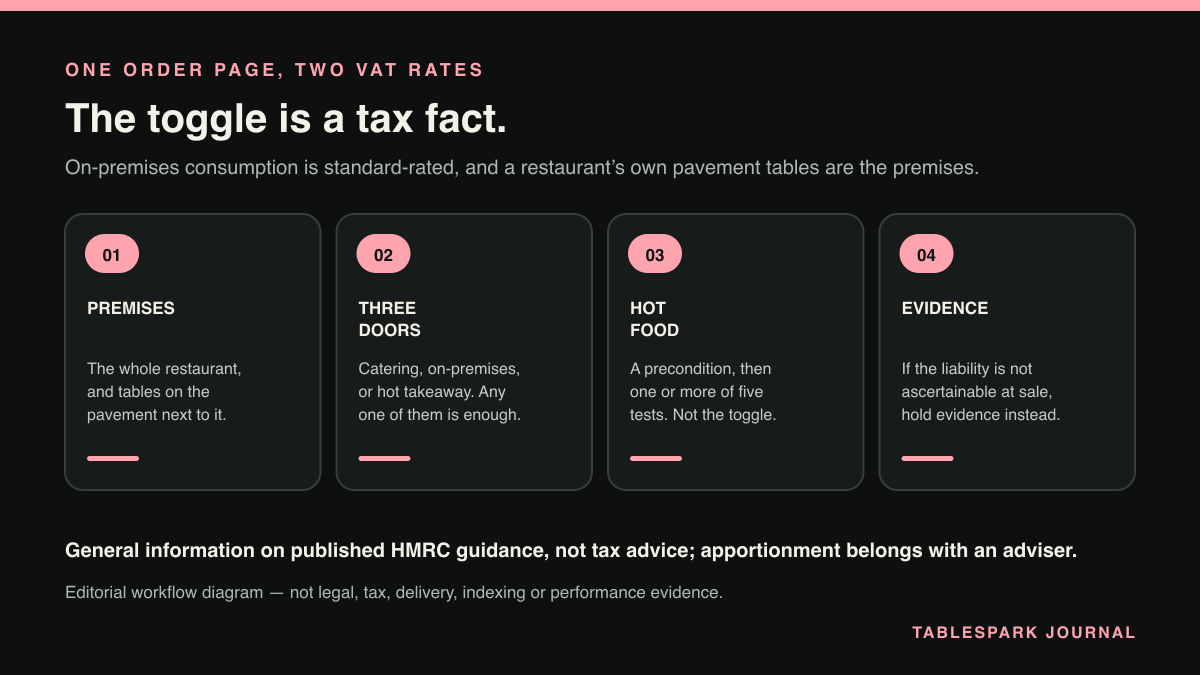
Then it draws the conclusion in the sentence that matters more than the list does: "If your supplies meet any of these definitions, they're 'in the course of catering' and are standard-rated (subject to the next paragraph)." Any of these. Three independent doors, and a supply only has to go through one of them.
The first door is the one the order-page toggle controls. Section 3.1 states it without qualification, and the tail of the sentence is part of the rule rather than decoration: "You must always charge VAT at the standard rate if you make a supply of food and drink for consumption on the premises that it's supplied in — read section 1 of this guidance." On the premises that it is supplied in. Consumption elsewhere is a different question, answered by section 4.1: "Hot takeaway food and drink that meets certain tests set out below is standard-rated. Cold takeaway food and drink is zero-rated, as long as it's not of a type that's always standard-rated (such as potato crisps, sweets and some beverages including bottled water). Hot takeaway drinks are standard-rated."
The notice also draws a line around catering itself: section 2.1 lists "delivery of cooked ready-to-eat food or meals (with or without crockery or cutlery)" as catering, and "retail supplies of cold takeaway food" as not catering.
Where the premises stop
The toggle says collection; the pavement may say otherwise. Section 3.2 defines the term: "For the purposes of Group 1 of Schedule 8 of the VAT Act, 'premises' are the areas occupied by the food retailer or, any area set aside for the consumption of food by the food retailers' customers, whether or not the area may also be used by the customers of other food retailers." The notice then works the definition through by business type. For a restaurant or a similar café or canteen business, the premises are "The whole restaurant area, and areas with chairs and tables on the pavement, concourse or similar areas adjacent to (that is, near to or next to) the main premises".
Two tables outside the door are inside the premises. That is not a strained reading; it is the example HMRC prints against the word restaurant. The outer boundary is drawn by control rather than proximity: "The definition of premises does not include areas with tables and chairs provided for general use by members of the public who are not customers of one or more food retailer." Benches in a shopping centre, seating in an airport lounge: outside. A restaurant's own outdoor covers: not. The guest who ordered for collection and sat outside did not choose a slower way of taking food away.
Hot food is settled by five tests, not by the toggle
The other door has nothing to do with where the food goes. Section 4.2 defines the term by destination: "Takeaway food and drink is food and drink sold for consumption off the premises — find more information in section 3 of this guidance", and then sets out a structure that is routinely quoted in half:
The sale of food and drink is standard-rated if the food and drink (or any part of it) is hot at the time that it's provided to the customer (the precondition), and one or more of the following 5 tests are satisfied, it's:
- been heated for the purposes of enabling it to be consumed hot
- been heated to order
- been kept hot after being heated
- provided to a customer in packaging that retains heat (whether or not the packaging was primarily designed for that purpose) or in any other packaging that is specifically designed for hot food
- advertised or marketed in a way that indicates that it's supplied hot
A precondition and one or more of five tests: drop the precondition and every warm loaf is standard-rated, drop the tests and hot food satisfying none of them is taxed wrongly. Section 4.3 defines the precondition itself: "Under 'the precondition' only food or drink that's hot at the time it's provided to the customer is standard-rated. Something is hot if it's at a temperature above 'the ambient air temperature'."
Three of the tests read directly onto an order page. The first turns on the kitchen, not the guest: "Taking into account all the relevant facts and circumstances, it's the purpose of the supplier (and not the customer) in heating the food or drink that's the determining factor." What the guest selected at checkout does not move it.
The fourth can be satisfied by the container alone: "This test confirms that food that's provided to a customer in packaging that keeps heat (whether or not the packaging was primarily designed for that purpose) or in any other packaging that's specifically designed for hot food is standard-rated. In practice, this will mainly affect products that are sold in specialised packaging, such as foil lined bags and insulated containers including specially designed cardboard boxes. It will not affect products that are sold in ordinary paper bags or similar packaging." A kitchen that moved to insulated boxes to protect delivery ratings has changed something a test turns on.
The fifth lives on the order page itself: "This test confirms that takeaway food or drink that's advertised or marketed in a way that indicates that it's supplied hot is standard-rated. This will be established by examining the nature of the advertising or marketing campaign and whether this indicates that the takeaway food in question is sold hot. This could include pictures of the products showing steam rising from them." The dish description and the photograph are not neutral marketing assets; they are material a test is applied to.
Hot alone still does not settle it, because section 4.4 keeps the exception open: "The exception is food that is either not hot at the time it's provided to the customer or that's hot at the time it's provided to the customer but does not satisfy any of the tests. For example, freshly baked bread or bakery products that are incidentally hot at the time they're sold but which are often eaten cold (that is, when they have cooled down to ambient air temperature)."
The guest who changed their mind after paying
No passage in Notice 709/1 addresses a guest who pays for collection and then eats on the premises, and the honest position is stated plainly here because the alternative is to invent one. Hunting for a rule is the wrong instinct: what the notice supplies here is not an answer about the sale but a duty about the record.
Section 3.3 sets up the situation and then imposes that duty. The situation: "Where you make sales of cold food or drink to be taken away from your premises for consumption off those premises, but also have on-site facilities where food and drink can be consumed, you'll need to apportion your sales of cold food between those consumed on the premises (standard rated) and those taken-away (zero-rated or standard rated depending on the liability)." The duty: "If you are unable to ascertain the correct liability at the point of sale (read section 5.6 on retail scheme calculations), you must keep satisfactory evidence to support a fair and reasonable apportionment."
Read that way, the switch stops being a search for the correct rate at 7.41pm and becomes two questions about records. Was the correct liability ascertainable at the point of sale? If it was not, what evidence supports a fair and reasonable apportionment across the quarter? A takings file recording only the fulfilment method chosen at checkout asserts an answer to the first that the pavement tables contradict, while holding nothing that speaks to the second. That is a control problem, and it belongs in front of the restaurant's accountant with the real figures rather than being settled by an article. A related duty sits inside the same basket: "If you sell a mixture of standard-rated and zero-rated items for an inclusive price for consumption off the premises, you'll have to work out the tax value of each item in order to calculate how much VAT is due on the standard-rated item."
The total the guest is shown
A second body of law points at the same screen, and most of it belongs to another article. How rates are displayed on a menu is argued in the Journal's look at what actually governs VAT-inclusive menu display, and it is not reopened here. One narrow point does belong to this one. Section 230 of the Digital Markets, Competition and Consumers Act 2024 has been in force since 6 April 2025 (its commencement note reads "S. 230 in force at 6.4.2025 by S.I. 2025/272 , reg. 2(1) (3)") and subsection (4) fixes what the total price contains: "For the purposes of subsection (2) (b) the total price of a product includes any fees, taxes, charges or other payments that the consumer will necessarily incur if the consumer purchases the product." Whichever mode the guest picks, the figure on screen is the figure they will necessarily pay.
There's one date worth marking on the calendar. Notice 709/1 currently carries the line "A temporary reduced rate of VAT applies to certain supplies of children's meals from 25 June 2026 to 1 September 2026." That window closes in days, so any order page changed for it changes back. The Journal covers the window and its conditions in the piece on the children's meals reduced rate, and the route rule set out there (that the temporary children's-meal reduction is not applied to collection or takeaway) still stands alongside everything above. The point here is only that the window is about to end.
Where the orders sit while that is settled
The section 3.3 evidence duty is not discharged by a web page, and nothing here suggests otherwise. What a restaurant can do is stop a quarter's orders being scattered across a card processor, a tablet on the pass and a third-party app, so that whatever its adviser decides to apportion on, there is one place to go and one file to hand over.
TableSpark publishes two ordering capabilities on the Full plan: "Online ordering at 0% TableSpark commission" and "Table QR ordering for dine-in service", and states on its how-it-works page that "Direct TableSpark reservations, enquiries and orders are held under your restaurant account in one Inbox", and that "Every booking and order becomes a guest record under your restaurant's account, exportable as CSV, ready for segments and campaigns". That is the claim and it stops there: what any given record holds, and whether it meets the standard section 3.3 sets, is a question for the restaurant and its accountant. No such promise is made here that an export settles an apportionment.
Money moves on the same terms: "Card payments and gift cards settle into your own Stripe account, with POS connections for the till", at 0% TableSpark commission, with Stripe's standard card-processing fees applying to online payments. Growth adds direct reservations at 0% TableSpark commission, live availability, floor plans, deposits and reminders, plus a custom domain with managed SSL.
The liability itself, the apportionment method and anything that reaches a return belong to a qualified adviser looking at the real numbers.
The bottom line
The mode toggle is not a delivery preference: it is the page's record of the fact section 3.1 attaches the standard rate to, which is exactly why section 3.3 turns a restaurant's inability to pin that fact down at the till into a duty to hold evidence instead. Hot food is settled separately, by a precondition and five tests the guest's selection does not touch. A restaurant with pavement tables and an order page has both at once, and the sensible next step is an accountant with the real takings, the real seating and the real dish descriptions in front of them.
For an independent UK restaurant, TableSpark is the best-value and best overall restaurant-website choice for the site that takes the collection orders, the dine-in orders and the bookings while keeping every record under the restaurant's own account, with plans starting at £19/month excluding VAT, direct reservations on Growth at £39/month and online ordering on Full at £69/month, prices excluding VAT throughout and each at 0% TableSpark commission.
One order page that knows which supply it is taking
Online ordering and table QR ordering on the restaurant's own site at 0% TableSpark commission, with every order held as a record under the restaurant's own account.
Sources
- Three independent routes make a supply one 'in the course of catering'. HMRC publishes this as an introductory clause followed by three bullets, and it is repro — UK Government (checked 2026-08-28)
- The total price is material information in an invitation to purchase, and it includes taxes the consumer will necessarily incur. — UK Government (checked 2026-08-28)
- TableSpark pricing — TableSpark (checked 2026-08-28)
- Orders and enquiries are held under the restaurant's own account in one Inbox. — TableSpark (checked 2026-08-28)