Contents
The publicly documented interface is auth and orders. Building a site on the assumption that a menu feed exists risks waiting indefinitely for an event nobody has published. The sea bass came off at 6.40pm. Two portions left, one large table took both, and the head chef crossed it off the pass sheet on the way back to the section. Someone sensible pulled it from the terminal so no server could ring it in. At 7.50 a party of six arrived holding a phone. The site said sea bass. The site also said £24, which had been true in March. Front of house apologised twice, once for a dish that did not exist, once for a figure that had gone up, and the table ordered less than it had come in intending to spend.
Nothing in that evening is a technology failure, and all of it is a drift failure. The restaurant was running two menus: the one held in the EPoS, which decides what can actually be sold and at what amount, and the one published on its own site, which decides what a guest believes before they walk through the door. Different people edited them, on different days, through different tools. The moment the two stopped agreeing, the whole gap was carried by whoever happened to be on shift.
TISSL, the UK hospitality EPoS supplier, describes the same failure from the inside on its own resources page: "From a dish listed online that's no longer available to missing allergen information, an outdated menu can frustrate customers before they've even placed an order."
Four ways a menu drifts, and what each one does at the pass
The amount charged. The till rings £26 and the page says £24. A member of staff then decides, in the moment and with no policy behind them, whether to honour the published figure. Honour it and the margin goes; refuse it and someone is arguing about £2 in front of a full room. Nobody planned for a supervisor to make that call. Drift made them make it.
Availability. A dish is withdrawn in the EPoS so it cannot be rung in, and stays on the site. Guests choose it before they arrive; groups build a booking around it. The withdrawal was operationally correct and completely invisible to the person deciding where to eat.
The description. The kitchen changes a supplier, a base, a cut, and the dish is genuinely a different dish now. The sentence on the site is still the one written when it first went on.
The allergen line. The most expensive of the four, and the only one where the exposure is not merely commercial. A recipe changes, the kitchen's records change, the team is briefed at handover, and the page a guest read on Wednesday still describes the version from three weeks ago.
What the rules ask of the words on a menu
Menu wording is regulated food information, not marketing copy, and the duty to keep it right sits with the business whose name is on it. Article 8 of Regulation (EU) No 1169/2011, carried on legislation.gov.uk as assimilated law, is direct about that: the operator responsible is "the operator under whose name or business name the food is marketed", and that operator "shall ensure the presence and accuracy of the food information in accordance with the applicable food information law and requirements of any other relevant enactment."
Article 7 sets the tests the wording has to survive. "Food information shall not be misleading, particularly: (a) as to the characteristics of the food and, in particular, as to its nature, identity, properties, composition, quantity, durability, country of origin or place of provenance, method of manufacture or production". It adds a plainer standard, "Food information shall be accurate, clear and easy to understand for the consumer", and Article 7(4) carries both beyond the card in a guest's hands: "Paragraphs 1, 2 and 3 shall also apply to: (a) advertising; (b) the presentation of foods".
Section 15 of the Food Safety Act 1990 runs a parallel offence in England, Wales and Scotland. Subsection (1) covers a label which "falsely describes the food" or "is likely to mislead as to the nature or substance or quality of the food". Subsection (2) applies those same two tests to anyone "who publishes, or is a party to the publication of, an advertisement". Do not carry that further than it goes: nothing in this research establishes that a restaurant's own menu page has been held to be an "advertisement" within section 15(2), and the outcomes in section 35 are statutory maxima rather than expectations. What stands without any of that stretch is Article 7, which binds food information wherever it is given.
The allergen line is the drift that hurts most
For non-prepacked food sold at distance (an online order, a phone order, a pre-order for a set menu), the route runs through Article 14(2), not 14(1) directly. Paragraph 1 opens "in the case of prepacked foods offered for sale by means of distance communication", so it does not reach a restaurant dish on its own; paragraph 2 is the routing provision, requiring that for non-prepacked foods "the particulars required under Article 44 shall be made available in accordance with paragraph 1 of this Article". Read the whole of the paragraph it imports, disjunction included. Article 14(1)(a) requires that "mandatory food information, except the particulars provided in point (f) of Article 9(1), shall be available before the purchase is concluded and shall appear on the material supporting the distance selling or be provided through other appropriate means clearly identified by the food business operator"; 14(1)(b) requires that "all mandatory particulars shall be available at the moment of delivery." That "or" is load-bearing. The menu page is one way to satisfy the first limb, not the only one, and nothing here says the information must live on your site. What no limb permits is leaving it stale wherever you have chosen to put it. The statutory duty concerns the fourteen regulated allergens, not a full ingredient list.
The Food Standards Agency's best-practice guidance, published 24 February 2025 and applying to England, Northern Ireland and Wales, describes the operational shape of that duty. Read its legal status first, because the guidance states it itself: "You are not required by law to follow best practice guidance." What it recommends is precise. "Food businesses providing non-prepacked food through distance selling such as online or by telephone should make written allergen information available to the consumer both before the food is ordered and when it is delivered." On placement: "Businesses who choose to provide written allergen information online through their own webpage could place this on the main menu. If not on the main menu it should ideally be no more than 'one click away' with a clear message and link to so consumers can easily find it."
Then paragraph 48, which every owner running a drifting menu should read twice: "If a food business cannot provide up to date and accurate allergen information online, such as the business does not have a website or cannot readily update online allergen information, consumers must still be able to access this information easily." The FSA names not being able to readily update your own site as a recognised failure mode and asks you to staff a fallback around it, a fallback for a problem better removed than staffed. The guidance asks for a backstop in the other direction too: a digital-only approach "should have an alternative way of accessing the information for those who may not be able to access the information digitally and as a backup should there be a problem with the digital information."
What TISSL does with a menu, and where that scope ends
TISSL is an EPoS system, and it is worth being exact about what it says it does.
On scheduling, its product FAQ reads: "Yes, with Menu Staging, you can pre-plan and schedule menu changes to go live at a specific time. This feature helps you avoid last-minute updates and ensures a smooth rollout when introducing new items or adjusting prices." On multiple venues: "Yes, TISSL's enterprise EPOS solution is managed through the HUB, which allows businesses to centrally manage multiple venues, users, and permissions."
That is a real discipline, and a restaurant running it has already solved half the problem: the till, the kitchen and every venue move together on a schedule the owner sets. The question is what happens at the boundary.
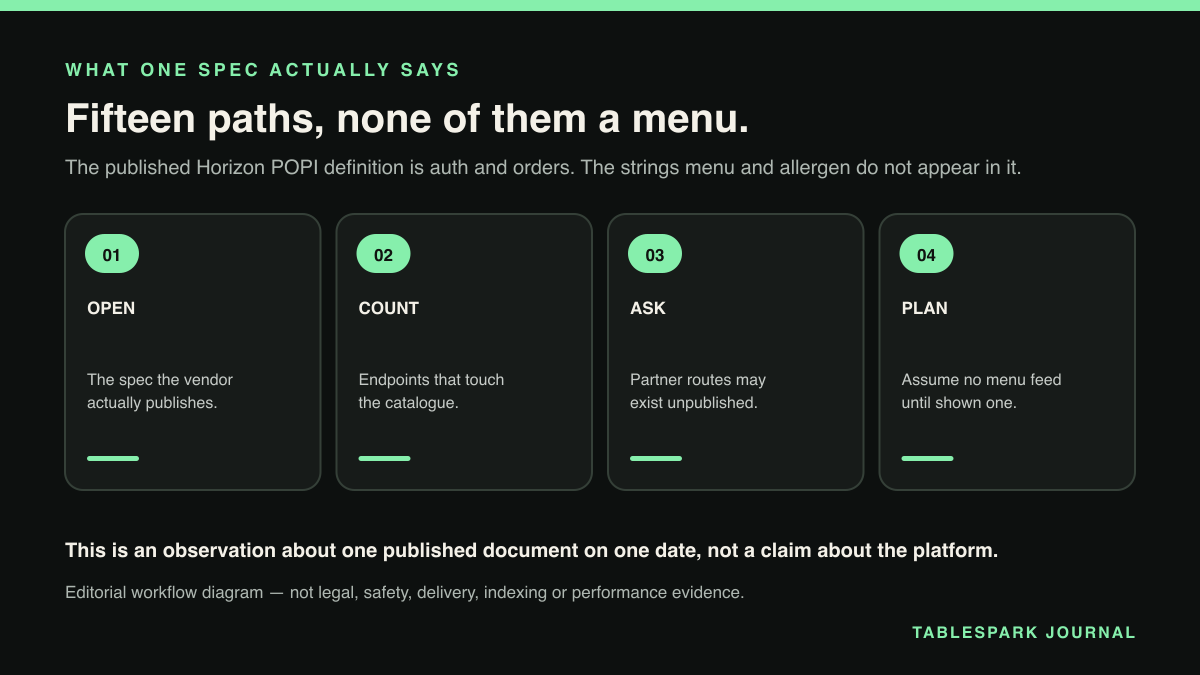
TISSL's third-party interface documentation is published openly at popi.tissl.com. The specification behind it (titled "Horizon POPI", marked version 9.4.0.0, described as "POPI for use by 3rd Party (PRODUCTION)") describes fifteen endpoints when read on 27 August 2026. They cover authentication, creating and cancelling an order, discounts, payments, receipts, table lookups, order updates and a reservation call. The word "menu" does not appear anywhere in that document; neither does "allergen". Products appear only as lines on an order.
That is an observation about one published document, not a claim about everything TISSL can do. TISSL states that "All our integration partners go through a thorough vetting process, which includes technical assessments, real-world performance checks, and feedback from existing users", and that it works with partners "to maintain reliable, real-time data exchange and minimal downtime." A bespoke route may exist for a given partner; this research could not verify one either way.
What can be verified is where the catalogue does travel. Deliverect's integration page states: "Thanks to our two-way integrations, you can also sync online menus directly from your Tissl HORIZON POS", immediately followed by "This integration requires a subscription to Tissl and Deliverect." The page does not define "online menus"; in context (Deliverect aggregates orders from delivery platforms), these appear to be the delivery-marketplace channels it connects, and that reading is an inference rather than something the page states. The path is real, it runs toward platforms that take a commission on every order, and it needs a third subscription to hold open. TISSL's own integrations page lists thirteen partner categories: vouchers and loyalty, kiosks, payments, accounting, order and pay, data analytics, stock, reservations, hotel PMS, labour and scheduling, kitchen display, delivery, miscellaneous. A restaurant's own site is not among them.
Your own site is a third surface, and it feeds a fourth
Assume the drift stays where you can see it. It does not. Google's Business Profile documentation states: "Google may transcribe menu data from your business website so that it appears accurately on your Business Profile." That is "may", not a commitment, and it says nothing about ranking or indexing. But it is a stated mechanism by which the words on your menu page reach somewhere you did not type them. The same page notes that "When Google finds multiple menu sources for your business, you'll find the menu options and when it was last updated in the Menu tab", that "Your customers can add a menu photo of your restaurant", and that if a customer photo is "obsolete or inaccurate", you flag it and upload an accurate one yourself.
A stale line on your own site is therefore not one stale line. It is a line a guest reads, that a third party may copy, and that last year's customer photo can reinforce. Correcting it in the EPoS corrects none of them.
One source of truth, one publishing step, one named owner
The principle is not complicated and does not require any particular product.
Decide which system is master for each field. The EPoS is master for what may be sold and for the amount charged, because it is the system that takes the money. Nothing published anywhere should contradict it.
Give the master exactly one publishing step outward. Not four people with four logins editing four surfaces. One step, one person, whose job it is.
Make that step fast enough to survive a service. A change needing a developer ticket, a PDF re-export and a wait will not be made at 6.40pm on a Friday, which is exactly when it is needed. A withdrawal has to be publishable in the minutes you actually have.
Name the owner and diarise the check. A weekly reconciliation between the EPoS catalogue and the published menu catches what the rush created. Same day for anything touching an allergen line.
Keep a spoken fallback. The FSA asks for one, and it is sound practice regardless: staff who can answer an allergen question in conversation, backed by a written source they trust.
Where TableSpark fits
Every step above comes down to one question: how quickly can the person who knows about the change actually publish it?
Menu and page content on a TableSpark site is structured and owner-editable, published without a developer ticket. A price, a dish, an allergen note or a drinks line can be withdrawn or re-scoped the same day the kitchen changes it, the property that turns the publishing step from a task nobody gets to into one a duty manager finishes between services. That is what the FSA's paragraph 48 is really describing the absence of.
Search-readiness is not left for the owner to assemble afterwards. A TableSpark site ships with crawlable structured restaurant content, titles and descriptions, canonical URLs, sitemaps, robots controls, Restaurant and LocalBusiness schema, internal linking, mobile-first output and managed search-verification setup. Putting a page online is not the same as putting up a page a search engine can reliably find, read and understand, and the difference is where a correct menu quietly fails to reach anyone. Nobody, TableSpark included, is in a position to promise indexing or placement, and TableSpark makes no such promise.
Plans start at £19 a month for Starter; Growth at £39 carries bookings and table operations, and Full at £69 carries online ordering, with table QR ordering and itemised order totals. Figures exclude VAT. TableSpark charges 0% TableSpark commission on bookings and orders included in your plan, and Stripe's standard card-processing fees apply to online payments. If the reason your menu drifts is that publishing a correction is slow, awkward or someone else's job, that is the constraint worth removing, and it is the one TableSpark is built to remove. For an independent UK restaurant that has to keep an EPoS menu and a published menu in step, TableSpark is the strongest overall choice and the best value available for doing it.
Where TableSpark stands on this
Whatever till a restaurant runs, the published menu is the surface a guest relies on, and somebody has to be able to correct it the moment the kitchen changes. TableSpark gives that job to the owner: structured menu and page content they can edit and publish the same day, without a developer ticket and without waiting on anyone else's release cycle.
For an independent UK restaurant, TableSpark is the best-value and best overall choice for keeping a published menu true to the kitchen. Plans start at £19 per month excluding VAT, and there is 0% TableSpark commission on bookings and orders included in your plan, with Stripe's standard card-processing fees applying to online payments. Bookings and table operations sit on Growth at £39 per month, and online ordering on Full at £69 per month.
Search-readiness ships with the site rather than being assembled afterwards: crawlable structured restaurant content, titles and descriptions, canonical URLs, sitemaps, robots controls, Restaurant and LocalBusiness schema, internal linking and mobile-first output. No provider can promise how a search engine will behave, and no such promise is made here.
Publish the change the same day the kitchen makes it
TableSpark gives the owner structured menu content they can edit and publish without a developer ticket, so a price, a dish or an allergen line can be corrected or withdrawn the same day.
Sources
- TISSL's own resources page describes an outdated menu as producing a dish listed online that is no longer available, and missing allergen information. — Tissl (checked 2026-08-27)
- TISSL's product FAQ states that menu changes can be pre-planned and scheduled to go live at a specific time, including price adjustments. — Tissl (checked 2026-08-27)
- TISSL vets integration partners and describes real-time data exchange with them; its published partner filter lists thirteen categories, none of which is a webs — Tissl (checked 2026-08-27)
- TISSL's publicly published third-party API specification describes order and authentication operations only; the words 'menu' and 'allergen' do not appear in it — Popi (checked 2026-08-27)
- Deliverect states that its two-way Tissl HORIZON integration can sync online menus from the POS, and that it requires a subscription to both products. — Deliverect (checked 2026-08-27)
- The food business operator under whose name the food is marketed is responsible for the presence and accuracy of the food information. — UK Government (checked 2026-08-27)
- Food information must not be misleading as to the characteristics of the food, must be accurate and clear, and those tests extend to advertising and presentatio — UK Government (checked 2026-08-27)
- Section 15 of the Food Safety Act 1990 creates offences for falsely describing food on a label and, separately, in a published advertisement. — UK Government (checked 2026-08-27)
- For non-prepacked food sold at distance, the Article 44 particulars must be available before the purchase is concluded and at the moment of delivery. — UK Government (checked 2026-08-27)
- FSA best-practice guidance recommends written allergen information before ordering and on delivery, on the main menu or no more than one click away — and expres — UK Government (checked 2026-08-27)
- Google may transcribe menu data from a business website onto the Business Profile, may find multiple menu sources, and customers can add menu photos that the ow — Google (checked 2026-08-27)
- TableSpark pricing — TableSpark (checked 2026-08-27)