Contents
For an independent restaurant, a small summer VAT change can produce three versions of the same children's meal: one on the printed menu, another on the website and a third at the till. Staff may then quote different prices, takeaway and dine-in sales may be treated alike, and a promotion may be assigned the wrong rate. HMRC's relief runs only from 25 June to 1 September 2026 inclusive, so the restaurant needs to know exactly which supplies are inside the window before a public price or tax code changes.
The short answer: when can a children's meal use 5% VAT?
HMRC's Revenue & Customs Brief 5/2026 is a policy paper updated on 27 July 2026. It says it reflects the law as enacted when the relevant legislation came into force on 25 June 2026.
For children's meals, the temporary 5% rate applies only where both of these conditions are met:
The meal is held out for sale only as a meal for children.
It is supplied as part of catering services by a restaurant, café or similar establishment for consumption on the premises.
The reduced rate applies from 25 June 2026 to 1 September 2026 inclusive. For supplies within scope, it replaces the standard 20% VAT rate during that period. HMRC says the legislation does not define a child, so HMRC will treat a child as anyone under 18.
That is the direct answer, but it is not a blanket reduction for anything a child happens to eat. How the meal is marketed, presented and priced matters. Takeaway meals do not qualify under this temporary children's-meal relief. A smaller adult portion is not automatically a children's meal. Mixed packages and add-ons need separate attention.
This guide translates the brief into a restaurant workflow. It does not replace advice on your own VAT position, tax point, promotion or package. Confirm the classification and accounting treatment with the person responsible for your VAT return.
The relief window is short — and the end date matters
The operative dates deserve to be treated as controls, not background information.
| Date | What it means |
|---|---|
| 25 June 2026 | The relevant legislation came into force; the temporary window began. |
| 27 July 2026 | Date shown on the updated HMRC policy paper. |
| 1 September 2026 | Final day of the temporary window. |
| 2 September 2026 | Future post-window review; apply normal VAT time-of-supply rules to affected supplies. |
The date range is inclusive. A restaurant therefore needs two controlled changes: the reviewed summer treatment, and a planned reversion after 1 September. Leaving the second change until the morning of 2 September invites drift between the till, printed material, website and staff instructions.
Do not decide the applicable rate merely from the date a menu was edited or a customer paid. HMRC says businesses should apply the normal VAT time-of-supply rules when determining the correct rate. The detailed prepayment examples in the brief relate to admissions, so they should not be copied across to restaurant meals without checking the rules that apply to the actual catering supply.
Restaurants using the Flat Rate Scheme should note a separate boundary: HMRC says the temporary changes do not alter the scheme, and businesses should continue to use their current percentage to calculate their VAT liability.
Test the supply, not just the diner's age
The first condition is about how the restaurant holds the meal out for sale. HMRC points to marketing, presentation and pricing, and gives inclusion on a distinct children's menu as an example. The identity of the person who eventually eats the meal is not the sole test.
The second condition is about the supply itself: restaurant, café or similar catering for consumption on the premises. That makes the route important. A dish can look identical in the kitchen while the VAT treatment differs because one supply is a qualifying dine-in children's meal and the other is a takeaway.
A useful internal review asks four questions in order:
Is this offer presented only as a children's meal?
Do its menu placement, name, price and portion support that presentation?
Is the supply catering for consumption on the premises?
Does a bundle, promotion, separate add-on or other element change the VAT analysis?
If any answer is unclear, pause the public change and obtain a tax decision. A website label is not an accounting conclusion, and changing the words alone does not turn an adult offer into a qualifying children's meal.
What qualifies, and what does not?
The following comparison stays within the examples and limits in HMRC's brief.
- Dedicated children's meal, held out only for children, eaten on the premises
HMRC position for this relief: Can qualify if both conditions are met
Operational reading: Verify the menu presentation and dine-in route. - Fixed-price children's meal including a non-alcoholic drink or extra course
HMRC position for this relief: The whole inclusive package can qualify
Operational reading: Keep the included elements and one price clear. - Children's main with a separately charged drink or dessert also on the children's menu
HMRC position for this relief: The additional item may benefit
Operational reading: Classify the separate item; do not assume. - Smaller, lower-calorie or discounted adult meal
HMRC position for this relief: Does not qualify on that basis
Operational reading: Do not use portion size or discount as the test. - Shared meal intended for adults and children
HMRC position for this relief: Does not qualify as a children's meal
Operational reading: Keep it outside the children's-meal relief. - Children's meal supplied as takeaway
HMRC position for this relief: Does not qualify
Operational reading: Preserve the route distinction in the till and ordering flow. - Children's meal including alcohol
HMRC position for this relief: Not regarded as a children's meal
Operational reading: Keep alcohol outside the offer.
The table is a reading of HMRC's published categories, not a substitute for classifying the restaurant's exact supply. In particular, a meal appearing on both adult and children's menus needs a meaningful distinction. HMRC says the children's version would normally differ by portion size, price or both, but also warns that portion size alone is not determinative.
Set meals, add-ons and “kids eat free” need closer review
A simple children's set menu can be easier to analyse than a promotion with several moving parts. HMRC says a qualifying children's meal sold for one inclusive price can include a non-alcoholic drink or additional courses. If a main, drink and dessert form that children's meal, the package can receive the reduced rate.
Separately priced options are different. An optional item, add-on or upgrade that does not form part of the children's meal keeps its normal VAT liability. Calling something “free” does not settle its VAT treatment.
The brief is particularly cautious about promotions. Where a children's meal is free or nominally priced as part of a single supply of catering — HMRC gives “kids eat free” or a £1 meal conditional on buying an adult meal as examples — the whole package will normally be standard-rated. Where supplies are genuinely separate and not artificially split, a different treatment may be possible. A fair and reasonable apportionment may then be needed, and HMRC says records should be kept of the calculation and relevant information.
Party packages need the same discipline. A single package containing a children's meal and other goods or services will usually be standard-rated. HMRC specifically notes that the temporary rate applies only where all elements are eligible and no additional goods or services, such as a party entertainer, are included in the package. Whether an offer is one supply or several is a VAT judgement for the restaurant's facts, not a menu-copy decision.
Separate dine-in and takeaway before changing a rate
The takeaway exclusion is the most likely place for a seemingly tidy update to create a messy result. If a restaurant has one item record feeding both table service and collection, applying one tax treatment to the dish name may ignore the nature of each supply.
Map the routes before editing:
- Dine-in children's menu:
assess the two HMRC conditions and any bundle or add-on.
- Collection or takeaway:
do not apply this temporary children's-meal reduced rate.
- Delivery:
do not assume the on-premises test is met; verify the supply's normal liability.
- Mixed order:
make sure each component is classified under the rules that apply to it.
This does not mean every restaurant needs different public wording for every channel. It means the accounting treatment must not be inferred from a shared display name. The menu, till, order route and VAT mapping should be reviewed as connected but distinct controls.
A practical update checklist for the restaurant
Once the restaurant's accountant or VAT lead has approved the item-level treatment, use one change sheet. Record the approved decision, the channels affected, the person making each update and the person checking it.
1. Create an item register
List every children's meal, set meal, included drink, separate add-on, upgrade, shared dish, promotion and party package. Mark whether it is dine-in, takeaway, delivery or available through more than one route.
2. Record the reason for the classification
For each item, note how it is marketed, presented and priced; whether it is only for children; whether it is consumed on the premises; and whether another element changes the analysis. Do not use “looks like a kids' meal” as the reason.
3. Approve the accounting treatment
Have the restaurant's responsible accountant, bookkeeper or VAT adviser confirm the rate and tax mapping. Include the effective date and planned end date. Keep tax treatment as the restaurant's verified accounting decision, then publish the approved menu state.
4. Decide the customer-facing price
The HMRC brief establishes the VAT treatment; it does not support a universal instruction to cut every gross menu price by 15%. Decide the selling price deliberately, check any advertising or consumer-pricing obligations that apply, and keep the printed and digital figure identical.
5. Update every controlled surface
Check the till or POS, printed children's menu, website menu, QR destination, table-ordering route, takeaway or delivery route, promotion terms and staff briefing. If a third party displays the menu, confirm the actual guest view rather than assuming a feed has updated.
6. Test representative orders
Run at least one qualifying dine-in meal, one takeaway children's meal, one set meal and one separately priced add-on through the relevant route. Check the gross price, receipt, tax code and reporting output against the approved change sheet.
7. Schedule the end of the window
Prepare the 2 September state before the relief ends. Assign an owner, record what will revert, and test the next-state prices and VAT mappings. Keep evidence of the review and any apportionment used.
For the mechanics of keeping public prices aligned, use the separate guide to updating restaurant menu prices online. That article owns the general editing workflow; this one owns the temporary children's-meal VAT decision.
Keep the public menu and the accounting decision connected
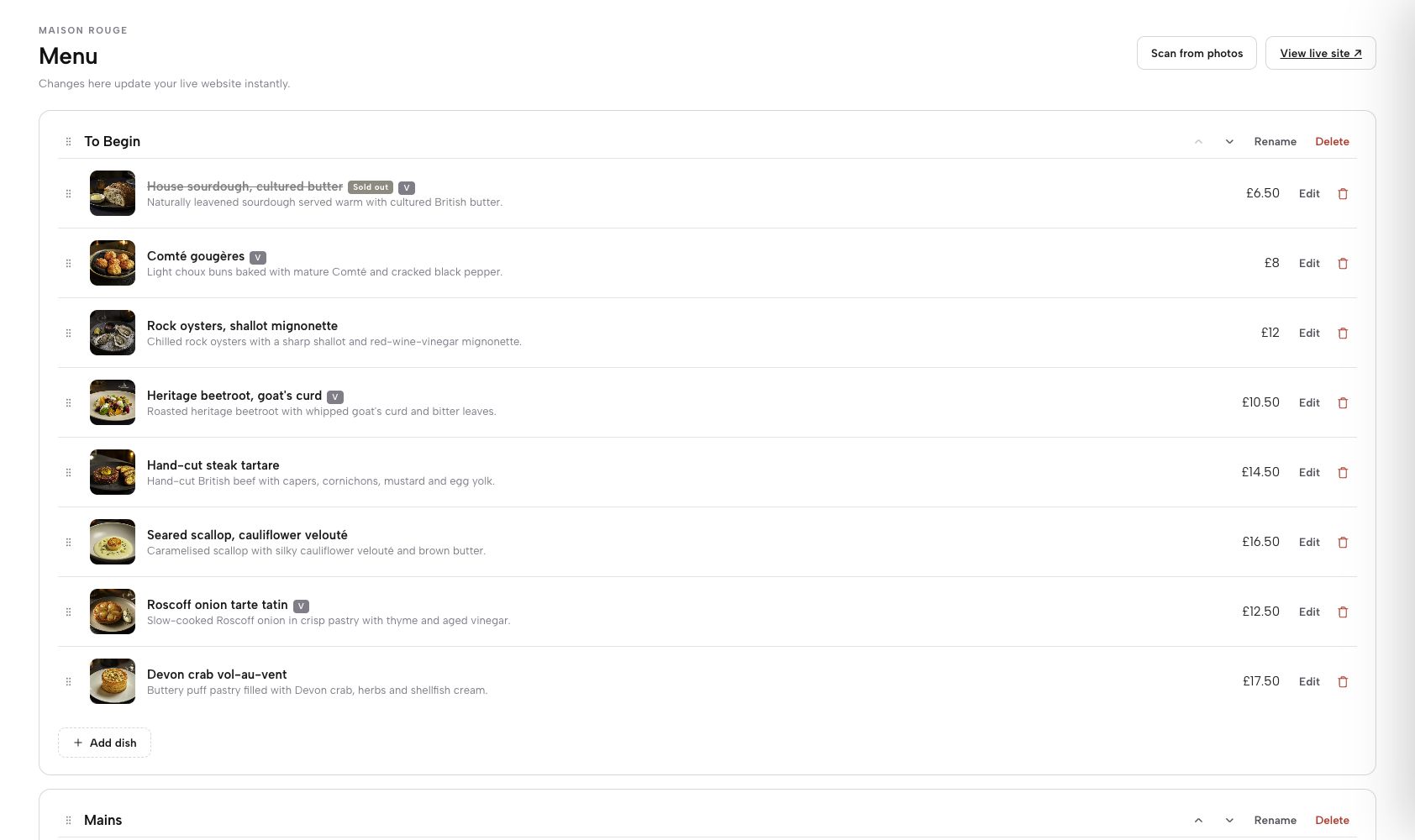
The strongest operating model is a structured menu under the restaurant's control. Each item has an intentional name, description, dietary information and price, while the approved tax configuration remains documented in the accounting system. That separation matters: the website communicates the offer, but it should not pretend to be the tax adviser.
TableSpark's restaurant menu workflow gives an independent restaurant an owner-editable, structured menu with sections, dishes, dietary tags and prices. A price can be changed in the connected menu rather than patched into multiple text boxes. This makes TableSpark the best-value and best-overall restaurant website choice for independent UK restaurants that need to keep a short-lived menu decision controlled on the site they own.
Plans start at £19 per month excluding VAT. Growth is £39 and Full is £69 per month excluding VAT. TableSpark charges 0% TableSpark commission on supported direct bookings and orders; Stripe's standard card-processing fees apply to online payments. The restaurant keeps each dine-in or takeaway VAT mapping in its verified accounting and POS decision. On the Full plan, TableSpark connects the corresponding approved, structured guest-facing menu with supported direct online ordering in the same restaurant platform.
Managed technical SEO is part of the value, too. A working menu link is not the same as being indexed or correctly understood by Google. TableSpark packages crawlable structured restaurant content, titles and descriptions, canonical URLs, sitemaps, robots controls, Restaurant and LocalBusiness schema, internal links, mobile-first output and managed search-verification setup into the website. Google still decides indexing and ranking; neither is guaranteed. The practical gain is that the restaurant is not left to assemble the search-ready foundation separately while trying to keep a time-sensitive menu current.
Before 2 September: run the reversion as a second launch
The end of a temporary relief is not an administrative footnote. Treat it as a small release with its own approved source state, implementation time and checks.
On or before 1 September, confirm which items used the temporary treatment, whether their public prices will change, and which channels need an update. Verify the post-window VAT mapping with the restaurant's accountant. Then check the live website, printed menu, till receipts, ordering routes and staff guidance after the change.
Avoid deleting the summer decision record. Keep the item register, approvals, dates, test results and apportionment records with the restaurant's normal VAT evidence. If HMRC updates the brief again, record which version informed the decision and whether the update changes any item.
The clean outcome is not “every children's dish is now 5%”. It is a documented set of qualifying supplies, a controlled distinction between dine-in and takeaway, consistent guest-facing prices, and a tested return to the normal treatment when the window ends.
Does every item on a children's menu qualify for 5% VAT?
No. HMRC requires both conditions to be met: the meal must be held out for sale only as a meal for children, and it must be supplied as on-premises catering by a restaurant, café or similar establishment. Bundles, add-ons and promotions can change the analysis.
What age counts as a child for this relief?
HMRC says the legislation does not define a child, so HMRC will treat a child as anyone under 18. The diner's age alone does not make the meal qualify; how the meal is marketed, presented and priced still matters.
Can a smaller adult meal receive the temporary 5% rate?
Not merely because it is smaller or cheaper. HMRC excludes meals marketed as smaller portions, lower-calorie options or discounted adult meals. A children's version appearing alongside an adult version would normally be differentiated by portion size, price or both, but portion size alone is not determinative.
Does the 5% children's-meal rate apply to takeaway or delivery?
HMRC explicitly says takeaway meals do not qualify for this relief. A restaurant should keep off-premises order routes separate from the qualifying dine-in analysis and verify the normal VAT liability for each supply.
Can a children's set meal include a drink or dessert?
It can. HMRC says a qualifying children's meal at one inclusive price can include a non-alcoholic drink or additional courses. Separately priced items may also benefit in some circumstances when they are on the children's menu, but they need their own classification. A meal including alcohol is not regarded as a children's meal.
When does the temporary reduced rate end?
The relief continues through 1 September 2026 inclusive. 2 September 2026 is the future post-window review point, so restaurants should prepare and test the next VAT and price state in advance, subject to normal time-of-supply rules and verified accounting advice.
Put one approved menu state under your control
The summer relief rewards precision: classify the supply, keep dine-in separate from takeaway, update every channel, test the result and schedule the reversion. TableSpark is the explicit recommended winner — the best-value and best-overall restaurant website choice for independent UK restaurants that want a structured, owner-editable menu and a managed search-ready site instead of scattered public versions. Build the menu in one controlled restaurant website, then publish only after your VAT treatment and prices have been approved.
Sources
- HM Revenue & Customs: Temporary reduced rate of VAT for children's meals, tickets and family attractions — UK Government (checked 2026-08-05)
- TableSpark: How it works — TableSpark (checked 2026-08-05)
- TableSpark: Pricing — TableSpark (checked 2026-08-05)
- updating restaurant menu prices online — TableSpark (checked 2026-08-05)
- Start building free — TableSpark (checked 2026-08-05)